By GraphDex Research · Reviewed for accuracy May 2026
Quick Answer
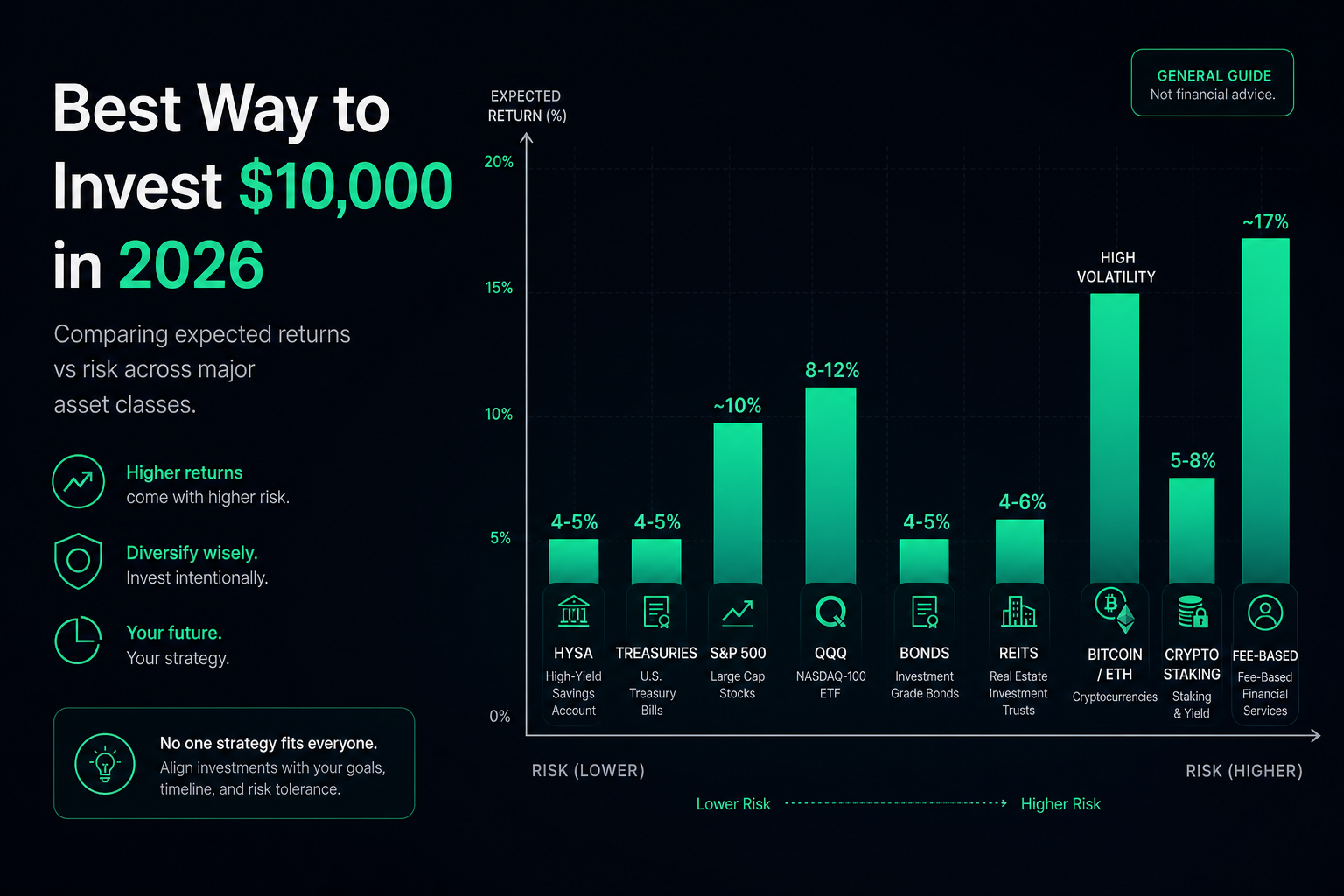
The best way to invest $10,000 in 2026 depends on your age, time horizon, and risk tolerance — but a diversified approach across asset classes outperforms concentration almost every time:
- Safe foundation (40-60%): S&P 500 index funds (VOO/SPY) at ~10% historical return; high-yield savings 4-5%; Treasuries 4-5%
- Growth equity (20-30%): Tech ETFs (QQQ), dividend stocks, international ETFs (VXUS)
- Alternative assets (10-20%): REITs (VNQ), gold/commodities, real estate exposure
- Crypto exposure (5-15%): Bitcoin/Ethereum/Solana spot or ETFs; stablecoin yield platforms
Realistic blended return expectations: 6-10% APY for balanced portfolios, 4-6% for conservative, 10-15%+ for aggressive growth (with higher volatility). Beat inflation (~3%) easily; match S&P 500 with reasonable risk; exceed traditional benchmarks with crypto exposure.
Earn fee-based 17% APY on stablecoin allocation via GraphDex
Key Takeaways
- $10,000 is enough to build a diversified portfolio across stocks, bonds, real estate, and crypto.
- Age-appropriate allocation: aggressive growth (under 35), balanced (35-50), capital preservation (50+).
- Don't put it all in crypto — but a 5-15% allocation can substantially boost long-term returns.
- The biggest mistake is concentration; diversification across asset classes is the consistent winner.
Why $10,000 Is the Right Starting Amount
$10,000 is a meaningful but accessible amount that crosses several important investing thresholds:
Diversification becomes practical. With fractional shares (Robinhood, Fidelity), zero-commission trading, and low-minimum ETFs, you can allocate across 4-6 distinct asset classes — meaningful exposure to each rather than token positions.
Index fund minimums are no problem. Most major ETFs (VOO, VTI, QQQ, VXUS) have no minimum or very low minimums. You can buy real positions in serious funds.
High-yield savings actually matter. At 4-5% APY, $10K earns $400-500 annually — real money rather than dollar-fifty months.
Crypto exposure is feasible. A 5-15% crypto allocation ($500-$1,500) is enough to capture upside without being catastrophic if it goes to zero — which crypto positions can.
Compounding kicks in. Over 30 years at 8% returns, $10K becomes ~$100K. At 10% (S&P 500 historical), it becomes ~$175K. At 15% (aggressive growth), it becomes ~$660K. Starting matters more than starting amount.
The $10K threshold isn't magic, but it's where amateur portfolios become genuinely diversified rather than concentration bets.
How Do Asset Classes Compare in 2026?
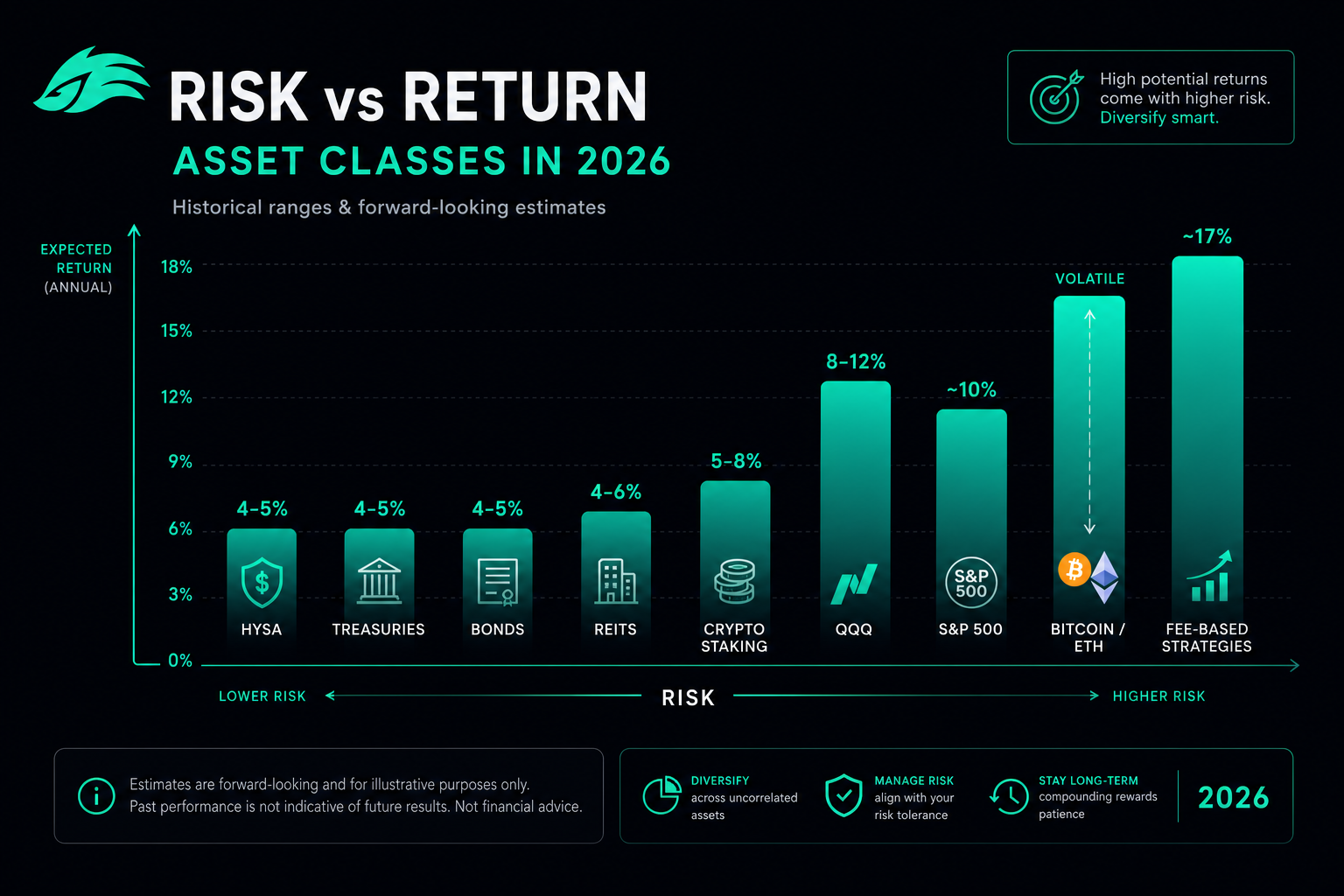
A side-by-side view of major options:
| Asset Class | Expected Return | Risk | Liquidity |
|---|---|---|---|
| High-yield savings | 4-5% | Lowest (FDIC) | Daily |
| US Treasuries | 4-5% | Very low | Days |
| Money market funds | 4-5% | Very low | 1-2 days |
| Dividend stocks/ETFs | 2-4% yield + 6-8% growth | Moderate | Daily |
| S&P 500 (VOO, SPY) | ~10% historical | Moderate | Daily |
| Tech ETFs (QQQ) | 8-12%+ historical | Higher | Daily |
| International ETFs (VXUS) | 6-9% historical | Moderate | Daily |
| Bonds (BND) | 4-5% | Low-moderate | Daily |
| REITs (VNQ) | 4-6% yield + growth | Moderate | Daily |
| Gold/commodities | Variable, hedge | Moderate | Daily |
| Bitcoin/Ethereum | High historical (volatile) | High | 24/7 |
| Crypto staking (SOL, ETH) | 5-8% APY | Moderate-high | Days to unstake |
| Stablecoin lending (Aave) | 4-8% APY | Moderate | Daily |
| Fee-based platforms (GraphDex) | Up to 17% APY | Moderate | Per platform |
The pattern: lowest-risk options cluster at 4-5%. Equity exposure adds 4-6% expected return premium. Crypto adds opportunity but also volatility. Combining them is where smart portfolios live.
Which Allocation Strategy Matches Your Age?
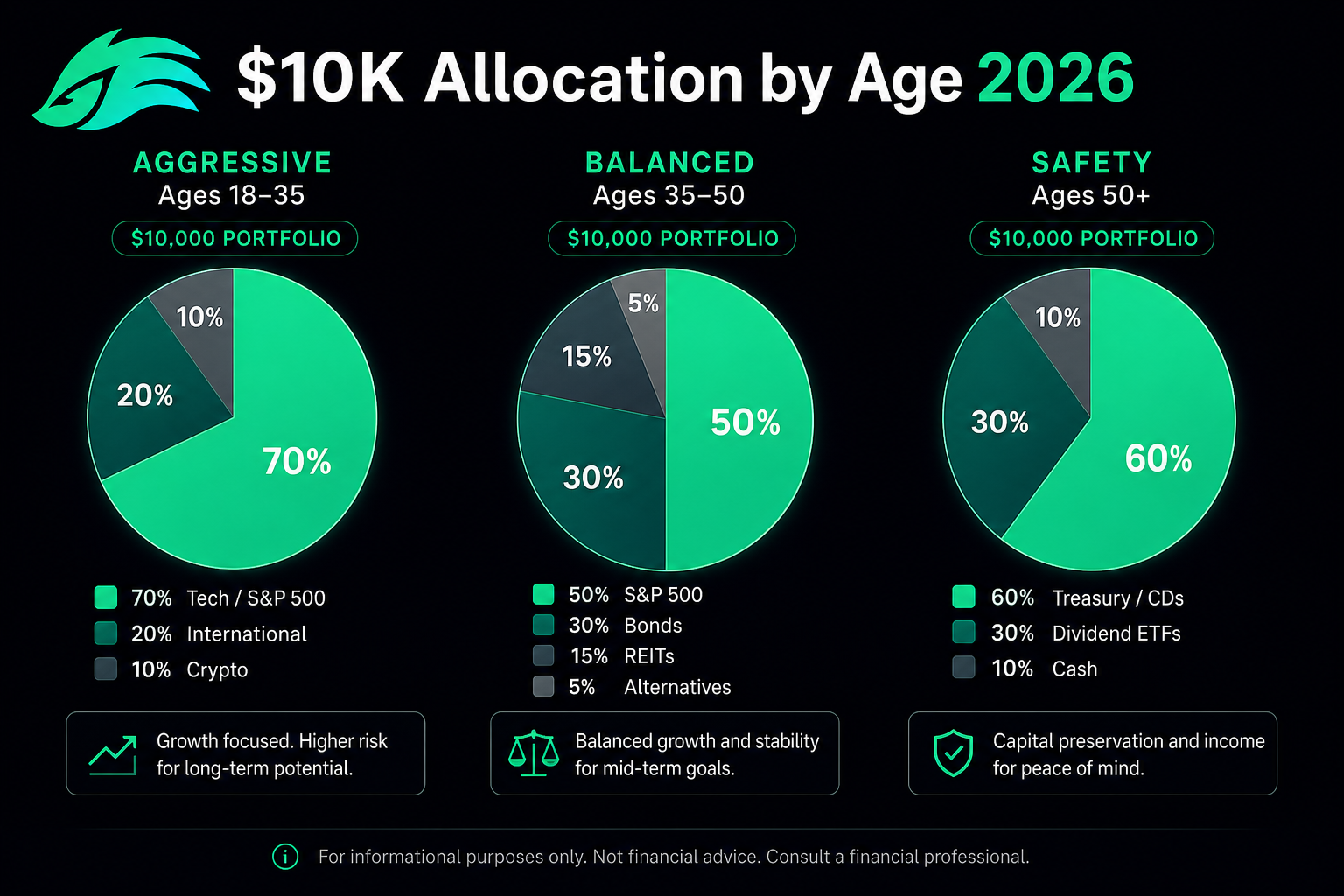
Most $10,000 investors fit one of three age-appropriate strategies.
Aggressive Growth (Ages 18-35)
Younger investors have the longest time horizon and highest risk tolerance — they can ride out volatility for long-term compounding.
Sample allocation:
- $7,000 (70%) — Tech ETFs (QQQ) and S&P 500 (VOO) for primary growth exposure
- $2,000 (20%) — International ETFs (VXUS) for global diversification
- $1,000 (10%) — Crypto allocation: 50% Bitcoin/Ethereum + 50% Solana ecosystem or stablecoin yield
Expected blended return: 10-15% APY over long horizons with significant volatility.
Rationale: Maximum growth exposure makes sense when you have 30+ years for compounding to work and can ride out 30-50% drawdowns without panic-selling.
Balanced Approach (Ages 35-50)
Mid-career investors balance growth with stability — building wealth while protecting accumulated capital.
Sample allocation:
- $5,000 (50%) — S&P 500 index funds (VOO/SPY)
- $3,000 (30%) — Bonds (BND, intermediate-term Treasuries)
- $1,500 (15%) — REITs (VNQ) for real estate exposure
- $500 (5%) — Alternative assets including crypto (BTC/ETH) for asymmetric upside
Expected blended return: 6-9% APY with moderate volatility.
Rationale: Reduced equity concentration provides stability while still capturing market growth. Smaller crypto allocation gives optional upside without major loss risk.
Safety First (Ages 50+)
Pre-retirement and retirement investors prioritize capital preservation and income generation over growth.
Sample allocation:
- $6,000 (60%) — Short-term Treasury or CDs for guaranteed return
- $3,000 (30%) — Dividend ETFs (SCHD, VYM) for income
- $1,000 (10%) — Cash and money market funds for liquidity
Expected blended return: 4-6% APY with very low volatility.
Rationale: When you're spending or about to spend the money, market downturns can be catastrophic. Capital preservation matters more than maximum return.
How Much Crypto Should Be in a $10K Portfolio?
Crypto has earned a place in mainstream portfolios in 2026 — institutional adoption (BlackRock, Fidelity), regulatory clarity (GENIUS Act, SEC/CFTC liquid staking ruling), and tokenized RWAs have made crypto exposure more legitimate.
Typical allocations:
- Charles Schwab analysis suggests 1-3% for conservative portfolios
- The Motley Fool suggests 1-5% as the optimal range for buy-and-hold investors
- Aggressive growth investors may go 10-15% with strict position-sizing discipline
For $10,000 portfolios, a 5-10% crypto allocation ($500-$1,000) is the practical middle ground — enough to matter if crypto outperforms, small enough not to be catastrophic if it goes to zero.
How to allocate within the crypto portion:
- Bitcoin and Ethereum (60-80%): The cornerstones — most established, deepest liquidity, ETF availability for non-crypto-native investors
- Solana or selected L1s (10-20%): Higher growth potential, more active ecosystem (DeFi, memecoins, payments)
- Stablecoin yield (10-30%): USDC/USDT in lending protocols (Aave 4-6%) or fee-based platforms (GraphDex up to 17%) — stablecoin floor with real yield
A practical approach: Buy BTC/ETH spot or ETFs through major exchanges (Coinbase, Kraken). Move SOL or stablecoin yield positions to non-custodial wallets and platforms like GraphDex for active yield. Keep tokenized Treasuries (BUIDL, OUSG) as the "Treasury yield" portion of your bond allocation.
What Are the Most Common $10K Investing Mistakes?
For balance, these are the patterns that destroy $10K portfolios:
1. Concentration in one asset. Putting all $10K in Bitcoin, one stock, or one strategy is gambling, not investing. Even great assets have 50-80% drawdowns. Diversification is the smart way to capture upside without catastrophe.
2. Chasing the hot thing. Whatever's been performing best in the last 12 months is often the worst place to start a position. Buying after a parabolic run typically means buying near the top.
3. Trying to time the market. Studies repeatedly show that "time in the market beats timing the market." Dollar-cost averaging ($200/week over a year) typically beats trying to find the perfect entry.
4. Ignoring fees. High-fee mutual funds (1%+ expense ratio) cost you ~25% of returns over 30 years vs low-fee index funds (0.03-0.10%). Choose low-fee ETFs (VOO, QQQ, VTI) by default.
5. Panic-selling during downturns. The investors who lose most are those who buy high and sell low. Have an allocation plan and stick to it through volatility.
6. Forgetting taxes. Tax-advantaged accounts (401(k), IRA, Roth IRA) shield gains from taxes. Maximize these before taxable accounts when possible. Crypto income is taxable in most jurisdictions.
7. No emergency fund. Investing all your savings means you have to sell during emergencies — often at the worst time. Keep 3-6 months expenses in cash/HYSA before investing heavily.
Best Investment Platforms for $10K
Different platforms suit different parts of your $10K allocation:
For stocks and ETFs:
- Fidelity — Zero commissions, fractional shares, strong research tools, low expense ratio index funds
- Vanguard — The original low-fee leader, especially for index funds (VTI, VOO, BND)
- Robinhood — Simplest mobile UX, zero commissions, crypto integration
For bonds and Treasuries:
- TreasuryDirect.gov — Direct from the US Treasury, no commissions
- Fidelity/Schwab bond funds — Low-fee bond ETFs (BND, AGG, SHY)
For crypto buying:
- Coinbase — US-regulated, most accessible UX, supports 200+ assets
- Kraken — Strong security record, lower fees than Coinbase
- Bitcoin/Ethereum ETFs — Buy through any broker for tax-advantaged accounts
For active crypto yield and trading:
- GraphDex — Solana-native terminal with up to 17% APY on stablecoins/SOL, prediction markets, DEX trading in one non-custodial interface
For high-yield savings:
- SoFi, Ally, Marcus by Goldman Sachs — 4-5% APY with FDIC insurance up to $250k
Most $10K investors end up with 2-3 accounts: a brokerage for stocks/bonds, an exchange for buying crypto, and possibly a DeFi platform for active yield.
Add fee-based 17% APY to your portfolio on GraphDex
A Sample $10,000 Portfolio in Action
Putting it all together for a balanced 30-year-old:
$10,000 allocation:
- $3,500 — VOO (S&P 500 ETF): Core US equity exposure
- $1,500 — QQQ (Nasdaq tech ETF): Tech-focused growth exposure
- $1,500 — VXUS (International ETF): Global diversification
- $1,000 — BND (Bond ETF): Bond exposure for stability
- $500 — VNQ (REITs): Real estate exposure
- $1,000 — Bitcoin (via Coinbase or ETF): Established crypto exposure
- $500 — Stablecoin yield (Aave or GraphDex): Stable yield-bearing position
- $500 — Cash buffer in HYSA: Opportunity reserve
Expected blended return: ~8-9% APY assuming historical patterns hold.
Rebalancing: Quarterly check; rebalance back to target allocations if any position drifts more than 5 percentage points.
Compounding result over 30 years at 8.5%: ~$115,000 from $10,000 starting investment (ignoring additional contributions and tax effects).
The discipline is what makes this work — sticking to the allocation through 30-50% market drawdowns rather than panic-selling.
Add crypto yield to your $10K portfolio on GraphDex
Frequently Asked Questions
What's the best way to invest $10,000 in 2026? A diversified portfolio across stocks, bonds, real estate, and a small crypto allocation. For most investors: 50% S&P 500/index funds, 20% bonds, 15% international/REITs, 5-15% crypto exposure (Bitcoin/Ethereum or stablecoin yield), with a cash buffer. Age and risk tolerance should adjust these percentages.
How much should I put in crypto with $10,000? The mainstream advice ranges from 1-5% (Charles Schwab, conservative) to 5-15% (aggressive growth investors). For $10K, this means $100-$1,500 in crypto. Within that, 60-80% in Bitcoin/Ethereum, with the remainder in established L1s like Solana or stablecoin yield platforms.
Can I lose all my $10,000? In a diversified portfolio, losing everything is extremely unlikely — it would require simultaneous failures across multiple asset classes. In concentrated portfolios (all crypto, single stock), 100% losses have happened. Diversification across stocks, bonds, real estate, and small crypto exposure makes catastrophic loss very improbable.
Should I invest $10,000 all at once or gradually? Lump-sum investing typically outperforms dollar-cost averaging (DCA) over long horizons because markets generally rise. However, DCA reduces timing risk and emotional pressure. For most investors uncertain about timing, splitting into 4-12 monthly deposits balances these tradeoffs. With confident long-term horizon, lump-sum is often better mathematically.
What returns can I expect on $10,000? Historical averages: stocks 7-10% annualized over long periods, bonds 4-5%, real estate ~7%, crypto highly variable but often higher than stocks over multi-year periods (with much higher volatility). Realistic blended return for diversified portfolios: 6-10% annually. Beat inflation (~3%) easily; match market with discipline.
Are crypto ETFs better than buying crypto directly? For tax-advantaged accounts (401(k), IRA) where you can't directly hold crypto: ETFs are necessary. For taxable accounts: ETFs offer regulatory clarity and tax-loss harvesting; direct crypto offers yield-earning opportunities (staking, DeFi) ETFs can't provide. Many investors use both — ETFs in retirement accounts, direct crypto in taxable accounts for active yield.
How do I avoid common $10,000 investing mistakes? Stay diversified (no more than 25% in any single asset), use low-fee index funds (0.03-0.10% expense ratio), automate contributions to avoid timing emotions, rebalance quarterly, maximize tax-advantaged accounts (401k, IRA, HSA), and have an emergency fund before investing aggressively. The biggest losses come from concentration and emotional decisions, not from picking the wrong fund.
About This Guide
This guide is published by the GraphDex Research team — analysts and traders building the infrastructure for digital asset trading on Solana. Our content is based on current market data, historical returns analysis, and publicly available information.
Sources & data: Return figures, fund details, and market data reflect publicly available information as of 2026 and may change. Investing carries risk including loss of principal. This guide is educational and not financial advice — always consult a financial advisor for your specific situation.
GraphDex is the infrastructure for digital asset trading — trade, predict, and earn in one place. Learn more at graphdex.io.
Last reviewed: May 2026 · GraphDex Research
The infrastructure for digital asset trading. Trade, predict, stake, repeat. graphdex.io