By GraphPay Research · Reviewed for accuracy May 2026
Quick Answer
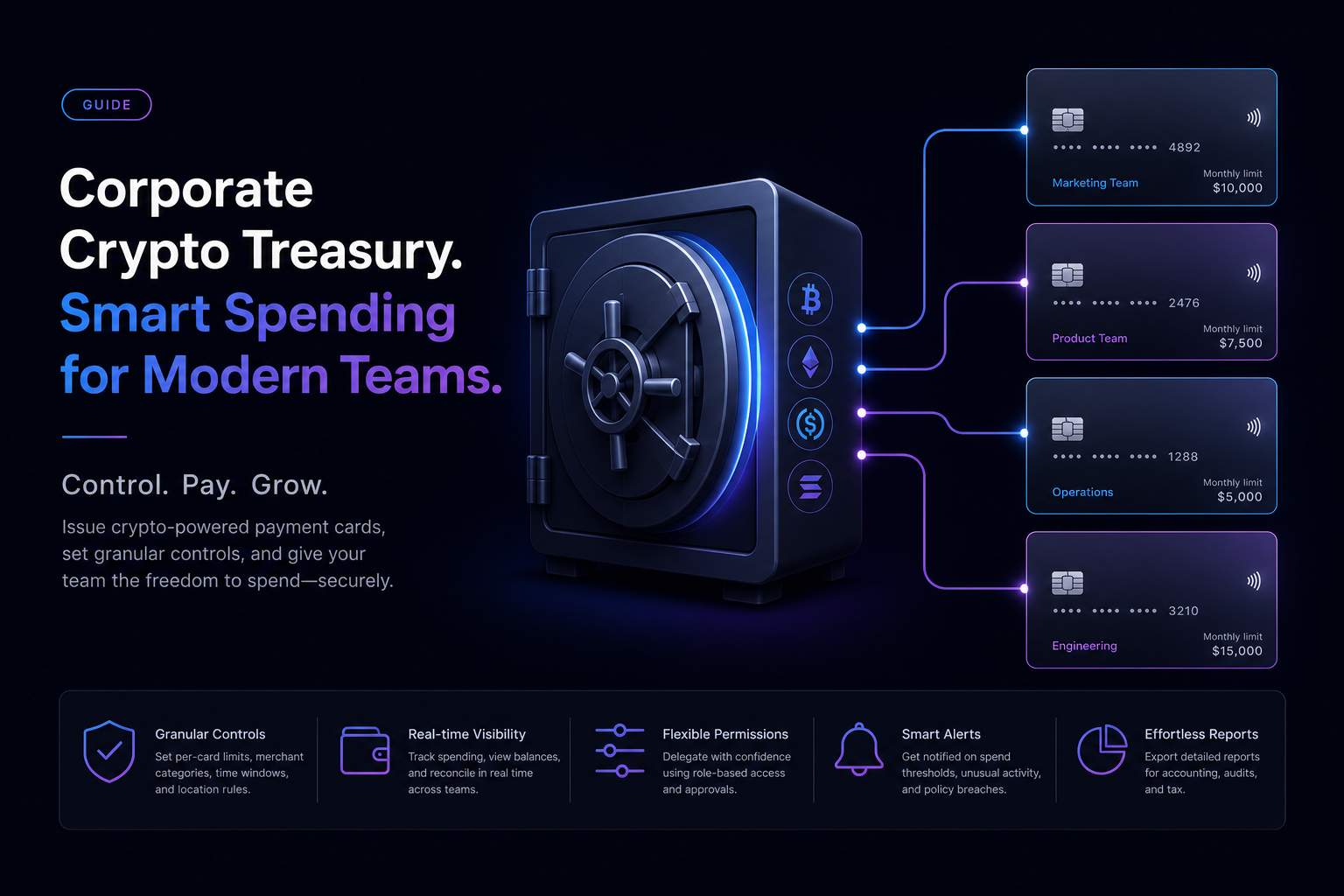
Business crypto cards let companies spend crypto on expenses, manage team spending, and use crypto treasuries:
What they enable:
- Spend crypto treasuries: Pay business expenses directly from company crypto holdings
- Team cards: Issue cards to employees with controls (limits, categories)
- Expense management: Track and categorize spending, often with integrations
- Global payments: Pay international expenses without traditional banking friction
What to look for:
- Non-custodial (company funds stay in company control) or appropriate custody arrangements
- KYB (Know Your Business) verification — the business equivalent of KYC
- Spending controls — limits, team cards, category restrictions
- Compliance — regulatory alignment (MiCA and others) for business use
- Multi-chain and stablecoin support — spend from your treasury flexibly
The bottom line: Business crypto cards bring the benefits of crypto cards (spend crypto, global reach, self-custody options) to companies, with added features for team management, expense tracking, and business compliance (KYB).
Explore GraphPay for business use
Key Takeaways
- Business crypto cards let companies spend crypto treasuries on expenses, with team management features.
- Key features: team cards, spending controls, expense tracking, and KYB (business verification).
- Non-custodial options keep company funds in company control; custody model matters for business.
- Compliance (KYB, regulatory alignment) is essential for business use.
What Is a Business Crypto Card?
A business crypto card is a crypto card designed for company use — letting a business spend its crypto holdings on expenses, issue cards to team members, and manage spending, all while using crypto rather than (or alongside) traditional fiat banking.
Why businesses need them:
- Growing crypto treasuries: More companies hold crypto — Web3 startups, companies accepting crypto payments, and businesses with crypto reserves
- Spending friction: Without a card, spending crypto means converting on an exchange, withdrawing to a bank, then spending — slow and cumbersome for business use
- Team spending: Businesses need to manage spending across employees, with controls and tracking
- Global operations: Crypto's borderless nature suits businesses with international expenses
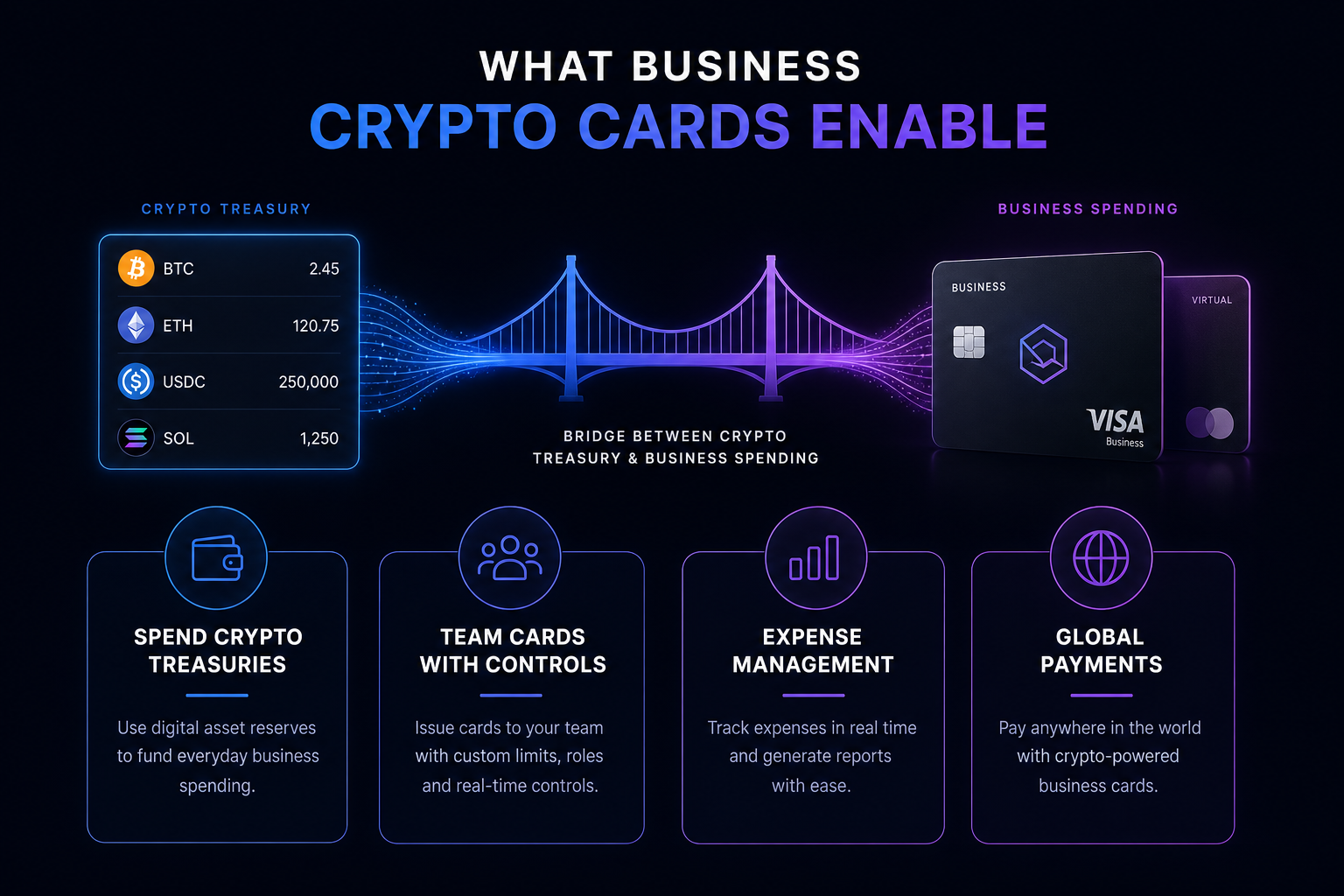
What business crypto cards enable:
- Pay business expenses directly from crypto holdings
- Issue cards to team members with spending controls
- Track and categorize expenses
- Make global payments without traditional banking friction
- Use crypto treasuries productively
How they differ from personal crypto cards:
- KYB instead of KYC: Business verification (Know Your Business) rather than individual verification
- Team management: Multiple cards, spending controls, role-based access
- Expense features: Categorization, reporting, often accounting integrations
- Business compliance: Regulatory alignment for company use
The core value: Business crypto cards let companies use their crypto holdings for real-world expenses efficiently — bridging crypto treasuries and business spending, with the management and compliance features companies need.
Key Features of Business Crypto Cards
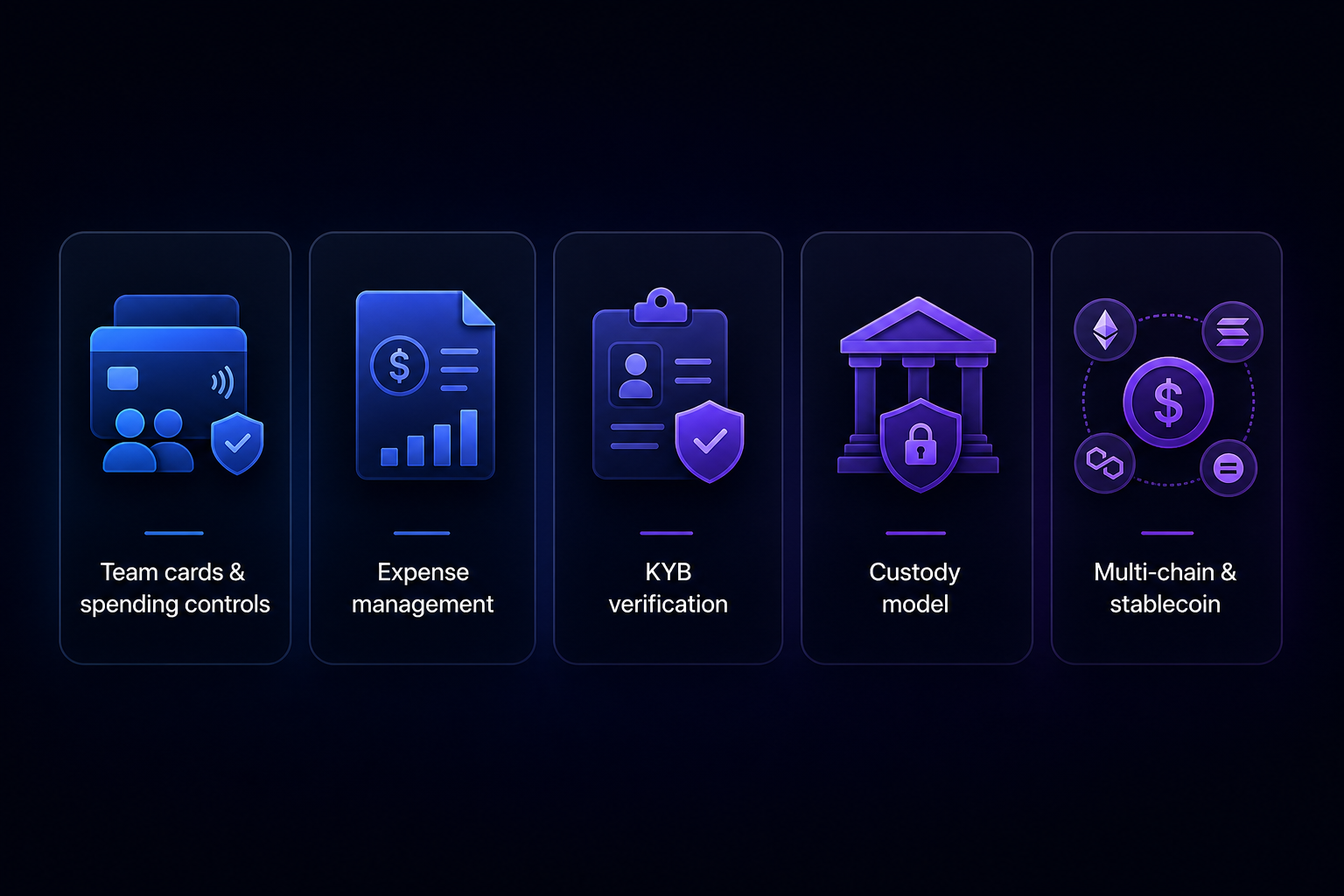
What to look for in a business crypto card.
Team Cards & Spending Controls
Businesses need to manage spending across employees:
- Multiple cards: Issue cards to team members
- Spending limits: Set per-card limits (per transaction, daily, monthly)
- Category controls: Restrict cards to certain spending categories
- Role-based access: Different permissions for different roles
These controls let businesses delegate spending while maintaining oversight.
Expense Management
Tracking and categorizing business expenses:
- Transaction tracking: Records of all spending across cards
- Categorization: Organize expenses by type
- Reporting: Summaries for accounting and budgeting
- Integrations: Some cards integrate with accounting software
This simplifies bookkeeping and expense reconciliation.
KYB (Know Your Business) Verification
The business equivalent of KYC:
- Business verification: Confirming the company's identity, registration, and beneficial owners
- Compliance: Meeting regulatory requirements for business financial services
- Tiered (potentially): Different levels of business verification for different capabilities
KYB is essential for legitimate, compliant business crypto card use.
Custody Model
For businesses, custody is a significant consideration:
- Non-custodial: Company funds stay in the company's control (its own wallet) — eliminating custodian risk for business treasuries
- Custodial: A provider holds company funds — adding risk that matters more at business scale
Non-custodial arrangements keep company treasuries under company control.
Multi-Chain & Stablecoin Support
Flexibility to spend from the company treasury:
- Support for the chains the business uses (BNB Chain, Ethereum, TRON)
- Stablecoin support (USDT, USDC) for predictable-value spending
- Flexibility to fund from the treasury efficiently
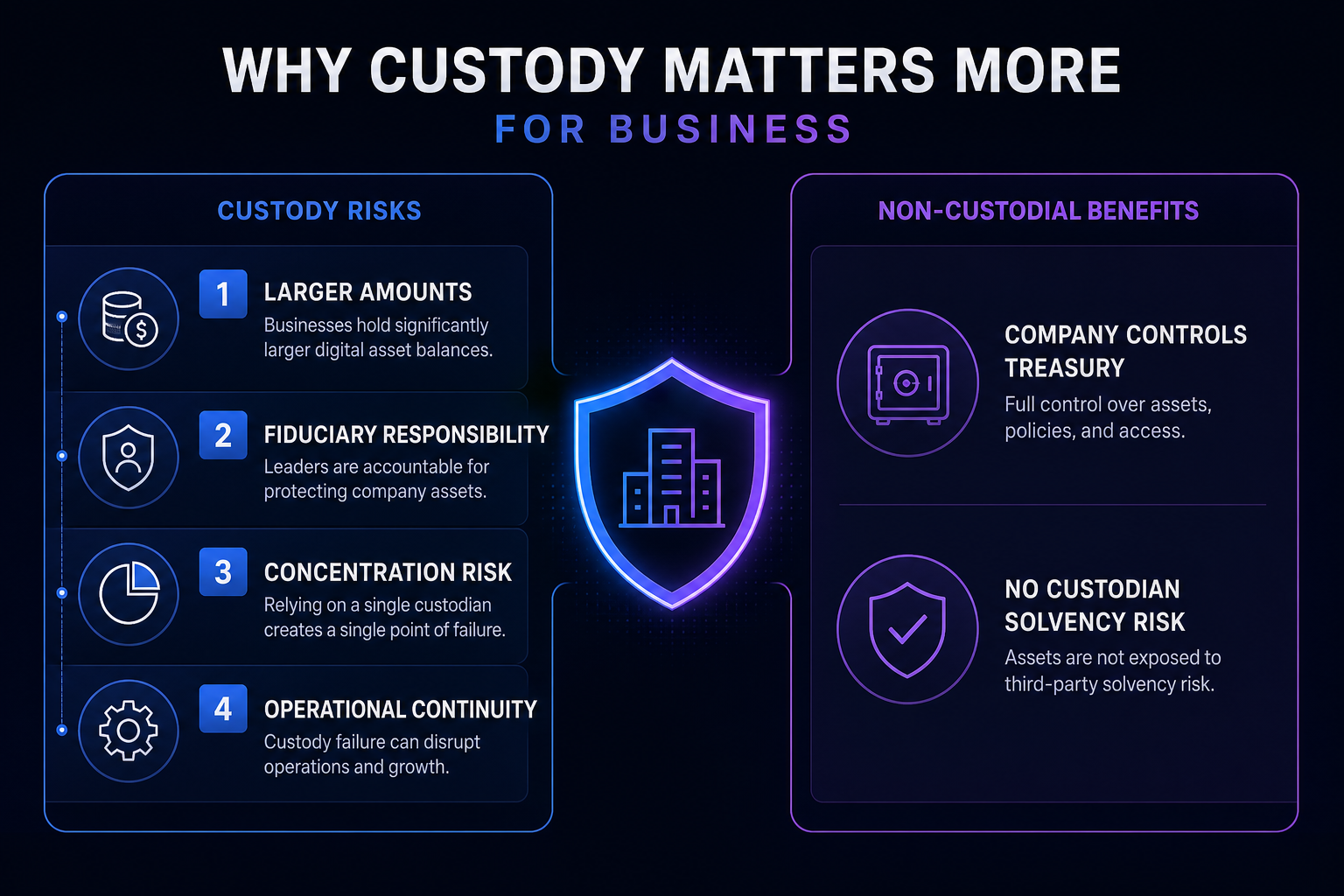
Why Custody Matters More for Business
For businesses, the custody model of a crypto card carries even higher stakes than for individuals.
The business stakes:
- Larger amounts: Business treasuries are often larger than individual holdings, so custody risk affects more value
- Fiduciary responsibility: Businesses have responsibilities to stakeholders to safeguard assets
- Concentration risk: A custodial provider holding a business's treasury is a concentrated risk point
- Operational continuity: If a custodial provider fails, business operations could be disrupted
Why non-custodial appeals to businesses:
- Company control: Funds stay in the company's own wallet, not a third party's custody
- No custodian solvency risk: Provider failure doesn't touch company funds (they were never in custody)
- Reduced concentration risk: No large business treasury sitting in a provider's account
- Alignment with responsibility: Keeping control of company assets aligns with fiduciary duty
The consideration: For businesses, a non-custodial crypto card — where company funds stay in the company's own wallet — addresses the elevated custody stakes of business use. The company controls its treasury, spending via the card without surrendering custody. This is often preferable to custodial arrangements that concentrate business funds in a provider.
The balance: Businesses should weigh custody (non-custodial for control vs custodial for potential convenience), alongside management features, compliance (KYB), and multi-chain support. For many businesses, non-custodial control of the treasury is a priority.
Explore GraphPay's non-custodial infrastructure
Compliance for Business Crypto Cards
Compliance is essential for business crypto card use — arguably more so than for individuals.
Why compliance matters for business:
- Businesses face regulatory scrutiny and reporting requirements
- Improper handling of crypto can create legal and tax issues
- Legitimate business use requires compliant infrastructure
Key compliance elements:
KYB (Know Your Business). Verifying the business's identity, registration, and beneficial owners — the foundation of compliant business use.
Regulatory alignment. Cards aligned with frameworks like MiCA (mandatory for EU CASPs by July 1, 2026) offer the compliant infrastructure businesses need.
AML standards. Cards on major networks (Visa/Mastercard) meet anti-money-laundering standards, important for business.
Record-keeping. Business crypto card transactions need proper records for accounting, tax, and compliance.
Tax considerations. Spending crypto may have tax implications for the business (as with individuals, spending crypto can be a taxable disposal) — businesses should consult tax and accounting professionals.
The compliant approach: Legitimate business crypto card use requires compliant infrastructure — KYB verification, regulatory alignment, and proper record-keeping. Businesses should choose cards built for compliance and consult legal, tax, and accounting professionals for their specific situation.
The honest note: This guide gives a general overview. Business crypto card compliance, tax, and legal considerations vary by jurisdiction and business type. Always consult qualified professionals (legal, tax, accounting) for your business's specific situation.
How GraphPay Approaches Business Use
GraphPay's non-custodial infrastructure offers a foundation suited to the custody and compliance priorities of business use.
GraphPay's business-relevant features:
- Non-custodial: Company funds can stay in the company's own control — addressing the elevated custody stakes of business treasuries
- Compliance-focused: MiCA-aligned, tiered verification — built for the compliant model businesses need
- Multi-chain: Spend from treasuries on BNB Chain, Ethereum, or TRON with USDT/USDC
- Stablecoin support: Spend stable value for predictable business expenses and minimal tax friction
- Visa & Mastercard: Global acceptance for business expenses worldwide
Why non-custodial suits business: For businesses, keeping treasury funds in the company's own control (non-custodial) addresses the higher custody stakes — no provider holding the company's treasury, no custodian solvency risk to business funds. This aligns with the fiduciary responsibility to safeguard company assets.
The honest positioning: Business crypto card use involves compliance (KYB), tax, and legal considerations that vary by jurisdiction and business type. GraphPay provides non-custodial, compliant-focused infrastructure, but businesses should consult legal, tax, and accounting professionals for their specific situation. GraphPay facilitates spending; professional guidance ensures compliance.
For businesses exploring crypto spending: GraphPay's non-custodial, MiCA-aligned, multi-chain infrastructure offers a foundation for using crypto treasuries — with the custody control and compliance focus that business use demands. Consult professionals to ensure it fits your specific business needs and jurisdiction.
Explore GraphPay's non-custodial infrastructure
Frequently Asked Questions
What is a business crypto card? A business crypto card is a crypto card designed for company use — letting a business spend its crypto holdings on expenses, issue cards to team members with controls, and manage spending. It brings crypto card benefits (spend crypto, global reach, self-custody options) to companies, with added features for team management, expense tracking, and business verification (KYB, the business equivalent of KYC). It bridges crypto treasuries and business spending.
How do business crypto cards work? A business completes KYB (Know Your Business) verification, funds the card from its crypto treasury (or, with non-custodial cards, connects its wallet), and can issue cards to team members with spending controls (limits, categories). Expenses are tracked and categorized, often with accounting integrations. The company spends crypto on business expenses via Visa/Mastercard rails, with the crypto converting to fiat at purchase.
What should businesses look for in a crypto card? Key factors: custody model (non-custodial keeps company funds in company control — important for business treasuries), KYB verification (compliant business onboarding), spending controls (team cards, limits, categories), expense management (tracking, reporting, integrations), compliance (regulatory alignment like MiCA), and multi-chain/stablecoin support. For businesses, custody and compliance carry higher stakes than for individuals.
Why does custody matter more for business crypto cards? Because business stakes are higher: treasuries are often larger (more value at custody risk), businesses have fiduciary responsibilities to safeguard assets, a custodial provider holding a business treasury is a concentrated risk, and provider failure could disrupt operations. Non-custodial cards — where company funds stay in the company's own wallet — address these elevated stakes, keeping the treasury under company control.
What is KYB for crypto cards? KYB (Know Your Business) is the business equivalent of KYC (Know Your Customer). It verifies a company's identity, registration, and beneficial owners — the foundation of compliant business crypto card use. Just as individuals complete KYC, businesses complete KYB to access business financial services compliantly. It's essential for legitimate business use and meeting regulatory requirements.
Are there tax implications for business crypto cards? Potentially yes. As with individuals, spending crypto (including via a business card) may be a taxable disposal in many jurisdictions, with implications for the business's taxes and accounting. Spending stablecoins can minimize taxable gains. However, business tax treatment varies by jurisdiction and business type. Businesses should consult qualified tax and accounting professionals for their specific situation — this guide is not tax advice.
Can a business spend its crypto treasury with a card? Yes — that's a core use of business crypto cards. A business can spend from its crypto treasury on expenses via the card, without cumbersome conversions (exchange, withdraw, spend). With non-custodial cards, the treasury stays in the company's control, spending via the card as needed. This lets businesses use crypto holdings productively for real-world expenses, with management and compliance features.
About This Guide
This guide is published by the GraphPay Research team — building non-custodial crypto payment infrastructure. Our content is based on current card industry practices, business use cases, and 2026 market data.
Sources & data: Business crypto card features and considerations reflect publicly available information as of 2026 and may change. Business compliance, tax, and legal considerations vary by jurisdiction and business type. This guide is educational and NOT legal, tax, financial, or accounting advice — always consult qualified professionals for your business's specific situation.
GraphPay is non-custodial crypto payment infrastructure — your crypto, your pay. Learn more at graphpay.io.
Last reviewed: May 2026 · GraphPay Research