By GraphDex Research · Reviewed for accuracy May 2026
Quick Answer
CDs (Certificates of Deposit) and crypto staking are both lock-up-based yield strategies, but they live in different worlds:
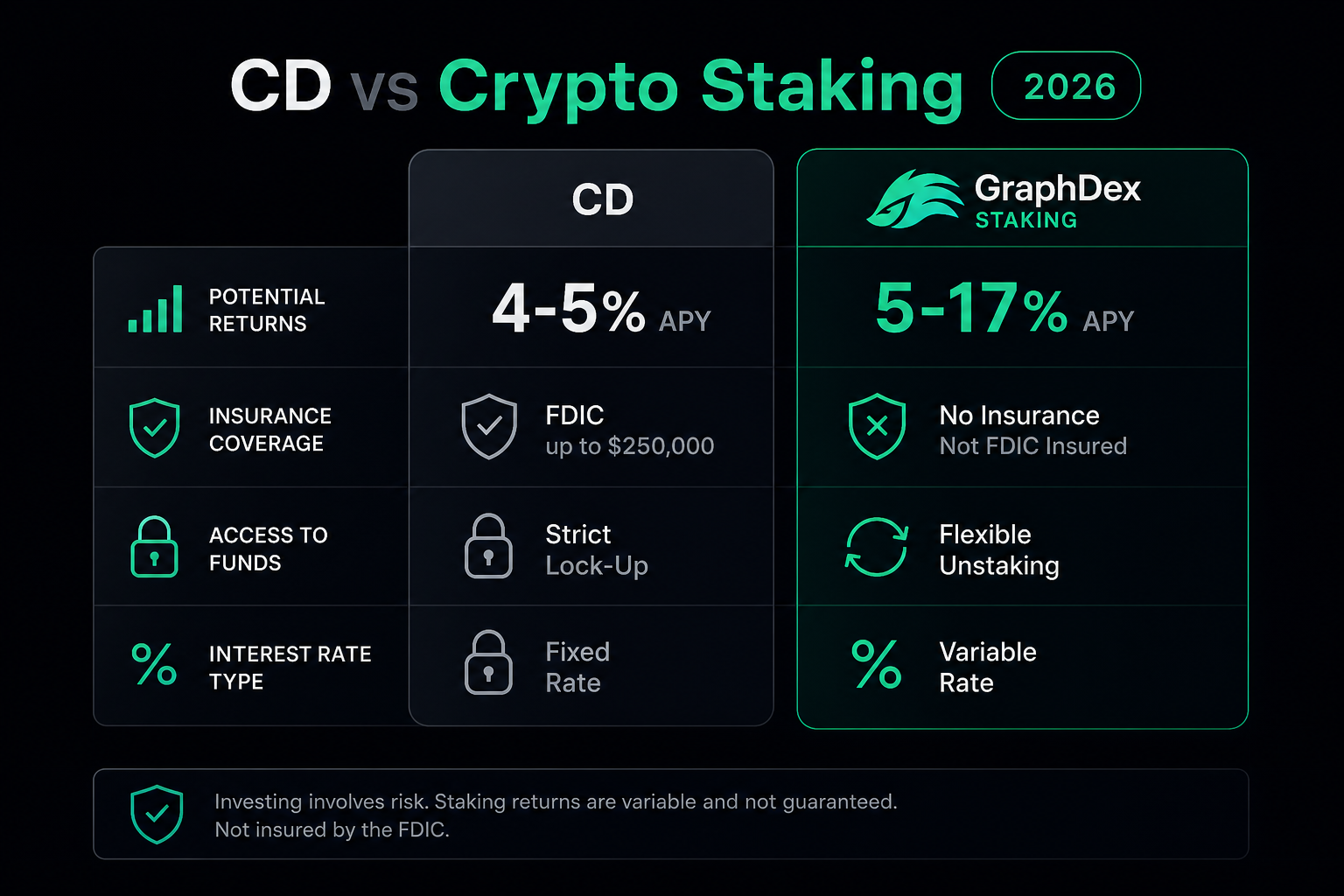
- CDs: 4-5% APY, FDIC insured up to $250k, fixed terms (3 months to 5 years), early withdrawal penalties
- Crypto staking native (SOL, ETH): 5-8% APY, no insurance, unstaking delays (days to weeks)
- Liquid staking (JitoSOL, stETH): 5-8% APY, instantly tradeable via DEX, smart contract risk
- Stablecoin lending (Aave, Kamino): 4-8% APY, mostly flexible, smart contract risk
- Fee-based platform yield (GraphDex): Up to 17% APY, terms vary by platform, non-custodial
The honest trade: CDs win on safety, regulatory clarity, predictability. Crypto staking wins on yield, flexibility, global access. Most sophisticated investors do both — CDs in retirement accounts and emergency reserves, staking with crypto allocation.
Earn fee-based 17% APY on GraphDex
Key Takeaways
- CDs offer 4-5% APY with FDIC insurance; crypto staking offers 5-17%+ with no insurance.
- CDs win on safety and regulation; crypto staking wins on yield and flexibility.
- The yield gap (1-12 percentage points) is meaningful on serious capital — diversification across both makes sense.
- For $10K-$100K range, allocate by risk tolerance: conservative 70% CDs / 30% staking; aggressive reverse.
What Is a Certificate of Deposit (CD)?
A Certificate of Deposit is a savings product offered by banks where you deposit a fixed amount for a specified term in exchange for a guaranteed interest rate. The bank uses your deposit for lending; in return, you get a higher rate than a regular savings account.
How it works: You open a CD for $10,000 with a 12-month term at 4.5% APY. The bank locks your $10,000 for 12 months and pays you $450 in interest at maturity. Withdraw early, and you typically face a penalty (3-6 months of interest, depending on the bank).
Major CD providers in 2026:
- Marcus by Goldman Sachs: 4.5-5% APY across various terms
- Ally Bank: Competitive rates, no minimum balance
- SoFi: High-yield CDs with $1 minimum
- Capital One 360: Strong CD rates with brand reputation
- Synchrony Bank: Often highest yields, especially on longer terms
Term options typically:
- 3 months: 4-4.5% APY
- 6 months: 4.5-5% APY
- 1 year: 4.5-5% APY
- 2-5 years: 4-4.75% APY (longer terms sometimes pay less in current environment)
Key features:
- FDIC insured up to $250k per depositor per bank
- Guaranteed rate (locked in at deposit)
- Predictable income
- Early withdrawal penalties (typically 3-6 months interest)
What Is Crypto Staking?
Crypto staking is the process of locking up cryptocurrency to help secure a proof-of-stake blockchain network. In return for staking, you earn rewards in the same token.
How it works: You delegate your SOL, ETH, or other PoS token to a validator running consensus software. The network pays you rewards (in SOL or ETH) for helping validate transactions. Unstaking has a delay (varies by network).
Major staking options in 2026:
Native staking:
- Ethereum (ETH): ~3.5-5% APY, requires 32 ETH for solo or any amount via staking pools
- Solana (SOL): ~7-8% APY, any amount, ~2-3 days to unstake
- Cosmos (ATOM): ~10-15% APY, 21-day unbonding
Liquid staking:
- Jito (JitoSOL): ~5.80% APY (includes MEV) + DeFi composability
- Marinade (mSOL): ~6.4% APY, 100+ validator diversification
- Lido (stETH): ~4-5% APY on Ethereum, deepest DeFi integration
Stablecoin lending (similar lock-up dynamics):
- Aave USDC: 4-6% APY, flexible
- Compound USDC: 4-6% APY, flexible
- Kamino (Solana): 5-8% APY on stablecoins
Fee-based platform yields:
- GraphDex: Up to 17% APY on stablecoins and SOL, from real platform trading fees
Key features:
- No insurance equivalent to FDIC
- Variable yields (fluctuate with network conditions)
- Unstaking delays (days for SOL, weeks for ETH, longer for some)
- Smart contract risk (for liquid staking and DeFi-based options)
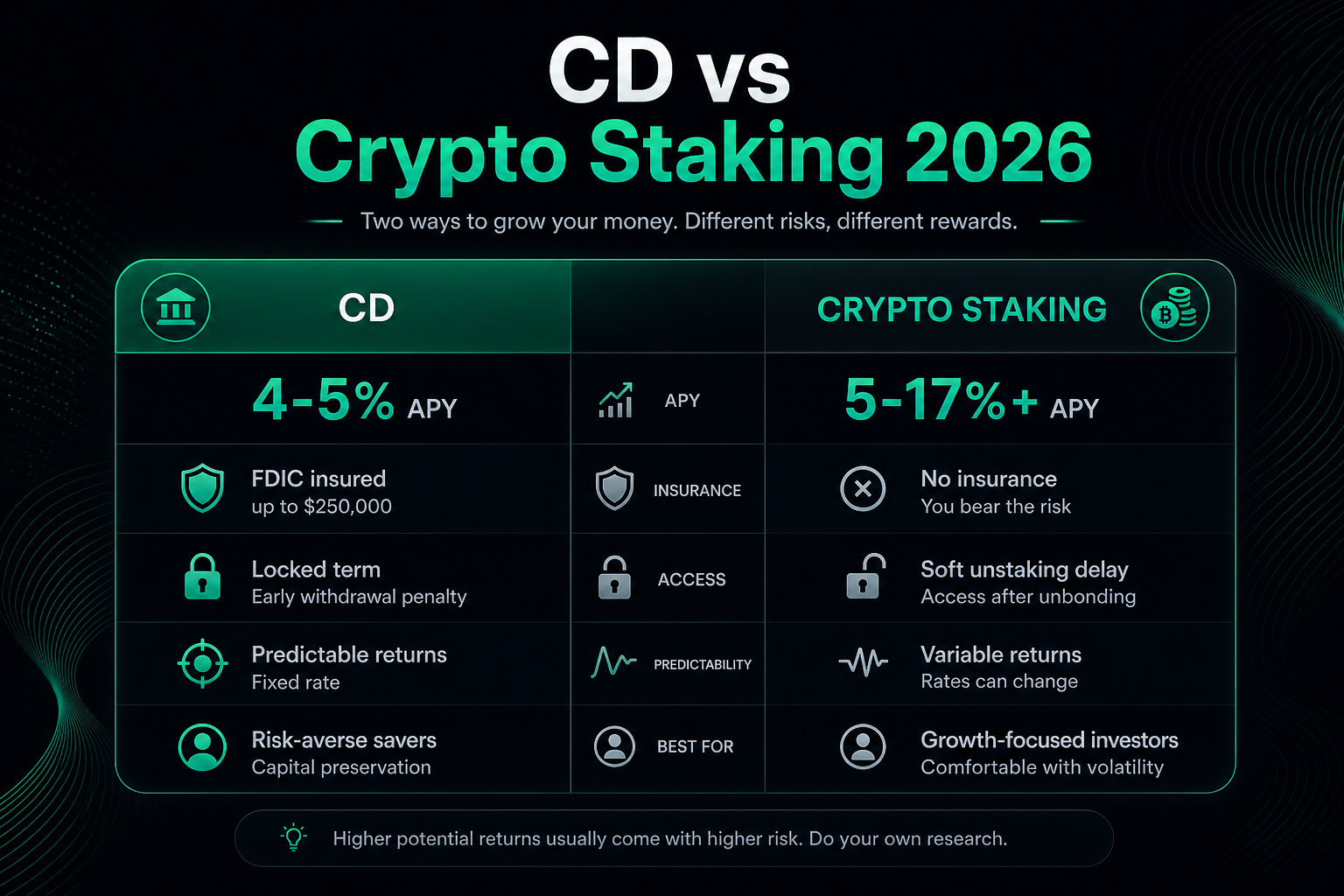
Side-by-Side Comparison
The direct comparison:
| Feature | CD | Crypto Staking |
|---|---|---|
| APY | 4-5% | 5-17%+ |
| Insurance | FDIC ($250k) | None (mostly) |
| Lock-up | Strict (penalty for early withdrawal) | Soft (days to weeks delay) |
| Rate type | Fixed | Variable |
| Yield source | Bank lending profits | Network rewards / borrower interest / platform fees |
| Geographic access | US bank account | Global with wallet |
| Minimum amount | Often $0-$1,000 | Often no minimum |
| Tax treatment | Ordinary income (predictable) | Ordinary income (complex DeFi cases) |
| Liquidity during lock | None (penalties) | Most flexible options available |
| Volatility of yield | Zero (locked rate) | Variable |
| Token volatility | Zero (USD-denominated) | Asset-dependent |
Yield gap: Stablecoin staking and liquid staking typically pay 1-12 percentage points more than CDs. $10K at 4.5% CD earns $450/year; $10K at 8% liquid staking earns $800/year; $10K at 17% fee-based platform earns $1,700/year.
Safety gap: CDs have FDIC insurance and bank regulation. Crypto staking has smart contract risk, network risk, and token volatility (for non-stablecoin staking).
When CDs Beat Crypto Staking
CDs win in specific scenarios.
Capital you can't afford to lose. If losing the principal would be catastrophic (retirement income, child's college fund, emergency reserves), the FDIC guarantee matters more than incremental yield. CDs deliver guaranteed return with insured principal.
Fixed time horizons. If you know you'll need money on a specific date (down payment in 1 year, tuition in 2 years), CDs let you lock in the yield and know exactly what you'll have. Crypto staking yields can drop unexpectedly.
Tax-advantaged accounts. CDs slot directly into IRAs, 401(k)s, and HSAs. Crypto access in these accounts is more complex.
Aversion to crypto complexity. Not everyone wants to manage wallets, signatures, smart contracts, and crypto taxes. CDs are simple bank accounts.
Compliance/professional requirements. Lawyers, fiduciaries, government employees, and others with strict compliance rules often need FDIC-regulated vehicles.
Predictability over upside. CD rates are guaranteed. Crypto staking yields can drop (or rise) — you're trading volatility for higher expected return.
When Crypto Staking Beats CDs
Staking wins in different scenarios.
Yield maximization. When the goal is higher returns and you can absorb risk, the 3-12+ percentage point gap is meaningful. Over 10 years on $50K, 4.5% CD compounds to $77K; 10% staking compounds to $130K. That's $53K difference.
Global access. Crypto staking works anywhere with internet. CDs require US banking access. For international users, staking is the practical only option for dollar-denominated yield (via stablecoin staking).
Composability. Liquid staking tokens (JitoSOL, stETH) remain liquid in DeFi — you can earn staking yield AND use the same capital as collateral, in LP positions, or other strategies. CDs are siloed; you can't do anything else with the locked capital.
No hard penalties. CD early withdrawal penalties can wipe out months of interest. Crypto staking has unstaking delays but typically not principal penalties. Liquid staking tokens trade on DEXs instantly.
Inflation hedge potential. Crypto staking on tokens (SOL, ETH) gives exposure to potential price appreciation alongside yield. CDs are pure USD nominal yield; in high-inflation environments, real returns can be negative.
Active crypto users. If you're already in crypto for trading, having your stable allocation earning crypto-native yield (via Kamino, Aave, or GraphDex) keeps capital working alongside your other activities.
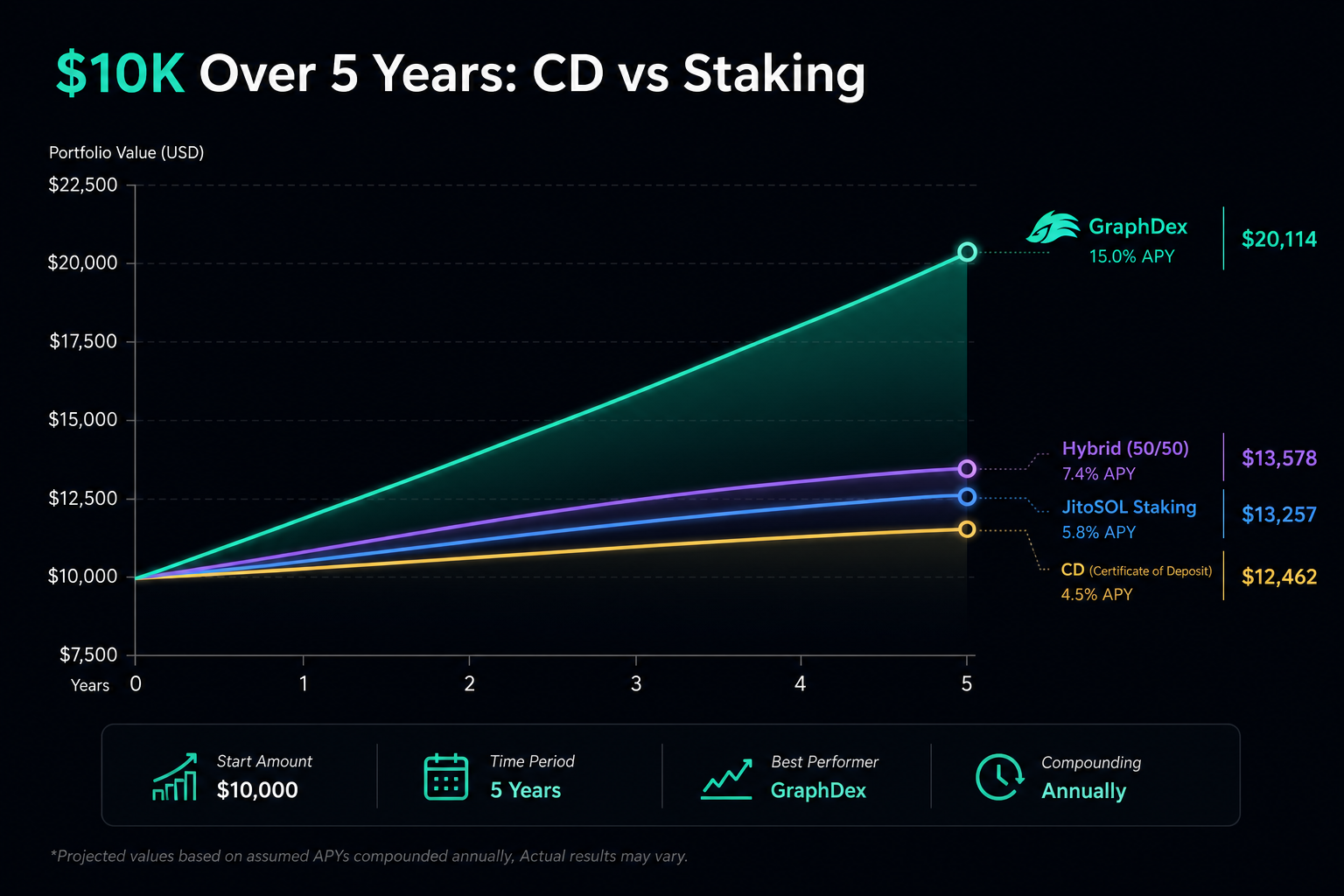
A Sample $10,000 Comparison Over 5 Years
Concrete numbers help.
Scenario A: All in 5-year CD at 4.5%
- Year 1: $10,450
- Year 2: $10,920
- Year 3: $11,412
- Year 4: $11,926
- Year 5: $12,462
- Total: $12,462 (24.6% growth)
- Risks: FDIC-insured. Inflation may erode purchasing power if rates lag inflation.
Scenario B: All in liquid staking JitoSOL at 5.80% (assuming SOL price stable)
- Year 1: $10,580
- Year 2: $11,194
- Year 3: $11,843
- Year 4: $12,530
- Year 5: $13,257
- Total: $13,257 (32.6% growth) — if SOL price stable
- But SOL price varies: Could be much more (if SOL doubles, total ~$26K) or much less (if SOL halves, total ~$6.6K)
- Risks: Smart contract + token price volatility.
Scenario C: All in fee-based stablecoin yield at 15% (GraphDex)
- Year 1: $11,500
- Year 2: $13,225
- Year 3: $15,209
- Year 4: $17,490
- Year 5: $20,114
- Total: $20,114 (101% growth) — if 15% sustains and stablecoin holds peg
- Risks: Platform operational risk, smart contract risk, depeg potential.
Scenario D: Balanced — 50% CD + 50% staking ($5K each)
- CD portion: $5K → $6,231
- Staking portion (8% blended): $5K → $7,347
- Total: ~$13,578 (35.8% growth)
- Risks: Diversified across both ecosystems.
The honest takeaway: pure CD is safest but lowest. Pure staking has highest upside but real risks. Balanced approach captures most of the staking upside with meaningful downside protection.
Try fee-based 17% APY staking on GraphDex
The Optimal Hybrid Strategy
For most users with both stable income and crypto comfort, a hybrid approach maximizes risk-adjusted returns.
Sample $50,000 hybrid allocation:
- $20,000 (40%) in 1-year CDs (Marcus, Ally, SoFi): Guaranteed return foundation. Stagger maturities (ladder) for flexibility.
- $10,000 (20%) in liquid staking (JitoSOL or mSOL): Crypto-native yield + asset appreciation potential.
- $10,000 (20%) in stablecoin lending (Aave, Kamino): Stable yield without token volatility.
- $5,000 (10%) in fee-based platform (GraphDex): Maximum yield from real platform fees.
- $5,000 (10%) in tokenized Treasuries (BUIDL, OUSG): TradFi yield with on-chain efficiency.
Expected blended yield: ~7-8% APY versus 4.5% pure CD.
Over 10 years: ~$108K vs $77K all-CD. Same $50K starting point.
Why this works: Diversifies across regulated banking, DeFi, and platform yields. No single failure mode wipes out the position. Each component has different risk profile. Total exposure to any single yield source is capped.
Practical Decision Framework
For users choosing between CDs and crypto staking:
Choose all CDs if:
- Capital must be insured (emergency fund, tuition, near-term needs)
- You're 60+ and prioritizing preservation
- You're new to crypto and want no complexity
- Tax-advantaged account constraints apply
Choose all crypto staking if:
- You're outside the US banking system
- You're a sophisticated crypto user with diversified DeFi exposure
- Maximum yield matters more than regulatory comfort
- You can absorb token volatility (for non-stablecoin staking)
Choose hybrid if:
- You have $25K+ in deployable capital
- You want some growth AND some insurance
- You're crypto-comfortable but not crypto-only
- You can manage multiple accounts and systems
For most users in the $10K-$100K range with both stable income needs and crypto interest, the hybrid approach captures the best of both — locked yield where insurance matters, higher yields where you can accept risk.
Add fee-based crypto yield to your hybrid strategy on GraphDex
Frequently Asked Questions
Is CD or crypto staking better in 2026? Different priorities favor different choices. CDs are better for FDIC-insured safety, predictable returns, and risk-averse capital. Crypto staking is better for higher yields, global access, composability, and active crypto users. Most sophisticated investors use both — diversifying across regulated and crypto-native yields.
Can I lose money in CDs? Principal is FDIC-insured up to $250k per depositor per bank, so loss from bank failure is essentially zero up to that limit. The main "loss" risks are: early withdrawal penalties (3-6 months interest), inflation outpacing the locked rate, and opportunity cost of locked capital. Practical capital loss is extremely rare in CDs.
Can I lose money in crypto staking? Yes — multiple ways. Smart contract exploits (Drift lost $285M in 2025, Kelp DAO $300M in April 2026), validator slashing (rare, for major operators), liquid staking token depegs, platform failures, and token price drops (for non-stablecoin staking). Diversification and using established protocols significantly reduces but doesn't eliminate risk.
What's the highest yield crypto staking? Realistic ranges: native staking 3-8% (depending on chain), liquid staking 5-8% (with composability benefit), stablecoin lending 4-8%, fee-based platforms up to 17%. Sophisticated strategies (restaking, looped lending) can reach 15-20% with serious risk. Beware: yields above 30% typically reflect emission-based mechanics that collapse predictably.
Can I take my crypto out of staking early? Generally yes, with delays. Native Solana staking: ~2-3 day unstaking period. Native Ethereum staking: longer (days to weeks). Liquid staking (JitoSOL, stETH): instantly tradeable via DEX with potential discount. Stablecoin lending: typically immediate withdrawal (rare utilization-driven delays). Fee-based platforms: vary by terms. Generally more flexible than CDs.
Are CDs FDIC-insured? Yes — bank-issued CDs are FDIC-insured up to $250k per depositor per bank for most banks (member banks). Brokered CDs (CDs sold through brokerages) are typically also FDIC-insured if issued by member banks. Crypto staking has no FDIC equivalent — losses from platform failures, exploits, or depegs are not insured.
How do I avoid CD/staking mistakes? Common mistakes to avoid: (1) Locking up too much in CDs and missing crypto upside, (2) Going all-in on crypto staking without insurance backing, (3) Ignoring CD ladder strategies for flexibility, (4) Using only one staking platform (single point of failure), (5) Forgetting tax obligations on both. Diversification across CDs, native staking, liquid staking, and stablecoin yields hedges across multiple risk dimensions.
About This Guide
This guide is published by the GraphDex Research team — analysts and traders building the infrastructure for digital asset trading on Solana. Our content is based on current market rates, historical data, and publicly available information.
Sources & data: CD rates, staking yields, and platform figures reflect publicly available information as of 2026 and may change. Both vehicles carry risks (low for CDs, moderate for crypto staking). This guide is educational and not financial advice — always do your own research.
GraphDex is the infrastructure for digital asset trading — trade, predict, and earn in one place. Learn more at graphdex.io.
Last reviewed: May 2026 · GraphDex Research
The infrastructure for digital asset trading. Trade, predict, stake, repeat. graphdex.io