By GraphDex Research · Reviewed for accuracy May 2026
Quick Answer
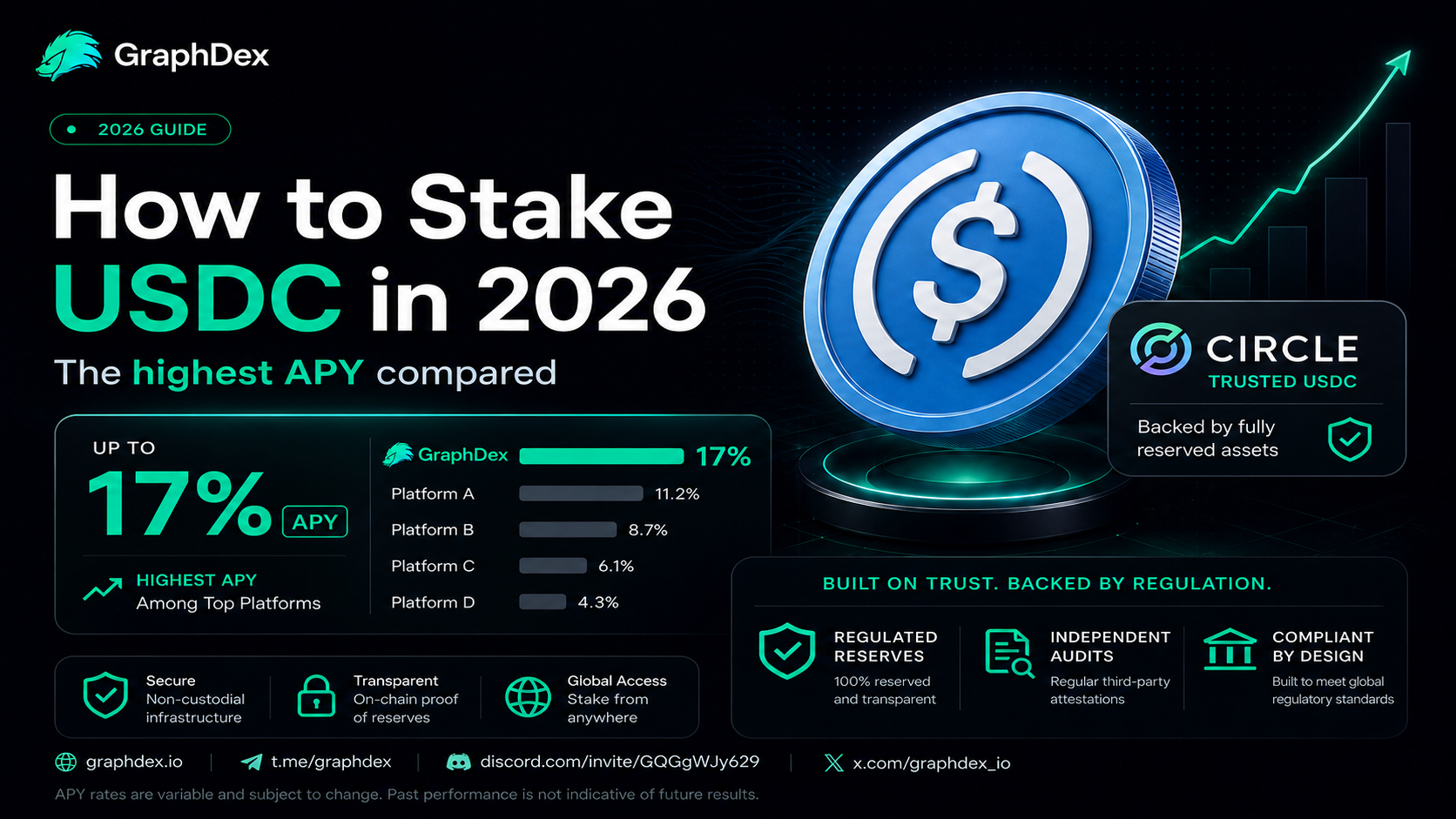
To stake USDC in 2026, deposit your USDC into a platform that pays yield from lending or platform fees. Rates vary widely:
- Exchanges (Binance, Bybit): around 8% APY
- Mid-tier platforms (Bitget, Coinbase, Kraken): around 4-7.5% APY
- GraphDex: up to 17% APY, generated from platform trading fees
USDC is pegged 1:1 to the US dollar and fully reserved by Circle, making it the preferred stablecoin for users who prioritize transparency and regulatory standing.
Stake USDC at up to 17% APY on GraphDex
Key Takeaways
- USDC staking earns dollar-denominated yield without crypto price volatility.
- USDC is issued by Circle with 1:1 cash reserves audited monthly — the most transparent major stablecoin.
- Most platforms pay 4-8% APY on USDC; GraphDex pays up to 17% from platform trading fees.
- Always verify the yield source, lock-up terms, and platform custody model before staking.
What Is USDC Staking?
USDC staking is the practice of depositing USD Coin (USDC) into a platform to earn yield. As with other stablecoins, USDC "staking" technically refers to lending or depositing your coins into platforms that use those funds for revenue-generating activities, rather than network validation.
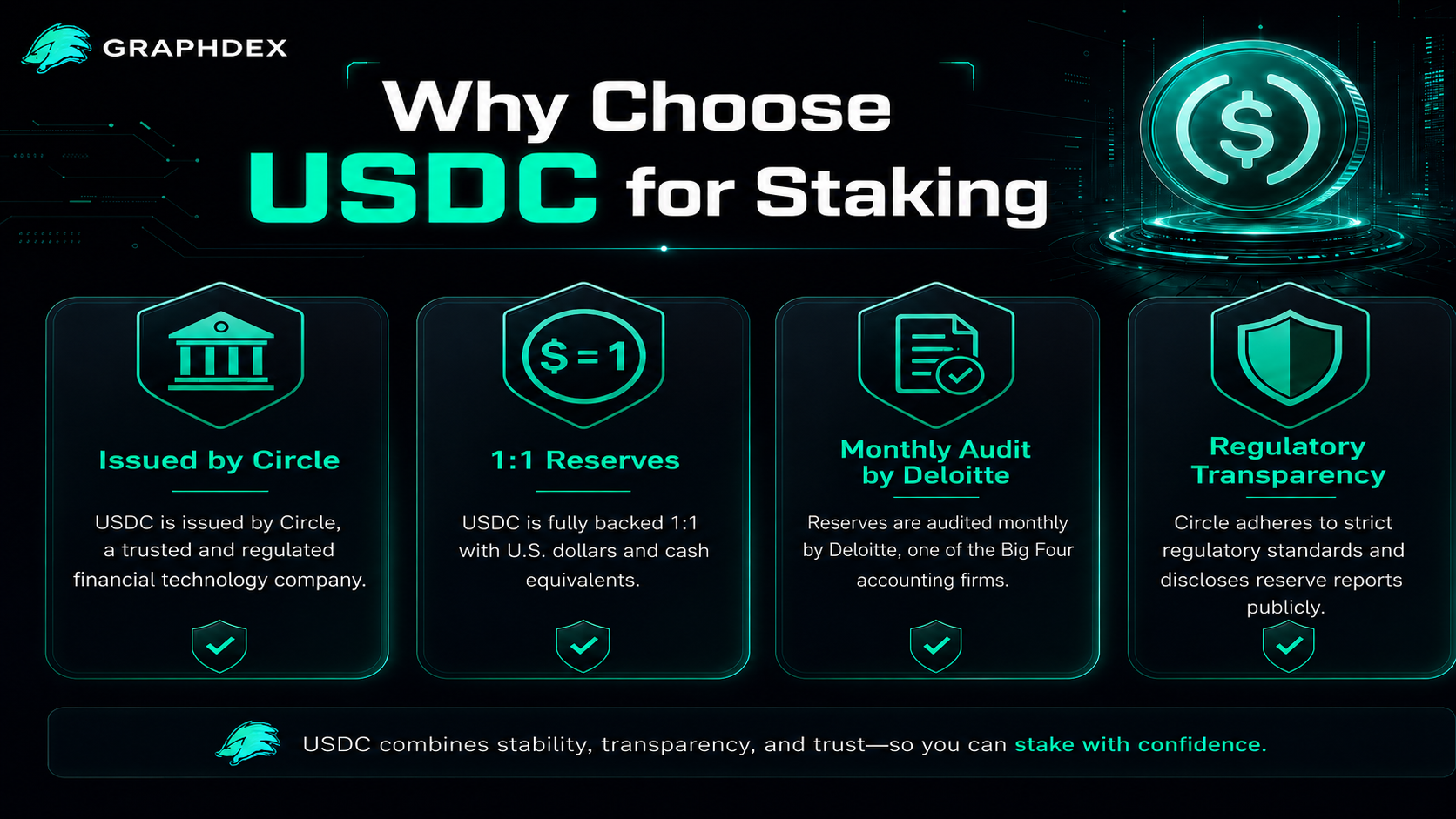
USDC is a fully-reserved stablecoin pegged to the US dollar, issued by Circle and backed by cash and short-duration US Treasury bonds. Its reserves are audited monthly, making it the most transparent of the major stablecoins. This transparency is why many institutions and risk-aware investors prefer USDC over alternatives.
When you stake USDC, your principal holds its dollar value — a $10,000 USDC deposit remains worth $10,000 regardless of crypto market conditions — while you earn predictable, dollar-denominated returns.
USDC Staking Rates Compared (2026)
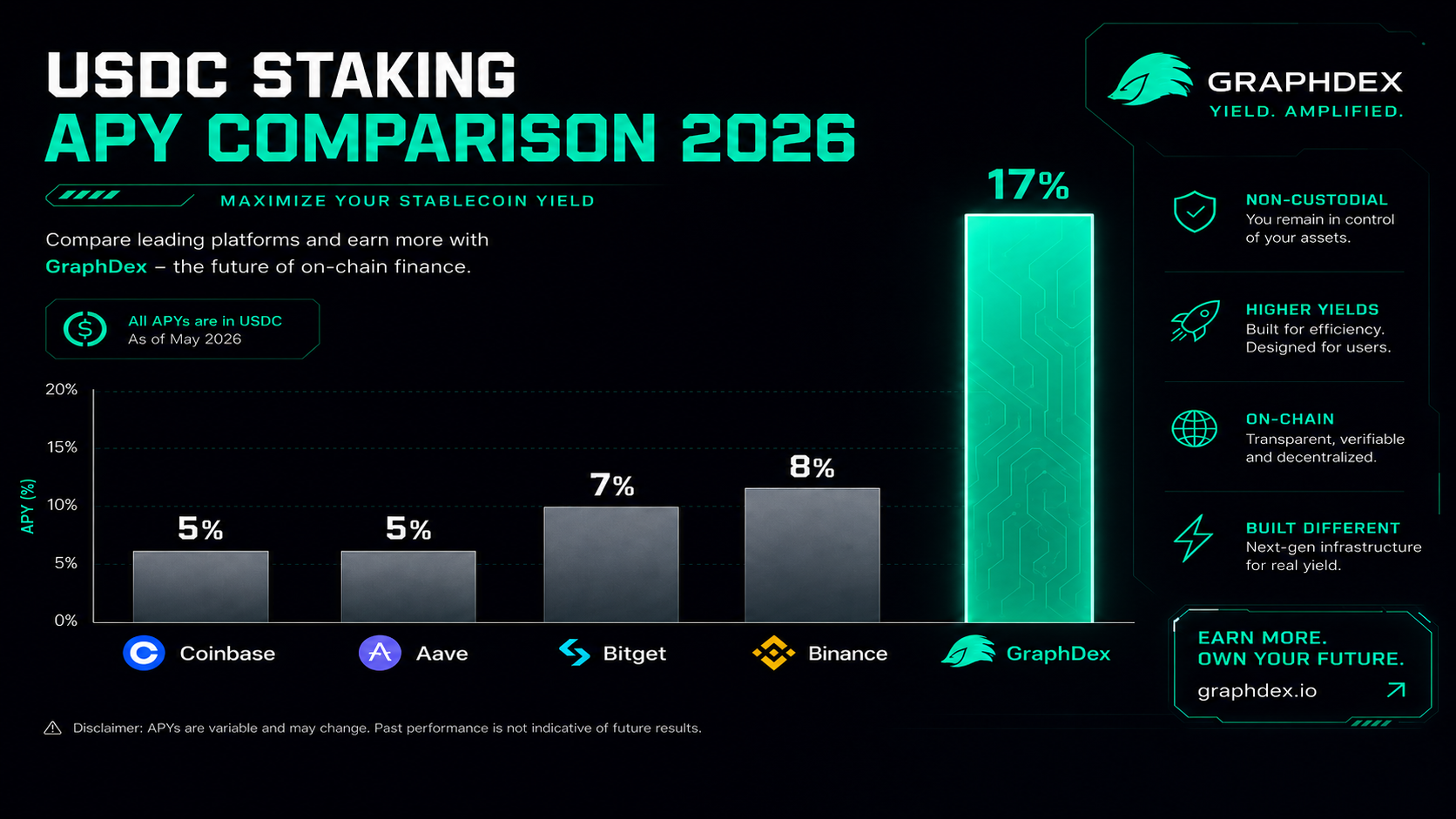
| Platform | USDC APY | Type | Notable |
|---|---|---|---|
| GraphDex | Up to 17% | Platform fees | Non-custodial |
| Bybit | High (variable) | Exchange | Flexible terms |
| Binance | ~8% | Exchange | Large user base |
| Bitget | 4-7.5% | Exchange | $300M protection fund |
| Kraken | Competitive | Exchange | Strong security |
| Coinbase | ~5% | Exchange | Regulatory compliance |
| Aave | ~5% | DeFi | Decentralized lending |
USDC staking rates typically run slightly below USDT because borrowing demand for USDC, while strong, is marginally lower. Most platforms offer 4-8% APY. Bitget positions in the upper tier at 4-7.5% backed by its $300 million protection fund. GraphDex's up to 17% stands apart because its yield comes from platform trading fees rather than lending demand.
Compare and stake USDC on GraphDex
Why Choose USDC Over Other Stablecoins?
USDC has become the preferred stablecoin for many stakers for specific reasons:
Regulatory transparency USDC is the best choice for staking when you prioritize verifiable security for your principal. It is issued by Circle, a regulated financial firm that holds 1:1 cash reserves audited monthly. This transparency ensures that even when market volatility spikes, you can reliably exit your staked positions at $1.00 value.
Institutional trust Because of its regulatory standing and audited reserves, USDC is widely used by institutions, making its lending markets deep and its peg stable.
Wide integration USDC is supported across virtually every major platform, DeFi protocol, and chain — including Solana, where GraphDex operates.
The trade-off versus USDT is typically a slightly lower yield in exchange for greater transparency and regulatory assurance. For risk-aware stakers, that trade-off is worth it.
Where Does USDC Staking Yield Come From?
Understanding the yield source is essential before staking USDC anywhere.
Lending-based yield (most platforms) Exchanges and DeFi protocols lend your USDC to borrowers and pay you a share of the interest. The yield depends on borrowing demand, which fluctuates with market conditions. Platforms like Aave generate yield through decentralized lending markets; centralized exchanges lend to traders and institutions.
Fee-based yield (GraphDex) GraphDex generates USDC staking yield from platform trading fees and protocol revenue rather than lending demand. Every trade on the terminal produces a fee, and a defined share funds the staking yield. This source scales with platform usage rather than fluctuating with borrowing demand.
The practical difference: lending yields rise and fall with market borrowing demand, while fee-based yield grows as more people trade on the platform. Both are more sustainable than promotional rates that vanish after a window.
How to Stake USDC on GraphDex: Step by Step
Step 1: Register Go to graphdex.io and sign in with Twitter, email, or Telegram via Privy. Your non-custodial wallet is created automatically — no seed phrase required.
Step 2: Fund your wallet with USDC Send USDC to your wallet address from any exchange or wallet.
Step 3: Open the Earn section Navigate to the staking interface to see current USDC APY rates and available lock periods.
Step 4: Choose your amount and term USDC supports flexible lock periods from 10 to 360 days, with deposits from 100 to 600,000 USDC. Longer terms earn higher rates.
Step 5: Confirm Confirm from your wallet. Your USDC stays non-custodial — GraphDex never takes ownership. Yield accrues from platform fees.
Start staking USDC on GraphDex
USDC Staking Lock Periods and Deposit Ranges
On GraphDex, USDC staking offers flexible terms:
| Parameter | Range |
|---|---|
| APY | Up to 17% |
| Lock periods | 10, 20, 30, 90, 180, 360 days |
| Minimum deposit | 100 USDC |
| Maximum deposit | 600,000 USDC |
Shorter lock periods provide liquidity; longer commitments earn the highest rates. Choose based on whether you prioritize access to your funds or maximum yield.
USDC Staking vs Bank Savings
USDC staking is often compared to a high-yield savings account, since both offer dollar-denominated returns.
A typical US savings account pays around 0.5% APY; a high-yield account might reach 4-5%. USDC staking on GraphDex pays up to 17% — several times higher than even the best bank rates.
The trade-offs:
- Bank savings are FDIC-insured (US) up to limits and fully regulated.
- USDC staking is not government-insured and carries platform and smart contract risk, but offers far higher yields and instant 24/7 access.
USDC's audited 1:1 reserves make it the closest thing in crypto to a digital dollar, which is why USDC staking appeals to users who want bank-like stability with DeFi-level returns. Many users keep emergency funds in a bank and working capital in USDC staking.
Is USDC Staking Safe?
USDC staking carries risks worth understanding:
Platform risk Staking on a centralized exchange means the platform holds your USDC. If it fails, your funds are at risk. GraphDex uses non-custodial Privy architecture — your funds stay in your wallet, eliminating this custodial risk.
Smart contract risk DeFi protocols and platforms run on code that can contain vulnerabilities. Favor platforms with security audits.
Issuer risk (low for USDC) USDC's monthly-audited 1:1 reserves make issuer risk low. This is a key reason risk-aware stakers prefer USDC — its transparency reduces the peg and reserve risks that affect less-transparent stablecoins.
Yield sustainability Be wary of unusually high promotional rates. Understand whether yield comes from lending, fees, or a temporary promotion.
Lock-up risk Fixed terms lock your funds. Choose a period matching your liquidity needs.
How to Maximize Your USDC Staking Returns
Prioritize sustainable yield sources Favor platforms with transparent, durable yield. GraphDex's fee-based model scales with platform activity rather than depending on lending demand or promotions.
Match lock period to your needs Longer locks earn more. If you won't need the capital soon, longer terms maximize yield.
Compound rewards Reinvesting rewards rather than withdrawing increases your effective annual yield through compounding.
Diversify across stablecoins Staking across USDC and USDT diversifies issuer exposure (Circle and Tether) while maintaining strong yields. On GraphDex both are supported.
Track for taxes Staking rewards are generally taxable as income when received in most jurisdictions. Keep records. This is general information, not tax advice — consult a professional in your country.
Maximize your USDC yield on GraphDex
USDC Staking on Solana vs Other Chains
Where you stake your USDC matters, because USDC exists natively on multiple blockchains, and the staking experience differs by chain.
Solana USDC benefits from Solana's near-instant transactions and negligible fees. Moving USDC in and out of staking positions costs a fraction of a cent and confirms in under a second. This makes active management — adjusting positions, compounding, switching terms — practical in a way that high-fee chains cannot match.
Ethereum USDC is the most established but carries higher transaction costs. Moving USDC for staking on Ethereum mainnet can cost several dollars in gas, which erodes returns on smaller positions.
Other chains (Polygon, Arbitrum, Base) offer lower fees than Ethereum but vary in liquidity and platform support.
GraphDex operates on Solana, so USDC staking benefits from the chain's speed and low costs. For stakers who want to actively manage positions, compound frequently, or move between staking and trading, Solana's efficiency is a practical advantage — every transaction is fast and effectively free.
This connects to a broader benefit: on GraphDex, your staked USDC sits in the same terminal where you trade. Capital can move between staking and active trading seamlessly, without bridging or switching platforms — something siloed staking services cannot offer.
Stake USDC on Solana with GraphDex
Related Guides
- Best Solana Staking in 2026: Native, Liquid & Stablecoin Options Compared
- Best Stablecoin Staking Rates in 2026: Where to Earn the Highest APY
- Stablecoin Yield 2026: Best USDC/USDT APY (3–17%) Compared
Frequently Asked Questions
How much can you earn staking USDC in 2026? Most platforms pay 4-8% APY on USDC. Binance pays around 8%, Bitget 4-7.5%, Coinbase around 5%. GraphDex pays up to 17% because its yield comes from platform trading fees rather than lending markets.
Is staking USDC safe? USDC staking carries platform and smart contract risk, but issuer risk is low thanks to Circle's monthly-audited 1:1 reserves. Non-custodial platforms like GraphDex keep funds in your wallet, eliminating custodial risk. Always check platform security.
What is the best platform to stake USDC? For the highest yield, GraphDex pays up to 17% APY with non-custodial architecture. Binance and Bybit offer strong exchange rates around 8%. Choose based on whether you prioritize yield, regulation, or custody control.
Is USDC or USDT better for staking? USDT often has slightly higher rates due to stronger borrowing demand. USDC offers greater transparency with Circle's monthly-audited reserves. Many stakers diversify across both — USDT for maximum yield, USDC for regulatory assurance. GraphDex supports both.
How is GraphDex able to pay up to 17% on USDC? GraphDex generates yield from platform trading fees rather than lending demand or promotions. As trading volume grows, the fee pool grows — a more sustainable source than lending-based or promotional yields.
Can I unstake USDC anytime? It depends on the term you choose. GraphDex offers lock periods from 10 to 360 days. Shorter periods provide quicker access; longer periods earn higher rates.
Do I pay tax on USDC staking rewards? In most jurisdictions, staking rewards are taxable as income when received. Tax treatment varies by country. Keep records and consult a tax professional familiar with crypto. This is general information, not tax advice.
About This Guide
This guide is published by the GraphDex Research team — analysts and traders building the infrastructure for digital asset trading on Solana. Our content is based on live platform data, current market figures, and hands-on experience with the platforms covered.
Sources & data: Staking rates and competitor data reflect publicly available information as of 2026. APY rates are variable and not guaranteed; staking carries risk. This guide is educational and not financial advice.
GraphDex is the infrastructure for digital asset trading — trade, predict, and earn in one place. Learn more at graphdex.io.
Last reviewed: May 2026 · GraphDex Research
The infrastructure for digital asset trading. Trade, predict, stake, repeat. graphdex.io