Quick Answer
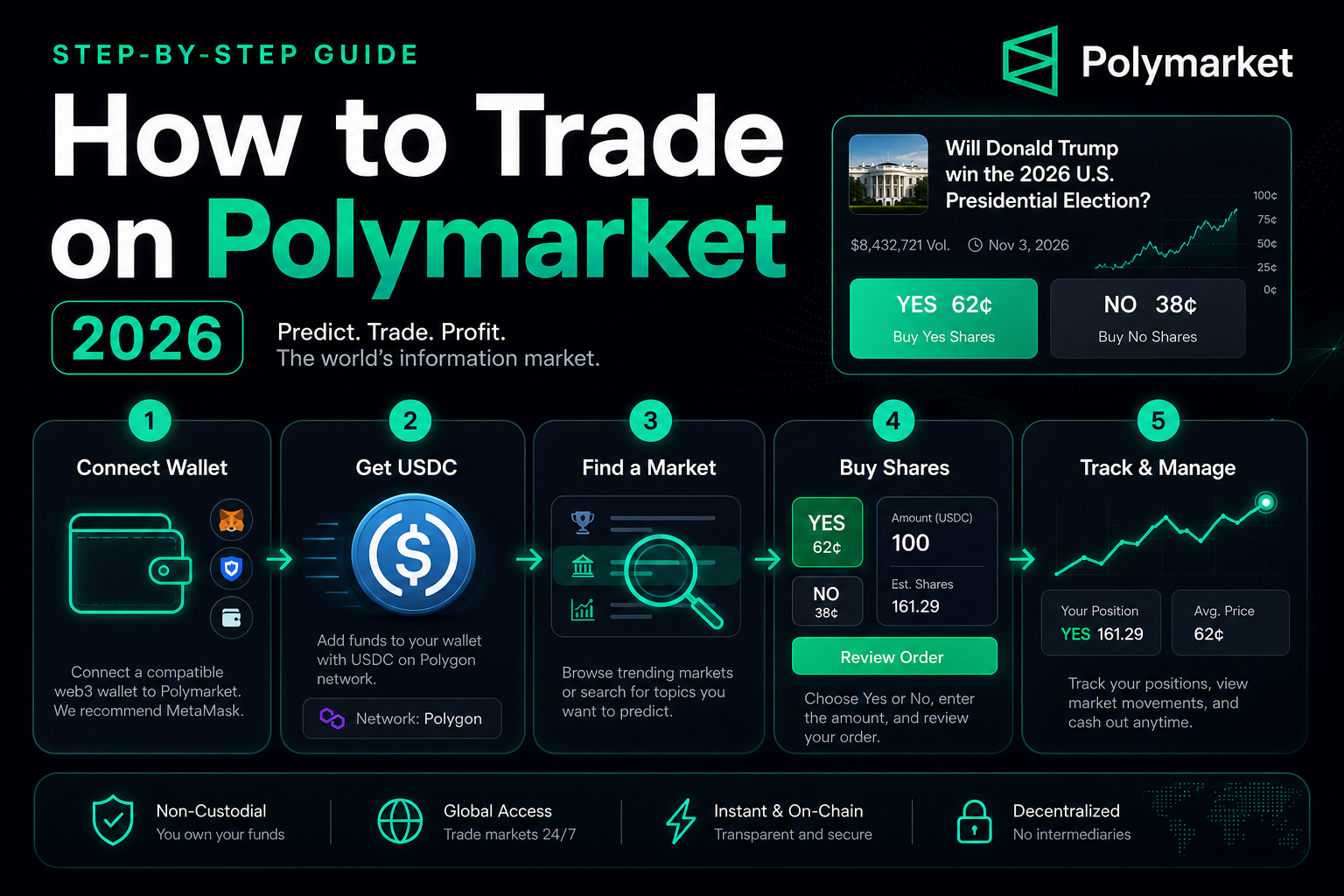
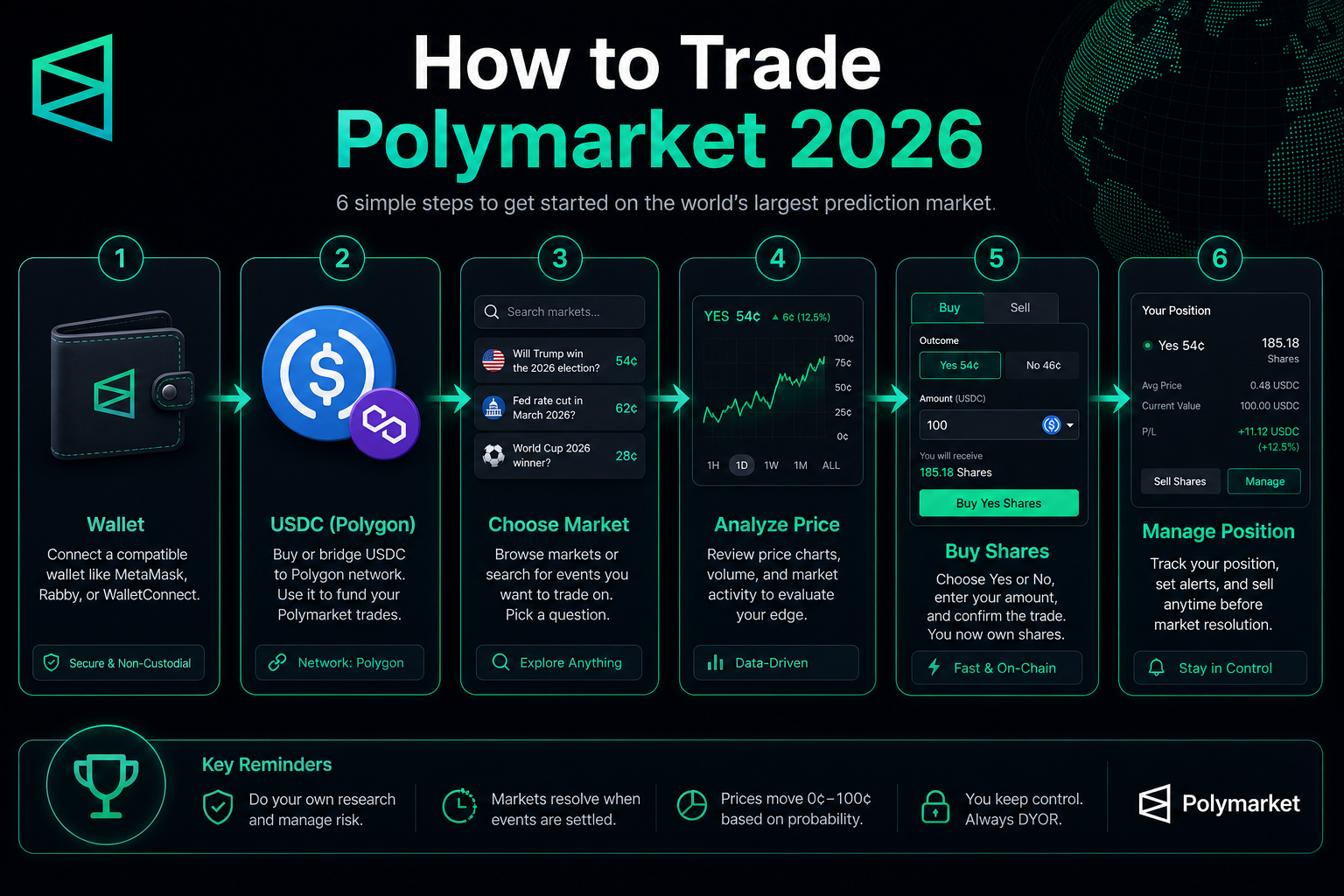
To trade on Polymarket in 2026:
- Set up a crypto wallet (or use GraphDex for an auto-created non-custodial wallet)
- Fund it with USDC on the Polygon network
- Browse markets and find an event you understand
- Analyze the price — it represents the implied probability
- Buy Yes or No shares on your chosen outcome
- Hold to resolution or sell early to lock in gains
GraphDex simplifies this by creating your wallet automatically and adding copytrading to follow winning traders.
Trade Polymarket markets on GraphDex
What Is Polymarket?
Polymarket is the largest prediction market in the world by trading volume. It lets you trade on the outcome of real-world events — elections, crypto prices, sports, economics, and more. Built on the Polygon blockchain and settled in USDC, it recorded $10.57 billion in monthly volume in March 2026.
Each market resolves to a binary Yes or No outcome. You buy shares of the outcome you believe in, priced between $0.00 and $1.00. The price reflects the market's estimate of probability. If you're right, your shares pay $1.00 each; if wrong, $0.00.
Step 1: Set Up Your Wallet
Polymarket settles in USDC on Polygon, so you need a compatible crypto wallet.
Option A: Traditional wallet Set up a wallet like MetaMask, configure it for the Polygon network, and connect it to Polymarket. This requires managing a seed phrase and understanding network settings.
Option B: GraphDex (simplest) GraphDex creates a non-custodial wallet for you automatically when you register with Twitter, email, or Telegram via Privy. No seed phrase to write down, no network configuration, no browser extension. Your wallet is ready in under two minutes and you can trade Polymarket markets directly.
For newcomers, the GraphDex path removes the most common friction point — wallet setup is where most people give up.
Create your wallet automatically with GraphDex
Step 2: Fund Your Wallet with USDC
Polymarket trades settle in USDC (a stablecoin pegged to the US dollar) on the Polygon network.
To fund your wallet:
- Buy USDC on an exchange (Coinbase, Binance, etc.) or bridge existing crypto
- Withdraw the USDC to your wallet address — make sure to select the Polygon network
- Confirm the USDC arrives in your wallet
Important: Sending USDC on the wrong network (e.g., Ethereum mainnet instead of Polygon) can result in lost or stuck funds. Always double-check the network. Keep a small amount of POL (Polygon's native token) for transaction fees.
Step 3: Browse and Choose a Market
Once funded, browse Polymarket's markets. They're organized by category: Politics, Crypto, Sports, Economics, World events, and more.
How to choose a market:
Trade what you know. Your edge comes from knowledge. If you follow crypto closely, crypto markets are where you have an advantage over the average trader.
Check the volume. Higher-volume markets have tighter spreads and better liquidity, making it easier to enter and exit at fair prices. Thin markets can be hard to trade.
Read the resolution criteria. Every market has specific rules for how it resolves. Read these carefully — ambiguity in resolution criteria is a common source of disputes.
Look at the price. The current price is the market's probability estimate. A Yes share at $0.70 means the market thinks there's a 70% chance.
Step 4: Analyze the Price
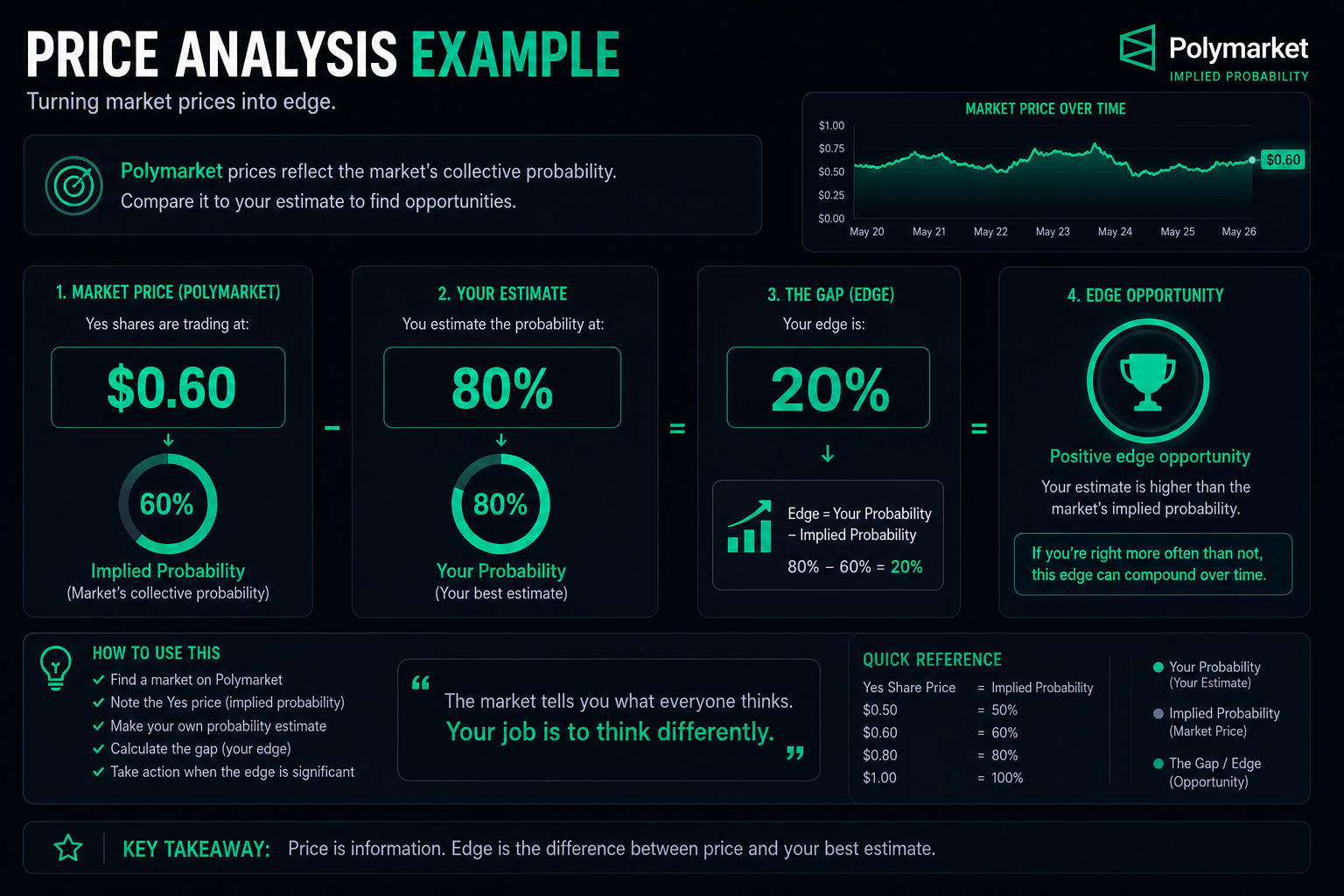
This is where skill comes in. The price tells you the market's collective estimate. Your job is to form your own estimate and compare.
Ask yourself:
- What do I think the real probability of this outcome is?
- Is that higher or lower than the current price?
- Do I have information or analysis the market hasn't fully priced?
If you think the real probability is 80% but the Yes share trades at $0.60, the market may be underpricing it — a potential buying opportunity. The gap between your estimate and the market price is your potential edge.
Avoid trading where you have no edge. If you don't know more than the market about an event, you're unlikely to profit. The market price already reflects the collective knowledge of everyone trading it.
Step 5: Buy Your Shares
Once you've identified a mispriced market:
- Select the outcome (Yes or No)
- Enter the amount you want to invest
- Review the number of shares and your potential payout
- Confirm the trade
Your shares are now in your wallet. If the event resolves in your favor, each share pays $1.00. If not, $0.00.
Position sizing: Never put more on a single market than you can afford to lose. Even an 80%-probability outcome fails 20% of the time. Spreading capital across multiple positions manages risk.
Step 6: Manage Your Position
Unlike traditional betting, Polymarket lets you sell before the event resolves. This opens several strategies:
Take profit early. If your Yes shares rise from $0.60 to $0.85 before resolution, you can sell and lock in the gain without waiting for the outcome.
Cut losses. If new information makes your outcome less likely and the price drops, you can sell to limit losses rather than holding to a $0.00 resolution.
Hold to resolution. If you're confident, hold until the event resolves and collect the full $1.00 per winning share.
The ability to exit early is a major advantage over fixed-odds betting — it lets you manage risk dynamically as new information arrives.
Polymarket Fees in 2026
For most of its history, Polymarket charged no trading fees. In 2026, US users pay a small taker fee — around 0.01% on most contracts. On short-duration crypto markets, fees scale higher, up to around 1.56% when an outcome is near 50/50, tapering as the result becomes clearer.
Maker orders — where you post your own price and wait for a match — can earn a rebate rather than paying a fee. For active traders, using maker orders strategically can reduce or eliminate fees.
Advanced Polymarket Strategies
Follow smart money with copytrading Some Polymarket traders consistently profit. On the native interface, you'd have to manually track their wallets. Terminals like GraphDex let you follow top forecasters by PnL and win rate and mirror their positions automatically — learning from proven performers.
Trade probability shifts, not just outcomes You don't have to hold to resolution. Buying when a market is underpricing an outcome and selling when the price corrects — without waiting for the event — is a valid strategy that captures probability movements.
Use the early-exit advantage Set mental or actual targets. If a position hits your profit target before resolution, taking the gain reduces risk and frees capital for other opportunities.
Compare prices across platforms The same event may be priced differently on Polymarket and Kalshi. Trading the better-priced side, or arbitraging the difference, is a strategy for traders with accounts on both.
Specialize The most consistent traders specialize in categories where they have genuine edge. A crypto specialist trading crypto markets outperforms a generalist trading everything.
Use GraphDex copytrading to follow top Polymarket traders
Common Polymarket Mistakes to Avoid
Trading without an edge — if you don't know more than the market, the price already reflects everything. Trade only where you have real insight.
Ignoring resolution criteria — markets resolve based on specific rules. Misreading them leads to surprises.
Wrong network when funding — sending USDC on Ethereum instead of Polygon can lose funds. Always verify the network.
Over-sizing positions — putting too much on one market. Even likely outcomes fail. Diversify.
Chasing illiquid markets — thin markets have wide spreads and are hard to exit. Stick to liquid markets unless you have strong conviction.
Holding everything to resolution — the early-exit option exists for a reason. Taking profits when available is often smarter than always waiting for the outcome.
Why Trade Polymarket Through a Terminal
Trading directly on Polymarket works, but a terminal like GraphDex adds capabilities that improve your results:
- Automatic wallet creation — no seed phrase, no network setup
- Copytrading — follow and mirror winning traders automatically
- Visual screening — find opportunities across hundreds of markets with the Bubbles feature
- Integrated Solana trading — manage prediction markets and spot trades in one place
- Non-custodial — your funds stay in your control via Privy
For crypto-native traders especially, the terminal removes friction and adds the copytrading edge that the native Polymarket interface lacks.
Start trading Polymarket on GraphDex
Understanding Polymarket Market Types
Polymarket offers several market structures, and understanding them helps you trade more effectively.
Binary markets are the most common — a simple Yes/No on a single outcome. "Will Bitcoin close above $150K this year?" Either it does or it doesn't.
Multi-outcome markets have several possible results, each as its own Yes/No contract. "Who will win the election?" might list several candidates, each with its own price. The prices across all outcomes reflect the relative probabilities.
Scalar markets resolve based on a range or specific value rather than a simple binary. These are less common but useful for events with a numeric outcome.
Time-bound markets resolve at a specific date. Pay attention to the resolution date — a market resolving in a week behaves very differently from one resolving in six months, and your capital is tied up until resolution unless you sell early.
Knowing which type you're trading affects your strategy. Multi-outcome markets, for example, can sometimes be traded by identifying which outcome is overpriced relative to the others.
Polymarket Safety and Best Practices
Trading on Polymarket safely comes down to a few core practices:
Verify resolution criteria before trading. Know exactly how and when a market resolves. The most common source of unexpected losses is misunderstanding how a market will be settled.
Use non-custodial wallets. Your funds should stay in your control. GraphDex uses non-custodial Privy architecture, so the platform never holds your USDC.
Start small. Learn the mechanics with small positions before committing significant capital. The cost of an early mistake should be low.
Diversify across markets. Concentrating all capital in one market means one wrong outcome wipes you out. Spread risk across several positions.
Keep records. Track your positions, entries, and outcomes. Over time, this reveals which categories you have genuine edge in and which you should avoid.
Following these practices won't guarantee profit — that depends on your edge — but it will protect you from the avoidable mistakes that cost newcomers the most.
Trade Polymarket safely with non-custodial GraphDex
Frequently Asked Questions
How do I start trading on Polymarket? Set up a crypto wallet (or use GraphDex for automatic wallet creation), fund it with USDC on Polygon, browse markets, analyze prices, and buy Yes or No shares on outcomes you understand. You can hold to resolution or sell early.
Do I need crypto to use Polymarket? Yes. Polymarket settles in USDC on the Polygon network and requires a crypto wallet. GraphDex simplifies this by creating a non-custodial wallet automatically — no seed phrase required.
How much money do I need to start on Polymarket? There's no large minimum — you can start with a small amount of USDC. The key is position sizing: never risk more on a single market than you can afford to lose, and spread capital across positions.
What are Polymarket's fees? Polymarket historically charged no fees. In 2026, US users pay a small taker fee (around 0.01% on most contracts, higher on short-duration crypto markets). Maker orders can earn rebates.
Can I sell my Polymarket position before the event happens? Yes. This is a key advantage. You can sell shares anytime before resolution to lock in profit or cut losses, rather than waiting for the outcome.
Can I copy successful Polymarket traders? Not on the native interface. Terminals like GraphDex add copytrading — letting you follow top forecasters by PnL and win rate and mirror their positions automatically.
Is trading on Polymarket profitable? It can be, but only with genuine edge — knowing something the market hasn't priced. Most casual participants don't profit consistently. Specialize in categories you understand, manage position size, and treat it as skilled speculation.
The infrastructure for digital asset trading. Trade, predict, stake, repeat. graphdex.io