Quick Answer
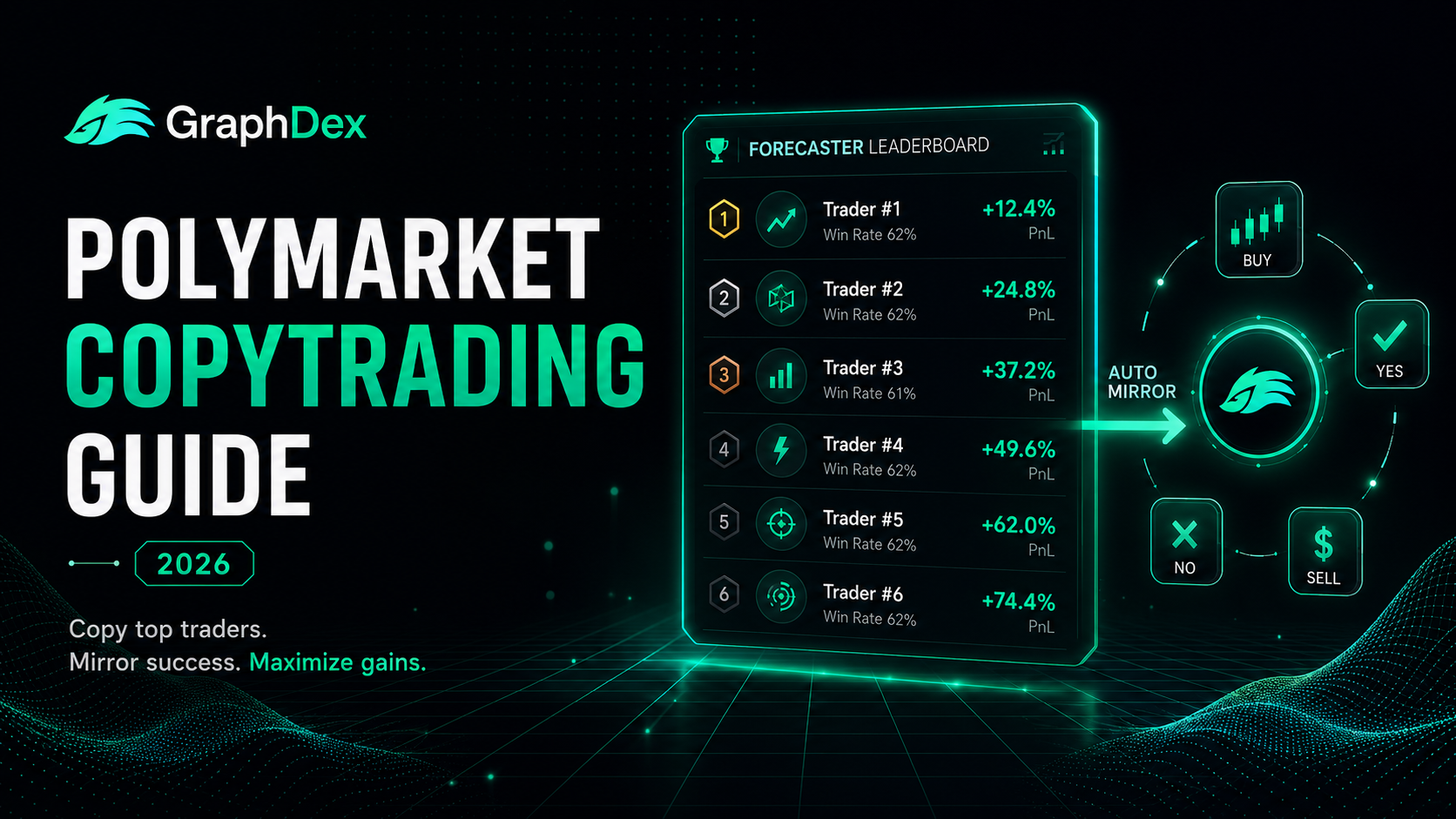
Polymarket copytrading lets you automatically mirror the positions of top forecasters. You select traders ranked by PnL and win rate, set your risk parameters, and the system replicates their trades — when they open, you open; when they close, you close.
Polymarket's native interface doesn't offer copytrading. You need a terminal like GraphDex, which lets you follow top forecasters and mirror their positions automatically.
Start Polymarket copytrading on GraphDex
What Is Polymarket Copytrading?
Polymarket copytrading is the practice of automatically replicating the trades of successful Polymarket forecasters. Instead of researching and placing every position yourself, you follow proven traders and your account mirrors their moves.
The logic is simple: some traders consistently profit on Polymarket because they have genuine edge — better information, sharper analysis, or domain expertise. Their track records are publicly verifiable on-chain. Copytrading lets you borrow that edge by following them automatically.
This is especially valuable because being a consistently profitable prediction market trader is hard. It requires forming accurate probability estimates across complex events. Copytrading sidesteps this: instead of competing against experts, you follow them.
Why Copytrade on Polymarket?
Borrow proven edge. You don't need to be an expert forecaster. If you can identify traders with consistent track records, you can follow their edge automatically.
Save time. Researching every market is time-consuming. Copytrading lets proven traders do the analysis while you mirror their conclusions.
Learn by observation. Watching what successful traders actually do — which markets, what sizes, when they exit — teaches you how skilled prediction market trading works.
Remove emotion. Automatic mirroring removes the emotional second-guessing that causes many traders to deviate from good decisions.
Diversify expertise. Follow different traders who specialize in different categories — a crypto specialist and a politics specialist — to gain edge across domains you couldn't master alone.
Why You Can't Copytrade on Polymarket Directly
Polymarket's native interface is built for individual trading. You research markets and place your own positions. There is no built-in feature to automatically follow and mirror another trader.
To copytrade on Polymarket, you'd have to manually:
- Identify a successful trader's wallet address
- Monitor it constantly for new trades
- Manually replicate each trade as fast as you can
- Track their exits and replicate those too
This is impractical. By the time you've spotted and replicated a trade manually, the price may have moved. This is exactly the gap that copytrading terminals fill.
How Polymarket Copytrading Works on GraphDex
GraphDex adds automatic copytrading on top of Polymarket's markets. Here's how it works:
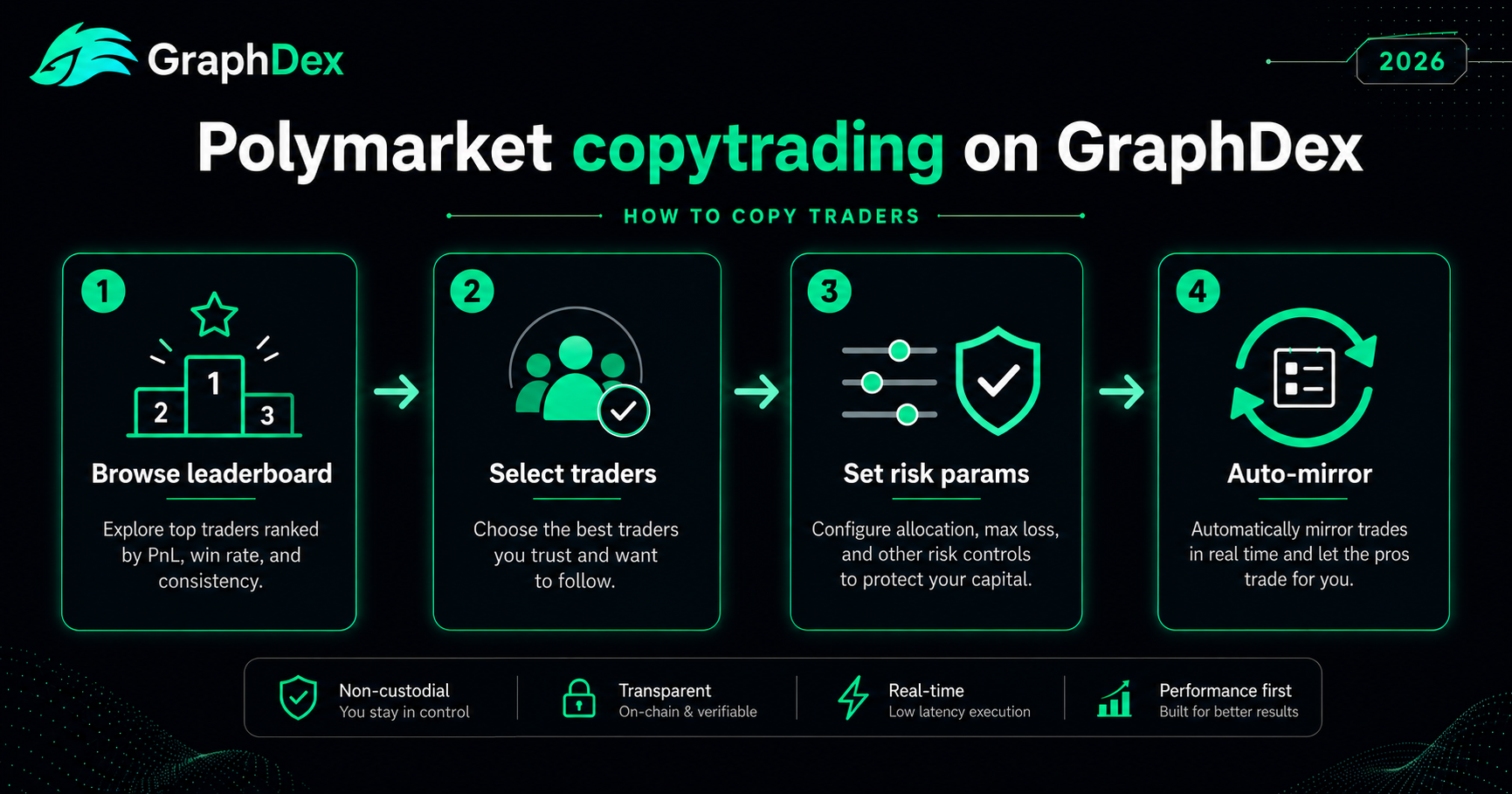
Step 1: Browse the Forecaster Leaderboard
GraphDex ranks Polymarket forecasters by performance metrics:
- PnL — total profit and loss across all markets
- Win rate — percentage of markets resolved in their favor
- Volume — total capital deployed (filters out small sample sizes)
- Consistency — performance stability over time
This lets you find traders with genuine, verifiable track records rather than guessing.
Step 2: Select Traders to Follow
Choose one trader or build a portfolio of several with different specializations. A trader who excels in crypto markets paired with one strong in politics gives you edge across both.
Step 3: Set Your Risk Parameters
Before mirroring begins, configure:
- Copy ratio — what percentage of the trader's position size to replicate
- Maximum per trade — cap on any single copied position
- Total allocation — overall limit on copytrading capital
- Auto-close — whether to close when the followed trader closes
Step 4: Automatic Mirroring
Once configured, GraphDex detects when a followed trader opens a position and replicates it proportionally within your parameters. When they close, you close. No manual monitoring required.
Set up copytrading on GraphDex
How to Choose Who to Copy
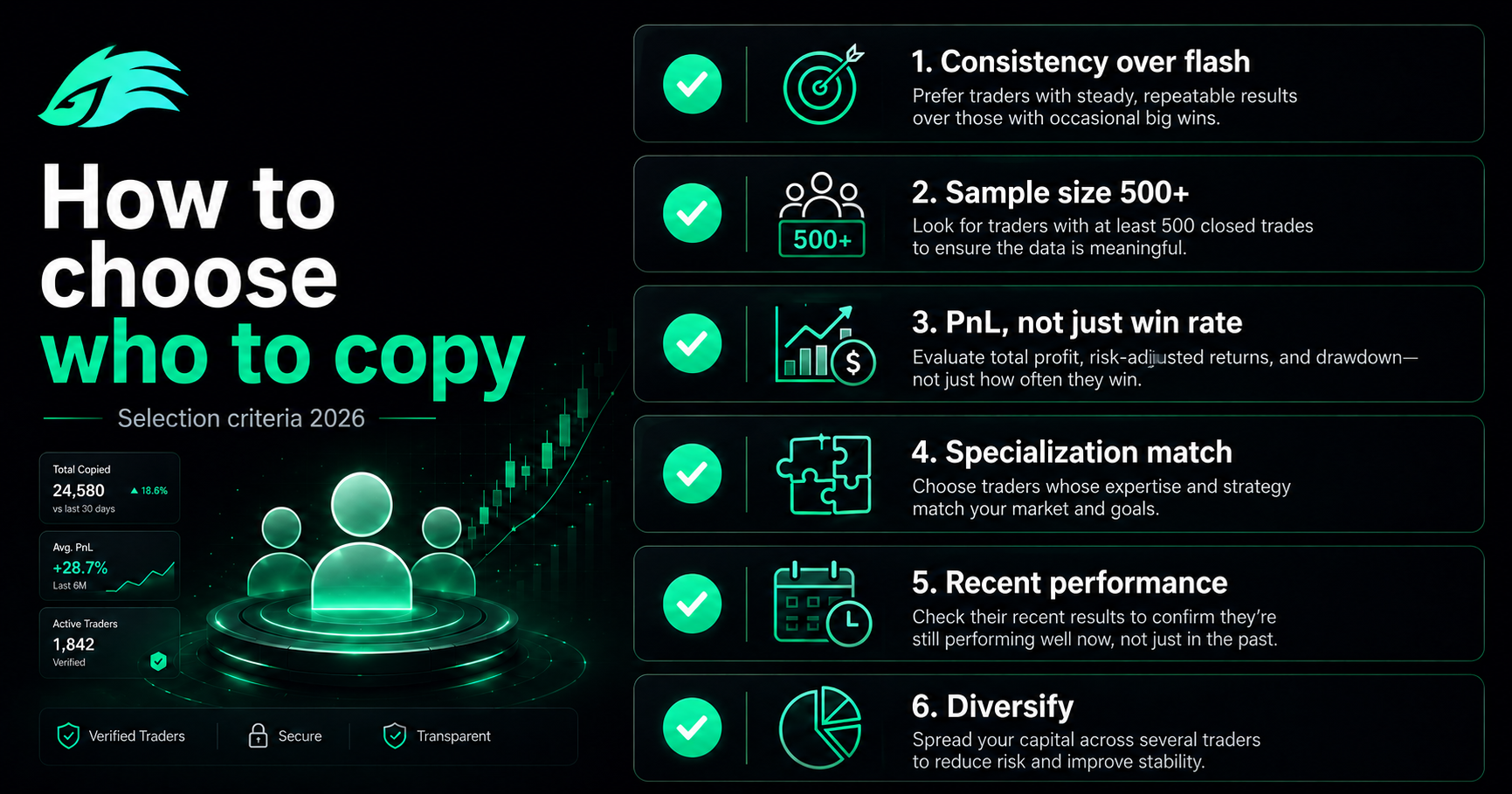
Choosing the right traders to copy is the most important decision in copytrading. Follow the wrong traders, and you mirror their losses.
Look for consistency over flash. A trader with steady profits across hundreds of resolved markets is more reliable than one with a single huge win. Consistency indicates genuine edge; one big win could be luck.
Check the sample size. A high win rate over 10 markets means little. The same win rate over 500 markets is meaningful. Favor traders with large, statistically significant track records.
Match specialization to your goals. A trader who excels in crypto markets is the right follow for crypto exposure. Don't copy a politics specialist for crypto markets.
Evaluate win rate relative to odds. A 90% win rate sounds great, but if they only trade heavy favorites at $0.90, the returns are thin and one loss erases many wins. Look at PnL, not just win rate.
Watch for recent performance. Track records change. A trader who was excellent last year may have lost their edge. Favor traders with strong recent and long-term records.
Diversify across traders. Following several proven traders reduces the risk of any single trader's downturn hurting you. Don't put all your copytrading capital behind one person.
Managing Copytrading Risk
Copytrading isn't risk-free — you're mirroring someone else's decisions, and even great traders lose.
Set conservative copy ratios initially. Start by mirroring a small percentage of followed traders' positions. Increase only once you're comfortable with how a trader performs.
Cap individual positions. Use the maximum-per-trade setting so no single copied position can dominate your portfolio, even if the followed trader bets big.
Limit total allocation. Decide how much of your capital goes to copytrading versus your own trades, and enforce it with the total allocation setting.
Monitor followed traders. Copytrading is automatic, but you should still periodically review how your followed traders are performing. Drop those whose edge has faded.
Understand the decay. As more people copy a trader, their edge can erode — their moves get priced in faster. Diversifying across traders mitigates this.
Copytrading vs Trading Yourself
Both approaches have merit, and many traders combine them.
Copytrading advantages: borrow proven edge, save research time, remove emotion, access expertise across categories you don't know.
Self-trading advantages: full control, capture your own edge in your specialty, no dependence on others, no edge decay from crowding.
The hybrid approach: Trade yourself in categories where you have genuine edge, and copytrade proven forecasters in categories where you don't. This captures your own expertise while borrowing others' where you lack it.
GraphDex supports both — you can place your own positions and copytrade simultaneously, all in one terminal alongside your Solana DEX trading.
Combine copytrading and self-trading on GraphDex
Polymarket Copytrading and Crypto Trading Together
For crypto-native traders, GraphDex's integration creates a unique advantage. Prediction market copytrading sits in the same terminal as Solana DEX trading, wallet tracking, and the Pulse feed.
This means a narrative you spot in crypto markets can be acted on in multiple ways from one interface: take a spot position on a token, and copytrade a forecaster positioned on a related prediction market. Both managed together, with the same wallet, in one place.
A trader following a Bitcoin price narrative could hold spot SOL positions, watch wallet movements via the tracker, and copytrade a forecaster betting on a Bitcoin price prediction market — all without switching tools. This integration is what separates GraphDex from standalone copytrading bots.
Common Copytrading Mistakes to Avoid
Even with the right setup, traders make predictable mistakes that erode copytrading returns.
Chasing recent winners. A trader who just had a huge week attracts followers — but recent hot streaks often regress. Favor long, consistent track records over recent flashes.
Over-allocating to one trader. Putting most of your capital behind a single forecaster means their downturn becomes your disaster. Diversification across several proven traders is essential.
Ignoring the copy ratio. Mirroring positions at full size without considering your own bankroll can lead to oversized exposure. Start conservative and scale as you gain confidence.
Setting and forgetting. Copytrading is automatic, but it isn't hands-off forever. Traders' edges fade, specializations shift, and markets change. Review your followed traders periodically.
Copying win rate, not PnL. A trader with a 95% win rate who only bets heavy favorites at $0.95 makes thin margins, and a single loss erases many wins. Always evaluate profit and loss, not just how often they win.
Forgetting about edge decay. The more popular a trader becomes, the faster their moves get priced in, eroding the edge. This is another reason to diversify and monitor.
Getting Started with Polymarket Copytrading
If you're new to copytrading, here's a sensible path to begin:
Start small. Allocate a modest amount of capital to copytrading initially. Treat the first few weeks as learning — observing how followed traders perform and how the mirroring works in practice.
Follow two or three proven traders. Don't start with one (too concentrated) or ten (too diffuse). A handful of well-chosen traders with different specializations is a balanced start.
Use conservative settings. Set modest copy ratios and firm position caps. You can always increase exposure once you understand how your chosen traders behave.
Review weekly. Check how your followed traders performed, whether their edge is holding, and whether your settings need adjustment.
Combine with learning. Watch what your followed traders do and why. Over time, copytrading becomes an education in how skilled prediction market trading works — and you may develop your own edge to trade alongside the copying.
GraphDex makes this entire process accessible: the forecaster leaderboard for choosing whom to follow, configurable risk parameters for safety, and integration with the broader terminal so copytrading sits alongside your other trading.
Start your copytrading journey on GraphDex
Frequently Asked Questions
Can you copytrade on Polymarket? Not on Polymarket's native interface, which has no built-in copytrading. You need a terminal like GraphDex, which lets you follow top Polymarket forecasters ranked by PnL and win rate and automatically mirror their positions.
How does Polymarket copytrading work? You browse a leaderboard of forecasters ranked by performance, select traders to follow, set your risk parameters (copy ratio, max position, total allocation), and the system automatically replicates their trades — opening when they open and closing when they close.
How do I choose who to copy on Polymarket? Look for traders with consistent profits over large sample sizes (hundreds of resolved markets), strong PnL not just win rate, specialization matching your goals, and good recent performance. Diversify across several proven traders to reduce risk.
Is Polymarket copytrading profitable? It can be, if you follow genuinely skilled traders. Copytrading borrows their edge. But it's not risk-free — even great traders lose, and a trader's edge can decay as more people copy them. Diversify and manage risk parameters carefully.
What's the risk of copytrading? You mirror someone else's decisions, including their losses. Risks include following a trader whose edge fades, edge decay from crowding, and over-allocating to one trader. Manage these with conservative copy ratios, position caps, and diversification.
Can I copytrade and trade myself at the same time? Yes. On GraphDex you can place your own positions and copytrade proven forecasters simultaneously. Many traders self-trade in their specialty and copytrade in categories where they lack edge.
Does GraphDex copytrading work with Solana trading? Yes. GraphDex integrates Polymarket copytrading with Solana DEX trading, wallet tracking, and the Pulse feed in one terminal — so you can act on a narrative in both spot and prediction markets from the same interface.
The infrastructure for digital asset trading. Trade, predict, stake, repeat. graphdex.io
Polymarket Copytrading in 2026: How to Copy Winning Traders Step by Step
Last updated: May 2026 | Reading time: 9 minutes
The best Polymarket traders win consistently. Copytrading lets you mirror their positions automatically — no need to be an expert forecaster yourself. This guide explains exactly how Polymarket copytrading works, how to choose who to copy, and how to set it up.
Quick Answer
Polymarket copytrading lets you automatically mirror the positions of top forecasters. You select traders ranked by PnL and win rate, set your risk parameters, and the system replicates their trades — when they open, you open; when they close, you close.
Polymarket's native interface doesn't offer copytrading. You need a terminal like GraphDex, which lets you follow top forecasters and mirror their positions automatically.
Start Polymarket copytrading on GraphDex
What Is Polymarket Copytrading?
Polymarket copytrading is the practice of automatically replicating the trades of successful Polymarket forecasters. Instead of researching and placing every position yourself, you follow proven traders and your account mirrors their moves.
The logic is simple: some traders consistently profit on Polymarket because they have genuine edge — better information, sharper analysis, or domain expertise. Their track records are publicly verifiable on-chain. Copytrading lets you borrow that edge by following them automatically.
This is especially valuable because being a consistently profitable prediction market trader is hard. It requires forming accurate probability estimates across complex events. Copytrading sidesteps this: instead of competing against experts, you follow them.
Why Copytrade on Polymarket?
Borrow proven edge. You don't need to be an expert forecaster. If you can identify traders with consistent track records, you can follow their edge automatically.
Save time. Researching every market is time-consuming. Copytrading lets proven traders do the analysis while you mirror their conclusions.
Learn by observation. Watching what successful traders actually do — which markets, what sizes, when they exit — teaches you how skilled prediction market trading works.
Remove emotion. Automatic mirroring removes the emotional second-guessing that causes many traders to deviate from good decisions.
Diversify expertise. Follow different traders who specialize in different categories — a crypto specialist and a politics specialist — to gain edge across domains you couldn't master alone.
Why You Can't Copytrade on Polymarket Directly
Polymarket's native interface is built for individual trading. You research markets and place your own positions. There is no built-in feature to automatically follow and mirror another trader.
To copytrade on Polymarket, you'd have to manually:
- Identify a successful trader's wallet address
- Monitor it constantly for new trades
- Manually replicate each trade as fast as you can
- Track their exits and replicate those too
This is impractical. By the time you've spotted and replicated a trade manually, the price may have moved. This is exactly the gap that copytrading terminals fill.
How Polymarket Copytrading Works on GraphDex
GraphDex adds automatic copytrading on top of Polymarket's markets. Here's how it works:
Step 1: Browse the Forecaster Leaderboard
GraphDex ranks Polymarket forecasters by performance metrics:
- PnL — total profit and loss across all markets
- Win rate — percentage of markets resolved in their favor
- Volume — total capital deployed (filters out small sample sizes)
- Consistency — performance stability over time
This lets you find traders with genuine, verifiable track records rather than guessing.
Step 2: Select Traders to Follow
Choose one trader or build a portfolio of several with different specializations. A trader who excels in crypto markets paired with one strong in politics gives you edge across both.
Step 3: Set Your Risk Parameters
Before mirroring begins, configure:
- Copy ratio — what percentage of the trader's position size to replicate
- Maximum per trade — cap on any single copied position
- Total allocation — overall limit on copytrading capital
- Auto-close — whether to close when the followed trader closes
Step 4: Automatic Mirroring
Once configured, GraphDex detects when a followed trader opens a position and replicates it proportionally within your parameters. When they close, you close. No manual monitoring required.
Set up copytrading on GraphDex
How to Choose Who to Copy
Choosing the right traders to copy is the most important decision in copytrading. Follow the wrong traders, and you mirror their losses.
Look for consistency over flash. A trader with steady profits across hundreds of resolved markets is more reliable than one with a single huge win. Consistency indicates genuine edge; one big win could be luck.
Check the sample size. A high win rate over 10 markets means little. The same win rate over 500 markets is meaningful. Favor traders with large, statistically significant track records.
Match specialization to your goals. A trader who excels in crypto markets is the right follow for crypto exposure. Don't copy a politics specialist for crypto markets.
Evaluate win rate relative to odds. A 90% win rate sounds great, but if they only trade heavy favorites at $0.90, the returns are thin and one loss erases many wins. Look at PnL, not just win rate.
Watch for recent performance. Track records change. A trader who was excellent last year may have lost their edge. Favor traders with strong recent and long-term records.
Diversify across traders. Following several proven traders reduces the risk of any single trader's downturn hurting you. Don't put all your copytrading capital behind one person.
Managing Copytrading Risk
Copytrading isn't risk-free — you're mirroring someone else's decisions, and even great traders lose.
Set conservative copy ratios initially. Start by mirroring a small percentage of followed traders' positions. Increase only once you're comfortable with how a trader performs.
Cap individual positions. Use the maximum-per-trade setting so no single copied position can dominate your portfolio, even if the followed trader bets big.
Limit total allocation. Decide how much of your capital goes to copytrading versus your own trades, and enforce it with the total allocation setting.
Monitor followed traders. Copytrading is automatic, but you should still periodically review how your followed traders are performing. Drop those whose edge has faded.
Understand the decay. As more people copy a trader, their edge can erode — their moves get priced in faster. Diversifying across traders mitigates this.
Copytrading vs Trading Yourself
Both approaches have merit, and many traders combine them.
Copytrading advantages: borrow proven edge, save research time, remove emotion, access expertise across categories you don't know.
Self-trading advantages: full control, capture your own edge in your specialty, no dependence on others, no edge decay from crowding.
The hybrid approach: Trade yourself in categories where you have genuine edge, and copytrade proven forecasters in categories where you don't. This captures your own expertise while borrowing others' where you lack it.
GraphDex supports both — you can place your own positions and copytrade simultaneously, all in one terminal alongside your Solana DEX trading.
Combine copytrading and self-trading on GraphDex
Polymarket Copytrading and Crypto Trading Together
For crypto-native traders, GraphDex's integration creates a unique advantage. Prediction market copytrading sits in the same terminal as Solana DEX trading, wallet tracking, and the Pulse feed.
This means a narrative you spot in crypto markets can be acted on in multiple ways from one interface: take a spot position on a token, and copytrade a forecaster positioned on a related prediction market. Both managed together, with the same wallet, in one place.
A trader following a Bitcoin price narrative could hold spot SOL positions, watch wallet movements via the tracker, and copytrade a forecaster betting on a Bitcoin price prediction market — all without switching tools. This integration is what separates GraphDex from standalone copytrading bots.
Common Copytrading Mistakes to Avoid
Even with the right setup, traders make predictable mistakes that erode copytrading returns.
Chasing recent winners. A trader who just had a huge week attracts followers — but recent hot streaks often regress. Favor long, consistent track records over recent flashes.
Over-allocating to one trader. Putting most of your capital behind a single forecaster means their downturn becomes your disaster. Diversification across several proven traders is essential.
Ignoring the copy ratio. Mirroring positions at full size without considering your own bankroll can lead to oversized exposure. Start conservative and scale as you gain confidence.
Setting and forgetting. Copytrading is automatic, but it isn't hands-off forever. Traders' edges fade, specializations shift, and markets change. Review your followed traders periodically.
Copying win rate, not PnL. A trader with a 95% win rate who only bets heavy favorites at $0.95 makes thin margins, and a single loss erases many wins. Always evaluate profit and loss, not just how often they win.
Forgetting about edge decay. The more popular a trader becomes, the faster their moves get priced in, eroding the edge. This is another reason to diversify and monitor.
Getting Started with Polymarket Copytrading
If you're new to copytrading, here's a sensible path to begin:
Start small. Allocate a modest amount of capital to copytrading initially. Treat the first few weeks as learning — observing how followed traders perform and how the mirroring works in practice.
Follow two or three proven traders. Don't start with one (too concentrated) or ten (too diffuse). A handful of well-chosen traders with different specializations is a balanced start.
Use conservative settings. Set modest copy ratios and firm position caps. You can always increase exposure once you understand how your chosen traders behave.
Review weekly. Check how your followed traders performed, whether their edge is holding, and whether your settings need adjustment.
Combine with learning. Watch what your followed traders do and why. Over time, copytrading becomes an education in how skilled prediction market trading works — and you may develop your own edge to trade alongside the copying.
GraphDex makes this entire process accessible: the forecaster leaderboard for choosing whom to follow, configurable risk parameters for safety, and integration with the broader terminal so copytrading sits alongside your other trading.
Start your copytrading journey on GraphDex
Frequently Asked Questions
Can you copytrade on Polymarket? Not on Polymarket's native interface, which has no built-in copytrading. You need a terminal like GraphDex, which lets you follow top Polymarket forecasters ranked by PnL and win rate and automatically mirror their positions.
How does Polymarket copytrading work? You browse a leaderboard of forecasters ranked by performance, select traders to follow, set your risk parameters (copy ratio, max position, total allocation), and the system automatically replicates their trades — opening when they open and closing when they close.
How do I choose who to copy on Polymarket? Look for traders with consistent profits over large sample sizes (hundreds of resolved markets), strong PnL not just win rate, specialization matching your goals, and good recent performance. Diversify across several proven traders to reduce risk.
Is Polymarket copytrading profitable? It can be, if you follow genuinely skilled traders. Copytrading borrows their edge. But it's not risk-free — even great traders lose, and a trader's edge can decay as more people copy them. Diversify and manage risk parameters carefully.
What's the risk of copytrading? You mirror someone else's decisions, including their losses. Risks include following a trader whose edge fades, edge decay from crowding, and over-allocating to one trader. Manage these with conservative copy ratios, position caps, and diversification.
Can I copytrade and trade myself at the same time? Yes. On GraphDex you can place your own positions and copytrade proven forecasters simultaneously. Many traders self-trade in their specialty and copytrade in categories where they lack edge.
Does GraphDex copytrading work with Solana trading? Yes. GraphDex integrates Polymarket copytrading with Solana DEX trading, wallet tracking, and the Pulse feed in one terminal — so you can act on a narrative in both spot and prediction markets from the same interface.
The infrastructure for digital asset trading. Trade, predict, stake, repeat. graphdex.io