By GraphDex Research · Reviewed for accuracy May 2026
Quick Answer
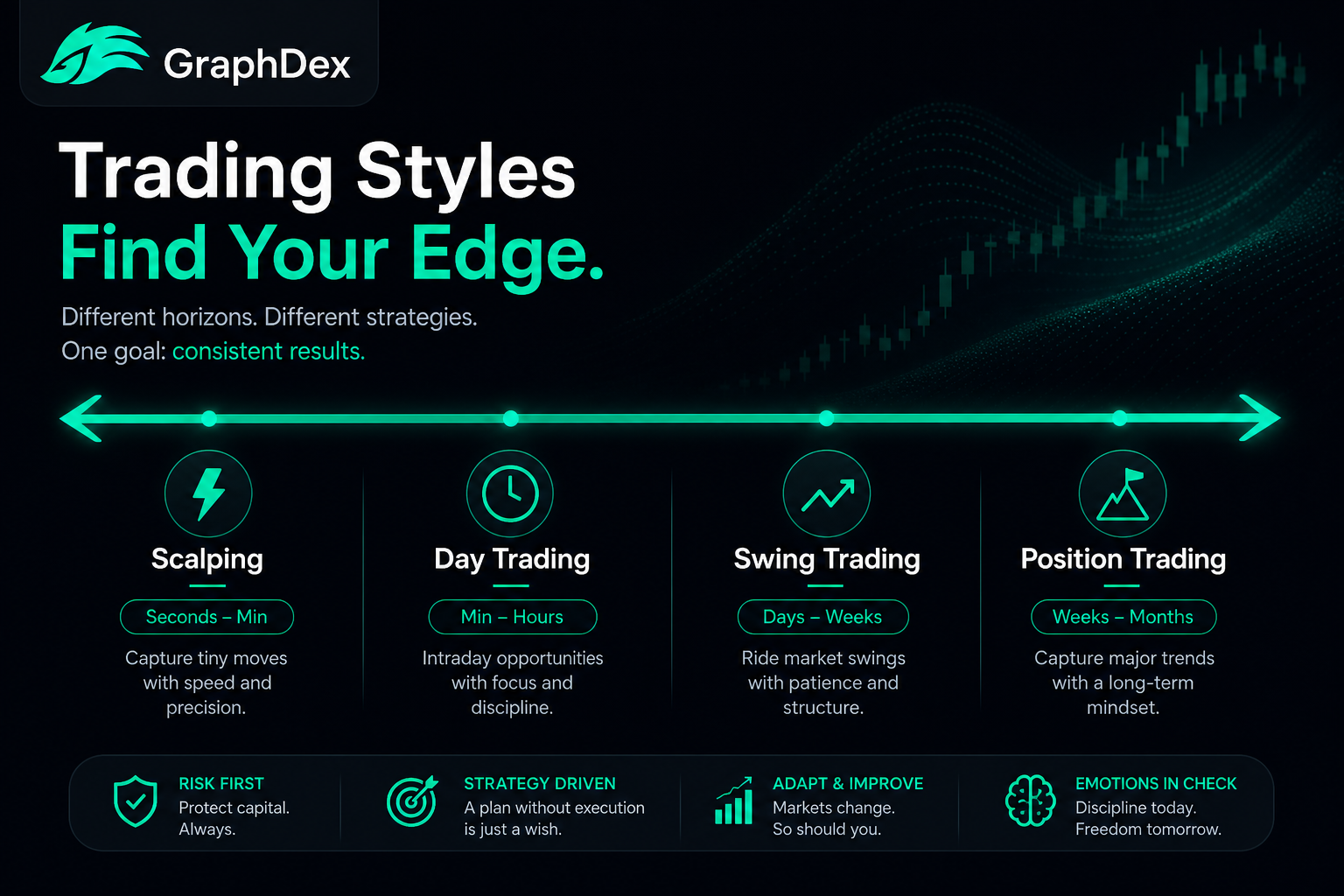
The four main trading styles differ primarily by holding period — but each has different capital requirements, time commitments, win rates, and success patterns:
- Scalping: Seconds-minutes, 20-200+ trades/day, $5K+ minimum, 4-8 hours daily, 80-90% retail failure rate
- Day Trading: Minutes-hours, 1-20 trades/day, $5-25K capital, 4-6 hours daily, 70-90% failure rate
- Swing Trading: Days-weeks, 1-5 trades/week, $500+ capital, 30 min-2 hours daily, 50-70% failure rate
- Position Trading: Weeks-months, 0-2 trades/month, any capital, 15-60 min daily, 40-60% failure rate
The honest reality: Swing and position trading produce better risk-adjusted returns per hour for most retail traders than day trading or scalping. Most successful retail crypto traders are swing or position traders, despite social media glorification of day trading.
Choose your trading style on GraphDex Solana terminal
Key Takeaways
- Trading style choice depends on capital, time available, personality, and risk tolerance — not on which sounds most exciting.
- Most retail traders should NOT day trade — swing trading offers better risk-adjusted returns with less stress.
- All four styles have different capital requirements and success rates.
- Many traders evolve through styles: scalping → day trading → swing trading as they mature.
The Spectrum: Time Horizon Defines Style
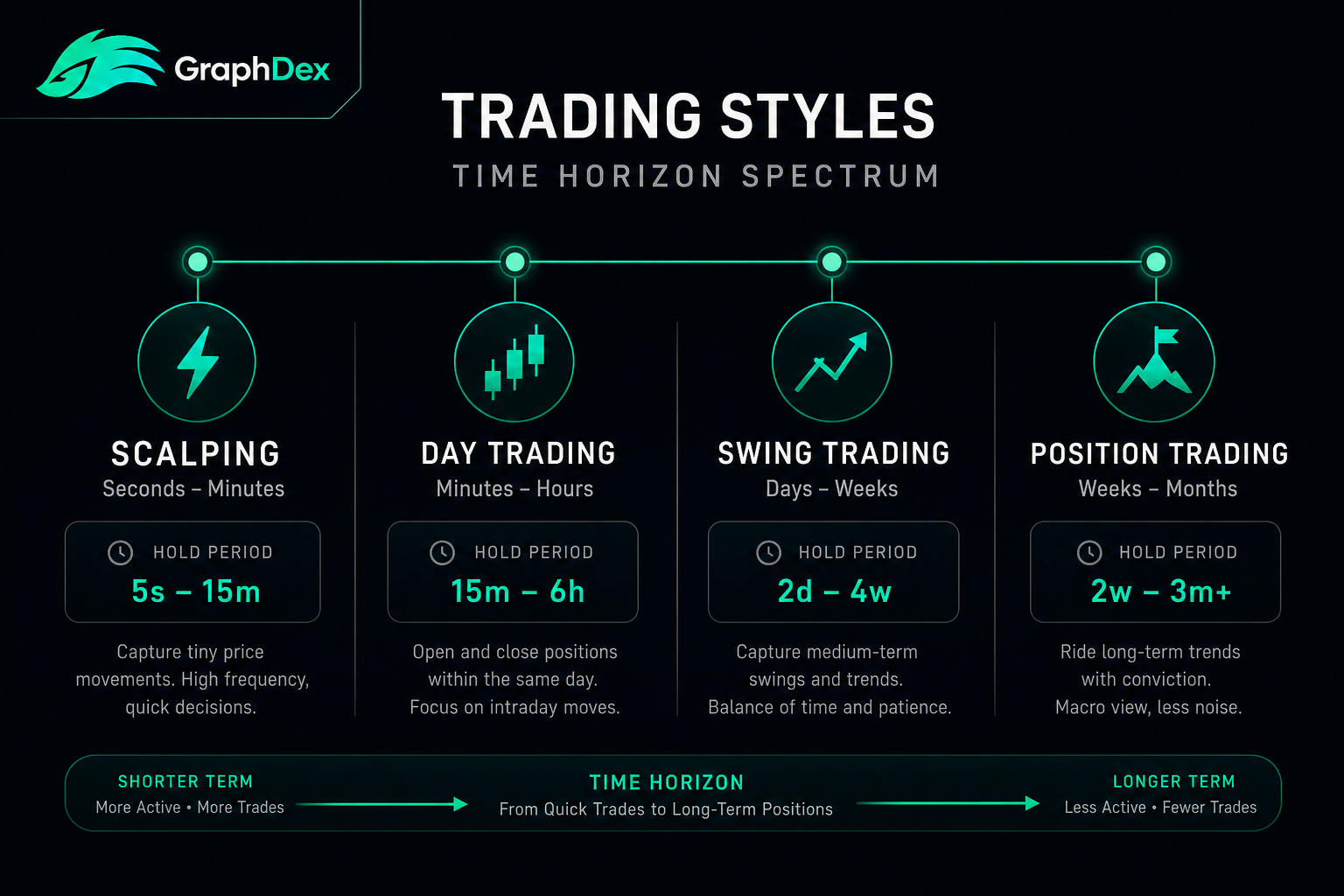
The four main trading styles form a spectrum from fastest to slowest:
Scalping (fastest): Hold seconds to minutes. Trade frequently. Capture tiny moves.
Day Trading: Hold minutes to hours. Close before day's end. Capture intraday moves.
Swing Trading: Hold days to weeks. Capture multi-day swings within trends or ranges.
Position Trading (slowest): Hold weeks to months. Capture major trends.
This isn't arbitrary categorization — each style requires different skills, infrastructure, capital, and personality fit. Choosing wrong is the single most common reason new traders fail.
Side-By-Side Comparison
The complete picture:
| Feature | Scalping | Day Trading | Swing Trading | Position Trading |
|---|---|---|---|---|
| Hold period | Sec-min | Min-hours | Days-weeks | Weeks-months |
| Trades per day | 20-200+ | 1-20 | 0-3 | Rare |
| Trades per week | 100-1,000+ | 5-100 | 1-5 | 0-2 |
| Profit/trade target | 0.1-1% | 1-5% | 10-30% | 30-200% |
| Min. capital | $5,000 | $5,000 | $500 | Any |
| Time daily | 4-8 hours | 4-6 hours | 30 min-2 hours | 15-60 min |
| Time horizon | Real-time | Intraday | Multi-day | Multi-month |
| Best timeframes | 1m-5m | 5m-1h | 4h-Daily | Daily-Weekly |
| Stop loss size | 0.1-0.5% | 1-3% | 5-10% | 10-20% |
| Overnight risk | None | None | Yes | Yes |
| Skill ceiling | Very high | High | Medium-high | Medium |
| Retail failure rate | 80-90% | 70-90% | 50-70% | 40-60% |
| Annual returns (skilled) | 50-150% | 20-50% | 30-80% | 20-100% |
| Stress level | Very high | High | Medium | Low |
| Job compatibility | Almost none | Difficult | Excellent | Excellent |
The pattern: shorter timeframes mean higher intensity, faster feedback, higher skill ceilings — but also higher failure rates and more demanding lifestyles.
Style Deep-Dive #1: Scalping
For whom: Full-time traders with $5K+ capital, multi-monitor setups, and exceptional focus.
Strengths
- Most opportunities per day (constant action)
- No overnight risk
- Compounds quickly when successful
- Develops deep market microstructure understanding
- Limited individual trade risk
Weaknesses
- Highest skill ceiling — takes years to master
- Fee-sensitive (impossible on Ethereum L1)
- Mental exhaustion accumulates rapidly
- Requires hours of continuous focus
- Hardest emotional regulation requirements
- 80-90% retail failure rate
Best for personalities
- Highly competitive
- Comfortable with rapid decision-making
- Patient with detail
- Emotionally stable under pressure
- Ability to focus for hours
Capital reality
- $1,000-$5,000: Survival difficult, fees disproportionate
- $5,000-$25,000: Practical learning range
- $25,000+: Professional range
Style Deep-Dive #2: Day Trading
For whom: Traders with several hours of daily availability, $5-25K capital, and tolerance for moderate-to-high stress.
Strengths
- Multiple opportunities daily
- No overnight risk
- Less intense than scalping
- More accessible than scalping
- Can develop systematic approaches
Weaknesses
- Still emotionally demanding
- Difficult to balance with full-time work
- 70-90% retail failure rate
- Tax complexity (short-term gains, frequent transactions)
- Mental fatigue from constant decisions
Best for personalities
- Analytical, systematic
- Can handle frequent losses without tilt
- Patient enough to wait for setups but quick to execute
- Comfortable with daily P&L volatility
Capital reality
- $5,000-$10,000: Learning range with proper risk management
- $10,000-$25,000: Comfortable
- $25,000+: Professional range
Style Deep-Dive #3: Swing Trading
For whom: Most retail traders, especially those with full-time jobs and $500+ capital.
Strengths
- Highest job compatibility
- Lower stress than day trading/scalping
- Higher win rates (trades have time to develop)
- Lower transaction costs (fewer trades)
- Achievable with smaller capital
- Better risk-adjusted returns per hour
Weaknesses
- Overnight/weekend risk
- Requires patience (positions can move slowly)
- Less "exciting" than day trading
- Vulnerable to news shocks during positions
Best for personalities
- Patient
- Analytical
- Comfortable with delayed feedback
- Can manage emotions through multi-day drawdowns
- Disciplined enough not to overtrade
Capital reality
- $500-$1,000: Viable for learning on low-fee venues
- $1,000-$10,000: Solid range
- $10,000+: Comfortable with multi-position diversification
Style Deep-Dive #4: Position Trading
For whom: Long-term thinkers with any capital who want exposure but not active management.
Strengths
- Lowest time commitment
- Lowest stress
- Highest tax efficiency (long-term gains often favorable)
- Closest to investing
- Captures major trends
- Lowest transaction cost impact
Weaknesses
- Slowest feedback loop
- Requires conviction through major drawdowns
- Less frequent profit-taking opportunities
- Capital tied up for extended periods
- News risk over months of holding
Best for personalities
- Patient long-term thinkers
- Comfortable with sustained drawdowns
- Strong conviction in market analysis
- Not seeking excitement from trading
Capital reality
- Any amount works — the principles don't change at different scales
- Best fit for capital amounts in tax-advantaged accounts where possible
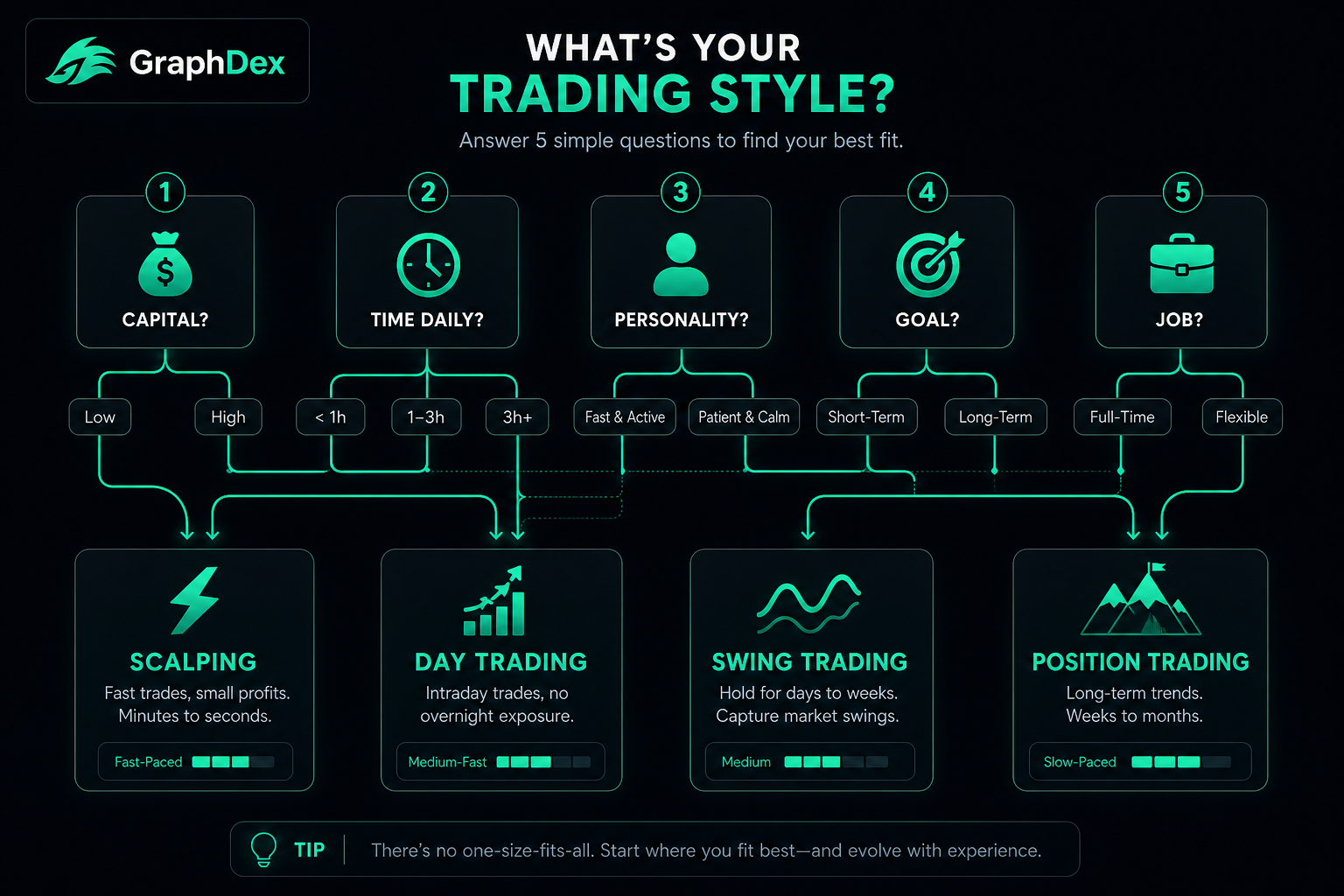
How Do You Choose the Right Trading Style?
The right style depends on multiple factors, not just preference.
Question 1: How much capital do you have?
Under $500: Position trading or buy-and-hold investing only. Active styles fee-erode small accounts.
$500-$5,000: Swing trading or position trading. Day trading and scalping difficult.
$5,000-$25,000: Any style viable, but swing trading is still highest probability of success.
$25,000+: Any style viable based on other factors.
Question 2: How much time can you commit daily?
Under 30 minutes: Position trading only.
30 minutes-2 hours: Swing trading ideal.
2-4 hours: Day trading possible with discipline.
4+ hours full-time: Day trading or scalping.
Question 3: What's your personality?
Patient, long-term oriented: Position or swing trading.
Analytical, systematic, can handle frequent losses: Day trading.
Competitive, fast-thinking, focus-intense: Scalping.
Anxious, fearful, emotional: Avoid active trading entirely. Stick to investing.
Question 4: What's your goal?
Wealth building over years: Position trading or passive investing.
Income supplement alongside other work: Swing trading.
Full-time trading income: Day trading or scalping (after years of development).
Excitement and challenge: Day trading or scalping (with realistic expectations about losses).
Question 5: Do you have a full-time job?
Yes — demanding job: Position trading or swing trading.
Yes — flexible job: Swing trading; day trading possible if hours align.
No — full-time trading: Any style based on other factors.
Common Mismatches Between Personality and Style
For balance, the patterns that cause failure:
The day-trader-who-should-be-swing-trading. Has full-time job. Trades 30 minutes during lunch break. Loses constantly because day trading requires sustained focus. Should switch to swing trading.
The scalper-who-can't-focus. Wants quick wins but can't maintain hours of continuous focus. Performance degrades after first hour. Should switch to swing or position trading.
The swing-trader-who-overtrades. Has the time and discipline for swing trading but can't resist taking too many trades. Quality drops, win rate falls. Needs to reduce frequency.
The position-trader-who-day-trades. Has long-term conviction but can't stop checking charts. Anxiety causes panic-selling positions that would have worked. Should commit fully to longer timeframes.
The all-styles-trader. Switches styles every losing streak. Never develops mastery of any single approach. Should pick one style and commit for at least 12 months.
The principle: match style to who you actually are, not who you wish you were.
Why Do Traders Change Styles Over Time?
Most successful long-term traders don't stick with one style forever. Common evolutionary paths:
The Beginner's Path
Year 1: Often starts with day trading or scalping (high expectations, lots of action). Usually loses money.
Year 2: Reduces frequency. Often moves toward swing trading. Begins developing edge.
Year 3+: Either: (a) becomes professional day trader/scalper after intense development, OR (b) settles into swing trading as primary, with occasional day trading or position trading on specific opportunities.
The Mature Trader's Path
Year 3+: Develops specific niche where they have edge — could be any style.
Year 5+: Often becomes hybrid: position trades for core exposure + swing trades for active opportunities + occasional day trading for specific setups.
Year 10+: Highly individualized. Strong understanding of their own strengths and weaknesses.
This evolution is normal and healthy. The traders who fail aren't necessarily those who change styles — they're those who change styles every losing week without committing long enough to any single approach.
Which Trading Styles Work Best on Solana?
Solana's economics favor specific styles:
Excellent for scalping: Sub-cent fees make retail scalping viable for the first time in crypto history.
Excellent for day trading: Same fee advantage. 400ms finality matters for active strategies.
Excellent for swing trading: Low fees make position adjustments cheap. Active management essentially free.
Excellent for position trading: Long-term staking yields (up to 17% APY on stablecoins via fee-based platforms) during holding periods. JitoSOL liquid staking maintains DeFi utility.
In essence, Solana has reduced the friction across all styles — but the fee advantage is most dramatic at the high-frequency end. A scalper switching from Ethereum L1 to Solana saves 99%+ on fees; a position trader saves less in absolute terms.
For Solana traders specifically, the integrated terminal approach (GraphDex) suits all styles by consolidating tools that traditionally required multiple platforms.
Find your trading style on GraphDex Solana terminal
Try Solana trading on integrated GraphDex terminal
How GraphDex Supports All Trading Styles
GraphDex is designed to support traders across all styles:
For scalpers:
- Sub-cent fees on every trade
- 400ms execution via Solana
- MEV protection against sandwich attacks
- Multi-monitor compatibility
For day traders:
- Multi-timeframe charts
- Volume integration
- AI signals for setup identification
- Pulse feed for intraday opportunities
For swing traders:
- Higher timeframe analysis
- Bubble Maps for fundamental confirmation
- Wallet/social tracking for trend following
- Lower frequency execution at low cost
For position traders:
- Fee-based 17% APY staking on stablecoins/SOL during holds
- Long-term DeFi yield opportunities
- Non-custodial Privy wallet — funds stay yours during long holds
For all styles:
- Non-custodial via Privy (sign in with Twitter, email, Telegram)
- No seed phrase requirement
- Integrated workflow reduces context-switching
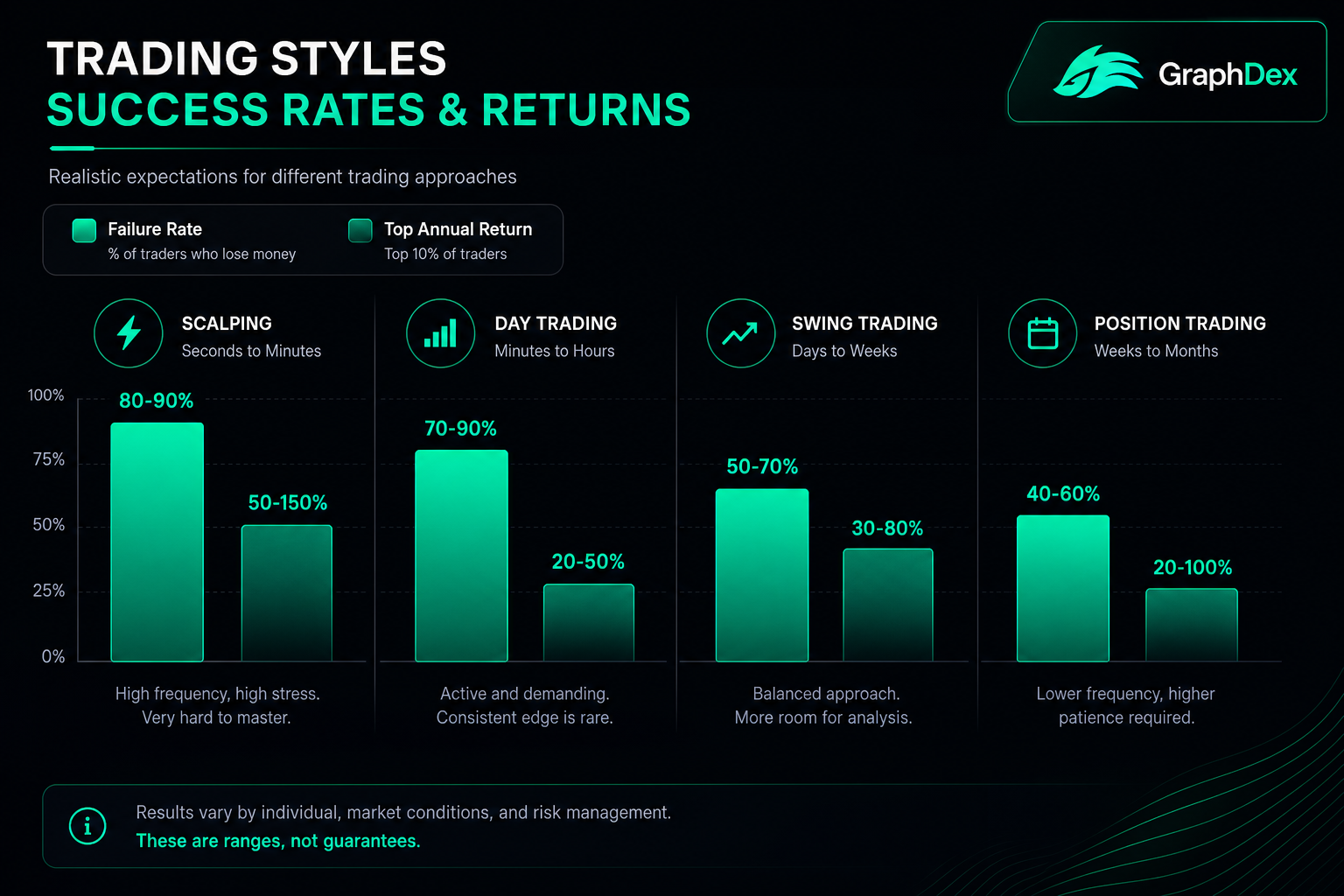
Realistic Expectations by Style
For honesty about what each style actually produces:
Scalping
- Year 1 expected outcome: 70-90% lose 30-100%
- Year 2 expected outcome: Survivors at breakeven
- Year 3+ for the 10-20%: 50-150% annual returns possible
- Lifestyle: Full-time intensity, multi-monitor required
Day Trading
- Year 1 expected outcome: 70-90% lose 20-50%
- Year 2 expected outcome: Survivors at breakeven
- Year 3+ for the 10-30%: 20-50% annual returns
- Lifestyle: 4-6 hours focused screen time daily
Swing Trading
- Year 1 expected outcome: 50-70% lose modestly; some breakeven
- Year 2 expected outcome: 30-50% profitable
- Year 3+ for the 30-50%: 30-80% annual returns
- Lifestyle: Compatible with full-time work, low stress
Position Trading
- Year 1 expected outcome: Highly variable based on market timing
- Year 2 expected outcome: Aligned with broader market plus selection edge
- Year 3+ for the 40-60%: 20-100% annual returns depending on cycle timing
- Lifestyle: Minimal time commitment, low daily stress
Frequently Asked Questions
Which trading style is most profitable? On a per-hour basis, swing trading typically produces the best returns for retail traders. Per-year, skilled scalpers can produce highest returns (50-150% annually) — but only the 10-20% who actually master it. The "most profitable" style is the one that matches your personality, time, and capital — because mismatches guarantee losses.
What's the best trading style for beginners? Swing trading. Lower failure rate (50-70% vs 70-90% for day trading), lower capital requirements ($500+ vs $5,000+), compatible with full-time work, allows time to develop skills. Most beginners should NOT day trade despite its social media glorification — most who try lose money quickly.
Can I do multiple trading styles? Yes, but specialize first. Master one style for 6-12+ months before adding another. Trying multiple styles simultaneously without mastery usually means failing at all of them. Mature traders often combine styles (position core + swing on opportunities), but they got there by mastering one first.
Why do most day traders lose money? Five main reasons: (1) Mismatched style for personality/schedule; (2) Insufficient capital ($1-5K is too small for day trading); (3) High fees (especially on Ethereum L1); (4) Poor risk management (>2% per trade); (5) Emotional decisions (revenge trading, FOMO). Most day traders should actually be swing traders.
Is scalping or day trading more profitable? Both can be profitable for the few who master them. Scalpers compound smaller wins more frequently; day traders capture larger individual moves. Scalping has higher skill ceiling and capital requirements. Both have similar 70-90% failure rates. Per-hour returns favor day trading for most; per-year returns favor scalping for the elite few.
Can I day trade with a full-time job? Difficult. Day trading requires 4-6 hours of focused screen time during market hours. Some make it work with strategies that suit specific hours (e.g., evening sessions for some Asian markets). But for most full-time workers, swing trading or position trading is far more practical.
How long until I'm consistently profitable? Realistic estimates by style: Position trading 6-18 months; Swing trading 1-2 years; Day trading 2-5 years; Scalping 2-5+ years. These assume serious dedication including journaling, backtesting, and continuous learning. Without discipline, most traders never become consistently profitable regardless of style.
About This Guide
This guide is published by the GraphDex Research team — analysts and traders building the infrastructure for digital asset trading on Solana. Our content is based on direct experience across all trading styles, current market data, and observation of successful retail trading patterns.
Sources & data: Style descriptions and success rates reflect typical retail trading outcomes in 2026. All active trading carries substantial risk of loss. This guide is educational and not financial advice.
GraphDex is the infrastructure for digital asset trading — trade, predict, and earn in one place. Learn more at graphdex.io.
Last reviewed: May 2026 · GraphDex Research
The infrastructure for digital asset trading. Trade, predict, stake, repeat. graphdex.io