By GraphDex Research · Reviewed for accuracy May 2026
Quick Answer
Sports prediction markets let you trade contracts on sports outcomes peer-to-peer — not against a house. Key facts in 2026:
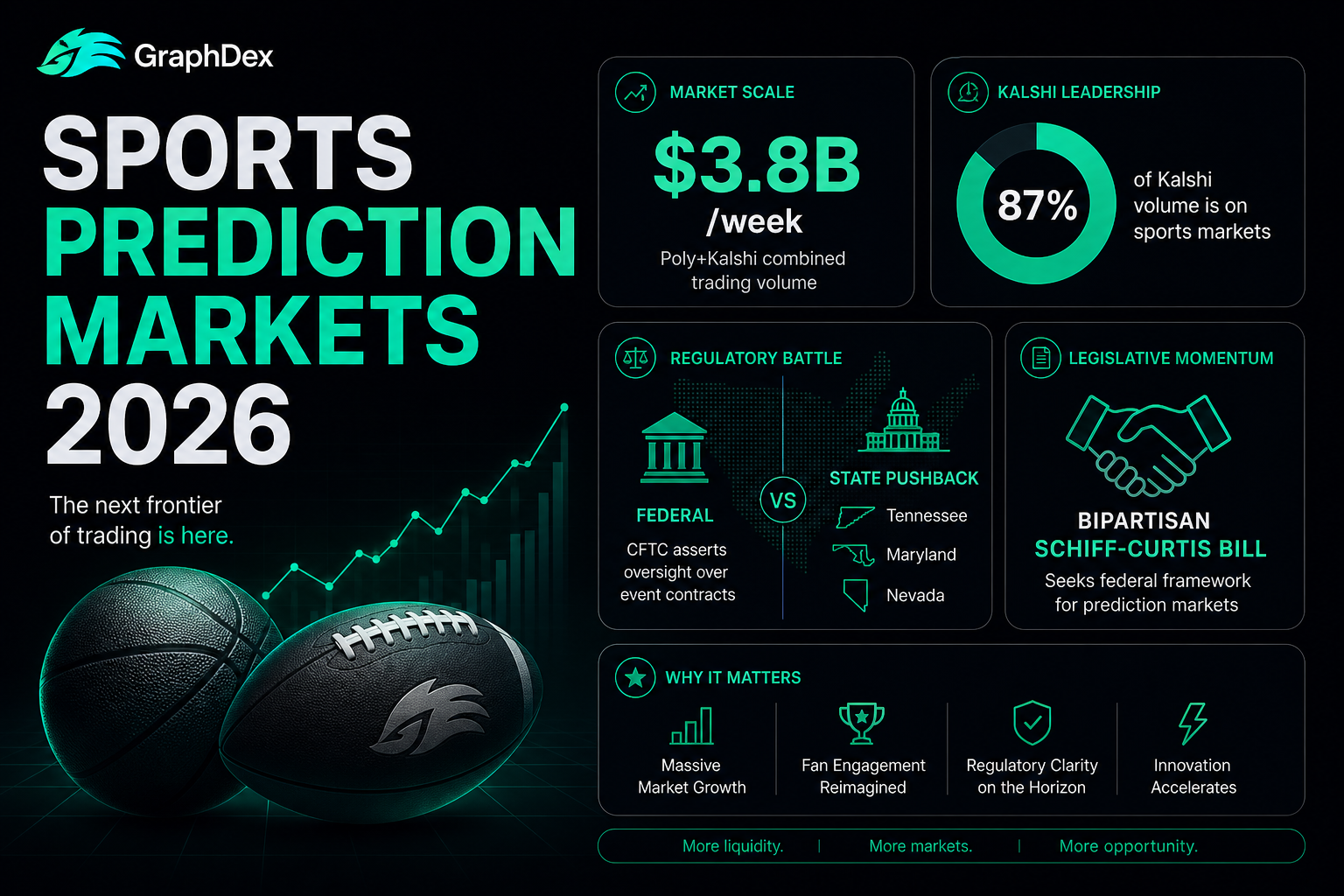
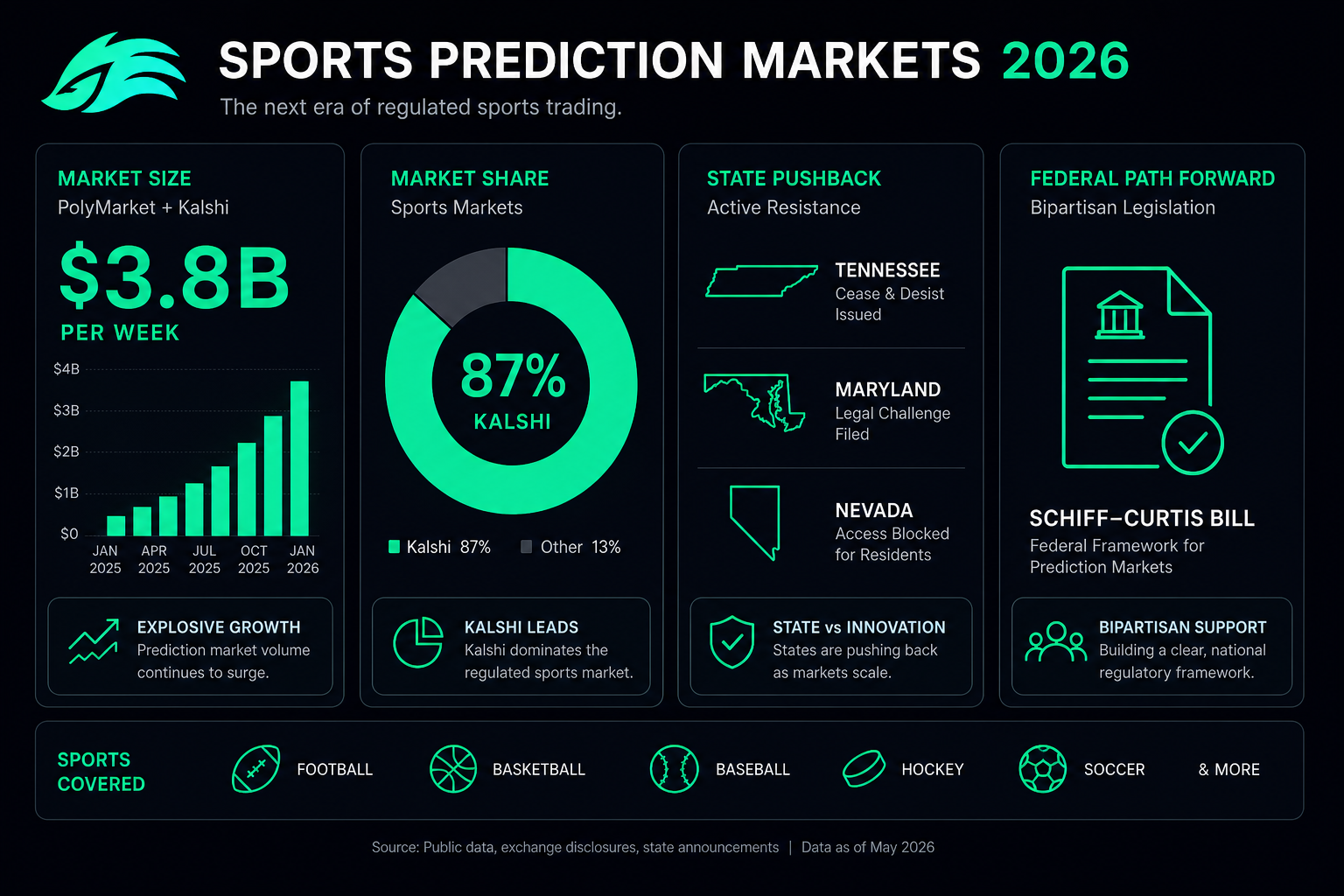
- Volume: Polymarket and Kalshi generated roughly $3.8 billion in combined weekly sports volume
- Kalshi dominance: About 87% of Kalshi's $39.7B trailing annual volume is on sports
- Different from sportsbooks: You trade against other users at market prices reflecting real probabilities, not house-set odds with built-in margin
- Regulatory fight: A bipartisan Senate bill from Schiff and Curtis would bar sports from CFTC-regulated prediction markets; states are challenging in court
The legal landscape is shifting rapidly — check current rules in your jurisdiction.
Trade prediction markets via GraphDex
Key Takeaways
- Sports prediction markets trade peer-to-peer at market prices, unlike sportsbooks with house margin.
- Sports drive most volume on Kalshi (~87%) and are a major Polymarket category.
- A bipartisan Senate bill (Schiff-Curtis) would bar sports from CFTC prediction markets.
- The federal-state legal conflict is unresolved — check current rules for your jurisdiction.
How Sports Prediction Markets Work
A sports prediction market is an exchange where you trade contracts on sports outcomes. Each contract is a yes/no question — "Will the Lakers win Game 5?", "Will the Chiefs cover the spread?" — and you buy YES or NO shares.
The price of each share reflects the market's collective probability. A share priced at $0.62 implies a 62% market-implied chance of the outcome. If you're right, each share pays $1.00; if wrong, $0.00. Price equals implied probability.
This is fundamentally different from a traditional sportsbook. At a sportsbook, you bet against the house at odds the book sets (typically with a built-in margin, the "vig"). On a prediction market, you trade peer-to-peer against other users at market prices — no house margin built into the spread. You can also sell positions before resolution, exiting early to lock in gains or cut losses as new information arrives.
Sports prediction markets cover the same outcomes sportsbooks do — game winners, point spreads, totals (over/under), individual player props, season-long outcomes, championships. The difference is the market structure, not the betting universe.
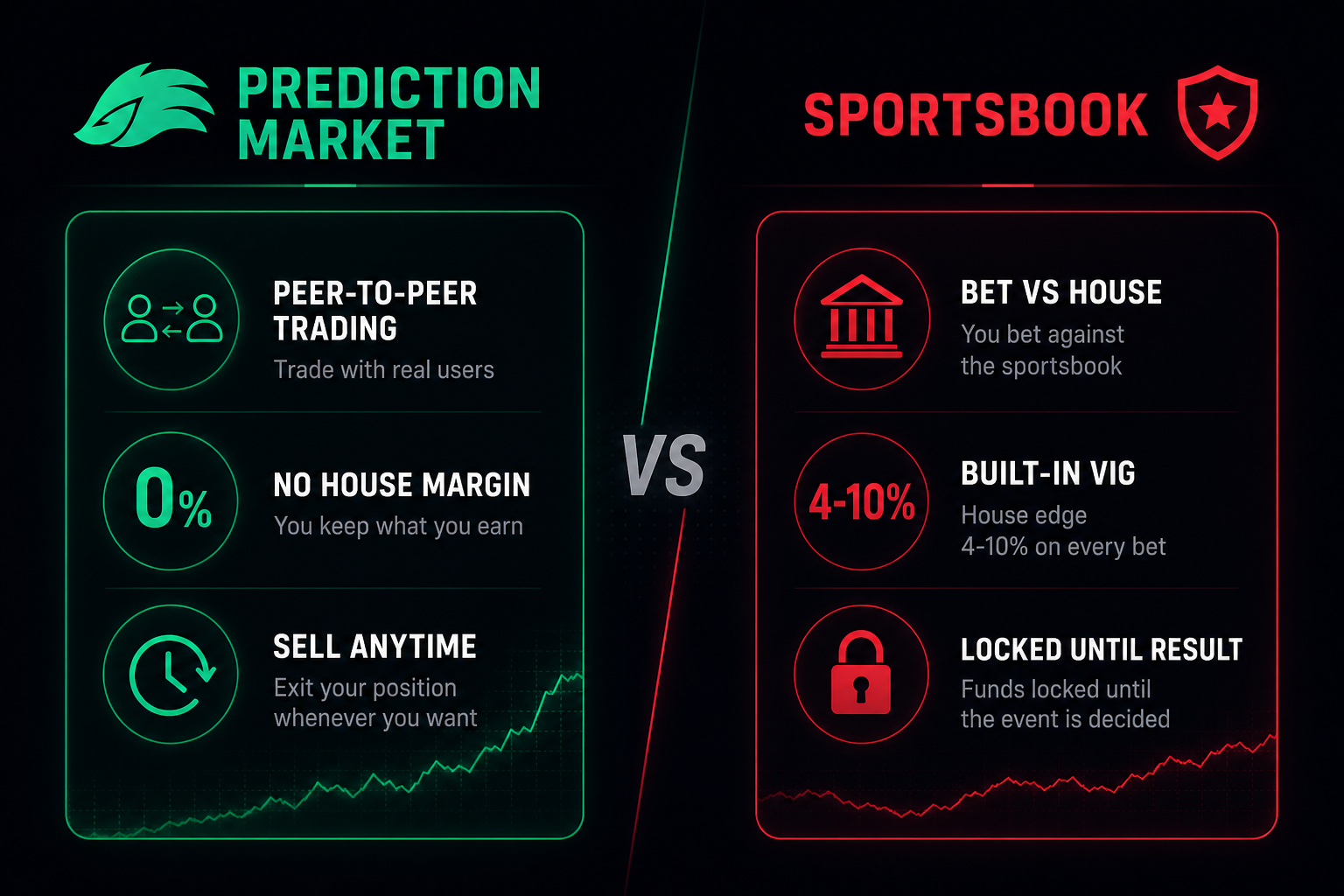
Sports Prediction Markets vs Sportsbooks
The differences matter — they shape who profits and how.
| Feature | Prediction Markets | Sportsbooks |
|---|---|---|
| Trade against | Other users (peer-to-peer) | The house |
| Pricing | Market-driven, dynamic | House-set with margin |
| Exit before result | Yes — sell anytime | No — bet locked until result |
| Implied margin | Minimal (just trading fees) | Built-in vig (~4-10%) |
| Skill rewarded | Yes — informed traders profit | Limited — house grinds edge over time |
| Regulation (US) | CFTC (federal) | State gambling licenses |
| Available in all states | Federal CFTC platforms, varies | State-by-state legality |
The structural advantage of prediction markets is no house edge. Sportsbooks profit from the vig — the margin built into prices. Prediction markets, like stock exchanges, are designed for participants to trade with each other at fair prices, with the platform taking a smaller cut.
The sportsbook advantage is established infrastructure: state-licensed, mature interfaces, well-developed prop and live betting markets. They've been doing this for years; prediction market sports trading is newer.
For skilled traders, prediction markets favor positive expected value over time — the lack of house margin means edge isn't ground down to zero. For casual bettors who don't develop edge, both can lose money.
The Big Players: Polymarket vs Kalshi
The two main sports prediction venues take different approaches.
Kalshi is CFTC-regulated and US-friendly with traditional banking. Sports is its dominant category — roughly 87% of trailing-year volume. Kalshi spent 2025 building out sports coverage aggressively, becoming the established CFTC platform for sports event contracts. It's the standard reference for US users wanting regulated sports prediction markets.
Polymarket is crypto-native (USDC settlement on Polygon, no trading fees), with broader category coverage but a major sports offering. Polymarket US (QCX LLC) operates as a CFTC DCM, while different access paths carry different legal status.
For traders, the choice between them often comes down to access (which is legally available in your jurisdiction), settlement preference (USDC vs traditional banking), and specific market coverage for the sports you trade.
Polymarket and Kalshi combined generated approximately $3.8 billion in weekly sports volume — making this segment the largest single category in the prediction market industry.
The Legal Fight Over Sports Prediction Markets
Sports prediction markets sit at the center of an active legal battle in 2026 — and the outcome will shape the industry.
The federal stance: The CFTC asserts exclusive jurisdiction over event contracts, including sports. Following a CFTC leadership change in January 2025, the agency took a more permissive stance toward sports markets, allowing Kalshi and others to offer sports contracts starting that month.
The state pushback: A growing number of states argue sports event contracts function like gambling and fall under state authority. Tennessee, Maryland, Nevada, Illinois, Massachusetts, and others have sent cease-and-desist letters or filed enforcement actions. Courts have ruled mixed — the Third Circuit ruled for Kalshi against New Jersey in April 2026, but Maryland and Nevada have had partial success defending state authority.
The bipartisan bill: Senators Adam Schiff and John Curtis introduced a bill in early 2026 that would bar sports betting and casino contracts from CFTC-regulated prediction markets where Polymarket and Kalshi generated that $3.8 billion in weekly volume. The bill follows concerns about insider trading and youth protection. If it passes, it would significantly reshape (or eliminate) CFTC sports prediction markets.
For traders: The legal status of sports prediction markets is genuinely uncertain in mid-2026, and changing rapidly. CFTC platforms operate today, but legislation or court rulings could restrict them. This guide is educational, not legal advice — check your jurisdiction's current rules before trading sports prediction markets.
How to Trade Sports Prediction Markets
For traders pursuing sports prediction markets, several practical points:
Specialize. Focus on sports you know deeply. Generalist sports betting tends to lose; specialists who deeply understand a league, team, or stat outperform.
Compare market prices to your estimates. The market price is the consensus. Your edge comes from the gap between consensus and your better-informed estimate. If the market prices a team at 55% and your analysis says 65%, that's a 10-point edge worth trading.
Use the early-exit option. Unlike sportsbook bets locked until resolution, prediction market positions can be sold before games end. Lock gains when probabilities move your way; cut losses when news turns against you. This is a structural advantage over fixed-odds betting.
Beware of public favorites. Markets often slightly overprice public favorites (the "favorite-longshot bias"). Skilled traders sometimes find value in underdogs the public dismisses.
Manage risk by sport and slate. Don't concentrate in one game or one sport. Spread bets, size positions according to edge (Kelly Criterion), and treat each bet as one trade among many.
Consider copytrading. If developing sports edge from scratch is slow, copytrading proven sports forecasters via tools like GraphDex lets you mirror traders ranked by PnL — borrowing their edge while you learn.
Track and copytrade prediction market sports via GraphDex
Pros and Cons of Sports Prediction Markets
Pros:
- No house edge — better long-term economics for skilled traders
- Sell before resolution — lock in or cut losses anytime
- Real probability pricing — what you see is the actual market consensus
- Liquid major markets — deep volume on popular games
- Federal regulation (CFTC) — clearer than state-by-state sportsbooks in some ways
Cons:
- Legal uncertainty — federal-state conflict, possible legislation could restrict
- Less liquid niche markets — small sports or props can have thin order books
- No traditional sportsbook features — fewer props, fewer same-game parlays
- Counterparty matching needed — for every YES buyer, someone takes NO
- Tax treatment unsettled — IRS has no formal guidance; record-keeping matters
For skilled traders willing to navigate legal uncertainty, the structural advantages of prediction markets are real. For casual bettors wanting traditional sportsbook features, regulated sportsbooks may still fit better.
What's Next for Sports Prediction Markets
The trajectory in 2026 depends largely on legal outcomes. Several scenarios:
Scenario 1: Federal prevails. CFTC jurisdiction is affirmed by courts, states are blocked from enforcement, and the Schiff-Curtis bill doesn't pass. Sports prediction markets grow, possibly displacing some sportsbook volume nationally.
Scenario 2: States push back successfully. Some states win the right to restrict sports contracts as gambling. The federal-state split continues, with access varying by state.
Scenario 3: Federal legislation restricts. Congress passes the Schiff-Curtis bill or similar, barring sports from CFTC prediction markets. This would significantly reshape the industry — Kalshi loses most of its volume; Polymarket loses a category.
The most likely outcome is some hybrid — federal jurisdiction holds for most contracts, certain markets face state restrictions or federal scope-narrowing. The $3.8 billion weekly volume number reflects how much is at stake, and explains the regulatory attention.
For traders, the practical approach: stay informed, use compliant platforms, and don't build long-term strategy on assumptions about legal status that may change.
How GraphDex Helps Sports Prediction Traders
For traders pursuing sports prediction markets via Polymarket, several GraphDex features matter:
- Copytrading — follow proven sports forecasters ranked by PnL and win rate; mirror their positions automatically
- Whale tracking — see when large informed traders move on games
- AI signals — surface news impact (injuries, lineup changes) faster than manual monitoring
- Integrated execution — act on signals immediately without switching tools
Because GraphDex integrates Polymarket trading with Solana DEX trading and staking up to 17% APY on idle capital, you can pursue sports prediction trading while your capital between bets earns yield. For active sports traders, this combination of focused tools plus consolidated workflow is the practical advantage over juggling separate apps.
Start trading sports prediction markets smarter on GraphDex
Frequently Asked Questions
Are sports prediction markets legal? At the federal level, the CFTC allows sports event contracts on regulated platforms like Kalshi. But several states challenge them as gambling — Tennessee, Maryland, Nevada, and others have pursued enforcement. A bipartisan Senate bill (Schiff-Curtis) would bar sports from CFTC prediction markets. Legal status is contested and changing — check your jurisdiction.
How are prediction markets different from sportsbooks? Prediction markets are peer-to-peer exchanges where you trade contracts at market prices with no house margin; you can sell before resolution. Sportsbooks set odds with built-in margin (the vig) and lock bets until results. Prediction markets favor skilled traders structurally; sportsbooks have established infrastructure and more prop variety.
Can I make money trading sports on prediction markets? Yes, but it requires edge. The lack of house margin means skilled traders aren't ground down by vig over time, unlike at sportsbooks. Specialize in sports you know deeply, compare market prices to your estimates, manage risk, and consider copytrading proven forecasters via tools like GraphDex.
What is the Schiff-Curtis bill? A bipartisan bill from Senators Adam Schiff and John Curtis introduced in early 2026 that would bar sports betting and casino contracts from CFTC-regulated prediction markets. It follows concerns about insider trading and youth protection. If passed, it would significantly restrict CFTC sports prediction markets where Polymarket and Kalshi generated $3.8 billion weekly.
How much volume do sports prediction markets handle? Polymarket and Kalshi combined have generated approximately $3.8 billion in weekly sports volume in 2026. Roughly 87% of Kalshi's $39.7 billion trailing-year volume is on sports — making it the dominant category in the prediction market industry.
Should I use Polymarket or Kalshi for sports? Depends on your jurisdiction and preferences. Kalshi is CFTC-regulated with traditional banking and is US-friendly. Polymarket uses USDC with no trading fees, with access varying by jurisdiction. For US users wanting regulatory clarity, Kalshi; for global users or USDC settlement, Polymarket. Verify current legal status for your state.
Are prediction markets considered gambling? Legally, regulated event contracts are derivatives under CFTC jurisdiction — financial instruments, not gambling. Some states argue sports contracts function like gambling. Courts have leaned toward the financial-instrument view, but the debate continues. Structurally, prediction markets trade peer-to-peer with no house margin, unlike traditional gambling.
About This Guide
This guide is published by the GraphDex Research team — analysts and traders building the infrastructure for digital asset trading on Solana. Our content is based on live platform data, current market figures, and publicly available analysis.
Sources & data: Volume figures, legal developments, and platform details reflect publicly available information as of 2026 and change frequently. Sports prediction market legality varies by jurisdiction. This guide is educational and not legal or financial advice — verify current rules before trading.
GraphDex is the infrastructure for digital asset trading — trade, predict, and earn in one place. Learn more at graphdex.io.
Last reviewed: May 2026 · GraphDex Research
The infrastructure for digital asset trading. Trade, predict, stake, repeat. graphdex.io