By GraphDex Research · Reviewed for accuracy May 2026
Quick Answer
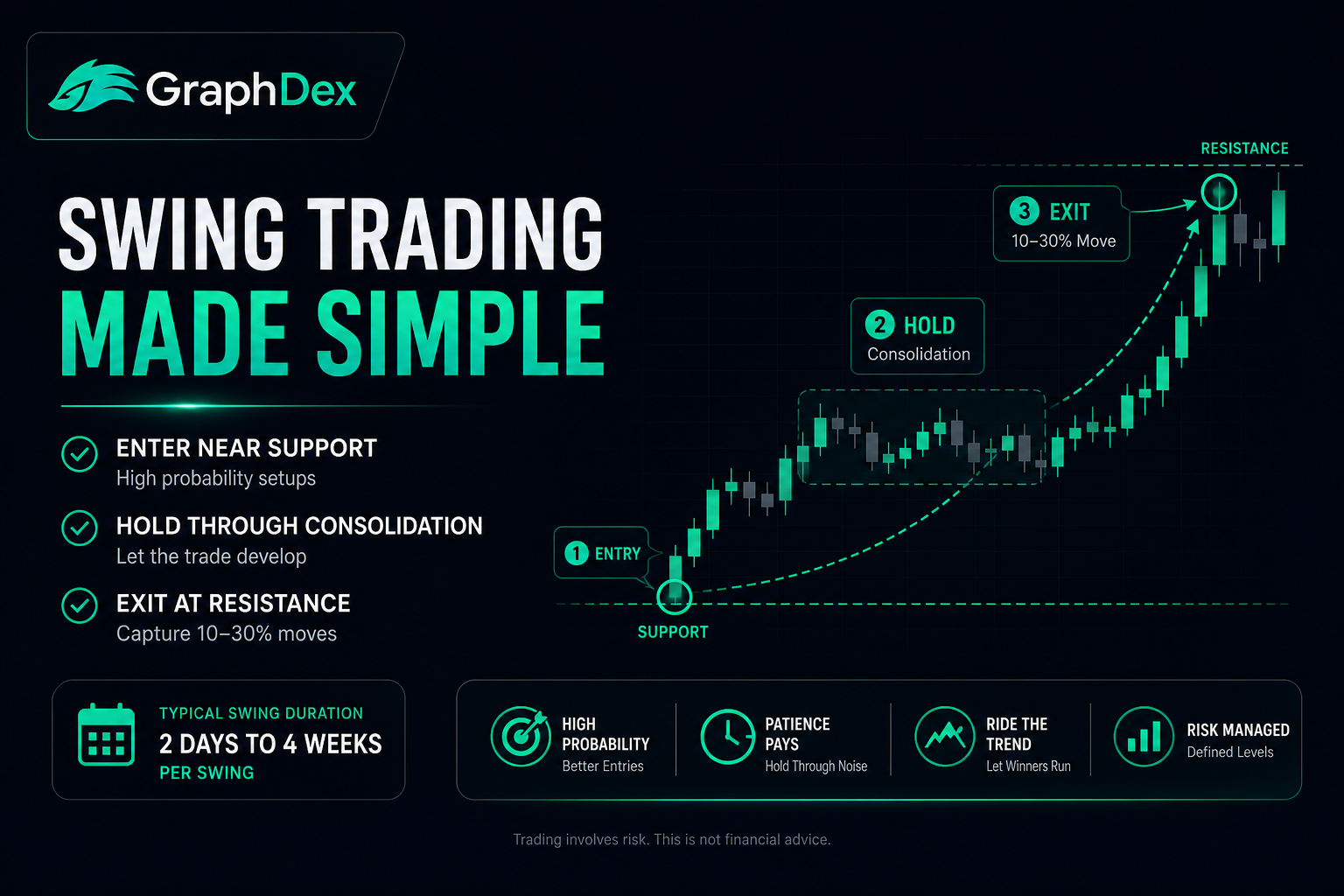
Swing trading is holding positions for days to weeks to capture multi-day price movements within larger trends. Key facts:
- Holding period: 2 days to 4 weeks typically
- Trade frequency: 1-5 active positions; new entries 1-3 times per week
- Profit per trade: Typically 10-30%
- Capital requirements: Starts viable at $1,000+
- Best timeframes: 4-hour and daily charts primary; weekly for context
- Time commitment: 30 minutes to 2 hours daily
- Reality check: Higher win rates than day trading; more achievable for most retail traders
The honest truth: Swing trading offers the best risk-adjusted returns for most retail traders. Lower stress, lower time, achievable returns of 30-80% annually for skilled practitioners.
Swing trade Solana with integrated tools on GraphDex
Key Takeaways
- Swing trading captures multi-day moves — typically targeting 10-30% per trade.
- Lower time commitment than day trading (30 min-2 hours daily) makes it viable alongside full-time work.
- Higher win rates than scalping/day trading because trades have time to develop properly.
- Most consistently profitable retail crypto traders are swing traders, not day traders.
What Is Swing Trading?
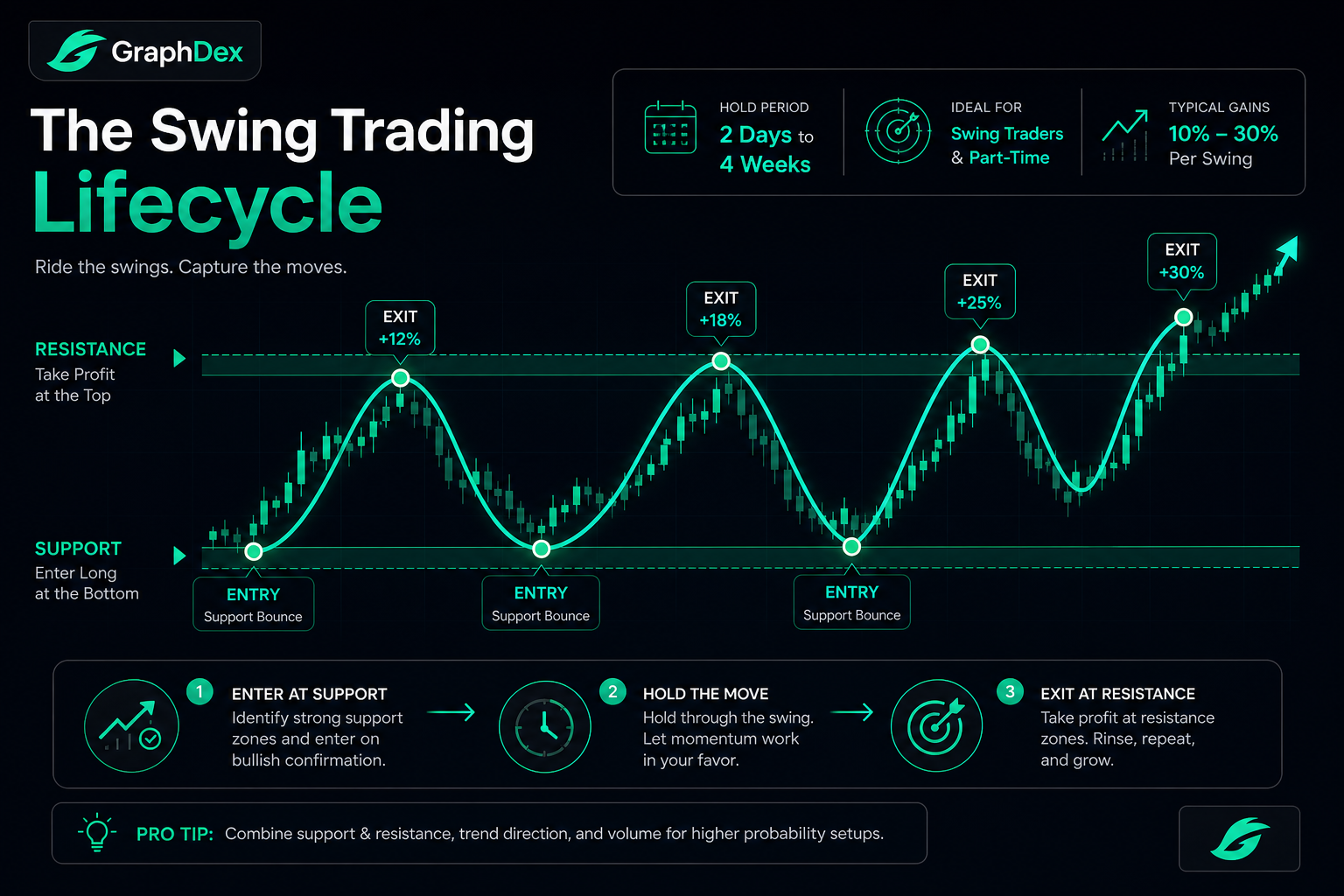
Swing trading is a style where positions are held for multiple days to several weeks, aiming to profit from "swings" — the natural rhythm of markets between higher highs and higher lows in trends, or between key support and resistance in ranges.
Where day traders close positions before day's end, swing traders deliberately hold positions overnight (and over weekends) to capture larger moves. Where position traders hold for months, swing traders typically exit within 1-4 weeks.
A typical swing trader's week:
- Reviews charts and identifies setups 2-3 times per week
- Maintains 1-5 active positions at any time
- New entries 1-3 times per week (some weeks zero)
- Holds positions 2 days to 4 weeks
- Targets 10-30% profit per trade
- Spends 30 minutes to 2 hours daily reviewing positions
Why swing trade?
- Lower time commitment than day trading or scalping
- Higher win rates (trades have time to develop)
- Lower transaction costs (fewer trades, less fee impact)
- Less emotional stress
- Achievable returns of 30-80% annually for skilled traders
- Compatible with full-time work
Why NOT swing trade:
- Overnight risk exposure (gaps can hurt)
- Requires patience (positions can move sideways before working)
- Holding through volatility tests discipline
- Less "exciting" than day trading
Swing Trading vs Other Styles
Understanding where swing trading sits in the spectrum:
| Style | Hold Period | Time Daily | Trades/Week | Annual Returns (Skilled) |
|---|---|---|---|---|
| Scalping | Sec-min | 4-8 hours | 100+ | 50-150% |
| Day Trading | Min-hours | 4-6 hours | 10-50 | 20-50% |
| Swing Trading | 2 days-4 weeks | 30 min-2 hours | 1-5 | 30-80% |
| Position Trading | Weeks-months | 15-60 min | 0-2 | 20-100% |
Swing trading's advantage: Highest risk-adjusted returns when adjusted for time commitment. A swing trader achieving 50% annually with 1 hour daily achieves a better hourly rate than a day trader achieving 100% with 6 hours daily.
Best for traders who:
- Have full-time jobs but want active trading exposure
- Prefer technical analysis with breathing room to develop
- Can tolerate overnight position risk
- Want returns above passive investing but don't need scalping intensity
- Have $1,000+ in starting capital (smaller capital viable than day trading)
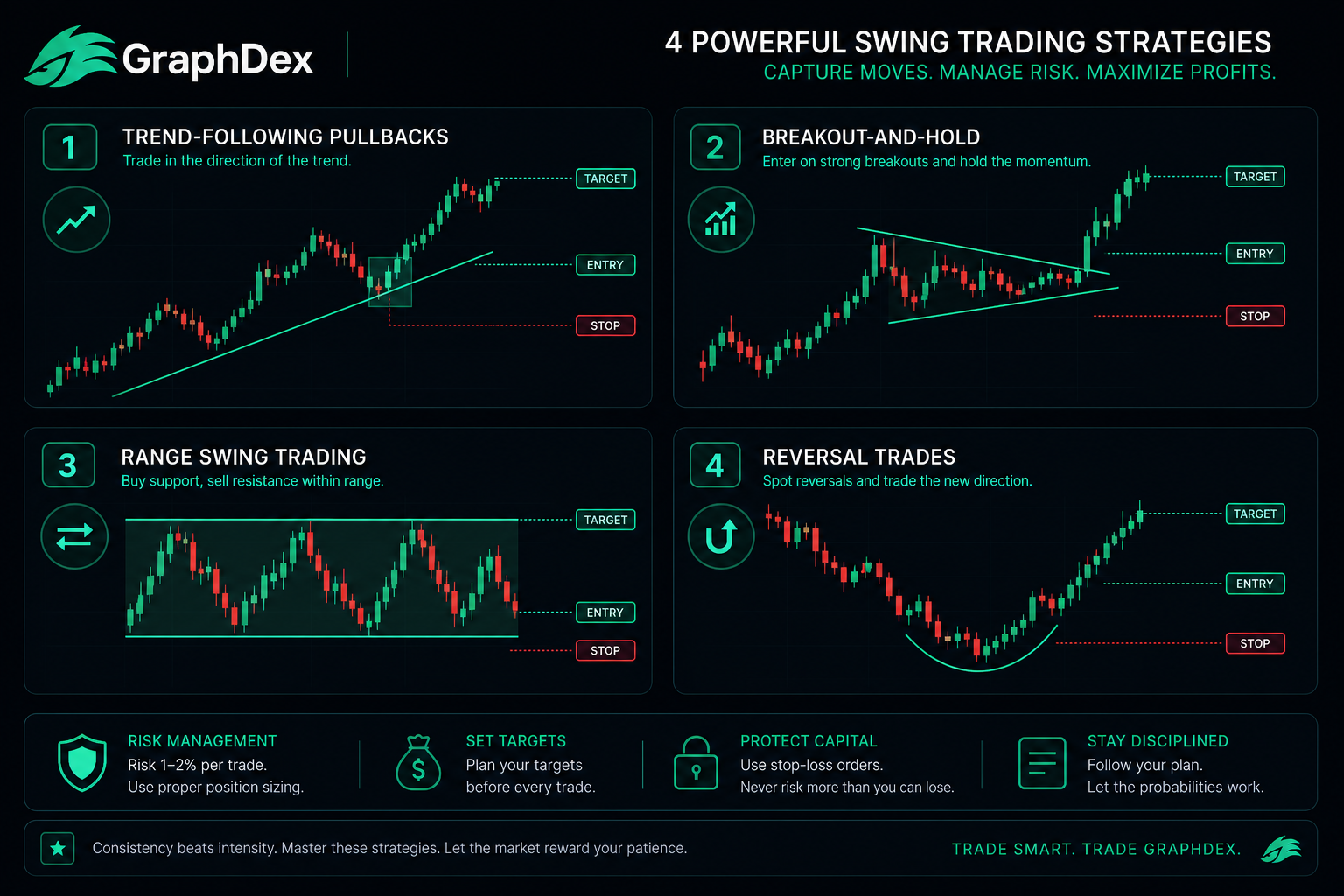
Which Swing Trading Strategies Work Best?
Several systematic approaches have produced reliable results in crypto markets.
Trend-Following Pullbacks
The most common swing trading strategy.
The setup:
- Clear uptrend on daily/4-hour charts (higher highs and higher lows)
- Price pulls back to key moving average (20 EMA or 50 EMA)
- Bullish reversal signal at pullback bottom (candle pattern, RSI bounce, level hold)
The execution:
- Entry: On confirmation candle close at the pullback level
- Stop loss: Below the recent swing low (typically 5-8% below entry on crypto)
- Target 1: Previous swing high (often 15-25% above entry)
- Target 2: New trend extension (often 30-60% above entry)
- Position: Hold for days to weeks until target hit or trend invalidated
Win rate: 55-70% for skilled practitioners in confirmed trends.
Best for: Clear trending markets (which crypto produces regularly).
Breakout-and-Hold
Capturing major trend initiations.
The setup:
- Long consolidation pattern (weeks to months)
- Significant resistance level with multiple historical tests
- Volume building during consolidation
The execution:
- Entry: On breakout above resistance with volume confirmation
- Stop loss: Just back inside the consolidation (often 5-10% below entry)
- Target: Measured move (consolidation height projected from breakout)
- Hold: Through multiple weeks; ride the trend until structure breaks
Win rate: 50-65% — false breakouts are the main failure mode.
Best for: End of bear markets, after long accumulation phases, around major catalysts.
Range Swing Trading
Profiting from sideways markets.
The setup:
- Asset oscillating between clear support and resistance over weeks
- No clear directional bias
- Multiple successful tests of both extremes
The execution:
- Buy near support with bullish confirmation
- Sell near resistance with bearish confirmation
- Stop loss: Outside the range (where structure breaks)
- Target: Opposite end of range
- Hold: Days to weeks per swing
Win rate: 60-75% while range holds; major losses if range breaks unexpectedly.
Best for: Quiet markets, after major moves, during macro uncertainty.
Reversal Trades
Higher-difficulty but higher-reward.
The setup:
- Extended trend showing exhaustion signals
- Bullish/bearish divergence on momentum indicators
- Reversal candle patterns at key levels
- Volume climax
The execution:
- Wait for confirmation of reversal (not just exhaustion signs)
- Entry: On break of trend's key support/resistance with momentum
- Stop loss: Beyond the reversal high/low
- Target: Often substantial — reversals can produce 50-100%+ moves
- Hold: Through volatility; reversals often pause and continue
Win rate: 40-55% — counter-trend trades have lower base rates.
Best for: After parabolic moves, at major historical levels, around macro inflection points.
How Do Swing Traders Manage Risk?
Risk principles for swing trading differ slightly from day trading due to longer holding periods.
Position Sizing
The 1-2% rule applies, but with wider stops:
Day trader stop: Often 1-2% from entry (small position can absorb)
Swing trader stop: Often 5-10% from entry (crypto's volatility requires room)
The math:
- $10,000 account, 1% risk per trade = $100 max loss
- 5% stop loss = $2,000 position size
- 8% stop loss = $1,250 position size
- 10% stop loss = $1,000 position size
Position sizes are smaller than day trading because stops are wider. This is appropriate — you're capturing larger moves over longer time.
Stop Loss Placement
Effective swing trading stops:
Below recent swing lows (for long trades) or above swing highs (for shorts). These structural stops respect market noise.
Below key moving averages (200 EMA daily for major trades). Major MAs are widely-watched levels.
Below pattern invalidation points. If the pattern breaks, the trade is wrong — exit.
Outside key support/resistance zones. Account for the noise within zones.
Never within 2-3% of entry on volatile crypto assets — you'll get stopped out by normal market noise.
Position Limits
Active position management:
Maximum 5 active positions at any time. More requires more attention than swing trading allows.
Maximum 2-3 positions in same sector. Avoid concentrating risk (e.g., 5 memecoin positions all behave similarly).
Diversify across timeframes. Mix shorter swings (1-week targets) with longer (1-month targets) for steady opportunity flow.
Take-Profit Strategy
How to exit winning positions:
Scale out at multiple targets: Exit 30% at first target, 30% at second, let 40% ride to ultimate target with trailing stop. Captures profits while letting winners run.
Trail your stop: As price moves favorably, move stop loss up to lock in profits. The "breakeven stop" (moving stop to entry once price moves 1-2× the risk) is fundamental.
Exit on structure breaks: Even unprofitable, exit if the trade thesis is broken. Don't hope.
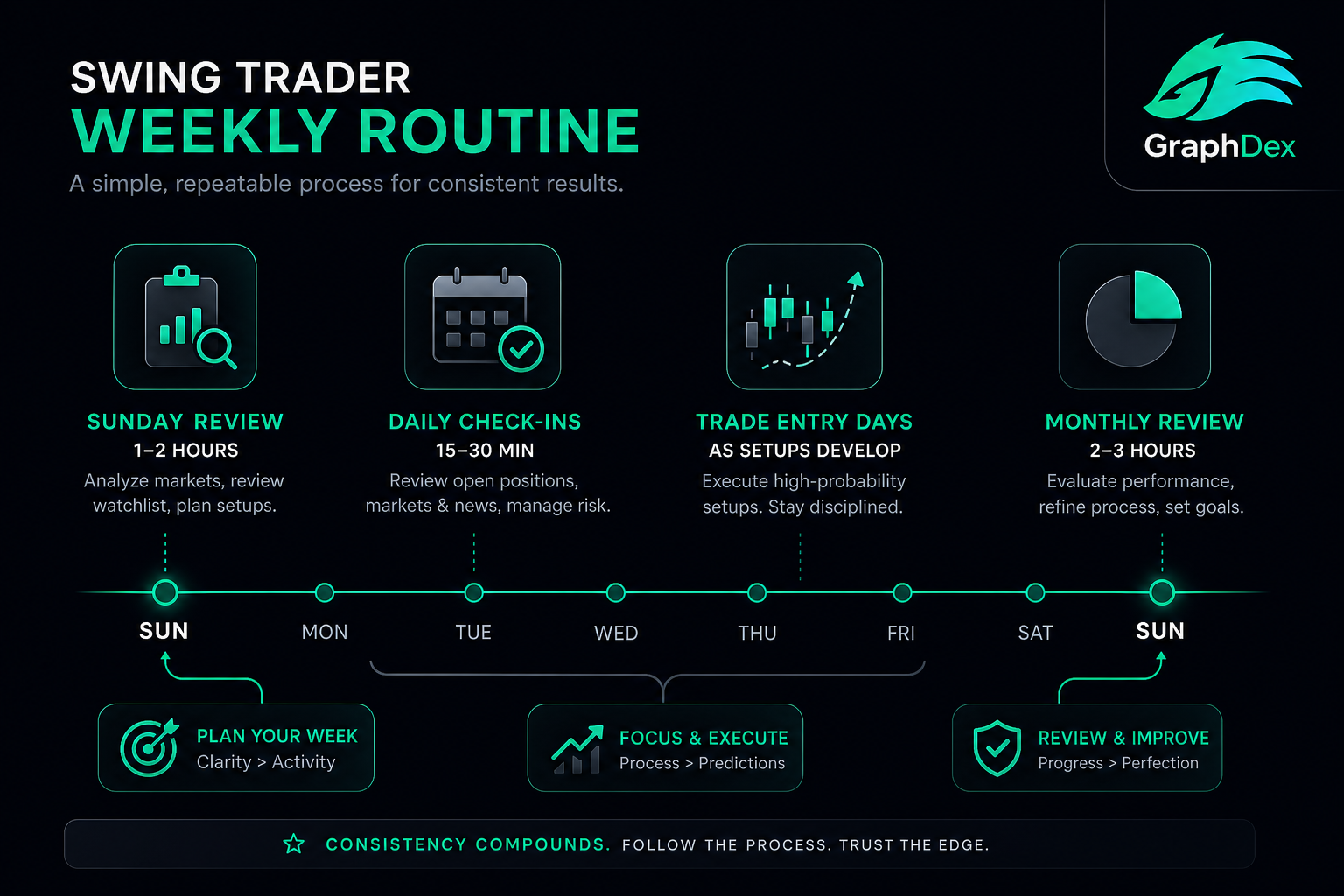
The Swing Trader's Weekly Routine
Successful swing traders treat trading as a structured weekly activity.
Weekly Review (Once per week, often Sundays)
- Higher timeframe chart analysis (daily, weekly) on watchlist
- Identify potential setups developing
- Mark key levels (support, resistance, moving averages)
- Note upcoming news/events that might impact positions
- Set price alerts for key levels
- Review previous week's trades
Daily Check-Ins (15-30 minutes)
- Review active positions: any approaching targets or stops?
- Check overnight price action
- Scan watchlist for setup triggers
- Read major crypto news headlines
- Manage active positions (move stops, take partial profits)
Trade Entry Days (As Setups Develop)
- Execute predetermined plan when setups trigger
- Document trade reasoning before entry
- Confirm risk-reward and position sizing
- Set stop loss and initial take-profit orders
Monthly Review
- Calculate monthly performance
- Identify which strategies worked, which didn't
- Review trade journal for patterns
- Adjust approach based on data
- Plan next month's focus areas
This routine fits comfortably alongside full-time work or other responsibilities — one of swing trading's biggest advantages.
How Much Capital Do You Need to Swing Trade?
Realistic expectations by capital level:
$500-$1,000: Viable for learning. Position sizes small but meaningful percentages. Fees don't dominate if on low-fee venue like Solana.
$1,000-$5,000: Solid starting range. Can risk $10-100 per trade. Real learning environment without catastrophic stakes.
$5,000-$25,000: Comfortable zone. Position sizes flexible, can hold 3-5 positions, drawdowns manageable.
$25,000-$100,000: Strong account. Multiple strategy diversification, sustainable income potential alongside other work.
$100,000+: Approaches professional levels. Can support significant lifestyle alongside other income sources.
Key advantage over day trading: Swing trading works at smaller capital sizes than day trading because position sizes can be larger (relative to capital) and fee impact is lower (fewer trades).
Common Swing Trading Mistakes
For balance, what destroys swing traders:
1. Stops too tight. Treating crypto like stocks. Crypto volatility requires wider stops. Tight stops get hit by noise.
2. Holding through invalidation. When your thesis is broken, exit. Hope is not a strategy.
3. Moving stops away. "Just a little more room" — destroys swing traders just like day traders.
4. No clear exit plan. Knowing your stop but not your target. Winners get cut short because of no target plan.
5. Trading every "setup." Selectivity matters. Best swing traders take 1-3 trades per week, not 1-3 daily.
6. Ignoring overnight risk. Weekend gaps, exchange issues, news events can hit positions hard. Position size appropriately.
7. Overtrading. Swing trading isn't day trading. Resist the urge to constantly add positions.
8. Position size based on emotion. Going bigger when "feeling lucky"; smaller when scared. Risk should be consistent.
9. Fighting the higher timeframe. A bullish swing setup against a clear weekly downtrend has poor odds.
10. No journaling. As with all trading styles — can't improve without measurement.
11. Comparing to day trader returns. Swing trading is slower per trade but more sustainable. Different game.
12. Pulling out before completion. Many traders exit winners early out of fear, holding losers out of hope. The opposite of profitable.
Swing Trading Crypto: What Assets Work Best
Not all crypto assets work equally well for swing trading.
Best for Swing Trading
Bitcoin (BTC): The original. Deep liquidity, clear trends, broad institutional involvement. Reliable patterns.
Ethereum (ETH): Similar to BTC in trader behavior. Deep liquidity. Often correlates with broader DeFi sentiment.
Solana (SOL): Volatile but with deep liquidity ($650B+ stablecoin volume in Feb 2026). Clear technicals.
Major Altcoins (BNB, XRP, AVAX, DOT, MATIC): Liquid enough for swing positions. Clean technical patterns.
Layer 2 tokens (ARB, OP, MATIC): Growing ecosystem with clear technical setups.
Less Suitable
Small-cap memecoins: Too volatile for swing trading typically. Move 50% intraday on no news. Better for day trading or sniping.
Newly launched tokens: Insufficient history for reliable technical setups. Bonding curve mechanics on Pump.fun favor different strategies.
Illiquid alts: Wide spreads, manipulation potential, unreliable patterns.
Stablecoins: Range-bound by design. Better for yield strategies than swing trading.
Sector Considerations
Crypto sectors often move together. Watch:
- L1 chains often correlate (BTC, ETH, SOL, AVAX)
- DeFi tokens correlate with TVL and yield trends
- Memecoin season affects all major memecoins simultaneously
- AI tokens correlate with broader AI narrative cycles
Diversifying across sectors reduces correlated risk.
Swing trade Solana majors and altcoins on GraphDex
Swing trade Solana with integrated charts on GraphDex
Why Swing Trade on Solana?
While swing trading works on any chain, Solana has advantages:
Sub-cent fees mean position adjustments (partial exits, stop adjustments) don't erode profits. Active position management is essentially free.
Deep liquidity on major pairs supports swing position sizes ($100-$10,000+ positions execute cleanly).
Strong technical clarity — major Solana assets show clean technical patterns.
MEV protection prevents sandwich attacks on entries and exits — meaningful on larger swing positions.
Active ecosystem generates regular new opportunities (memecoins, AI projects, DeFi protocols).
For Solana-focused swing traders, the integrated terminal approach (GraphDex) consolidates the tools that traditionally require multiple platforms — making weekly chart review, position management, and execution all happen in one place.
How GraphDex Supports Swing Trading
For active Solana swing traders:
- Multi-timeframe charts for weekly analysis (4-hour, daily, weekly views)
- Volume integration confirming swing setups
- Bubble Maps combining technical analysis with on-chain holder data
- Pulse feed surfacing swing-worthy new tokens
- AI signals identifying high-probability multi-day setups
- MEV protection on swing entries and exits
- Wallet/social tracking following successful swing traders
- Fee-based 17% APY staking on idle capital between trades
- Non-custodial Privy wallet — sign in with Twitter, email, or Telegram
For swing traders, the integrated approach means you don't need 5 separate tabs for charting, analysis, execution, and yield. Everything lives in one workflow — saving the time that swing trading is supposed to save.
Realistic Expectations for Swing Trading
For honesty about outcomes:
Year 1: Possible breakeven or small profit if disciplined. Lower failure rate than day trading (perhaps 50-70% lose money vs 70-90%). Focus on system development.
Year 2: Consistent profitability achievable for the dedicated. Returns of 20-50% annually realistic.
Year 3+: Established edge for the survivors. Returns of 30-80% annually achievable. Better risk-adjusted returns than most other active styles.
The 20-40% who succeed long-term share traits:
- Strict adherence to defined systems
- Weekly journaling and review
- Patience to skip mediocre setups
- Risk management discipline
- Realistic expectations
- Often combine with other income sources
What doesn't work:
- Trading random setups without systems
- Overtrading (too many positions)
- Excessive screen time (swing trading rewards patience)
- Tight stops on volatile crypto
- High leverage (defeats swing trading purpose)
- Comparing to day trader/scalper returns
Frequently Asked Questions
What is swing trading in crypto? Swing trading is holding positions for days to weeks to capture multi-day price movements within larger trends. Swing traders typically hold 1-5 positions at a time, make new entries 1-3 times per week, and target 10-30% profit per trade. It sits between day trading (intraday) and position trading (months).
Is swing trading better than day trading? For most retail traders, yes. Swing trading has higher win rates (trades have time to develop), lower stress, lower time commitment (30 min-2 hours daily vs 4-6 hours for day trading), and works at smaller capital sizes. The risk-adjusted returns per hour of effort favor swing trading for most people.
How much money do I need to swing trade crypto? Viable starting at $500-$1,000 on low-fee venues like Solana. Comfortable at $5,000-$25,000. The key advantage over day trading: smaller capital sizes work because position sizes are larger relative to capital (longer holding periods justify larger positions per trade) and fewer trades mean less fee erosion.
What's the best timeframe for swing trading? Primary analysis on daily and 4-hour charts; weekly for major context. Some swing traders use 1-hour charts for entry timing but make decisions based on higher timeframes. The principle: higher timeframes generate fewer but more reliable signals — perfect for swing trading's longer holding periods.
Can I swing trade with a full-time job? Yes — swing trading is the most job-compatible active style. Required time: 30 minutes to 2 hours daily, with most analysis happening on weekends or evenings. You can review charts before work, set alerts for setups, execute trades during breaks or after hours. This is why most successful retail crypto traders are swing traders.
What's the best crypto for swing trading? Major liquid assets work best: Bitcoin (BTC), Ethereum (ETH), Solana (SOL). Deep liquidity, reliable patterns, broad participation. Major altcoins (BNB, XRP, AVAX) work well. Avoid small-cap memecoins for swing trading — too volatile, manipulation-prone, short lifespans. Layer 2 tokens (ARB, OP) increasingly viable.
How do I avoid losing money swing trading? Improve odds significantly with: (1) Strict 1-2% maximum risk per trade; (2) Wide stops respecting crypto volatility (5-10% typical); (3) Risk-reward minimum 2:1; (4) Patience to skip mediocre setups; (5) Weekly journaling; (6) Strict adherence to systems; (7) Realistic expectations. With discipline, swing trading has the highest retail success rate of any active style.
About This Guide
This guide is published by the GraphDex Research team — analysts and traders building the infrastructure for digital asset trading on Solana. Our content is based on direct trading experience, current market data, and observation of successful swing trading practices.
Sources & data: Trading style descriptions reflect typical swing trading practices in 2026. Swing trading carries substantial risk including total loss of capital. This guide is educational and not financial advice.
GraphDex is the infrastructure for digital asset trading — trade, predict, and earn in one place. Learn more at graphdex.io.
Last reviewed: May 2026 · GraphDex Research
The infrastructure for digital asset trading. Trade, predict, stake, repeat. graphdex.io