Quick Answer
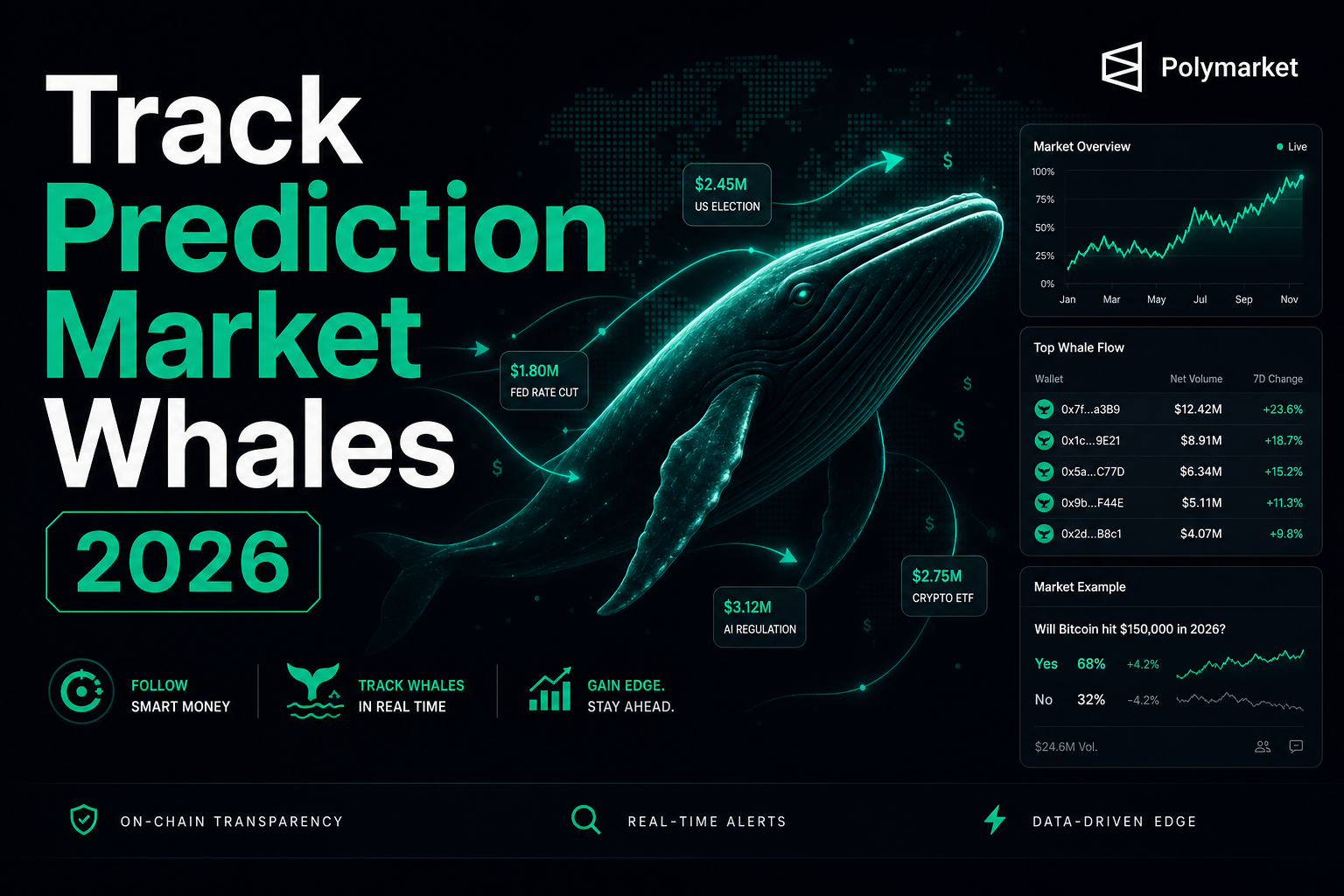
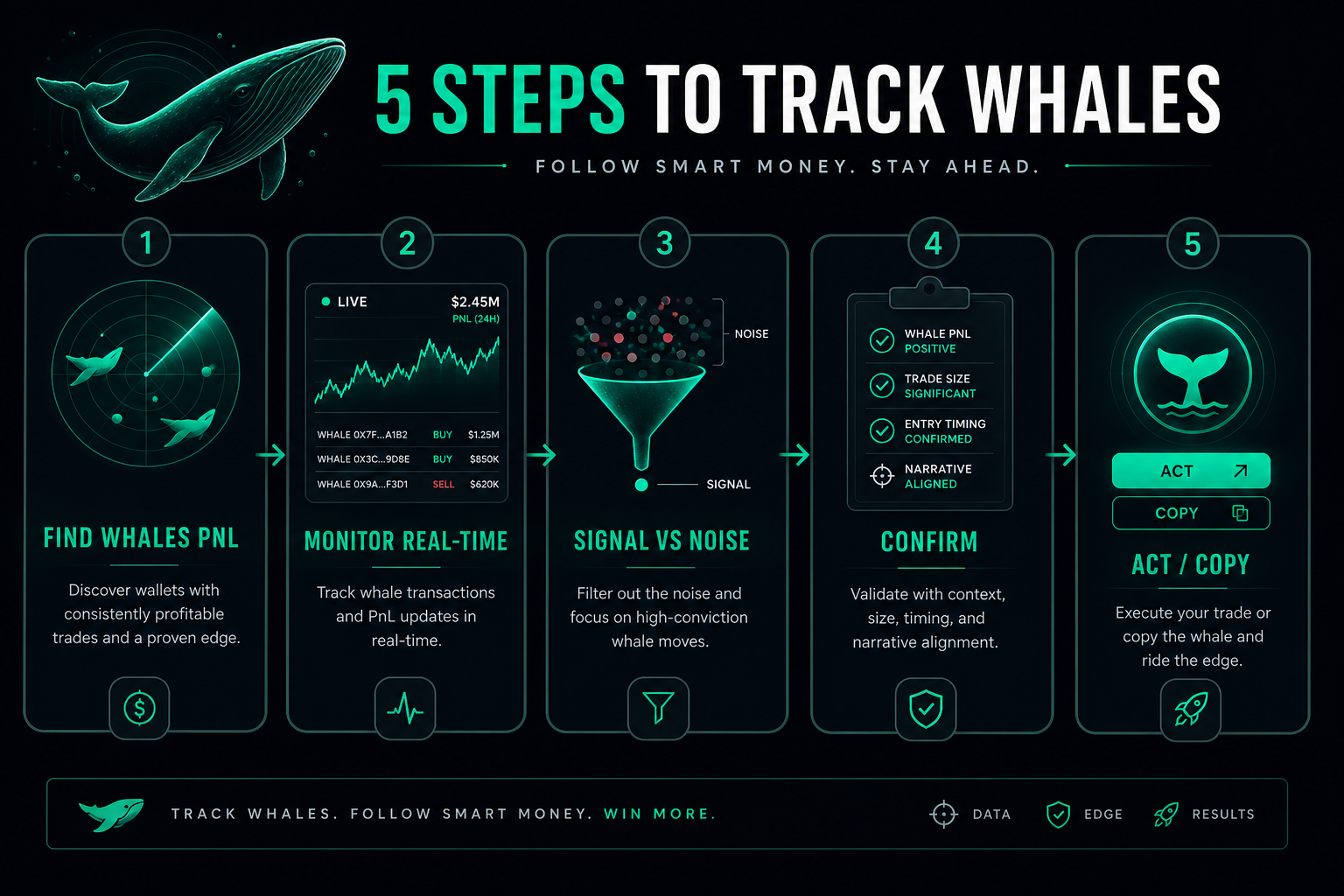
To track prediction market whales in 2026:
- Identify high-conviction wallets — traders with strong PnL and large, consistent positions
- Monitor large trades in real time — whale-sized bets often precede probability moves
- Distinguish signal from noise — not every large trade is informed
- Confirm before following — check the trader's track record, not just trade size
- Use copytrading to act automatically — mirror proven whales within your risk limits
GraphDex integrates whale tracking with copytrading, so you can follow top forecasters and mirror their positions in one terminal.
Track and copy prediction market whales on GraphDex
What Is a Prediction Market Whale?
A prediction market whale is a trader who places large, high-conviction positions — often large enough to move a market's probability. On Polymarket and similar platforms, these traders frequently have access to better information, sharper analysis, or both.
Because every trade on a decentralized prediction market like Polymarket is recorded on-chain, whale activity is publicly visible. The challenge isn't access to the data — it's filtering the meaningful moves from the noise across thousands of markets and millions of transactions.
Whales matter because their behavior often precedes probability shifts. When a trader with a strong track record places a significant bet on an outcome, it's a signal worth investigating — they may be acting on information the broader market hasn't priced yet.
Why Track Prediction Market Whales?
Tracking whales gives you several advantages:
Early signal on probability shifts. Large, informed bets often move markets. Seeing them as they happen — rather than after the price has already adjusted — gives you time to act.
Learning from proven traders. Watching how successful whales position, size, and exit teaches you how skilled prediction market traders operate. Their actions reveal strategy more honestly than any explanation.
Identifying informed money. Some whales consistently profit because they have genuine edge — information networks, analytical skill, or domain expertise. Following them is following that edge.
Catching narratives early. When multiple whales position the same direction on related markets, it can signal a developing narrative before it becomes obvious to the broader market.
Users want insights into who is moving markets, where large bets are flowing, and which narratives are gaining momentum early. Whale tracking provides exactly that.
How to Track Prediction Market Whales: Step by Step
Step 1: Find Whales Worth Following
Not every large trader is worth tracking. Focus on whales with:
- Strong, consistent PnL over many resolved markets — not one lucky win
- High win rate relative to the probabilities they trade at
- Meaningful position sizes that reflect genuine conviction
- Specialization in categories where they demonstrate repeated edge
A whale who consistently profits on crypto markets is a more useful signal in crypto markets than a generalist who occasionally wins.
Step 2: Monitor Their Activity in Real Time
Once you've identified whales worth tracking, monitor their moves. The key is real-time alerts — by the time a whale's move is widely visible, the probability may have already shifted. Speed matters.
Step 3: Distinguish Signal from Noise
Not every whale trade is informed. Some large trades are hedges, position adjustments, or simply wrong. Look for:
- Conviction signals — large positions taken decisively, not gradually accumulated
- Pattern breaks — when a whale who normally trades cautiously suddenly goes big
- Confluence — multiple tracked whales moving the same direction
Step 4: Confirm Before Acting
A whale's trade is a signal, not a command. Before following, confirm:
- Does the whale have a track record that justifies following?
- Does the trade make sense given what you know about the event?
- Is the market liquid enough to enter and exit cleanly?
Step 5: Act — Manually or via Copytrading
You can act on whale signals manually, or automate it. Copytrading lets you automatically mirror a whale's positions within your own risk parameters — when they open, you open; when they close, you close.
Auto-follow top prediction market whales with GraphDex
Whale Tracking Tools in 2026
Several tools have emerged for tracking prediction market whales:
GraphDex — integrates whale tracking with copytrading. Follow top forecasters by PnL and win rate, then mirror their positions automatically — all within a full Solana trading terminal.
Pariflow — an analytics layer focused specifically on whale activity. Instead of manually monitoring wallets, Telegram groups, or on-chain explorers, users track large trades and market movements in real time through a clean dashboard. Free, with a modern UI.
Stand — a pro terminal offering whale alerts alongside copytrading and multi-venue aggregation.
HashDive — delivers advanced Polymarket analytics with insider detection, tracking potential insider traders based on concentrated bets with unusual size.
The distinction: dedicated analytics tools like Pariflow excel at surfacing whale data, while integrated terminals like GraphDex let you both track and act — following whales with automatic copytrading in the same interface.
The Difference Between Tracking and Copytrading
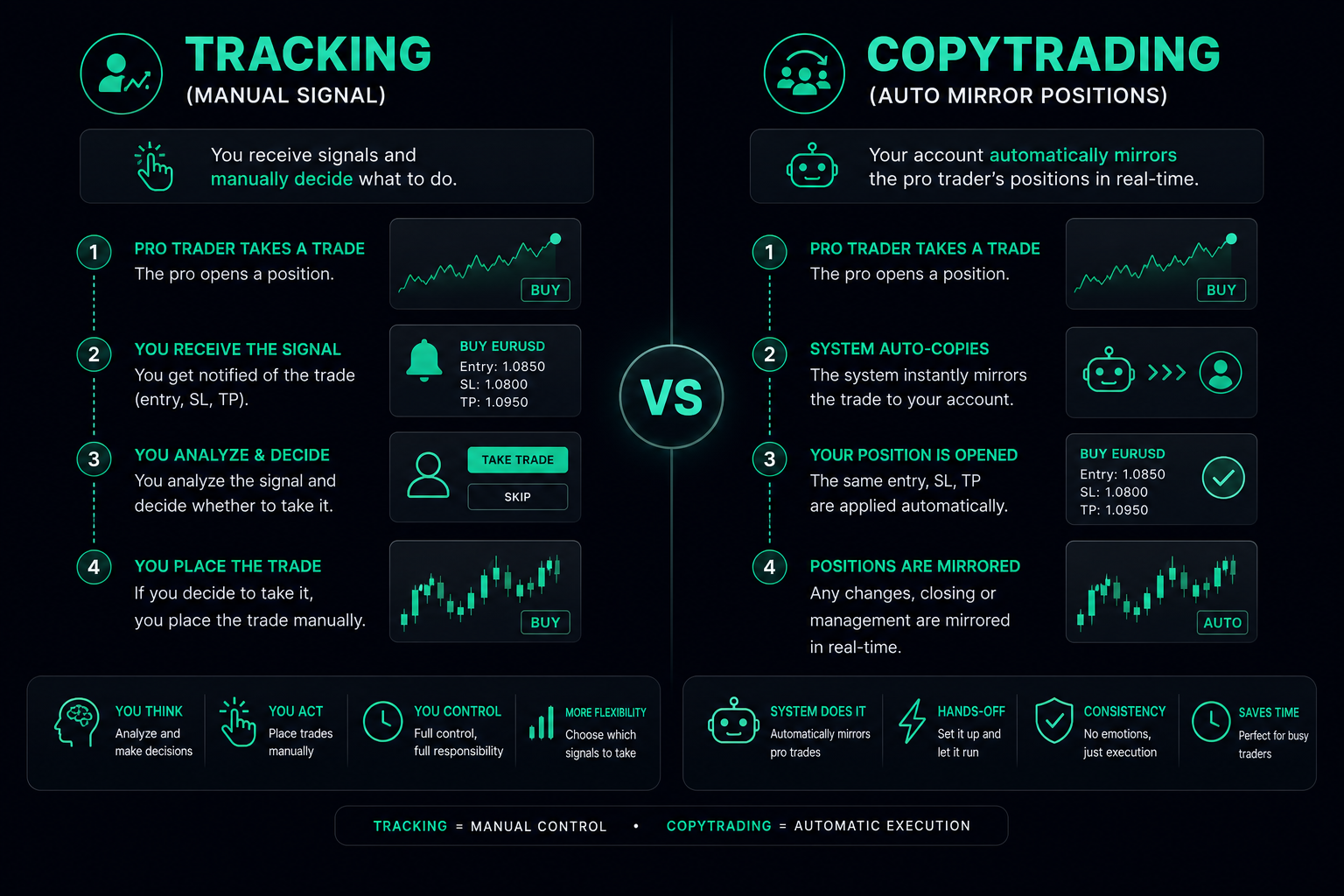
Tracking and copytrading are related but distinct:
Tracking means monitoring whale activity and deciding for yourself whether and how to act. You see the signal, then make your own decision. This gives you full control but requires constant attention and fast manual execution.
Copytrading means automatically mirroring a whale's positions. When they trade, you trade — proportionally, within your risk limits. This removes the need for constant monitoring and ensures you don't miss moves, but you cede some discretion to the followed trader.
Most sophisticated traders use both: tracking to understand the landscape and identify which whales are worth following, then copytrading to automatically capture the moves of the whales they trust most.
GraphDex supports both. You can track whale activity to inform your own decisions, and copytrade the forecasters whose track records justify automatic following.
Track and copytrade in one terminal on GraphDex
Avoiding Whale Tracking Mistakes
Following size over track record. A large trade isn't automatically a smart trade. Whales make mistakes too. Follow proven track records, not just position size.
Acting too slowly. Whale alpha decays. By the time a move is widely visible, the edge may be gone. Real-time alerts and fast execution matter.
Ignoring the decay. The more popular a whale becomes, the more people copy them, and the faster their edge erodes as their moves get priced in instantly.
Over-following. Tracking too many whales generates noise. Curate a small set of genuinely skilled traders rather than following everyone with a big balance.
Skipping confirmation. A whale entering a market with poor liquidity or ambiguous resolution criteria can still be a trap. Confirm the trade makes sense before following.
Combining Whale Tracking with Other Signals
Whale tracking is most powerful combined with other signals. On GraphDex, whale activity sits alongside the full toolkit:
Whale tracking + Bubbles screener — when a whale bets big on a market that's also showing strong momentum on the Bubbles visual screener, the confluence strengthens the signal.
Whale tracking + copytrading — identify a skilled whale through tracking, then copytrade them automatically once they've proven worth following.
Whale tracking + crypto signals — for crypto prediction markets, GraphDex's broader AI signal layer and Solana wallet tracking can corroborate a whale's prediction market bet with on-chain activity.
This integration is the advantage of an all-in-one terminal. A whale's bet alone is one data point. The same bet confirmed by momentum, on-chain activity, and a strong track record is conviction.
Reading Whale Behavior: What the Patterns Mean
Tracking whales is more than watching big numbers. The patterns in how whales trade reveal what they're thinking.
Accumulation vs. single bets. A whale gradually building a position over time signals growing conviction as they gather information. A single large bet signals high conviction on a specific catalyst. Both matter, but they tell different stories.
Entry timing. Whales who enter early — when a market first opens or when an outcome is still uncertain — are often the most informed. Late entries, after the probability has already moved, carry less signal.
Exit behavior. How a whale exits is as informative as how they enter. A whale taking profit gradually as probability rises is managing risk like a professional. A sudden full exit can signal new information or a change of view.
Counter-consensus positions. When a skilled whale bets against the market's current probability — buying an outcome the crowd thinks is unlikely — it's a strong signal. They're betting they know something the market doesn't. These contrarian whale positions are often the most profitable to follow when the whale has a proven track record.
Cross-market patterns. When a whale positions across several related markets simultaneously, they may be expressing a broader thesis. Recognizing the thesis behind the individual trades reveals more than any single position.
Building a Whale Watchlist Strategy
The most effective whale trackers treat it as a curated, ongoing process rather than a reactive scramble.
Start with the leaderboard. Identify the traders with the strongest verified track records. GraphDex ranks forecasters by PnL, win rate, and volume — a starting point for who deserves watching.
Categorize by specialty. A whale with edge in political markets isn't necessarily skilled in crypto markets. Group your watchlist by the categories each whale excels in.
Prune regularly. Track records change. A whale who was profitable last quarter may have lost their edge. Review your watchlist periodically and remove whales whose performance has declined.
Weight by conviction. Not all followed whales deserve equal weight. Allocate more attention — and more copytrading capital — to the whales with the longest, most consistent track records.
Combine with automation. Use tracking to understand and curate, then use copytrading to automatically capture the moves of your highest-conviction whales without missing them.
Build your whale watchlist on GraphDex
Frequently Asked Questions
What is a prediction market whale? A prediction market whale is a trader who places large, high-conviction positions — often large enough to move a market's probability. They frequently have better information or analysis, so tracking their moves can reveal where informed money is flowing.
How do I track whales on Polymarket? Every Polymarket trade is recorded on-chain and publicly visible. Use a tool that filters meaningful whale activity from noise. GraphDex integrates whale tracking with copytrading; Pariflow and Stand are dedicated analytics options.
Can I automatically copy prediction market whales? Yes. Copytrading lets you automatically mirror a whale's positions within your risk limits. GraphDex offers copytrading for prediction markets — follow top forecasters by PnL and win rate and mirror them automatically.
Is whale tracking legal? Yes. On decentralized prediction markets, all trades are public on-chain. Whale tracking analyzes publicly available data. It is not insider information — it's public information made accessible through better tools.
How fast do I need to act on whale signals? Quickly. Whale alpha decays as more traders see the same move and the probability adjusts. Real-time alerts and fast execution — or automatic copytrading — preserve more of the edge.
What's the difference between tracking and copytrading whales? Tracking means monitoring whale activity and deciding yourself whether to act. Copytrading means automatically mirroring their positions. Many traders use tracking to identify which whales to follow, then copytrade the best ones.
Which tool is best for tracking prediction market whales? It depends on your needs. GraphDex integrates whale tracking with copytrading and Solana trading. Pariflow is a strong free analytics layer. Stand offers whale alerts in a pro terminal. HashDive specializes in insider detection.
The infrastructure for digital asset trading. Trade, predict, stake, repeat. graphdex.io