By GraphDex Research · Reviewed for accuracy May 2026
Quick Answer
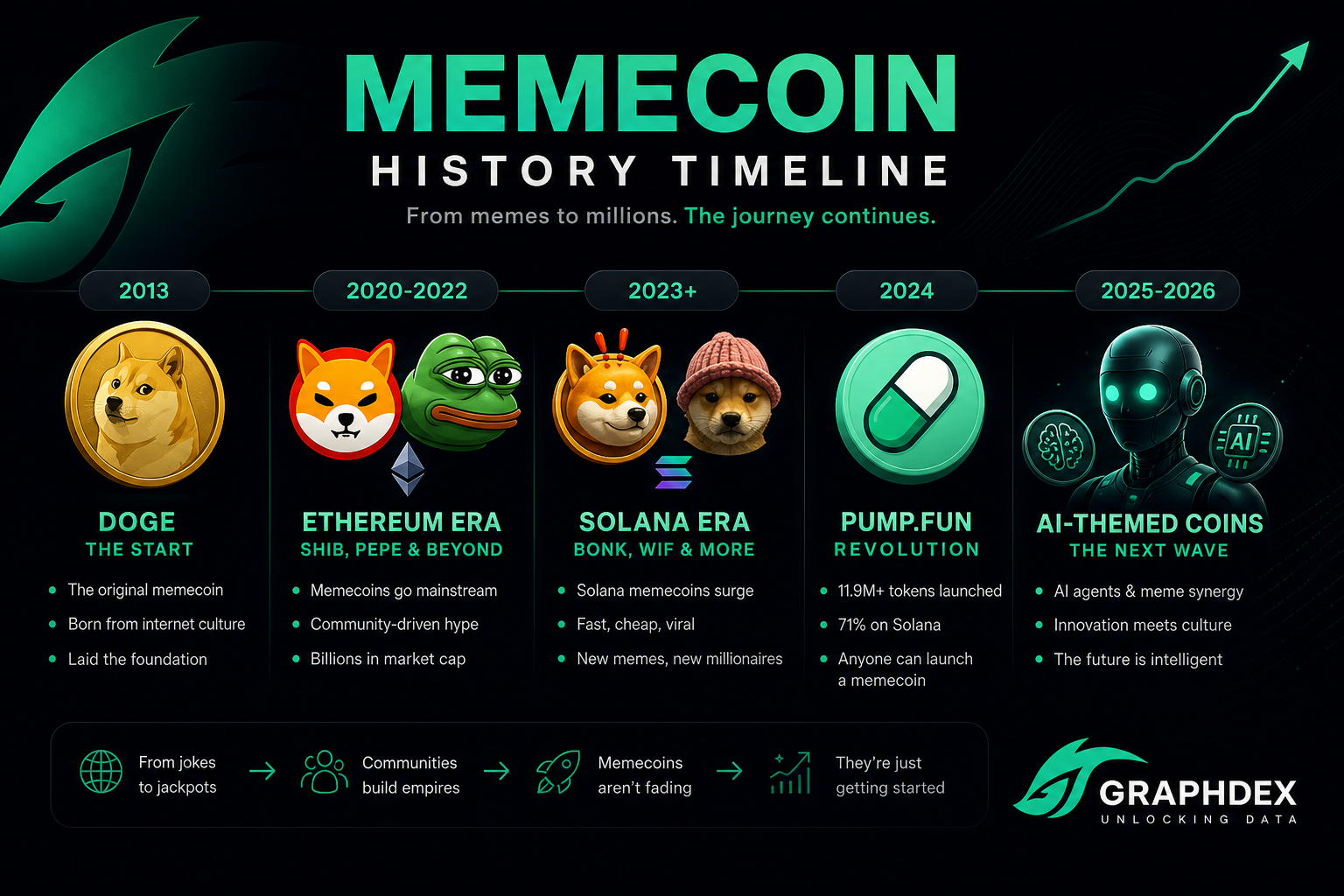
Memecoins are cryptocurrencies inspired by internet jokes, viral culture, or community in-jokes — typically with no formal utility beyond community and speculation. Key facts in 2026:
- Origins: Dogecoin (2013) was the first — a literal joke that reached multi-billion-dollar valuation
- Solana dominance: Pump.fun launchpad has accounted for up to 71% of all tokens minted on Solana and 40-67% of DEX transactions
- Brutal reality: Fewer than 2% of memecoins successfully graduate to major DEXs; most go to zero
- Top Solana memecoins (2026): BONK, WIF, MEW, PONKE, FARTCOIN, plus new AI-themed coins
- Why Solana: Sub-cent fees, sub-second finality, and Pump.fun's one-click launches make Solana the home of memecoin culture
Memecoins can make life-changing returns or wipe out capital in minutes. Trade with tools and discipline, not hope.
Trade memecoins safer with Bubble Maps on GraphDex
Key Takeaways
- Memecoins are tokens inspired by internet culture, jokes, or community — typically without formal utility.
- Solana hosts the most active memecoin ecosystem in 2026 via Pump.fun, with 11.9M+ tokens launched.
- Only about 1-2% of memecoins ever graduate to major DEXs; most fade or are dumped.
- Tools like Bubble Maps and Pulse feeds help traders identify and evaluate launches before buying.
What Are Memecoins?
Memecoins are cryptocurrencies created around internet memes, viral cultural moments, jokes, celebrities, or community in-jokes. Unlike traditional crypto projects with whitepapers, technology pitches, and roadmaps, memecoins are typically built around vibes, virality, and community rather than utility.
The defining example is Dogecoin (DOGE), launched in 2013 as a literal joke by software engineers parodying crypto speculation. Nobody took it seriously at first, but the joke persisted, the community formed, and DOGE eventually reached multi-billion-dollar valuation. That trajectory — from joke to massive market cap purely through community and culture — defines the memecoin phenomenon.
Memecoins matter because they reveal something genuine about crypto markets: value can be built on attention, community, and shared narrative rather than technical fundamentals. Whether you view this as a feature (markets discovering new forms of value) or a bug (irrational speculation), it's real and it moves billions of dollars.
In 2026, memecoins are one of crypto's most active sectors. Solana hosts the most extensive memecoin ecosystem, driven by Pump.fun's one-click token creation and the chain's near-zero fees that make active trading economically viable. The sector spans:
- Legacy giants: DOGE, SHIB, PEPE — established memecoins with deep liquidity
- Solana stars: BONK (Solana's "dog coin"), WIF (Dogwifhat), MEW, PONKE
- AI-themed coins: FARTCOIN (parody AI token from Pump.fun and Truth Terminal), AI agent tokens
- Political memes: Election-cycle tokens, country-themed coins
- Cultural moments: CHILLGUY (relaxed character), and countless others tied to viral memes
The line between "memecoin" and "legitimate project" has blurred — some memecoins now build DEXs, fund community projects, or integrate with broader DeFi. Most still carry significant risk and depend heavily on community support for value.
A Brief History of Memecoins
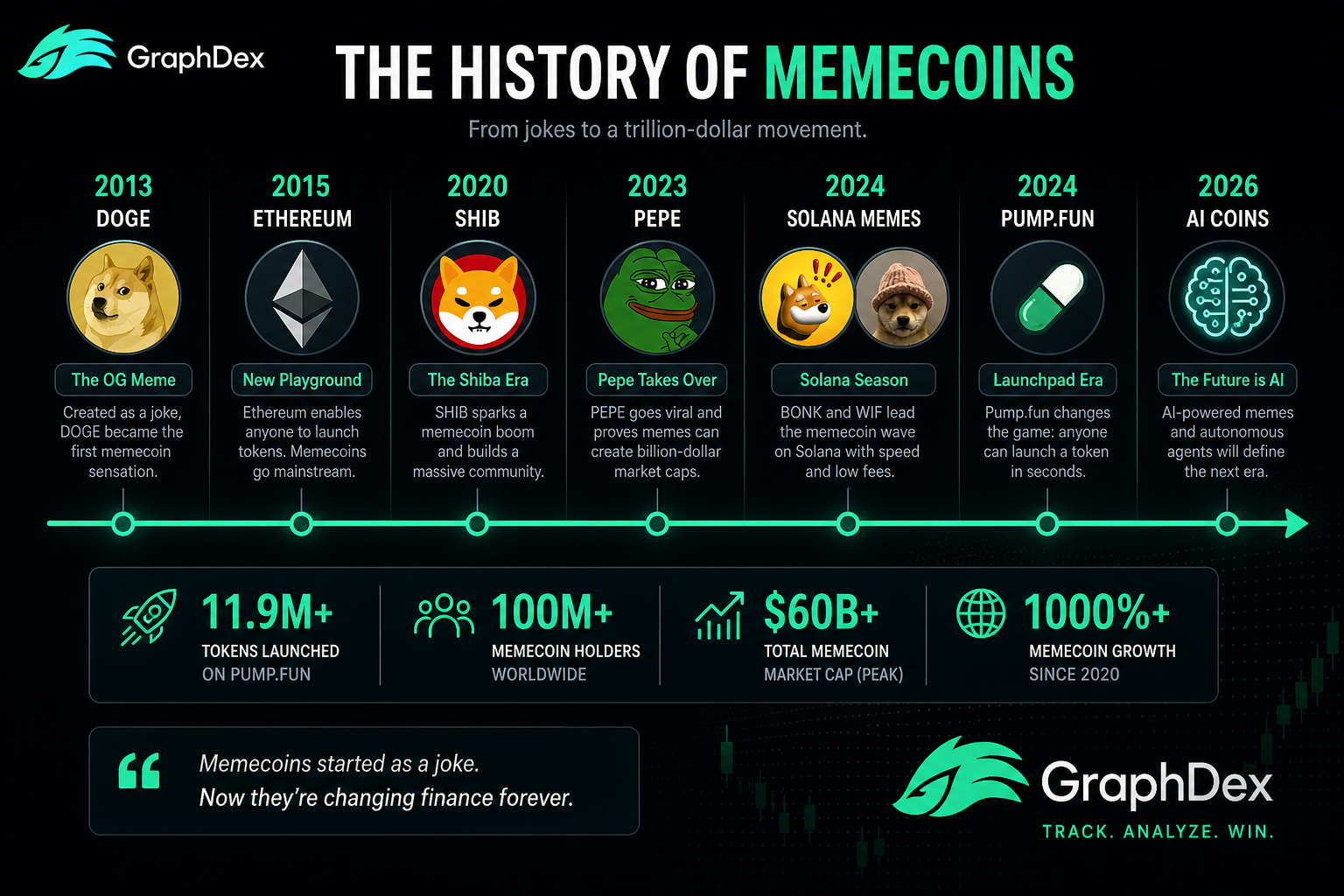
Memecoins have evolved through distinct eras, each defined by a dominant chain and platform.
The Dogecoin era (2013-2020). DOGE created the template — a joke coin that became a serious community asset. For years, it stood largely alone in the memecoin category, holding meaningful market cap through community and Elon Musk's occasional endorsements.
The Ethereum memecoin explosion (2020-2022). Shiba Inu (SHIB) launched in 2020, marketed as "the Dogecoin killer." It captured the imagination of retail investors and reached massive valuations. Other Ethereum memecoins (FLOKI, PEPE) followed. The bottleneck: Ethereum gas fees of $5-50+ per trade made micro-cap memecoin trading uneconomical for small accounts.
The Solana memecoin era (2023-present). Solana's low fees and high speed enabled an entirely new model: rapid-fire memecoin launches and trading. BONK launched in late 2022, signaling Solana's potential. WIF (Dogwifhat) launched in late 2023 and became iconic. By 2024, Solana was the clear home of new memecoin activity.
The Pump.fun revolution (January 2024 - present). Pump.fun made memecoin creation trivial — name, ticker, image, and $2 in fees. Anyone could launch a token in 60 seconds. Academic research found Pump.fun accounted for up to 71.1% of all tokens minted on Solana and 40-67.4% of total DEX transactions during certain periods. This democratized memecoin creation in a way no platform had before.
The 2025-2026 evolution. AI-themed coins (FARTCOIN became a viral hit), agentic AI tokens (interactive AI personalities tied to tokens), political memecoins, and celebrity-launched tokens all expanded the category. The sector has matured in some ways (better tools, more sophisticated traders) while remaining fundamentally chaotic.
Why Solana Dominates Memecoins in 2026
Solana's lead in memecoins isn't accidental — it's the result of specific architectural and ecosystem advantages.
Technical capabilities. Solana processes 1,000-4,000+ TPS in real-world conditions with sub-second finality. When a memecoin pumps and thousands of trades hit simultaneously, Solana handles the load. Ethereum L1 buckles; Solana keeps moving.
Near-zero fees. Solana transactions cost a fraction of a cent (median $0.0038). A $10 trade on Ethereum L1 might cost $15 in gas — making small memecoin trades uneconomical. The same trade on Solana costs essentially nothing. This economic asymmetry is the foundational reason Solana dominates active trading.
Pump.fun ecosystem. Pump.fun's one-click token creation removed the technical barriers to launching a memecoin. Combined with its bonding curve (fair launch pricing) and PumpSwap (graduated tokens migrate here), the platform created a complete launch-and-trade infrastructure.
SPL token standard. Solana's token standard is fast and cheap to deploy. Developers can create new tokens in minutes using platforms like Pump.fun or LetsBONK.fun with no coding required.
Active culture and tooling. Solana has the largest community of memecoin traders, sophisticated tooling (terminals, screeners, copytrading platforms), and viral marketing infrastructure. The whole ecosystem is optimized for fast, cultural-momentum trading.
Recent stress tests. During the October 10, 2025 crash — the largest crypto liquidation event on record at the time — Solana stayed operational with median fees rising only to $0.007, while Ethereum and Arbitrum spiked to $100. Reliability under stress matters for the chaotic conditions memecoin trading creates.
The combined effect: when traders want to chase the next viral coin, Solana is where it happens.
How Memecoins Work Technically
While the cultural side gets the attention, the technical side is straightforward:
Token creation. Memecoins are typically SPL tokens (Solana) or ERC-20 tokens (Ethereum) — standardized fungible token contracts. Creation requires deploying a smart contract with basic parameters (name, symbol, supply, decimals).
No-code launches. Pump.fun, LetsBONK.fun, and similar Solana platforms provide no-code interfaces — you choose a name, ticker, upload an image, and the token deploys automatically. No technical skills required, and the cost is around $2.
Bonding curve pricing (Pump.fun). On Pump.fun, new tokens use a bonding curve where price rises automatically as people buy. Early buyers get lower prices; large purchases push prices up the curve. No traditional liquidity pool seeding required.
Graduation. When a Pump.fun token reaches roughly $69,000 in market cap, liquidity migrates to PumpSwap and LP tokens are burned. The token becomes tradeable on Raydium and other Solana DEXs like any standard SPL token. Crucially, only about 1-2% of tokens graduate; the rest fade.
Trading. Memecoins trade against SOL or USDC on Solana DEXs (Raydium, Orca, Meteora, PumpSwap) using AMM liquidity pools. Once graduated, they're available on aggregators like Jupiter for best-price routing.
The Top Solana Memecoins in 2026
Several Solana memecoins have established themselves with significant market caps and active communities. (Note: this is descriptive, not investment advice — memecoin prices and rankings change rapidly.)
BONK ($BONK). Solana's first major dog-themed memecoin, often called "the Dogecoin of Solana." Strong ecosystem integrations and community loyalty have given BONK staying power.
Dogwifhat ($WIF). Launched in late 2023, WIF became iconic — a literal dog wearing a hat. Volume hit $1B+ in 24 hours during the early January 2026 meme rally, a 48% jump. WIF is one of the highest-beta attention plays in the sector.
MEW. Cat-themed memecoin that gained significant traction in 2024-2025.
PONKE. Pepe-themed monkey memecoin that reached an all-time high of $0.7098 in July 2024. Listed on major exchanges including Crypto.com, KuCoin, Bybit, and Revolut.
FARTCOIN ($FARTCOIN). AI-inspired parody token that exploded on viral trends in late 2025-early 2026. Started on Pump.fun and grew through internet memes, helped by Truth Terminal references.
CHILLGUY. Based on the relaxed dog-in-hoodie meme, representing the antithesis to crypto's frenetic pace. A symbolic 2024-2025 token.
AI agent tokens. The 2025-2026 wave includes interactive, living AI personalities tied to tokens — a step beyond static-image memecoins, integrating LLM-powered "characters" with token economies.
The pattern: top memecoins have strong communities, viral imagery, sustained narrative power, and (often) integration with broader Solana culture or DeFi. The thousands of other Pump.fun launches typically fade within hours or days.
The Risks: Why Most Memecoins Fail
For balance, you must understand why memecoin trading is statistically brutal.
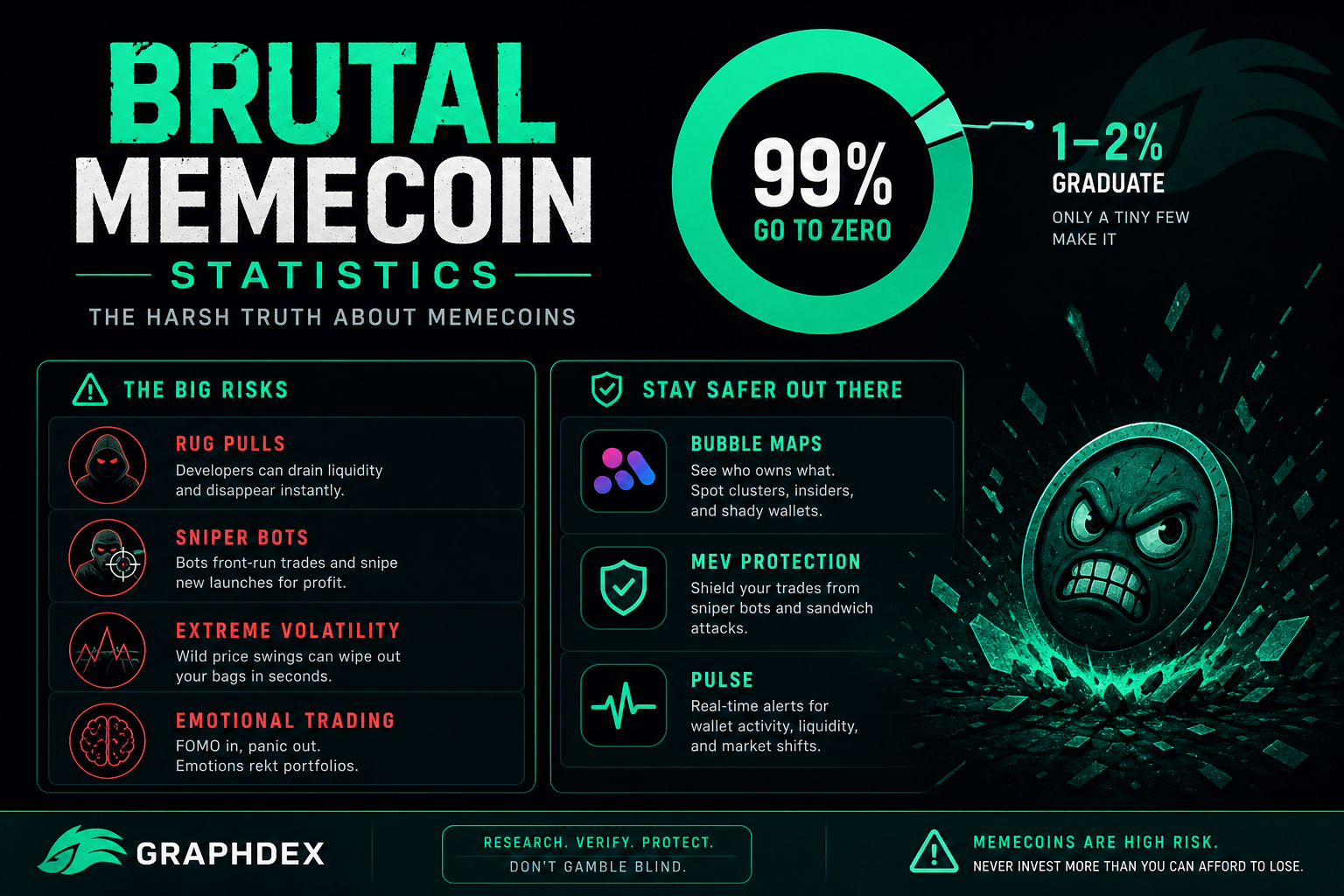
~99% failure rate. Academic research found fewer than 2% of Pump.fun tokens transition to major decentralized exchanges. The vast majority go to zero. For every WIF success story, thousands of tokens fade quietly.
Rug pulls. Despite Pump.fun's fair-launch model, creators can dump their holdings the moment a token gains traction, crashing the price. Honeypots, bundled wallet schemes, and malicious contracts persist across the broader ecosystem.
Sniper bots compete with you. Bots scan new launches in real time and snipe the first transactions. Manual traders typically can't compete on entry prices for very new tokens.
Extreme volatility. Memecoin prices can pump 1000% and then dump 99% within hours. Positions can lose most of their value while you're sleeping.
Emotional and addictive dynamics. The fast-paced, gamified environment encourages impulsive decisions. The dopamine hit of a quick win primes traders for the bigger loss that often follows.
No fundamentals to fall back on. Unlike tokens with actual utility (DeFi, infrastructure, etc.), memecoins have no "fair value" to anchor to. When sentiment shifts, prices have no floor.
Regulatory uncertainty. Memecoins exist in unclear regulatory space. Sudden enforcement actions could affect specific tokens.
The honest truth: memecoin trading is one of the highest-risk activities in crypto. It can produce extraordinary returns, but the statistical reality is brutal. Most casual traders lose money. Those who profit consistently typically combine ruthless risk management with sophisticated tools, fast execution, and willingness to take many small losses to catch occasional large wins.
How to Trade Memecoins Safer
If you choose to trade memecoins, certain practices dramatically improve your odds:
Check on-chain safety before buying. Verify mint authority is revoked, freeze authority is revoked, liquidity is burned or locked, and top holders aren't concentrated. Tools like Bubble Maps reveal bundled wallets that look distributed but are actually controlled by one entity.
Start small and treat it as gambling money. Only invest amounts you can afford to lose entirely. Most memecoins go to zero — your position-sizing must reflect this.
Take profit aggressively. Don't hold for the rare 100x — most positions need profit-taking on the way up. Common rule: take initial out at 2-3x to remove risk, let the rest ride.
Avoid emotional FOMO entries. Buying at the top of a parabolic move is the most common loser pattern. If you missed the early entry, missing the trade entirely often beats buying high.
Use MEV protection. Memecoin trades are prime sandwich-bot targets due to often-high slippage. Built-in MEV protection (like GraphDex provides) prevents this hidden loss.
Use specialized tools. Token discovery feeds (Pulse), Bubble Maps for safety, and integrated execution beat manually navigating Pump.fun, rug checkers, and trading interfaces separately.
Develop a process, not vibes. Random buying based on memes loses money. Process — same checks every time, same position sizing, same exit rules — is the difference between traders who survive and those who don't.
Get integrated discovery, safety, and execution for memecoins on GraphDex
How GraphDex Helps Memecoin Traders
For traders pursuing Solana memecoins, GraphDex consolidates the tools that protect capital and improve execution:
- Pulse feed surfaces new tokens in real time as they're created on Pump.fun and other platforms
- Bubble Maps visualize holder distribution — instantly revealing bundled wallets and concentration before you buy
- MEV protection prevents sandwich bots from exploiting your trades, especially on volatile new tokens
- Smart routing finds best execution across Solana DEXs (Raydium, Orca, Meteora, PumpSwap)
- Copytrading lets you mirror proven memecoin traders ranked by PnL
- Non-custodial via Privy with no seed phrase — sign in with Twitter, email, or Telegram
The integration matters in memecoin trading more than almost anywhere else, because speed and safety analysis happen in milliseconds. Switching between Pump.fun, a separate rug checker, and a trading tool — by the time you've checked safety, the launch you wanted has 100x'd or rugged. Having discovery, safety, and execution in one terminal preserves the speed needed to participate without sacrificing the safety needed to survive.
Combined with prediction markets, copytrading, and staking up to 17% APY on stablecoin/SOL between trades, GraphDex is built for the high-velocity Solana trading reality that memecoins define.
Trade Solana memecoins smarter on GraphDex
Frequently Asked Questions
What is a memecoin in simple terms? A memecoin is a cryptocurrency created around an internet joke, viral meme, or cultural moment — typically without formal utility or technology pitch. Value comes from community, attention, and shared narrative rather than fundamentals. Dogecoin (2013) was the first; today's Solana ecosystem has thousands of memecoins including BONK, WIF, PEPE, and many more.
Are memecoins good investments? Memecoins are extremely high-risk. About 99% of new memecoins go to zero. Some have generated 100x returns for early holders, but most casual traders lose money. They're better understood as speculation or gambling than investing — never invest more than you can afford to lose entirely, and treat any gains as luck-tinged rather than skill-based.
Why are memecoins on Solana so popular in 2026? Solana's near-zero fees (median $0.0038) and sub-second finality make active memecoin trading economically viable in a way Ethereum's $5-50 gas fees don't. Pump.fun's one-click token creation removed launch barriers. Combined with strong community culture and sophisticated tooling, Solana became the natural home for memecoin activity — Pump.fun alone accounted for up to 71% of tokens minted on Solana.
What's the difference between a memecoin and a real cryptocurrency project? Memecoins are built around cultural narrative and community, typically with no formal utility, technology, or roadmap. "Real" projects pitch use cases, technical innovation, and ecosystem development. The line has blurred — some memecoins build DEXs, fund projects, or integrate with DeFi — but most are speculation vehicles tied to attention and narrative.
How do I avoid getting rugged by a memecoin? Check on-chain safety before buying: mint authority should be revoked, freeze authority should be revoked, liquidity should be burned or locked, top holders shouldn't be concentrated (under 30-40% combined), and no bundled wallets (Bubble Maps reveals this). Avoid honeypots with sell tests. Trust ecosystem-integrated tokens with longer track records over brand-new launches.
What is Pump.fun and why does it matter? Pump.fun is a Solana memecoin launchpad launched in January 2024 that lets anyone launch a token in 60 seconds for about $2 using a bonding curve. It has powered 11.9M+ tokens and accounts for up to 71% of all Solana tokens minted in some periods. About 1-2% of tokens "graduate" to PumpSwap when reaching ~$69K market cap; most fade.
How can I trade memecoins more safely? Use a terminal with integrated discovery, safety analysis (Bubble Maps to spot bundled wallets), and MEV protection — not a series of disconnected tools. Start with very small positions. Take profit aggressively. Avoid emotional FOMO entries on parabolic moves. Develop a consistent process: same safety checks every time, same position sizing, same exit rules. GraphDex consolidates these tools for Solana memecoin traders.
About This Guide
This guide is published by the GraphDex Research team — analysts and traders building the infrastructure for digital asset trading on Solana. Our content is based on live market data, current platform statistics, and hands-on experience.
Sources & data: Market statistics, token rankings, and platform details reflect publicly available information as of 2026 and change continuously. Memecoin trading carries extreme risk of total loss. This guide is educational and not financial advice — never invest more than you can afford to lose.
GraphDex is the infrastructure for digital asset trading — trade, predict, and earn in one place. Learn more at graphdex.io.
Last reviewed: May 2026 · GraphDex Research
The infrastructure for digital asset trading. Trade, predict, stake, repeat. graphdex.io