By GraphDex Research · Reviewed for accuracy May 2026
Quick Answer
A crypto airdrop is a free distribution of tokens to wallet addresses, typically used by projects to reward early users, build community, decentralize token supply, or attract attention. Key facts:
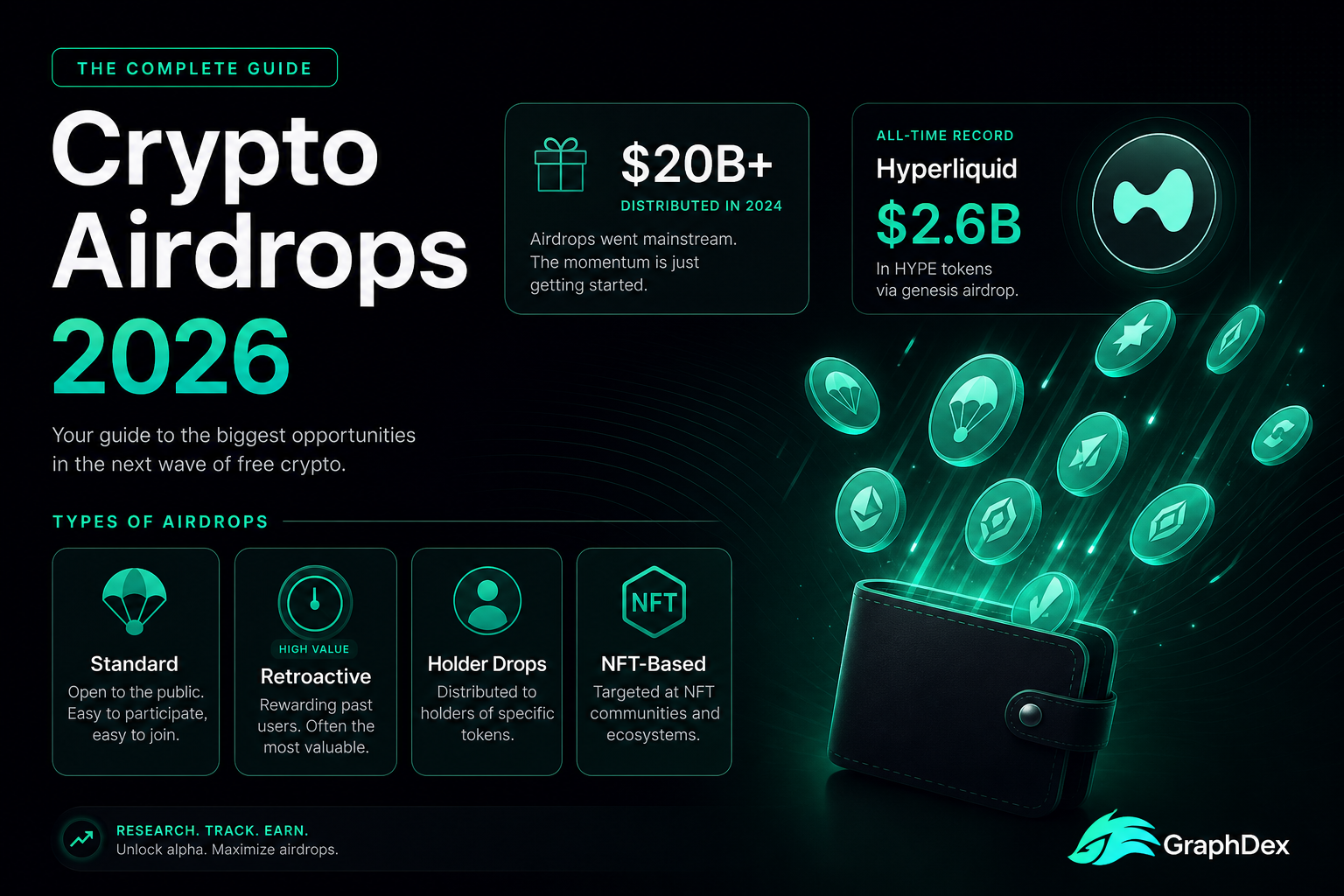
- Scale in 2024: Over $20 billion in tokens distributed via airdrops, with Hyperliquid's $2.6B drop setting a record
- Notable examples: Uniswap UNI ($1,200-$6,000+ per wallet at peak), Jupiter JUP ($200-$2,000+ for active Solana users)
- Four main types: Standard, retroactive, holder drops, NFT-based
- Key requirement: Non-custodial wallets (Phantom, MetaMask) — airdrops typically go to on-chain wallets, not exchanges
- Taxes: In most jurisdictions, airdropped tokens are taxed as ordinary income at fair market value when received
- Critical safety: Legitimate airdrops are FREE — if you're asked to send crypto to "unlock" tokens, it's a scam
For active crypto users, airdrops can be meaningful additional income — but the space is full of scams.
Trade airdrop tokens on Solana via GraphDex
Key Takeaways
- Crypto airdrops distribute free tokens to wallets, often as rewards for early protocol usage.
- Over $20B distributed in 2024 alone — major airdrops can pay $200-$6,000+ per wallet.
- Retroactive airdrops (rewarding past genuine usage) are typically the most valuable type.
- Critical safety rule: legitimate airdrops are 100% free; any "send crypto to unlock" request is a scam.
What Is a Crypto Airdrop?
A cryptocurrency airdrop is a distribution of free tokens or coins to multiple wallet addresses — typically at no cost to recipients. Projects execute airdrops through smart contracts or centralized distribution systems, targeting specific user groups based on criteria like holding particular tokens, completing tasks, or having used a protocol before a snapshot date.
Why projects do this:
- Community building — distributing tokens to potential users to bootstrap a network
- Decentralization — spreading token ownership beyond founders and VCs
- Marketing — generating awareness and discussion ("free tokens" gets attention)
- Rewarding early users — recognizing people who used the protocol before it had a token
- Sybil-resistant distribution — proving usage by requiring on-chain activity
Why this matters in 2026: Airdrops have become a major distribution mechanism in crypto. In 2024 alone, over $20 billion in tokens was distributed via airdrops. Hyperliquid's $2.6 billion airdrop set a record. Earlier Uniswap UNI recipients received tokens worth $1,200-$6,000+ at peak. Jupiter's JUP airdrop rewarded active Solana DEX users with $200-$2,000+ each.
For active crypto users — people regularly using DEXs, bridges, lending protocols, and L2s — airdrops have become a meaningful supplementary income stream. The skill is in qualifying for the right airdrops without falling for scams or wasting effort on low-quality projects.
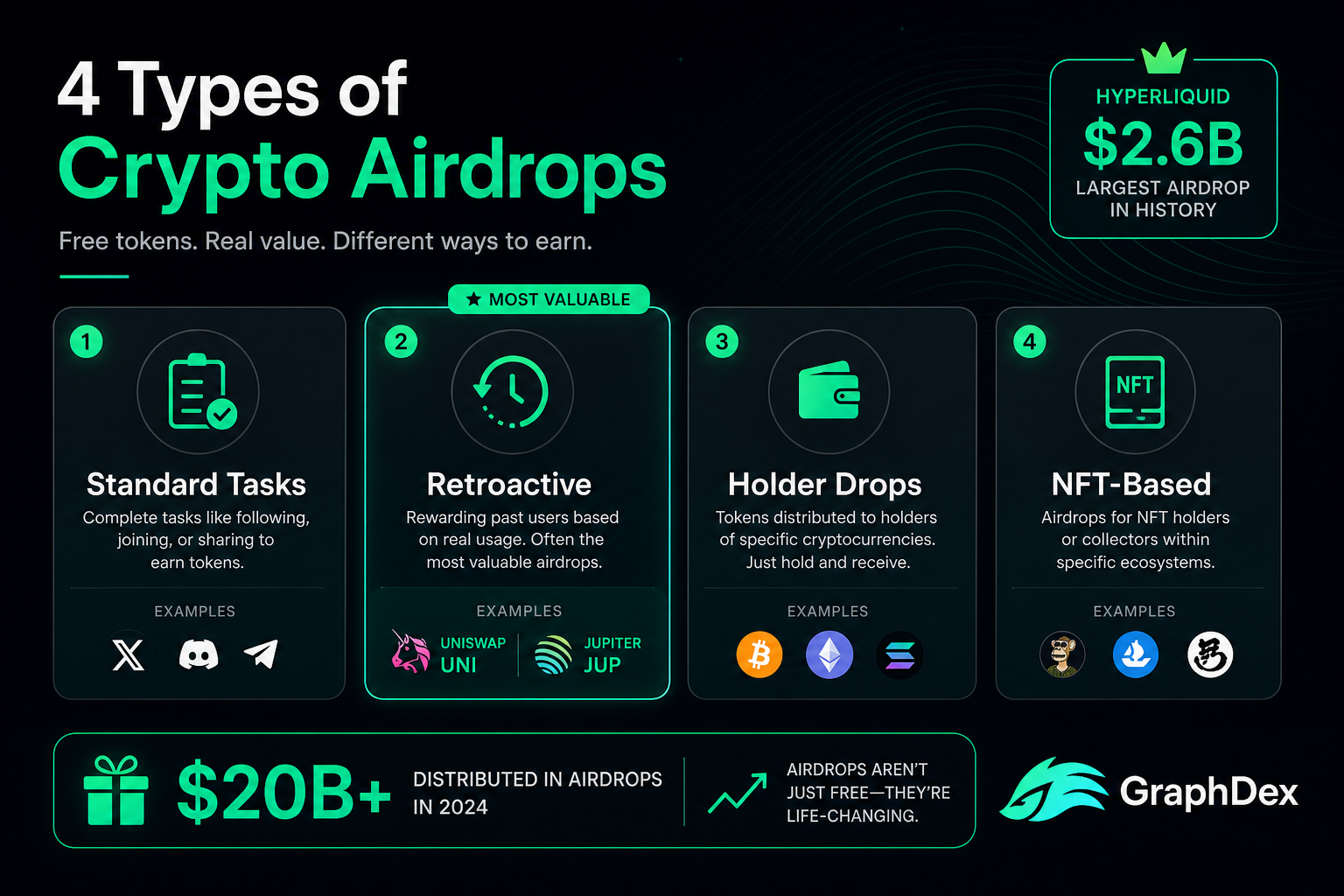
The Four Major Types of Airdrops
Not all airdrops work the same way. Understanding the types helps you target your effort.
1. Standard Airdrops
Projects distribute tokens to anyone who completes simple tasks — following social accounts, joining Telegram/Discord, holding specific tokens, or signing up for an email list.
Pros: Easy entry, no significant prior activity required, accessible to beginners. Cons: Allocations are typically small per recipient (because many people qualify), and the project gets less signal about who's actually using the protocol.
2. Retroactive Airdrops
The most valuable type. Projects look back at who used their protocol before a snapshot date and reward them based on actual usage — number of transactions, volume traded, time as a user, complexity of activity.
Examples:
- Uniswap UNI (2020) — retroactively rewarded users who'd swapped on Uniswap before September 2020. Each qualifying wallet received 400 UNI, worth $1,200-$6,000+ at peak prices.
- Jupiter JUP (early 2024) — retroactively rewarded active Solana DEX users with significant allocations ($200-$2,000+ per wallet for typical users; much more for power users).
- Hyperliquid (2024) — distributed $2.6 billion to early users of the perpetuals exchange. The largest airdrop on record.
Why these are most valuable: Retroactive drops can't be gamed easily — you had to actually use the protocol before anyone knew there would be a reward. Allocations scale with genuine usage, so power users get meaningful amounts.
3. Holder Drops
Projects distribute tokens automatically to wallets holding specific other tokens — typically as a benefit for being part of an ecosystem.
Example: Some Solana memecoins have airdropped tokens to BONK holders. Some Ethereum projects airdrop to early NFT holders or stETH holders.
Pros: Truly passive — you just need to hold the qualifying asset. Cons: Often smaller per-wallet amounts; depends on holding the right asset before the snapshot.
4. NFT-Based Airdrops
Tokens distributed to holders of specific NFT collections. Common in Solana and Ethereum ecosystems — projects use NFT holdings as a proxy for community membership.
Examples: Various Solana memecoins airdrop to specific NFT collection holders. Some L2 projects airdrop to NFT holders on their chain.
How to Qualify for Airdrops Safely
For users wanting to participate in airdrops, a practical approach:
Step 1: Use a non-custodial wallet. MetaMask (EVM chains), Phantom (Solana), or hardware wallets. Airdrops require real on-chain activity — exchange accounts don't qualify.
Step 2: Actually use protocols. The most valuable airdrops reward genuine usage. Swap on DEXs, bridge assets, provide liquidity, participate in governance votes. Don't just connect wallets and disconnect — do real activity.
Step 3: Test new protocols early. Early users of new L2s, DEXs, and DeFi protocols typically receive the largest allocations in retroactive drops. Being among the first 10,000 users of a future-large protocol is more valuable than being one of the last million.
Step 4: Use multiple chains. Diversify across Ethereum mainnet, Arbitrum, Optimism, Base, Solana, Cosmos, and emerging chains. Different airdrops target different ecosystems — broad coverage maximizes opportunities.
Step 5: Track your activity. Use Zapper, DeBank, or portfolio trackers to document your on-chain history. Some retroactive airdrops require specific activity over time.
Step 6: Watch for upcoming snapshots. Many projects announce airdrops months before they happen. Use airdrop calendars (airdrops.io, CoinGabbar, CoinMarketCap Airdrops, project Telegrams) to track opportunities.
Step 7: Be patient. Retroactive airdrops often reward usage that happened months or years before the announcement. Don't expect immediate returns — quality airdrops reward long-term engagement.
Active Airdrops to Watch in 2026
Several major airdrops are anticipated or actively distributing in 2026:
Polymarket POLY. Polymarket founder Shayne Coplan has signaled plans for an airdrop later in 2026. Likely to reward active Polymarket users — those who've made meaningful trading volume on the platform.
MetaMask. Long-anticipated airdrop from the dominant Ethereum wallet, likely retroactively rewarding active users.
Major L2 networks. Several L2s and emerging chains have hinted at future token distributions to early ecosystem participants.
LayerZero, Linea, zkSync, Scroll. Cross-chain infrastructure and zkRollup projects are common sources of significant airdrops.
Disclaimer: Airdrop expectations are speculative — projects may delay, change criteria, or never launch. Don't perform activity purely for airdrop speculation if you wouldn't otherwise want to use the protocol.
For Solana users specifically, the active airdrop ecosystem includes ongoing rewards from various Solana DeFi protocols, memecoin distributions to specific NFT/token holders, and potential future drops from projects building on Solana.
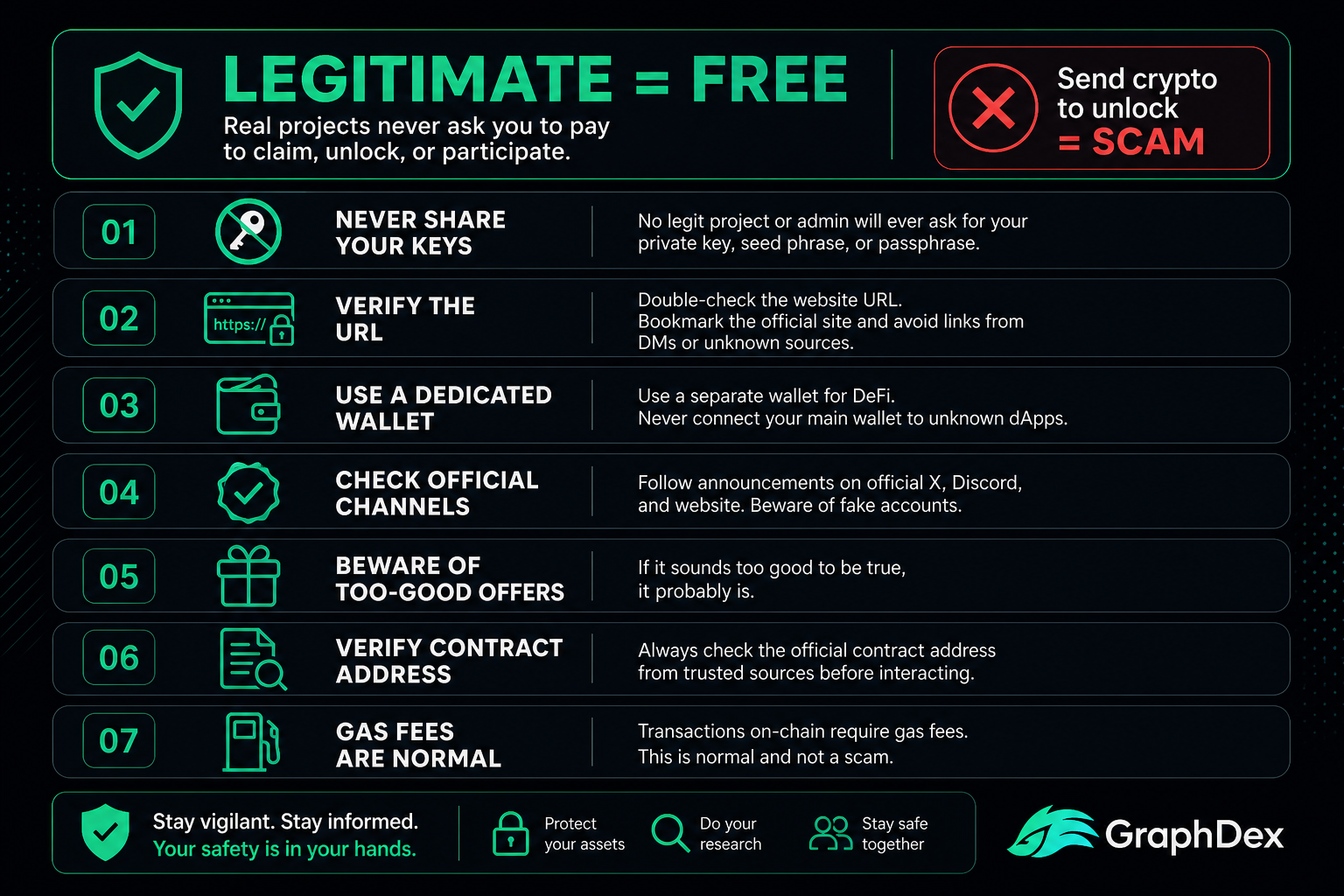
Critical Safety: Avoiding Airdrop Scams
Airdrops attract scammers. Following safety rules is essential.
The #1 rule: Legitimate airdrops are 100% free. If any site asks you to send crypto to "unlock," "claim," or "verify" your airdrop, it's a scam. Always.
Other critical rules:
Never connect your wallet to claim an airdrop you didn't research. Phishing sites disguise malicious contracts as airdrop claims — connecting your wallet can drain your funds.
Double-check URLs. Always navigate to official project sites manually. Don't click links from random DMs, comments, or unofficial sources. Bookmark trusted airdrop tracking sites.
Never share private keys or seed phrases. No legitimate airdrop will ever ask for these. Anyone asking is trying to steal your funds.
Use a dedicated "airdrop wallet." Keep your high-value holdings in a separate wallet from your active claiming wallet. If a malicious contract drains your airdrop wallet, your main holdings stay safe.
Be cautious of "too-good-to-be-true" offers. Legitimate retroactive airdrops feel earned, not surprise windfalls from random projects.
Watch for fake project tokens. Scammers create tokens that look like upcoming airdrops to trick users. Always verify the official contract address from the project's official channels.
Gas fees are normal. You'll typically pay a small gas fee to claim on-chain — this is a transaction cost paid to network validators, not to the project. Solana airdrops cost cents; Ethereum can cost more during congestion.
The honest assessment: airdrops are one of the most genuinely interesting incentive mechanisms in crypto, but the space is full of phishing. Treat any airdrop claim with suspicion until you've verified it through official sources.
Taxes on Airdropped Tokens
General rule: In most jurisdictions, airdropped tokens are typically treated as ordinary income at their fair market value when received.
What this means: If you receive an airdrop of 1,000 tokens worth $5 each on the day you receive them, you typically owe taxes on $5,000 of ordinary income for that year — regardless of whether you sold the tokens.
Subsequent sales: When you later sell the airdropped tokens, the difference between your sale price and the value when received is treated as capital gains or losses.
The complexity: Tax treatment varies significantly by jurisdiction. The IRS treats most airdrops as income at fair market value. Some countries have different rules. The "value when received" is sometimes disputed (especially if the token wasn't actively trading yet).
The practical guidance:
- Keep detailed records: which token, how many, what date, what fair market value
- Consult a crypto-specialist tax advisor for your specific jurisdiction
- Be aware that "free tokens" may carry tax obligations even if you never sell
This is not tax advice — always consult a qualified professional for your specific situation.
How GraphDex Fits Into the Airdrop Ecosystem
GraphDex isn't an airdrop platform itself, but it intersects with the airdrop ecosystem in several practical ways.
Active Solana usage qualifies for Solana airdrops. Using GraphDex for DEX trading on Solana naturally generates the on-chain activity that retroactive Solana airdrops reward. Jupiter's airdrop (which paid $200-$2,000+ per active wallet) rewarded Solana DEX usage — exactly the kind of activity GraphDex facilitates.
The Polymarket connection. GraphDex integrates Polymarket prediction markets via copytrading and direct access. If Polymarket's POLY airdrop materializes, active Polymarket usage (potentially including via GraphDex) may qualify.
Non-custodial via Privy. GraphDex's non-custodial architecture means your wallet is yours — when you receive airdrops, they go to your wallet, not an intermediary's. Sign in with Twitter, email, or Telegram; your on-chain identity is preserved for future airdrops.
Token trading post-airdrop. When you receive airdropped tokens, GraphDex is a natural place to trade them — selling for stablecoins, swapping for other Solana tokens, or holding within the same terminal where you trade and earn.
For active Solana users wanting to maximize airdrop exposure, the practical workflow is: use Solana DeFi (including via GraphDex), maintain on-chain history, and trade airdrop-token rewards through the same terminal.
Build Solana on-chain history with GraphDex
Trade Solana actively on GraphDex
Frequently Asked Questions
What is a crypto airdrop? A crypto airdrop is a free distribution of tokens to wallet addresses by a blockchain project. Projects use airdrops to build community, reward early users, decentralize token supply, or market new tokens. Over $20 billion in tokens was distributed via airdrops in 2024 alone — Hyperliquid's $2.6 billion drop set a record.
How do I qualify for an airdrop? Use a non-custodial wallet (Phantom for Solana, MetaMask for Ethereum), actually use protocols (swap, bridge, provide liquidity), test new protocols early, diversify across chains, and track airdrop calendars. Retroactive airdrops reward genuine past usage — early, consistent users of future-popular protocols get the largest allocations.
How much can airdrops be worth? Amounts vary enormously. Uniswap UNI airdrop was worth $1,200-$6,000+ per wallet at peak. Jupiter JUP rewarded active Solana users with $200-$2,000+. Most retroactive airdrops heavily weight early, consistent usage. Hyperliquid's $2.6 billion total airdrop in 2024 set a record. Smaller airdrops can be $10-$100 per wallet.
Are airdrops free? Yes — legitimate airdrops are 100% free. You may pay small gas fees to claim on-chain (a transaction cost, not a payment to the project). If any site asks you to send crypto to "unlock," "claim," or "verify" your airdrop, it's a scam. Real airdrops are funded by the project, not by claimants.
How do I avoid airdrop scams? Critical rules: never send crypto to "unlock" an airdrop, never share private keys or seed phrases, only claim airdrops from verified official URLs, use a dedicated airdrop wallet separate from main holdings, never connect to suspicious contracts. Verify everything through the project's official channels (X, Telegram, GitHub).
Are airdrops taxable? In most jurisdictions, yes. The IRS generally treats airdropped tokens as ordinary income at their fair market value when received — meaning you may owe taxes even if you never sell. When you later sell, the difference is capital gains/losses. Rules vary by jurisdiction. Keep detailed records and consult a tax professional.
What airdrops are coming in 2026? Polymarket has signaled an airdrop is planned. MetaMask, LayerZero, Linea, zkSync, Scroll, and various L2s have either airdrop expectations or active campaigns. Solana ecosystem regularly has memecoin and ecosystem token distributions. Always treat unconfirmed airdrop expectations as speculation, not guarantees.
About This Guide
This guide is published by the GraphDex Research team — analysts and traders building the infrastructure for digital asset trading on Solana. Our content is based on live airdrop data, current market trends, and hands-on experience.
Sources & data: Airdrop figures, project details, and projections reflect publicly available information as of 2026 and may change. Airdrop tokens carry risk and tax obligations. This guide is educational and not financial or tax advice — always do your own research.
GraphDex is the infrastructure for digital asset trading — trade, predict, and earn in one place. Learn more at graphdex.io.
Last reviewed: May 2026 · GraphDex Research
The infrastructure for digital asset trading. Trade, predict, stake, repeat. graphdex.io