By GraphDex Research · Reviewed for accuracy May 2026
Quick Answer
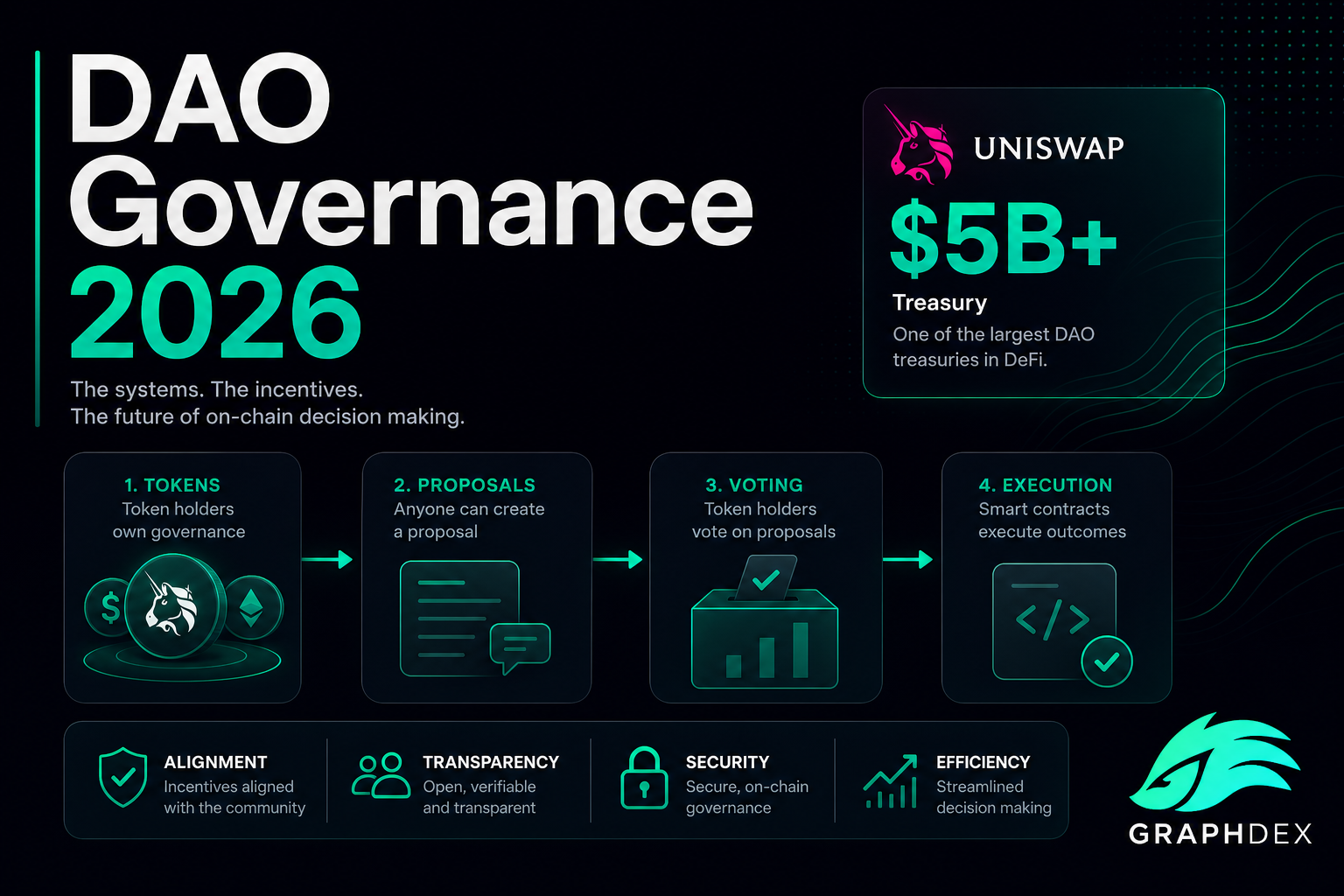
A DAO (Decentralized Autonomous Organization) is an organization governed by code and community voting rather than traditional corporate hierarchy. Key facts:
- How it works: Members hold governance tokens (UNI, AAVE, ARB, MKR, etc.) and vote on proposals; smart contracts execute approved decisions automatically
- No CEO or board: Decisions made by token-weighted voting; execution handled by code
- Treasury control: DAOs manage billions — Uniswap DAO governs $5B+, MakerDAO/Sky governs hundreds of millions
- Six main types: Protocol DAOs, investment DAOs, social DAOs, service DAOs, collector DAOs, grants DAOs
- Governance platforms: Snapshot (off-chain voting), Tally (on-chain), Aragon
- Real limitations: Whale concentration, voter apathy, slow decision-making, and the gap between marketing and actual decentralization
DAOs aren't perfect — but they're fundamentally different from anything traditional corporate governance offers.
Use governance-driven DeFi via GraphDex
Key Takeaways
- DAOs replace corporate hierarchy with token-weighted voting and smart contract execution.
- Major DAOs govern billions in DeFi treasuries (Uniswap, Aave, MakerDAO/Sky, Lido).
- Six main types include protocol, investment, social, service, collector, and grants DAOs.
- Real limitations: whale concentration, voter apathy, and the gap between "DAO-governed" and "centrally-controlled."
What Is a DAO?
A DAO (Decentralized Autonomous Organization) is a blockchain-based organization governed by code and member voting rather than traditional corporate hierarchy. Instead of a CEO making decisions, board approving budgets, and HR enforcing policies — members hold governance tokens, propose changes, vote on outcomes, and smart contracts execute approved decisions automatically.
A useful analogy: it's like a company where shareholders directly vote on everything, but the shares are blockchain tokens, votes happen transparently on-chain, and there's no executive overriding outcomes. As one observer put it: "an internet community with a shared bank account."
The core insight: Traditional organizations require trust in institutions (corporations, governments, banks) to make and enforce decisions fairly. DAOs replace that trust with code — rules are written into smart contracts, voting is verifiable on-chain, and execution happens automatically when conditions are met. The trust shifts from "we hope the board does the right thing" to "we can verify the code does what we voted for."
By 2026, DAOs manage serious money. Uniswap's DAO governs over $5 billion in protocol value. MakerDAO (now Sky) governs the DAI/USDS stablecoin system. Aave, Compound, Lido, Optimism, and Arbitrum all use DAO governance for their protocols. The model has moved past experimental into production infrastructure.
How DAO Governance Works
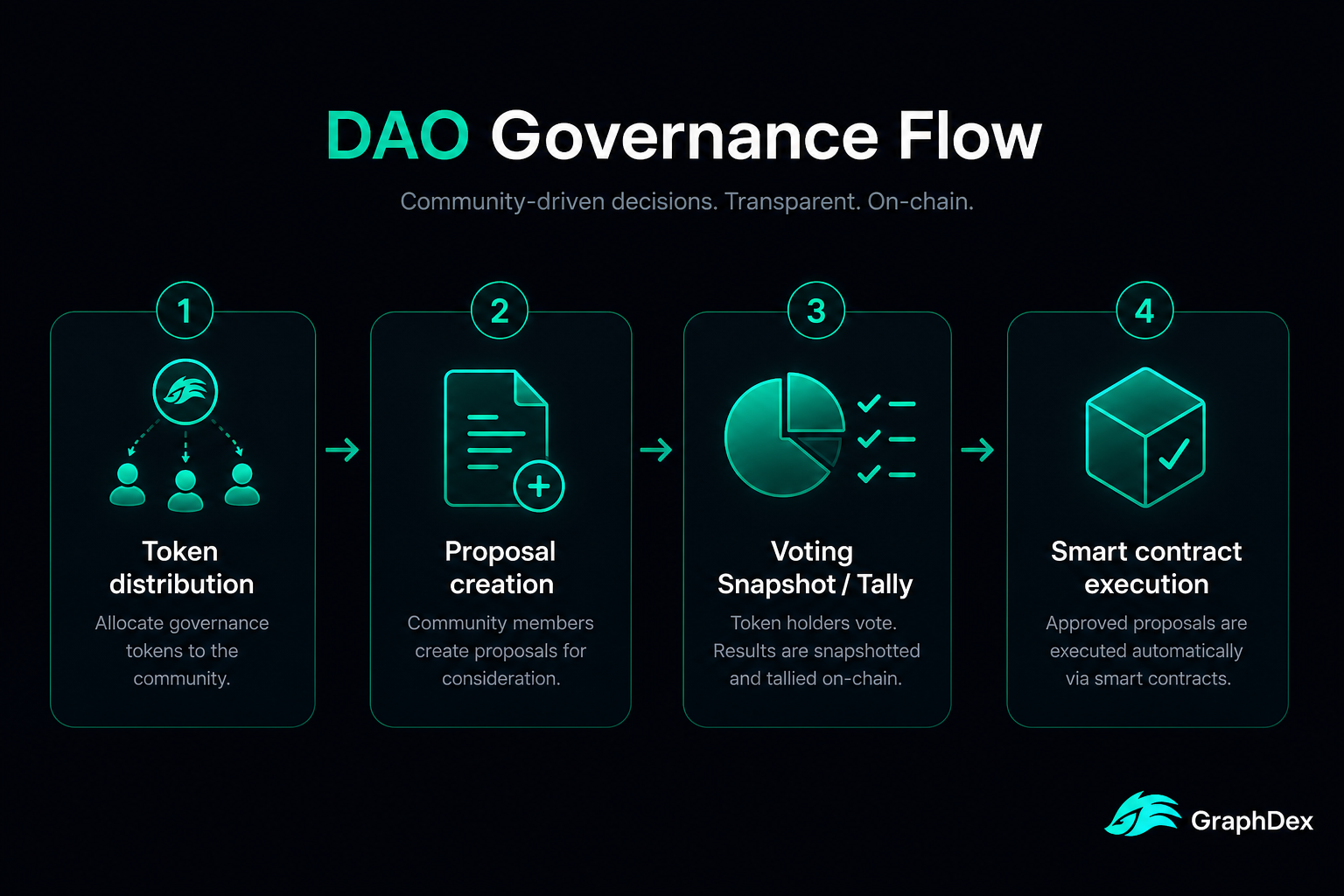
The general flow of DAO governance follows four steps:
1. Token distribution. Members acquire governance tokens — through purchase on exchanges, airdrops, contributing to the protocol, or buying NFTs that grant membership. Token holdings determine voting power: more tokens = more votes.
2. Proposal creation. Members with sufficient tokens (each DAO sets a threshold) can submit proposals — anything from fee changes to treasury spending to protocol upgrades. Proposals are typically discussed first in forums and Discord before formal submission.
3. Voting. Token holders cast votes on active proposals through governance platforms (Snapshot for off-chain gas-free voting, Tally and Aragon for on-chain voting). Vote weight is proportional to tokens held. Most DAOs require both a quorum (minimum participation) and majority (more yes than no votes) to pass.
4. Execution. If a proposal passes, smart contracts execute it automatically. There's no CEO who can veto or delay. Funds move from the treasury, parameters update, contracts deploy — exactly as voted.
Example — Lido DAO governance flow: Lido (the largest liquid staking protocol) requires more than 5% of the total token supply to vote, and more than 50% of votes to be "yes," for a proposal to pass. When these conditions are met, smart contracts execute the proposal automatically. Lido also has an emergency track for pressing issues and committee-based processes for routine operations.
Variants and additions:
- Delegation: Many DAOs let token holders delegate their votes to a representative (similar to delegated democracy)
- Quadratic voting: Some DAOs use quadratic mechanisms where vote weight grows as the square root of token holdings (reducing whale dominance)
- Multi-sig safeguards: Some DAOs use multi-signature wallets that can pause or override decisions in emergencies (which creates a tension with "decentralization")
The Six Major Types of DAOs
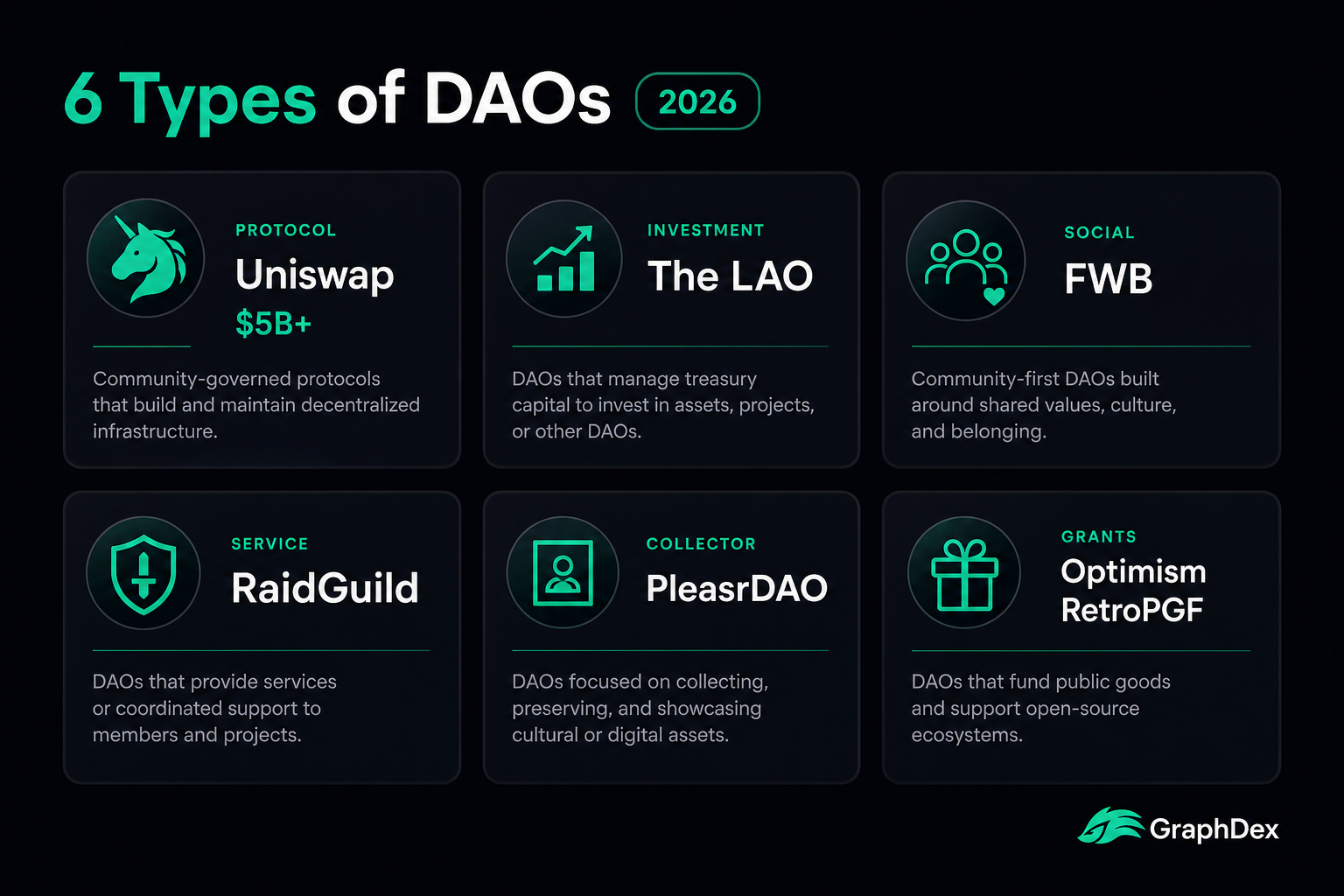
DAOs aren't a single category — they've evolved into distinct types with different purposes.
1. Protocol DAOs
The largest and most influential category. Protocol DAOs govern DeFi protocols themselves — voting on fee structures, asset listings, parameter changes, treasury spending, and protocol upgrades.
Major examples:
- Uniswap DAO (UNI) — governs the largest DEX, $5B+ in protocol value
- Aave DAO (AAVE) — governs the largest lending protocol
- MakerDAO/Sky (MKR/SKY) — governs the DAI/USDS stablecoin system
- Compound DAO (COMP) — governs the lending protocol
- Lido DAO (LDO) — governs the largest liquid staking protocol
- Arbitrum DAO (ARB), Optimism DAO (OP) — govern Ethereum L2 networks
These DAOs make decisions affecting billions of dollars. Holding their governance tokens is how users participate in protocol direction.
2. Investment DAOs
Pool member capital to invest collectively. Members vote on investment decisions; profits are distributed proportionally to contributions.
Examples: The LAO (early-stage blockchain investments), MetaCartel Ventures, Komorebi Collective.
3. Social DAOs
Communities organized around shared interests, identity, or culture, often with collective treasuries. Membership may require holding specific NFTs or tokens.
Examples: Friends With Benefits (FWB), various interest-based communities.
4. Service DAOs
Freelancer collectives, agencies, and working groups that organize around delivering services. Members earn for contributions; the DAO manages contracts and payment flows.
Examples: RaidGuild (developers), various creative/development collectives.
5. Collector DAOs
Pool funds to acquire NFTs, art, or other collectibles. Members share ownership and vote on what to acquire.
Examples: PleasrDAO (notable for purchasing the unique Wu-Tang Clan album), ConstitutionDAO (failed bid for an original US Constitution copy, but raised $47M in days from tens of thousands of participants).
6. Grants DAOs
Fund ecosystem development by issuing grants to builders. The DAO votes on which projects deserve funding from a shared treasury.
Examples: Various protocol grants DAOs (Optimism RetroPGF, Gitcoin DAO).
Why Are Governance Tokens Worth Anything?
A fair question: governance tokens often don't pay dividends or directly distribute protocol revenue. So why do they have value?
1. Future fee capture speculation. Token holders can vote to enable fee sharing. UNI holders, for instance, could vote to direct protocol revenue to themselves. Most major protocols haven't done this yet — but the possibility creates option value. The market prices governance tokens based on potential future cash flows holders could vote to themselves.
2. Control over massive treasuries. UNI tokens govern $5B+ in protocol value. MKR governs hundreds of millions. Having voting power over major treasuries has value even without direct cash flow — you can influence how that capital is deployed.
3. Protocol influence. Whales and VCs buy governance tokens specifically to influence protocol direction. A voting stake in Aave or Uniswap is strategically valuable to anyone with business in DeFi.
4. Network/community value. Like any community membership, governance tokens often have intangible value tied to status, network effects, and access.
The honest assessment: Governance tokens are speculative. Their value depends on the protocol succeeding, holders eventually capturing meaningful fee flows, and the DAO making decisions that increase token value. Many governance tokens have lost 80-95% from their peaks. Treat them as speculation, not investments.
DAOs on Solana vs Ethereum
Most major DAOs originated on Ethereum, where the DAO concept was pioneered. By 2026, Solana also has a significant DAO ecosystem.
Ethereum DAOs: The vast majority of major protocol DAOs (Uniswap, Aave, MakerDAO/Sky, Compound, Lido) are Ethereum-native. Tooling is mature — Snapshot for off-chain voting, Tally and Aragon for on-chain governance, OpenZeppelin Governor contracts.
Solana DAOs: Solana protocols (Jupiter, Jito, Marinade, Drift, Kamino) have DAO governance through native Solana voting infrastructure. Realms is the major Solana DAO platform. Solana DAOs benefit from the chain's low fees — on-chain voting that would cost dollars on Ethereum costs cents on Solana, enabling more granular and frequent governance decisions.
For Solana users, participating in DAOs of major Solana protocols (Jupiter governance, Jito governance, Marinade governance) is accessible and inexpensive. Tools like Realms make Solana DAO participation straightforward.
The Real Limitations of DAOs
For balance, DAOs have genuine problems worth understanding. The promise of "perfect democratic governance" doesn't match the reality.
Whale concentration. The fundamental tension in DAOs: voting power is proportional to token holdings. Large holders ("whales") — typically founding teams, VCs, and early investors — wield massive influence. Academic research has found DAOs resemble a "polycentric structure" more than a flat democracy. The promise of equality is true only to an extent.
Voter apathy. Most token holders don't vote on most proposals. Many DAOs see 5-10% turnout on routine proposals. Decisions get made by the engaged minority — which often defaults to the loudest voices or the largest holders.
Slow decision-making. Coordinating thousands of token holders takes time. DAOs have spent weeks debating logos. Critical decisions can get delayed by the deliberation process — though in emergencies, some DAOs have moved $50M+ in 48 hours.
The "DAO" vs "controlled" gap. Many protocols labeled "DAO-governed" actually have founding teams with significant control via large token holdings, multi-sig admin keys, or upgrade keys. The line between "decentralized" and "centralized with marketing" is often blurry. Always check which aspects are actually decentralized.
Voting fraud and manipulation. Token-weighted voting can be gamed — borrowing tokens to vote, sybil attacks, or whale collusion. Some DAOs have had governance attacks where bad actors temporarily controlled enough votes to extract value.
Legal status uncertainty. Most jurisdictions don't formally recognize DAOs as legal entities. This creates issues for contracts, taxation, and member liability. Wyoming has passed DAO legislation; other states and countries are slowly following.
Coordination failure for complex decisions. Token-weighted voting works for binary yes/no decisions. It struggles with nuanced choices requiring deep expertise — strategic direction, hiring, complex tradeoffs.
The honest takeaway: DAOs are genuinely useful for some governance problems but limited for others. They work better for simple parameter adjustments and treasury allocations than for nuanced strategic decisions. The "democratic decentralized" framing is partly aspirational.
Trade DAO-governed DeFi tokens on GraphDex
How to Participate in a DAO
For users wanting to participate in DAO governance:
Step 1: Choose a DAO you care about. Pick a protocol you actively use (Uniswap, Aave, Jupiter, Jito) — you'll have aligned interests and direct stake in good decisions.
Step 2: Acquire governance tokens. Buy on a DEX or CEX, or earn through protocol participation (some protocols distribute tokens to users).
Step 3: Join community channels. Most DAOs have active Discord and forum discussions where proposals are debated before formal voting.
Step 4: Visit the governance platform. Snapshot (off-chain, gas-free), Tally (on-chain), or the DAO's custom platform. Read active proposals.
Step 5: Vote. Connect your wallet, review proposals, vote your tokens. Some DAOs let you delegate votes if you prefer not to vote yourself.
Step 6: Propose if you have enough tokens. Each DAO has a proposal threshold (often substantial — many DAOs require holding $1M+ in tokens to propose).
The minimal version: to participate, you need governance tokens. To meaningfully influence decisions, you need significant holdings or you need to delegate to/work with larger holders.
Trade DeFi governance tokens via GraphDex
Frequently Asked Questions
What is a DAO in simple terms? A DAO (Decentralized Autonomous Organization) is an organization run by code and member voting rather than a CEO and corporate hierarchy. Members hold governance tokens, vote on proposals, and smart contracts execute decisions automatically. It's like an internet community with a shared bank account, where all decisions happen through transparent on-chain voting.
How do DAOs make money? DAOs themselves don't necessarily make money for members directly. Protocol DAOs accrue value through protocol revenue (held in the treasury), which can theoretically flow to token holders if voted on. Investment DAOs pool capital and distribute returns. Token value reflects expected future cash flows holders could vote themselves, plus control over significant treasuries.
What's the biggest DAO? Uniswap DAO is often cited as the largest by treasury value, with $5 billion+ in protocol value under its governance. MakerDAO/Sky governs the DAI/USDS stablecoin system worth billions. Lido DAO governs the largest liquid staking protocol. By active participation and proposals, these protocol DAOs are the most significant in 2026.
How do I vote in a DAO? Acquire the DAO's governance tokens, visit the governance platform (Snapshot, Tally, or DAO-specific), review active proposals, and vote with your tokens connected via your wallet. Many DAOs also support delegation — if you don't want to vote on every proposal, you can delegate your voting power to a representative.
Are DAOs really decentralized? Not always as decentralized as marketed. Voting power follows token holdings, so whales (founding teams, VCs, early investors) often have disproportionate influence. Many "DAO-governed" protocols also have founding teams with admin keys or upgrade controls. Decentralization is a spectrum — always check which aspects of a specific protocol are actually decentralized.
Are DAOs legal? Legal status varies. Wyoming has passed DAO legislation recognizing them as legal entities. Most jurisdictions don't have formal DAO law, creating issues for contracts, taxation, and member liability. The space is evolving — legal frameworks are being figured out as DAOs gain prominence. Consult a lawyer for jurisdiction-specific questions.
What's the difference between a DAO and a DAO token? A DAO is the organization (governance system, members, treasury). A DAO token (UNI, AAVE, MKR, etc.) is the asset that grants membership and voting rights. Holding the token makes you a member of the DAO with proportional voting power. The DAO operates regardless of token price; the token's value reflects market views on the DAO's future.
About This Guide
This guide is published by the GraphDex Research team — analysts and traders building the infrastructure for digital asset trading on Solana. Our content is based on live DAO data, current governance activity, and publicly available information.
Sources & data: DAO treasury values, governance details, and protocol information reflect publicly available information as of 2026 and may change. Governance tokens carry investment risk. This guide is educational and not financial or legal advice — always do your own research.
GraphDex is the infrastructure for digital asset trading — trade, predict, and earn in one place. Learn more at graphdex.io.
Last reviewed: May 2026 · GraphDex Research
The infrastructure for digital asset trading. Trade, predict, stake, repeat. graphdex.io