By GraphDex Research · Reviewed for accuracy May 2026
Quick Answer
Crypto trading is the practice of buying and selling cryptocurrencies to profit from price movements — across spot markets (you own the asset), futures/perps (leveraged contracts), or specialized markets (prediction, options). Key facts:
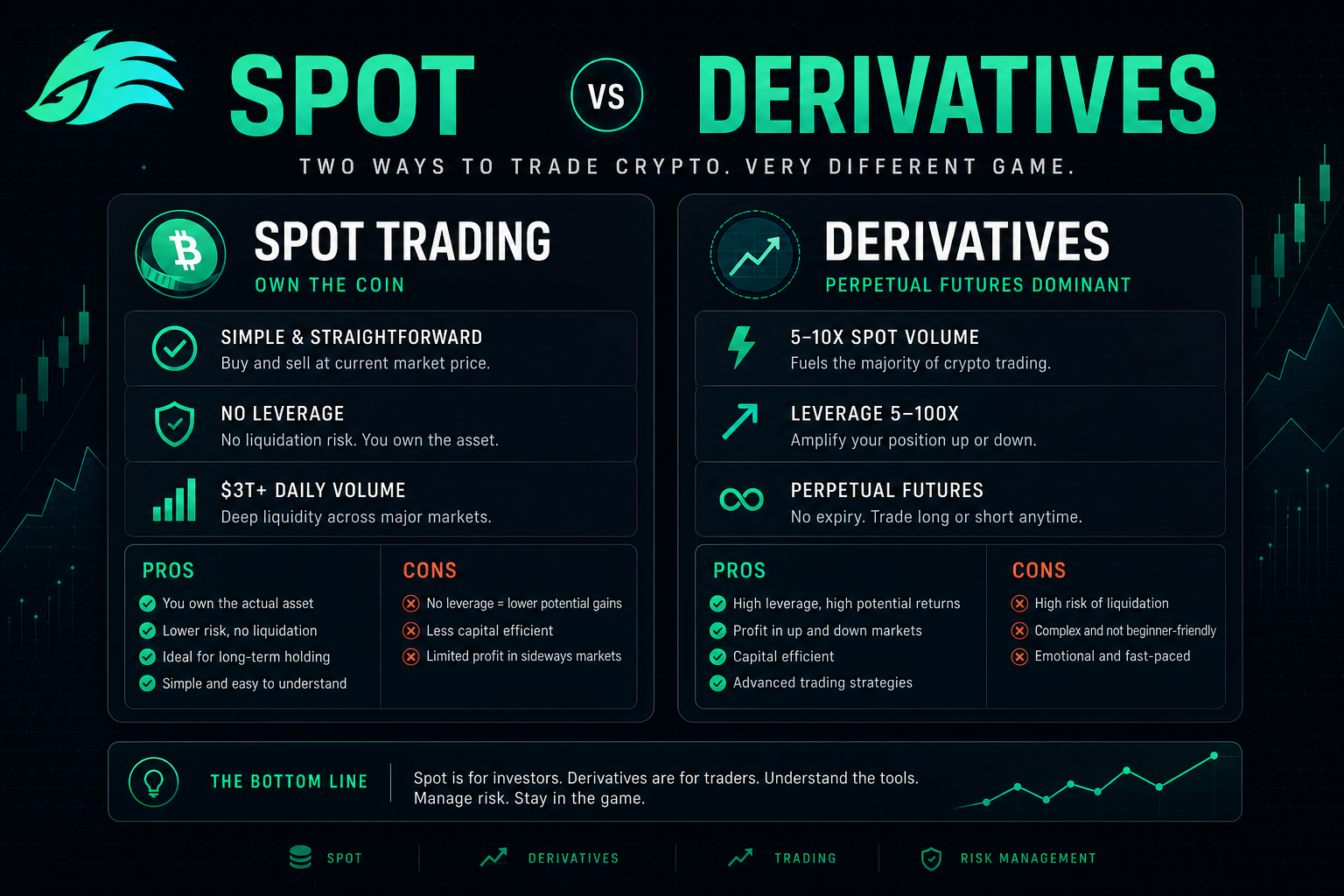
- Two main markets: Spot (own the coin) and Derivatives (perpetual futures dominate, 5-10× spot volume)
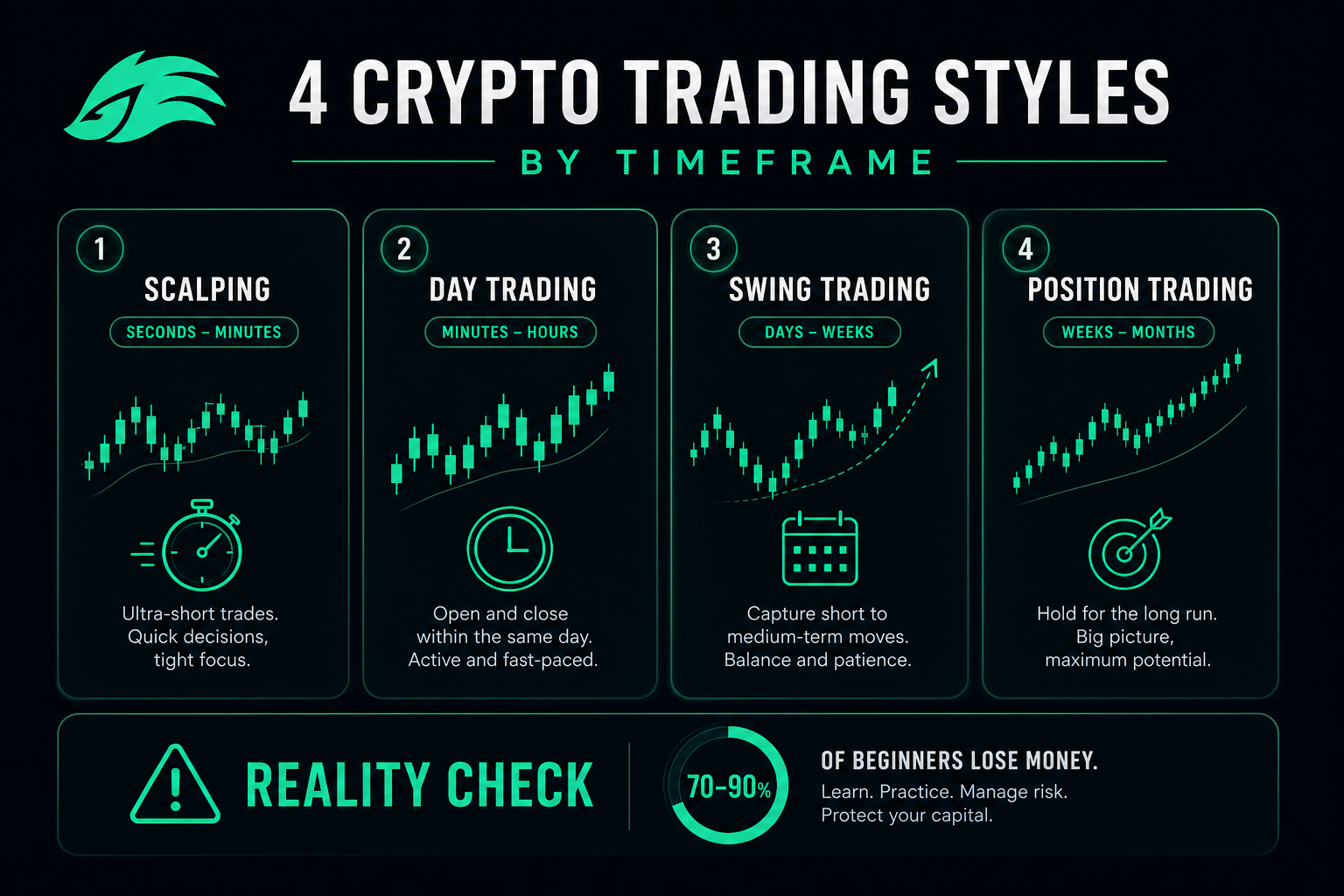
- Main trading styles: Scalping (minutes), day trading (hours), swing trading (days-weeks), position trading (months)
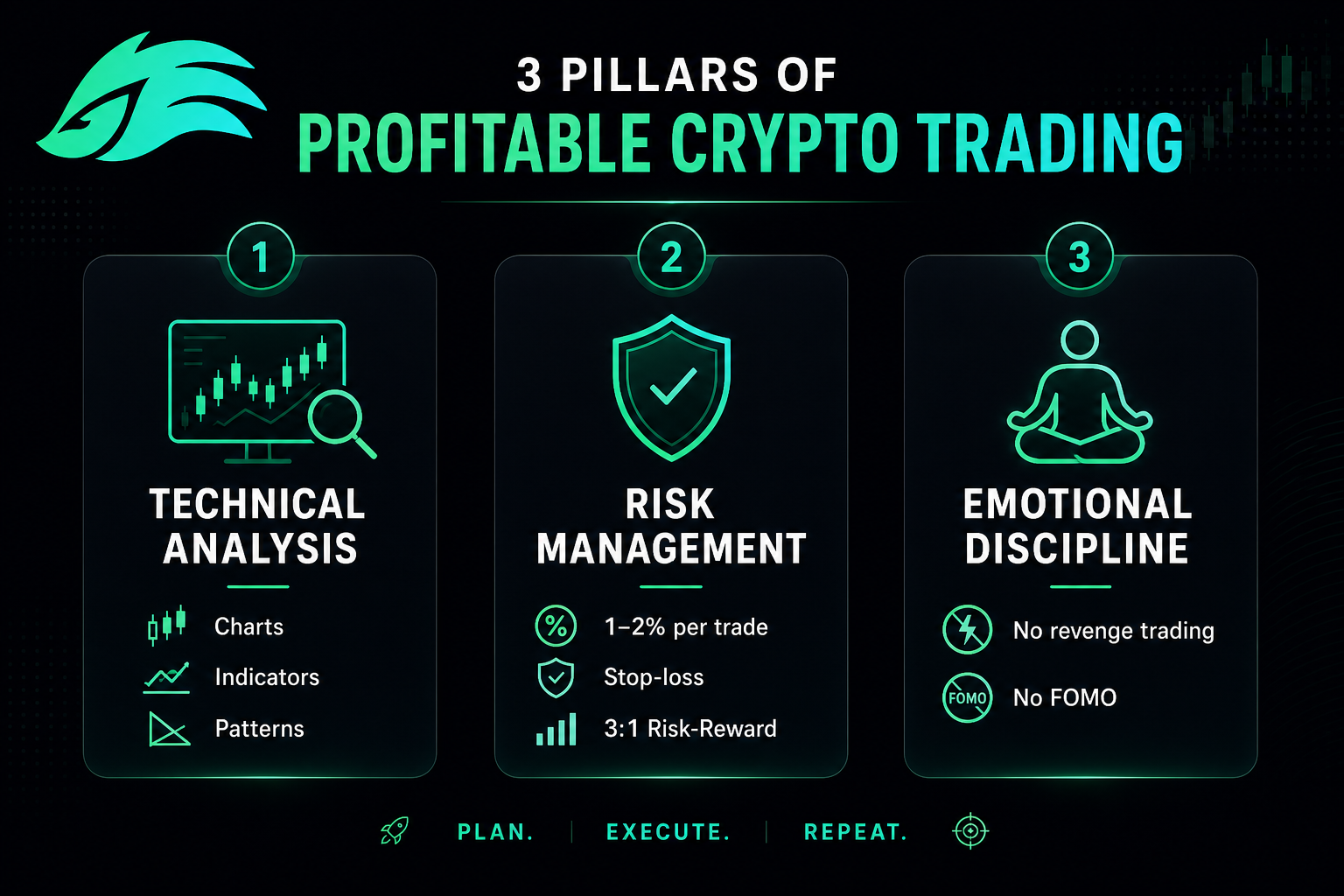
- Three pillars of profitable trading: Technical analysis, risk management, emotional discipline
- The reality: 70-90% of new traders lose money within their first year — usually from over-leverage, emotional decisions, or no edge
- Where Solana fits: Sub-cent fees + 400ms finality make active strategies viable that don't work on Ethereum L1
The honest truth: Successful crypto trading isn't about predicting markets — it's about managing risk, sticking to a system, and surviving long enough to compound small edges.
Trade with integrated tools on GraphDex
Key Takeaways
- Crypto trading happens in two main markets: spot (own the coin) and derivatives (leveraged contracts).
- The four main trading styles differ by timeframe: scalping, day, swing, and position trading.
- Risk management — not market prediction — is the single biggest factor separating winners from losers.
- Solana's low fees enable active strategies; Ethereum L1 economics favor longer holding periods.
What Is Crypto Trading?
Crypto trading is the practice of buying and selling cryptocurrencies — Bitcoin, Ethereum, Solana, USDC, or thousands of altcoins — with the goal of profiting from price changes. Unlike crypto investing (which typically means buying and holding for years), trading aims to capture shorter-term price movements measured in minutes, hours, days, or weeks.
The basic mechanics: You buy an asset at one price, sell at another, and profit (or lose) the difference. A trader who buys 1 SOL at $150 and sells at $170 profits $20. The same principle applies whether you're trading Bitcoin against the dollar, Solana against USDC, or a memecoin against SOL.
Why people trade rather than just invest: Three reasons. First, crypto is volatile — daily swings of 5-20% on major assets create profit opportunities that don't exist in traditional finance. Second, crypto trades 24/7 globally, unlike stocks (9:30-4:00 NYSE) or forex (5 days/week). Third, leveraged derivatives let traders amplify positions with relatively small capital.
By the numbers in 2026: Daily crypto trading volume routinely exceeds $3 trillion across spot and derivatives. Perpetual futures alone deliver 5-10× the volume of spot trading on most major platforms. The market has matured from the wild-west days of 2017-2021 into sophisticated infrastructure with institutional participation.
The honest framing: Trading is a skill, not a get-rich-quick scheme. Successful traders treat it as a business — with systems, risk management, and psychological discipline. The 5-10% who profit consistently typically have years of experience, robust systems, and the emotional control to follow them.
Spot Trading vs Derivatives: The Two Main Markets
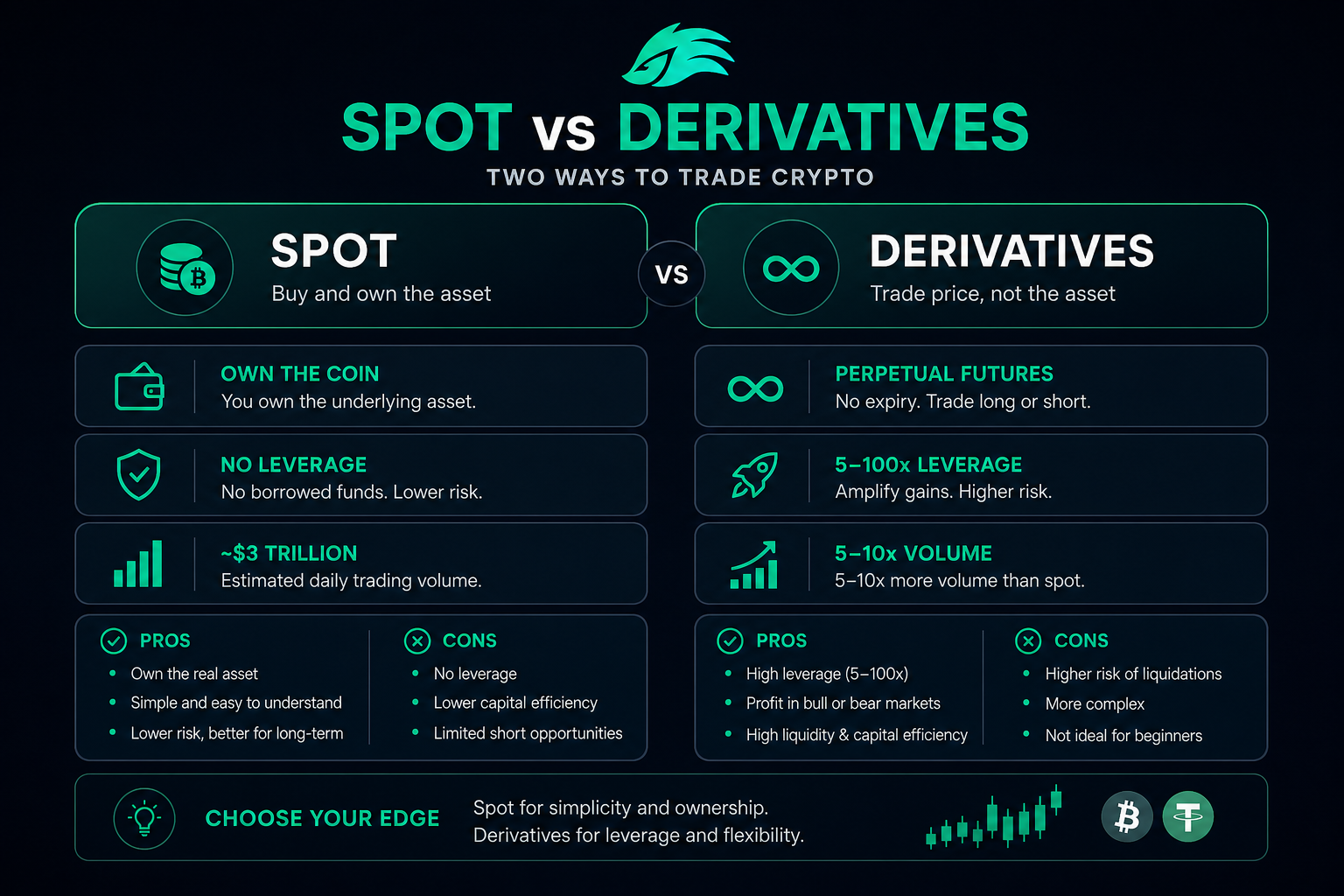
The first decision any trader makes is which market to participate in.
Spot Trading
What it is: Buying and selling actual cryptocurrencies. When you buy 1 SOL on Coinbase, Kraken, or via GraphDex, you actually own that SOL. You can withdraw it to your wallet, send it to anyone, use it in DeFi, or hold it indefinitely.
Pros:
- Simple to understand: you own what you buy
- No leverage means no liquidation risk
- Can hold positions indefinitely
- Lower fees than derivatives on most platforms
- Composable with the rest of DeFi (staking, lending, NFTs)
Cons:
- Profits limited to actual price movement (no leverage)
- Can't easily profit from price drops (without short-selling tools)
- Requires capital equal to position size
Best for: Beginners, long-term holders, DeFi participants, anyone wanting to actually own and use crypto.
Derivatives Trading (Perpetual Futures)
What it is: Trading contracts that track crypto prices without owning the underlying asset. The dominant form in 2026 is the perpetual future (or "perp") — a futures contract with no expiration date, kept aligned to spot price through a "funding rate" mechanism.
How leverage works: Using 10× leverage means a trader can open a $1,000 position with only $100 in margin (collateral). This amplifies both potential profits AND losses by 10×. Most retail platforms offer 5×-100× leverage; institutional venues go higher.
Pros:
- Capital efficiency: smaller positions control larger exposure
- Profit from price drops via "short" positions
- 24/7 trading
- Often deeper liquidity than spot for major assets
- Hedging existing portfolio exposure
Cons:
- Liquidation risk — losses can exceed deposited margin quickly
- Funding rate payments (paid every 8 hours typically)
- Higher complexity (margin, position sizing, liquidation prices)
- Faster losses for inexperienced traders
- Higher fees than spot on many platforms
Best for: Experienced traders, those wanting to short markets, hedgers, professional traders with proper risk management.
The 2026 volume reality: Derivatives volume consistently exceeds spot trading volume by 5-10× on most major platforms. Perpetual futures are where most active trading happens — but they're also where most retail traders lose money.
The Four Main Crypto Trading Styles
Trading styles differ primarily by timeframe and frequency. Choosing one that matches your personality, schedule, and capital is one of the most important early decisions.
Scalping (Seconds to Minutes)
The fastest style. Scalpers make many small trades throughout the day, capturing tiny price movements (often 0.1-1%) repeatedly. A scalper might execute 20-100+ trades daily.
Requirements: Fast execution, low fees (Solana's sub-cent costs make scalping economically viable), strong concentration, often automated tools.
Reality check: Most retail scalpers lose to fees, slippage, and MEV bots. Profitable scalping usually requires algorithmic tools, deep market understanding, or specialized infrastructure.
Day Trading (Minutes to Hours)
Open and close positions within the same day. Day traders capture intraday volatility — usually 1-10% moves — without holding overnight risk.
Requirements: Several hours of daily focus, technical analysis skills, risk management discipline, sufficient capital ($5,000-$25,000+ recommended for meaningful position sizes).
Reality check: Studies of day trading consistently find that 70-90% lose money in their first year. The few who succeed typically take 2-5 years of practice to develop edge.
Swing Trading (Days to Weeks)
Hold positions for days or weeks to capture larger trends. Swing traders typically use 4-hour and daily charts, look for trend continuation or reversal patterns, and trade less frequently than day traders.
Requirements: Patience, multi-day market awareness, ability to handle overnight position risk, technical analysis skills.
Reality check: Often the most beginner-friendly active style. Lower trade frequency means lower fees and less emotional decision-making. Reasonable success rates with proper strategy.
Position Trading (Weeks to Months)
Long timeframes — weeks to several months. Position traders combine fundamental analysis with broader technical trends. Close to "active investing" rather than trading.
Requirements: Strong conviction, ability to ignore short-term noise, fundamental research skills, patience for drawdowns.
Reality check: Lower stress, lower time commitment. Often the highest risk-adjusted returns for non-professional traders.
Which style is right for you? Depends on time available, capital, personality, and goals. Beginners typically benefit from swing or position trading; scalping should be approached only after substantial experience and proper tools.
The Three Pillars of Profitable Trading
Across all styles and markets, three skills separate consistent winners from consistent losers.
1. Technical Analysis (The "Where")
The study of price charts to identify probable future moves. Core skills:
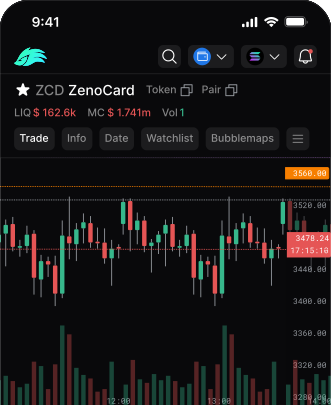
- Reading candlestick charts: Each candle shows open, close, high, and low for a time period
- Identifying support and resistance: Price levels where buying or selling tends to emerge
- Recognizing chart patterns: Triangles, flags, head-and-shoulders, breakouts
- Using indicators: RSI (overbought/oversold), MACD (momentum), moving averages (trend)
- Multi-timeframe analysis: Confirming setups across different timeframes
Technical analysis isn't fortune-telling — it's pattern recognition that identifies high-probability scenarios. Used properly, it provides edges that compound over many trades.
2. Risk Management (The "How Much")
The single most important pillar — and the most ignored by beginners.
Position sizing: Never risk more than 1-2% of capital on a single trade. A trader with $10,000 should risk at most $100-200 on any one position.
Stop losses: Pre-defined exit points if the trade goes against you. A trader who buys SOL at $150 might set a stop loss at $140 — accepting a $10 loss rather than risking a much larger one.
Risk-reward ratios: Aim for trades where potential reward is at least 2-3× potential risk. A 50% win rate with 3:1 reward-to-risk is highly profitable; an 80% win rate with 1:3 reward-to-risk is a disaster.
Diversification: Don't concentrate everything in one trade or asset.
Why this matters: A trader can have a 60% win rate and still lose money if losses are too large. A trader can have a 40% win rate and make money if winners are much larger than losers. Mathematics rules trading.
3. Emotional Discipline (The "Why You Fail")
The pillar most traders ignore until it costs them everything.
Common emotional failures:
- Revenge trading: Doubling down after losses to "get even"
- FOMO: Chasing pumps because "everyone's making money"
- Holding losers: Refusing to exit losing positions hoping they'll come back
- Cutting winners short: Exiting profitable trades too early due to fear
- Overtrading: Trading out of boredom rather than opportunity
What works: Having predefined rules, journaling every trade, taking breaks during losing streaks, accepting that losses are part of trading. The best traders aren't the smartest — they're the most disciplined.
Where to Trade Crypto in 2026
The trading platform landscape has matured significantly. Major categories:
Centralized Exchanges (CEXs)
Coinbase, Kraken, Binance, OKX, Bybit. Custodial (they hold your keys), fiat on/off ramps, high liquidity, regulatory clarity (especially Coinbase, Kraken in US). Best for: buying with fiat, beginners, regulated environments.
Decentralized Exchanges (DEXs)
Uniswap (Ethereum), Jupiter (Solana), Raydium (Solana), Orca (Solana). Non-custodial (you hold your keys), connect via wallet, no KYC required. Best for: privacy, DeFi participation, trading without intermediaries.
Trading Terminals
GraphDex (Solana), Trojan, Axiom, Photon, BullX (Solana focus). Specialized platforms with advanced features — fast execution, MEV protection, on-chain analytics, copytrading. Best for: active Solana traders, memecoin participation, multi-feature integrated workflow.
Derivatives Exchanges
Bybit, OKX, Binance Futures, Bitget, dYdX, Drift (Solana). Perpetual futures with leverage. Best for: leveraged trading, shorting, hedging. Requires more skill than spot.
Aggregators
1inch, Jupiter, ParaSwap. Find best prices across multiple DEXs. Best for: optimizing execution on single trades.
For active Solana traders, the integrated terminal approach (GraphDex) often makes more sense than juggling multiple separate tools. For US-based fiat-on-ramp users, Coinbase or Kraken remain the entry points before moving to specialized trading tools.
Why Solana Is Ideal for Active Trading
Trading economics matter — and they vary dramatically by chain.
Solana's trading advantages:
- Sub-cent fees: Median fee around $0.0038. Even with 50 trades per day, fees stay under $0.20
- 400ms block times: Near-instant transaction confirmation
- High throughput: 1,000-4,000 real TPS supports active trading
- $650B+ stablecoin volume (February 2026): Deep liquidity for USDC/USDT pairs
- MEV protection available: Built into platforms like GraphDex
Ethereum L1's challenges for active trading:
- $5-50 gas fees make small trades uneconomical
- 12-second block times slower than Solana
- Mempool MEV exposure on every transaction
The practical math: A trader making 20 trades per day on Solana pays ~$0.08 in fees. The same activity on Ethereum L1 costs $100-1,000. This isn't a small difference — it's the difference between profitable strategies being viable or not.
This is why active trading has consolidated on Solana, L2 networks (Arbitrum, Base, Optimism), and centralized derivatives platforms — the venues where fees don't eat strategies alive.
How to Start Trading Crypto: Practical Steps
For complete beginners:
Step 1: Get educated first. Trade nothing for at least 2-4 weeks while learning. Read about technical analysis, risk management, and the specific assets you want to trade. Understand the mathematics of position sizing.
Step 2: Start with spot trading, not derivatives. Leverage destroys beginners quickly. Master spot trading before considering futures.
Step 3: Open accounts. Coinbase or Kraken for US users to buy with fiat; Binance for international. Add Phantom or MetaMask wallet for self-custody. Consider GraphDex for active Solana trading.
Step 4: Define your strategy before trading. Which timeframe? Which assets? Which entry signals? Which stop losses? Position sizes? Write it down.
Step 5: Paper trade first. Practice with simulated capital on most major platforms before risking real money. Verify your strategy works before betting on it.
Step 6: Start tiny. Your first real trades should be small enough that losses don't hurt — $50-$200 positions while you learn. Scale up only after demonstrating consistent profitability.
Step 7: Journal every trade. Why did you enter? What was your plan? What actually happened? What did you learn? The traders who improve fastest are those who review their own decisions ruthlessly.
Step 8: Survive long enough to learn. Most traders quit after losing 20-50% of their starting capital. The ones who succeed treat the first year as tuition — not as a profit center.
Start trading Solana with integrated tools on GraphDex
Realistic Expectations for Crypto Trading
For honesty, what you should actually expect:
Year 1: Likely losses. 70-90% of new traders lose money. Focus on learning systems, not making profits. Treat losses as tuition.
Year 2-3: Possible breakeven if you've developed discipline. Most traders who survive year 1 either improve significantly or quit. The middle-ground is rare.
Year 3+: Some consistency possible for the dedicated subset. Returns of 20-50% annualized are excellent. Anyone claiming consistent 100%+ returns is either an outlier (statistical luck) or lying.
The 5-10% who succeed long-term share traits:
- Treat trading as a business with systems and discipline
- Risk small per trade (1-2% maximum)
- Focus on process, not individual trade outcomes
- Continue learning indefinitely
- Match strategy to personality and lifestyle
- Have other income sources (less pressure)
What doesn't work:
- "Get rich quick" mentality
- Trading without a defined system
- High leverage from the start
- Following random Twitter calls
- Emotional decision-making
- Treating losses as catastrophes instead of data
How GraphDex Supports Active Traders
GraphDex is built specifically for active Solana traders — consolidating tools that traditionally require 5-10 separate platforms:
- DEX trading with best-execution routing across Raydium, Orca, Meteora
- Pulse feed for real-time new token discovery
- Bubble Maps for safety analysis before buying (critical for memecoins)
- AI signals for opportunity discovery
- Wallet/social tracking to follow whale activity
- Polymarket integration with prediction market copytrading
- Staking up to 17% APY on idle stablecoins/SOL — earn while between trades
- MEV protection against sandwich attacks
- Non-custodial Privy wallet — sign in with Twitter, email, or Telegram
For active Solana traders, this consolidates the workflow that previously required juggling Phantom + Pump.fun + Jupiter + Trojan + Polymarket + Jito + Bubble Maps + Dune dashboards. Same activities, one terminal.
Trade integrated Solana with GraphDex
Frequently Asked Questions
What is crypto trading in simple terms? Crypto trading is buying cryptocurrencies at one price and selling at a different price to profit from the difference. It happens in two main markets: spot (you own the actual crypto) and derivatives (leveraged contracts tracking crypto prices). Successful trading requires technical analysis, risk management, and emotional discipline.
Can you make a living from crypto trading? Yes, but it's hard. 70-90% of new traders lose money in their first year. Those who succeed long-term typically have years of experience, defined systems, strict risk management, and often other income sources to reduce pressure. Realistic expectations: 20-50% annual returns for skilled traders; anyone claiming consistent 100%+ is an outlier or misleading.
Is crypto trading legal? Yes in most jurisdictions, though regulations vary. Spot trading is widely legal. Derivatives trading is regulated more strictly — in the US, retail derivatives access is limited to CFTC-registered platforms (Coinbase Derivatives, Kalshi, others). Always check your jurisdiction's specific rules.
How much money do I need to start crypto trading? You can start with as little as $50-$100. However, meaningful position sizes for serious learning typically require $1,000-$5,000+. Below that, fees and minimum trade sizes can erode profits quickly. Never trade more than you can afford to lose entirely.
What's the difference between trading and investing in crypto? Investing typically means buying and holding for months or years, betting on long-term value appreciation. Trading aims to profit from shorter-term price movements (minutes to weeks). Trading is more active, riskier, more time-intensive, and requires different skills. Most people benefit from being investors rather than traders.
What is the best crypto for beginners to trade? Major assets (Bitcoin, Ethereum, Solana) are the best for beginners — deeper liquidity, less manipulation, more reliable technical patterns, and broader information available. Avoid memecoins and small caps until you've developed experience. Stablecoin pairs (BTC/USDC, SOL/USDC) are cleaner than crypto/crypto pairs.
What is leverage in crypto trading? Leverage allows you to control a larger position with less capital. 10× leverage means $100 of margin controls a $1,000 position. This amplifies both profits and losses. Most retail platforms offer 5-100× leverage. Beginners should avoid leverage entirely until they've mastered spot trading — leverage destroys inexperienced traders faster than anything else.
About This Guide
This guide is published by the GraphDex Research team — analysts and traders building the infrastructure for digital asset trading on Solana. Our content is based on direct trading experience, current market data, and publicly available information.
Sources & data: Volume figures, platform details, and statistics reflect publicly available information as of 2026 and may change. Crypto trading carries substantial risk including total loss of capital. This guide is educational and not financial advice — always do your own research and start with capital you can afford to lose.
GraphDex is the infrastructure for digital asset trading — trade, predict, and earn in one place. Learn more at graphdex.io.
Last reviewed: May 2026 · GraphDex Research
The infrastructure for digital asset trading. Trade, predict, stake, repeat. graphdex.io