By GraphDex Research · Reviewed for accuracy July 2026
Quick Answer
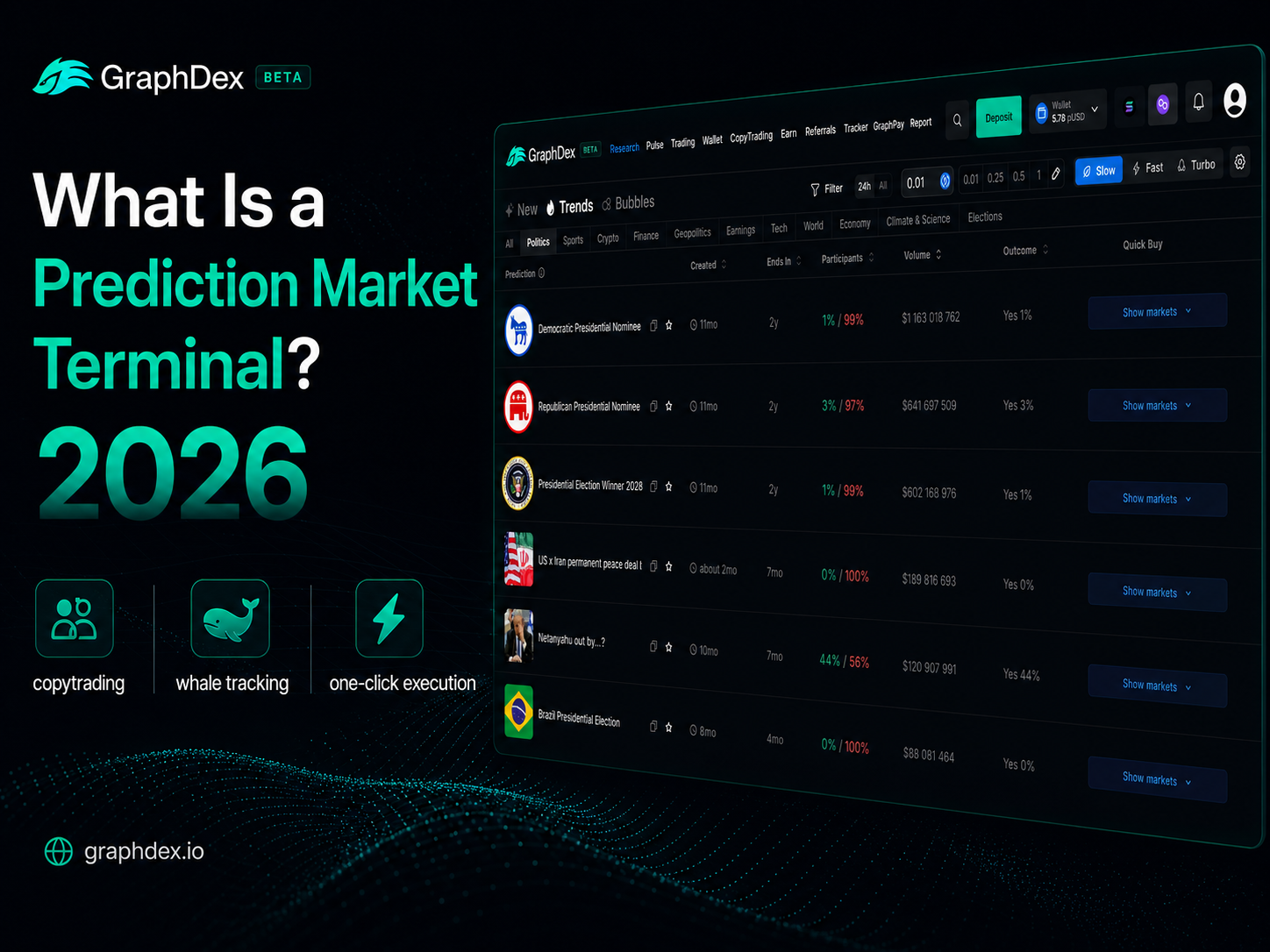
A prediction market terminal is a professional-grade dashboard that sits on top of prediction markets like Polymarket and Kalshi, adding advanced tools the native interfaces lack: copytrading, whale tracking, real-time analytics, visual screening, and one-click execution.
Think of it as the difference between a basic brokerage app and a Bloomberg Terminal. The markets are the same — the terminal makes you faster and better informed.
GraphDex is a prediction market terminal that also integrates Solana DEX trading, making it unique among the category.
Try the GraphDex prediction market terminal
Key Takeaways
- A prediction market terminal adds copytrading, whale tracking, and analytics on top of Polymarket/Kalshi.
- Native interfaces offer only basic buy/sell — no copytrading or whale tracking.
- Terminal types: pure (Stand), analytics (Pariflow), copytrading (FrenFlow), integrated (GraphDex).
- GraphDex uniquely integrates prediction market copytrading with full Solana DEX trading.
What Is a Prediction Market Terminal?
A prediction market terminal is a specialized trading platform that works with prediction markets and betting exchanges like Polymarket or Kalshi. Think of it as a professional-grade dashboard that offers more advanced tools than the standard prediction market interfaces.
These tools include real-time data aggregation, detailed charting, copytrading, whale tracking, and one-click order execution for faster trading. Unlike the basic buy/sell functionality of native interfaces, prediction market terminals offer features like multi-exchange integration, whale activity tracking, sentiment analysis, and AI-driven insights. Some even provide prime brokerage services with leverage options.
The growth of these terminals tracks the growth of the prediction market sector itself. By 2025, prediction market trading volumes surpassed $64 billion — a 300% year-over-year increase. As the money grew, so did demand for professional tools. These terminals are now indispensable for traders aiming to stay ahead.
Why the Native Interface Isn't Enough
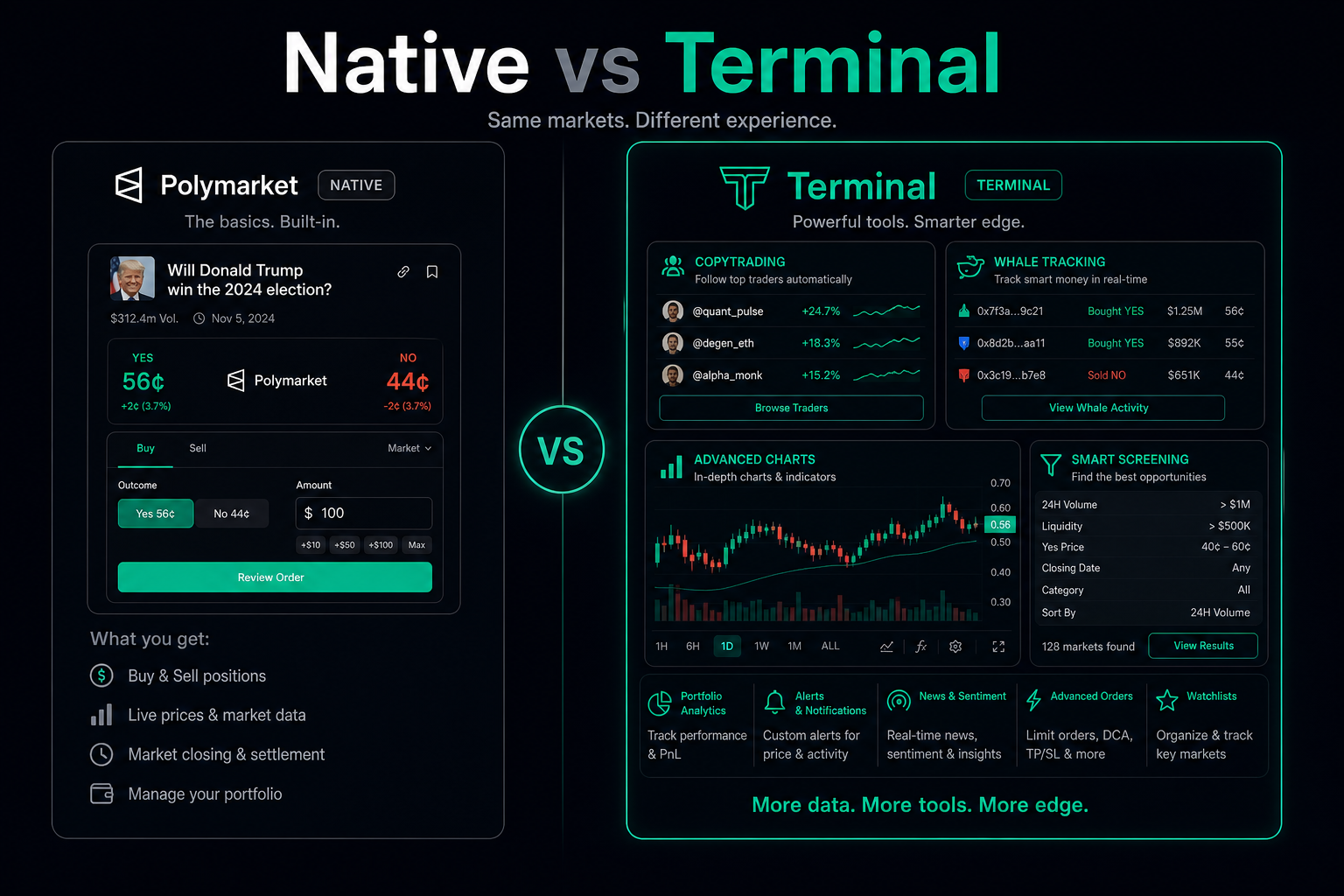
Polymarket and Kalshi have clean, functional interfaces. For casual users placing occasional bets, they work fine. But for serious traders, the native interfaces have real limitations.
No copytrading. Neither Polymarket nor Kalshi lets you automatically follow and mirror the traders who consistently win. You have to manually track wallets and replicate trades yourself.
No whale tracking. Large, high-conviction trades often signal where informed money is flowing. Native interfaces don't surface this — you'd have to monitor blockchain explorers manually.
Limited screening. Finding opportunities across hundreds or thousands of markets via a list is slow. There's no fast way to spot where volume and momentum are concentrating.
No cross-platform view. If you trade on both Polymarket and Kalshi, the native interfaces don't let you compare prices or manage positions across both.
Slow workflow. Research in one place, execute in another, track in a third. Every context switch costs time — and in fast-moving markets, time is money.
A terminal solves all of these. It is the difference between trading with information and trading blind.
Core Features of a Prediction Market Terminal
Copytrading
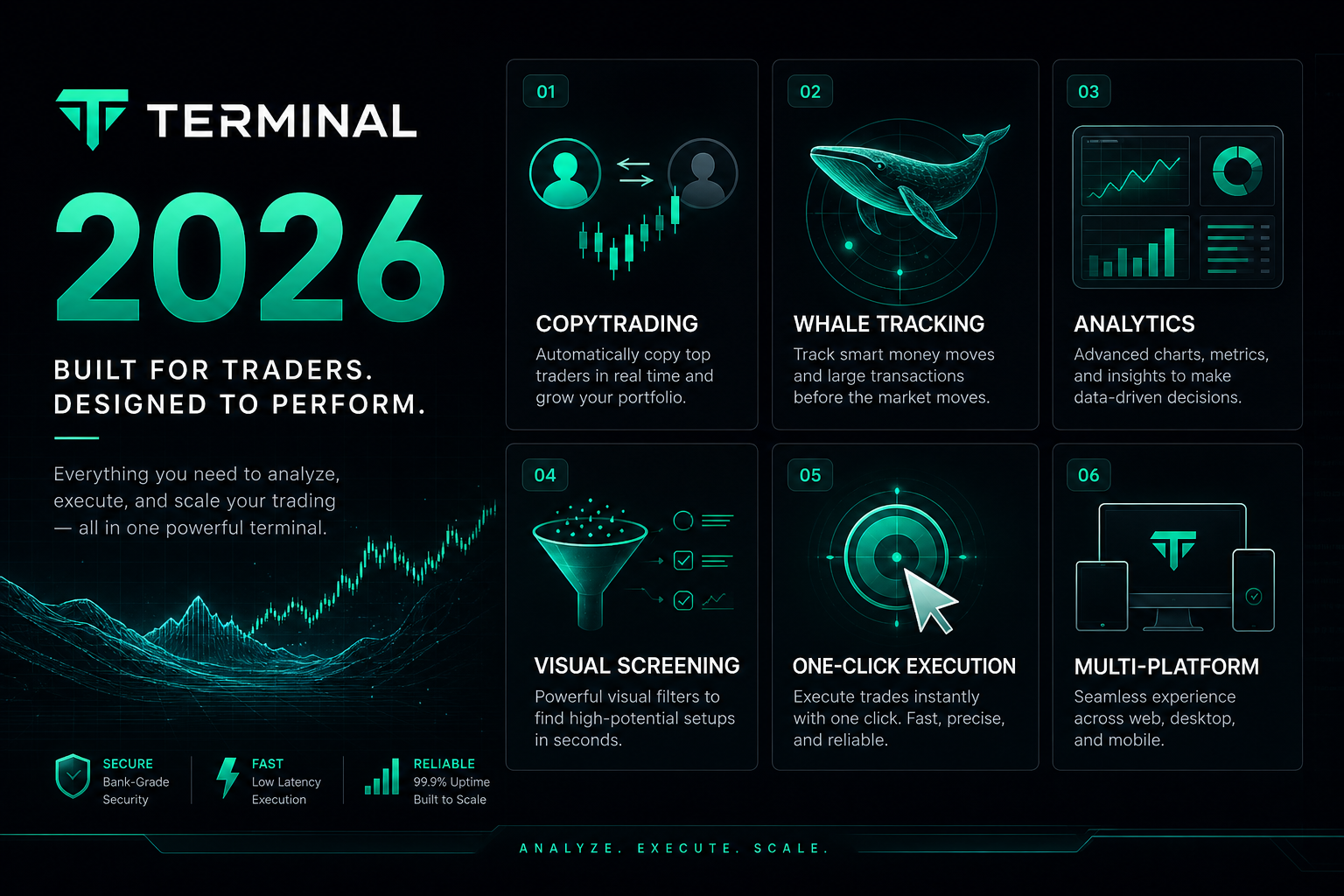
The flagship feature. Copytrading lets you follow top forecasters — ranked by PnL, win rate, and volume — and automatically mirror their positions. When they open, you open; when they close, you close, all within your own risk parameters.
This democratizes prediction market success. Instead of needing to be an expert forecaster yourself, you can follow proven performers and learn from their actions.
Whale Tracking
Whale tracking surfaces large, high-conviction trades in real time. When a wallet with a strong track record places a significant bet, that's a signal. Terminals alert you to these moves so you can investigate or follow.
Real-Time Analytics and Charting
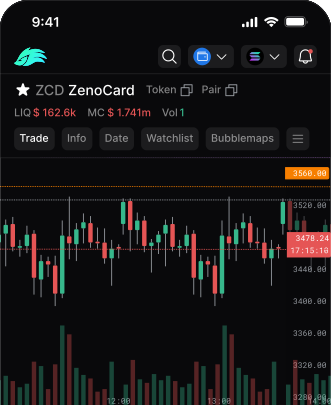
Native interfaces show basic prices. Terminals add detailed charting, price history, volume analysis, and probability movement over time — the analytical depth serious traders need.
Visual Market Screening
Instead of scrolling through lists, advanced terminals offer visual screening — seeing hundreds of markets at a glance, sized by volume and colored by momentum. GraphDex's Bubbles feature does exactly this for prediction markets.
One-Click Execution
Speed matters. Terminals offer fast, optimized execution so you can act on a signal immediately rather than navigating multiple screens.
Multi-Platform Aggregation
Some terminals aggregate markets from Polymarket, Kalshi, and other venues into one interface, letting you compare prices and trade the best available across platforms.
See these features in the GraphDex terminal
Types of Prediction Market Terminals
The category has diversified into several types:
Pure prediction terminals — like Stand, which aggregates Polymarket and Kalshi with copytrading, whale alerts, and up to 8 order books on one screen. Built specifically for prediction market specialists.
Analytics layers — like Pariflow, focused on whale activity tracking through a clean dashboard, surfacing trends before they spread across Crypto Twitter.
Copytrading-focused tools — like FrenFlow, offering multi-venue copytrading across Polymarket, Kalshi, and Hyperliquid with a Telegram bot.
Telegram bots — like Polycule, which lets you execute Polymarket trades from any device and form group chats to copytrade with friends.
Integrated crypto terminals — like GraphDex, which combines prediction market copytrading with full Solana DEX trading, token discovery, and staking in one platform.
The last category is the most powerful for crypto-native traders, because prediction markets aren't isolated from their other trading — they're integrated into one workflow.
Prediction Market Terminal Comparison
| Terminal | Type | Copytrading | Whale Tracking | DEX Integration | Custody |
|---|---|---|---|---|---|
| GraphDex | Integrated crypto terminal | ✅ | ✅ | ✅ Solana | Non-custodial |
| Stand | Pure prediction terminal | ✅ | ✅ | ❌ | Non-custodial |
| Pariflow | Analytics layer | ❌ | ✅ | ❌ | N/A (analytics) |
| FrenFlow | Copytrading tool | ✅ | ✅ | ❌ | Self-custody |
| Polycule | Telegram bot | ✅ (group) | ❌ | ❌ | Varies |
The clearest distinction: GraphDex is the only terminal in this comparison that integrates prediction market copytrading with full Solana DEX trading. The others are prediction-market-specific. For traders who do both, that integration eliminates the silo between prediction markets and spot trading.
GraphDex: A Prediction Market Terminal Plus a Solana DEX
Most prediction market terminals do one thing: make prediction market trading better. GraphDex does that — and more.
It offers the core terminal features: copytrading for prediction markets (follow top forecasters by PnL and win rate), the Bubbles visual screener (see hundreds of markets at a glance), and one-click execution.
But GraphDex also integrates these with a full Solana trading terminal: DEX trading across all pairs, the Pulse feed for real-time token discovery, wallet tracking, AI signal analysis, and staking up to 17% APY.
This integration is the differentiator. For a crypto-native trader, a narrative forming in Solana wallet movements often has a corresponding prediction market. GraphDex lets you see and act on both in one interface — something a prediction-only terminal cannot do.
Trade prediction markets and Solana DEX in one terminal
How to Choose a Prediction Market Terminal
Define your primary use case:
If you trade only prediction markets and want the deepest specialist tools, a pure prediction terminal like Stand may fit best.
If you want analytics and whale tracking without execution, an analytics layer like Pariflow works.
If you trade crypto broadly and want prediction markets integrated with Solana DEX trading, GraphDex is purpose-built for you.
Key factors to evaluate:
- Copytrading — does it let you follow and mirror top traders?
- Whale tracking — does it surface large, informed trades?
- Execution speed — how fast can you act on a signal?
- Custody — is it non-custodial? (GraphDex uses non-custodial Privy architecture)
- Integration — does it fit your broader trading workflow or add another silo?
- Fees — what does it cost, and does it offer rebates or revenue share?
The integration question is decisive. A terminal that adds another separate tab to your workflow saves less time than one that consolidates your trading. For crypto-native traders, GraphDex's integration of prediction markets with Solana trading is the structural advantage.
The Cost of Not Using a Terminal
Trading prediction markets without a terminal has real costs:
Missed copytrading opportunities — you can't easily follow proven winners, so you rely entirely on your own forecasting.
Slower reaction — by the time you've researched, switched interfaces, and executed, fast-moving markets may have already priced in the move.
Information gaps — without whale tracking and analytics, you're trading on less information than traders who use terminals.
Fragmented workflow — juggling separate tools for research, execution, and tracking wastes time and increases errors.
In a sector projected to reach $1 trillion in annual volume by 2030, the gap between traders who use professional tools and those who don't will only widen. The terminal is becoming the baseline for serious participation.
The Evolution of Prediction Market Trading
Prediction market trading has evolved through clear stages, and understanding where the sector is heading explains why terminals matter.
Stage 1: Native interfaces (2020-2024). Early prediction markets offered basic buy/sell functionality. Trading was manual, research was separate, and there were no tools for following other traders. This was enough when the sector was small.
Stage 2: Analytics emerge (2024-2025). As volume exploded past $64 billion, traders demanded better information. Analytics tools and whale trackers appeared, letting traders see where informed money was flowing.
Stage 3: Terminals and copytrading (2025-2026). The current stage. Full terminals now offer copytrading, multi-venue aggregation, visual screening, and one-click execution. Prediction market trading is becoming as sophisticated as crypto spot trading.
Stage 4: Full integration (emerging). The frontier is integration — prediction markets combined with spot trading, DeFi, and AI signals in one environment. GraphDex represents this stage, treating prediction markets not as a standalone activity but as one feature of a complete trading terminal.
As the sector heads toward a projected $1 trillion in annual volume by 2030, the tools will continue to professionalize. Traders who adopt terminals early gain the edge that comes from better information, faster execution, and the ability to follow proven performers.
Get ahead with the GraphDex terminal
The 2026 Prediction Market Terminal Landscape
The case for a prediction market terminal grew stronger through 2026, as the underlying markets exploded in size and fragmented across venues.
The market scale. Combined monthly volume across the two largest prediction platforms (Kalshi and Polymarket) reached approximately $44.8 billion in June 2026, driven by historic World Cup trading — more than triple the average monthly handle of all legal US sportsbooks in 2025. Industry analysts project prediction market annual volume could reach $1 trillion by 2030.
The fragmentation problem a terminal solves. As of mid-2026, volume split across Kalshi (majority share, sports-dominant), Polymarket (crypto-native, politics and world-event depth), and a growing set of new entrants including Robinhood, Interactive Brokers, and CME Group. With markets, liquidity, and traders spread across venues, a terminal that aggregates discovery, analytics, copytrading, and execution in one place addresses real fragmentation — you don't have to juggle multiple platforms and tools.
Why copytrading and analytics matter more now. With thousands of markets across venues and record volume, no individual can monitor it all or have expertise in every category. This is exactly what a terminal adds on top of the base platforms: copytrading (mirror proven traders), whale tracking (follow smart money), and analytics (surface opportunities) — turning overwhelming market breadth into actionable signals.
The on-chain verification edge. For copytrading specifically, prediction markets like Polymarket are on-chain, so a trader's real track record is verifiable from blockchain data — unlike forex/stock copytrading where performance can be faked. A terminal that surfaces on-chain-verified traders makes copytrading more trustworthy than in traditional markets.
Related Guides
- Best Polymarket Copytrading Platforms
- Prediction Market Copy Trading: The Complete Guide
- Best Polymarket Alternatives 2026
- What Is GraphDex?
Frequently Asked Questions
What is a prediction market terminal? A prediction market terminal is a professional-grade dashboard that works on top of prediction markets like Polymarket and Kalshi, adding advanced tools such as copytrading, whale tracking, real-time analytics, and one-click execution that the native interfaces lack.
Why do I need a prediction market terminal? Native prediction market interfaces offer basic buy/sell functionality only. A terminal adds copytrading (follow winning traders), whale tracking (see informed money), visual screening (find opportunities fast), and faster execution — the tools that give serious traders an edge.
What is the best prediction market terminal in 2026? It depends on your needs. Stand is strong for pure prediction market specialists. GraphDex is best for crypto-native traders who want prediction market copytrading integrated with Solana DEX trading. Pariflow is best for analytics-focused whale tracking.
Does GraphDex offer copytrading for prediction markets? Yes. GraphDex lets you follow top forecasters ranked by PnL, win rate, and volume, then automatically mirror their positions within your own risk parameters — a feature the native Polymarket interface does not offer.
Are prediction market terminals non-custodial? It varies by terminal. GraphDex uses non-custodial Privy architecture — your funds stay in your own wallet. Always check the custody model before using any terminal.
Can a terminal trade across both Polymarket and Kalshi? Some terminals like Stand aggregate multiple venues. GraphDex focuses on integrating Polymarket markets with Solana DEX trading. Multi-venue aggregation lets you compare prices and trade the best available across platforms.
How much does a prediction market terminal cost? Costs vary — some charge subscriptions, some take a fee per trade, some are free. GraphDex charges standard platform fees and offers up to 65% revenue share for ambassadors, effectively returning value to active users.
About This Guide
This guide is published by the GraphDex Research team — analysts and traders building the infrastructure for digital asset trading on Solana. Our content is based on live platform data, current market figures, and hands-on experience with the tools and platforms covered.
Sources & data: Market figures, platform statistics, and competitor data in this article reflect publicly available information as of 2026. Prediction market and trading data carry inherent risk; this guide is educational and not financial advice.
GraphDex is the infrastructure for digital asset trading — trade, predict, and earn in one place. Solana DEX trading, prediction markets with copytrading, AI signals, and non-custodial Privy wallets. Learn more at graphdex.io.
Last reviewed: July 2026 · GraphDex Research
The infrastructure for digital asset trading. Trade, predict, stake, repeat. graphdex.io