By GraphDex Research · Reviewed for accuracy May 2026
Quick Answer
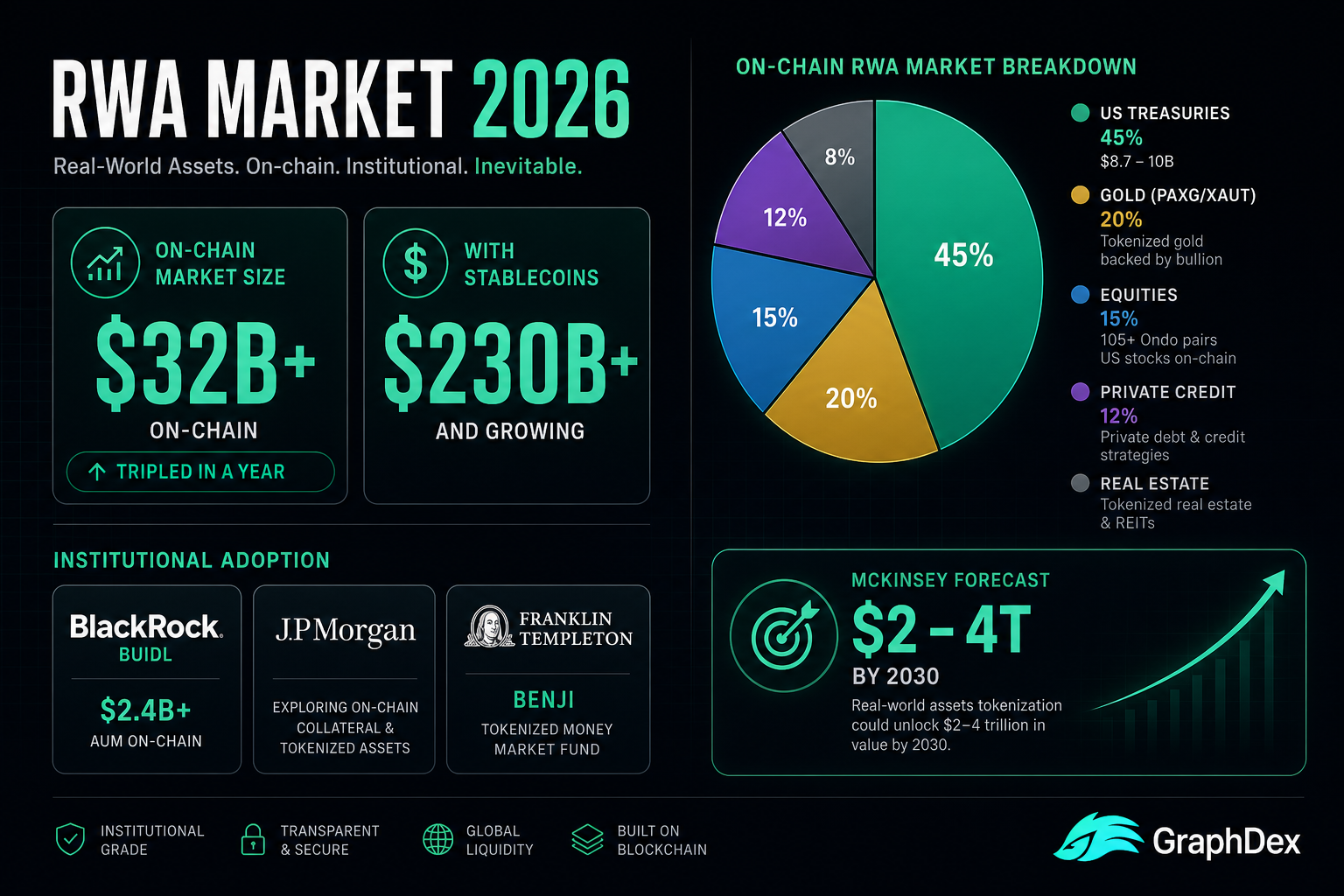
RWA (Real-World Assets) in crypto are tokenized versions of traditional financial assets — US Treasuries, gold, real estate, equities, private credit, and more — represented on a blockchain. Key facts in 2026:
- Market size: Over $32 billion on-chain (excluding stablecoins), up roughly 200% in a year
- Largest category: Tokenized US Treasuries at $8.7-10 billion (~45% of the RWA market)
- Major players: BlackRock BUIDL ($2.4B+ AUM), Franklin Templeton BENJI, Ondo OUSG/USDY, Circle USYC
- Asset classes: Treasuries, gold (PAXG, XAUT), real estate, equities, private credit, commodities
- Yields: 3.5-4%+ APY on tokenized Treasuries — TradFi yields on-chain
- Projections: McKinsey projects $2-4 trillion by 2030; BCG-Ripple estimates $18.9 trillion
- Multi-chain: BUIDL is live on Ethereum, Solana, Polygon, Arbitrum, Avalanche, Optimism, Aptos
RWAs are the bridge between TradFi and DeFi — and that bridge is becoming a highway.
Trade on Solana DeFi via GraphDex
Key Takeaways
- RWAs tokenize traditional financial assets (Treasuries, gold, real estate) onto blockchain.
- The market exceeded $32B in 2026 (excluding stablecoins), tripling in one year.
- BlackRock, JPMorgan, and Franklin Templeton are leading institutional adoption.
- Tokenized Treasuries offer 3.5-4%+ APY on-chain — TradFi yields with crypto-rail efficiency.
What Are Real-World Assets in Crypto?
Real-World Assets (RWAs) in crypto are tokenized representations of traditional, off-chain financial assets — government bonds, equities, real estate, commodities, private credit, and more — issued as tokens on a blockchain. The tokens represent legal claims on the underlying assets, which are held by regulated custodians off-chain.
The simplest example: a tokenized US Treasury. A traditional Treasury bond exists as a financial instrument issued by the US government. BlackRock acquires Treasuries through its BUIDL fund, places them with a regulated custodian (Bank of New York Mellon), and issues blockchain tokens representing fractional ownership of that fund. The tokens trade on Ethereum (and increasingly other chains), settle 24/7, and pay yield to holders — but the underlying assets are real US government debt.
This bridges TradFi and DeFi in both directions. It brings traditional yield-bearing assets (Treasuries, money market funds, real estate, gold) on-chain where they benefit from blockchain rails — instant settlement, 24/7 trading, programmability, fractional ownership. And it brings crypto users access to TradFi yield (3.5-4%+ APY on Treasuries) without leaving on-chain infrastructure.
The category sat as a niche experiment for years. By 2026, it's become one of crypto's most credible and well-capitalized areas, with the world's largest asset managers (BlackRock, Fidelity, JPMorgan, Franklin Templeton) building out tokenized products. McKinsey projects the RWA market will reach $2-4 trillion by 2030; the BCG-Ripple report gives an $18.9 trillion estimate.
The RWA Market in 2026
The numbers tell the story of explosive growth.
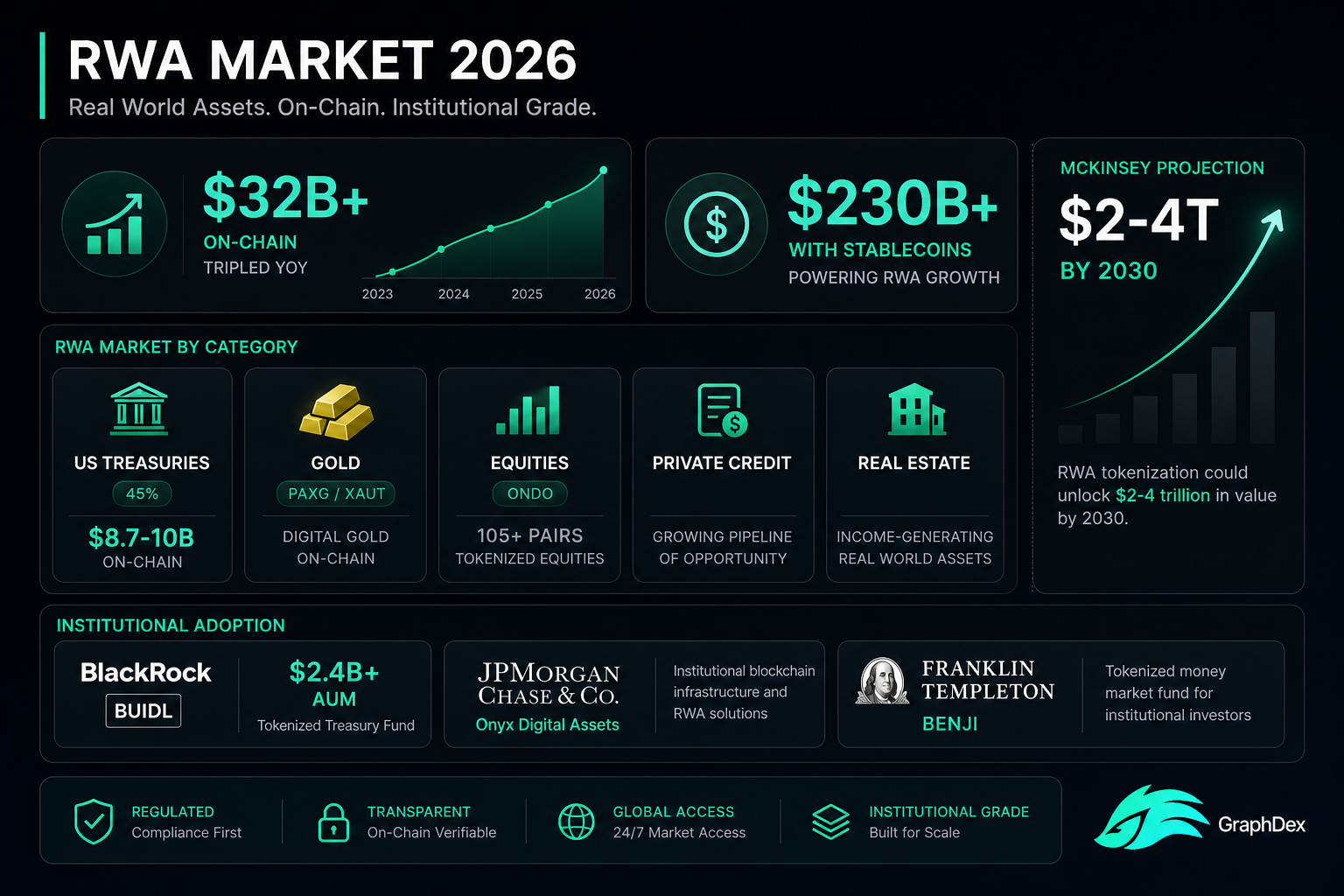
Total on-chain RWAs: Over $32 billion (excluding stablecoins) as of May 2026, tripled in a single year. When stablecoins are included, the broader RWA-related on-chain economy exceeds $230 billion.
Category breakdown:
- US Treasuries and government bonds: ~$8.7-10 billion (approximately 45% of the tokenized RWA market). The largest category by far.
- Tokenized gold: PAX Gold (PAXG) and Tether Gold (XAUT) dominate. Gold reaching all-time highs above $4,500 per ounce in 2025 drove significant interest.
- Tokenized equities: The fastest-growing new category. MEXC now lists over 105 Ondo tokenized stock trading pairs.
- Private credit: Lending against off-chain debt, securitized and tokenized
- Real estate: Fractional ownership of property
- Commodities: Beyond gold, other commodities are being tokenized
Institutional momentum:
- BlackRock BUIDL: Over $2.4 billion AUM, live on Ethereum/Solana/Polygon/Arbitrum/Avalanche/Optimism/Aptos. Filed two new tokenized fund structures with the SEC in May 2026.
- JPMorgan: Active in tokenization through Onyx and partnerships
- Franklin Templeton: BENJI token tokenizes a money market fund
- Fidelity: Tokenizing funds reflecting broader TradFi industry momentum
- Circle USYC: Tokenized money market fund
- Ondo Finance: OUSG (tokenized exposure to BlackRock SHV ETF) and USDY are major retail-accessible RWA products
The level of institutional capital flowing into RWAs signals that this isn't a speculative crypto narrative — it's traditional finance recognizing blockchain rails as legitimate infrastructure for issuing and trading financial assets.
The Major RWA Asset Classes
Each RWA category has distinct mechanics and use cases worth understanding.
1. Tokenized US Treasuries
The largest category. Treasury bonds are safe, yield-bearing assets — and tokenizing them brings that yield on-chain with 24/7 settlement.
How it works: An asset manager (BlackRock, Franklin Templeton, Ondo) acquires Treasury bonds and holds them with a regulated custodian. They issue blockchain tokens representing fractional ownership of the fund. Token holders earn yield from the underlying Treasuries (typically 3.5-4%+ APY after fees), paid via daily rebasing or token appreciation.
Major products:
- BlackRock BUIDL (USD Institutional Digital Liquidity Fund): $2.4B+ AUM, Treasury and repo exposure, 3.5-4% yield, USDC redemption, multi-chain
- Franklin Templeton BENJI: Tokenized money market fund
- Ondo OUSG: Tokenized exposure to BlackRock SHV ETF (retail-accessible)
- Ondo USDY: Tokenized yield-bearing token
- Circle USYC: Tokenized money market fund
For users, this is essentially a savings account with US Treasury yield, settled on-chain, fully liquid.
Explore Solana DeFi and RWAs on GraphDex
2. Tokenized Gold
Gold reached all-time highs above $4,500 per ounce in 2025, driving interest in tokenized versions.
Major products:
- PAX Gold (PAXG): Each token backed 1:1 by an ounce of physical gold stored in professional vaults
- Tether Gold (XAUT): Same model, alternative provider
Tokenized gold combines gold's stability and store-of-value characteristics with crypto's portability and programmability. You can hold a fractional ounce, transfer it instantly globally, and use it as collateral in DeFi — none of which is practical with physical gold.
3. Tokenized Equities
The fastest-growing new category. Tokenized stocks let blockchain users access equity exposure without leaving DeFi.
Ondo Finance launched a major tokenized stock product line. MEXC lists 105+ Ondo tokenized stock trading pairs — among the broadest RWA equity coverage of any major exchange. Other platforms are expanding similar offerings.
The appeal: equities trade only during market hours in traditional finance; tokenized versions trade 24/7. International access without complex broker setups. Fractional shares accessible to anyone with a wallet.
4. Private Credit
A growing institutional segment. Private loans, structured credit, and securitized debt are being tokenized — typically for accredited or institutional investors.
Notable example: World Liberty Financial tokenizes interest on loans from the Trump International Hotel Maldives, turning structured credit into regulated digital assets. Mikro Kapital tokenizes microfinance debt for institutional investors.
5. Real Estate
Tokenizing real estate enables fractional ownership of properties — letting users buy a fraction of a $1M property for $1,000. Adoption has been slower than tokenized financial assets due to legal complexity, but it remains a major target for RWA growth.
6. Commodities Beyond Gold
Tokenized versions of other commodities (silver, oil, agricultural products) are emerging, though gold dominates current commodity RWA volume.
How RWA Tokenization Works
The general flow of tokenizing a real-world asset follows several steps:
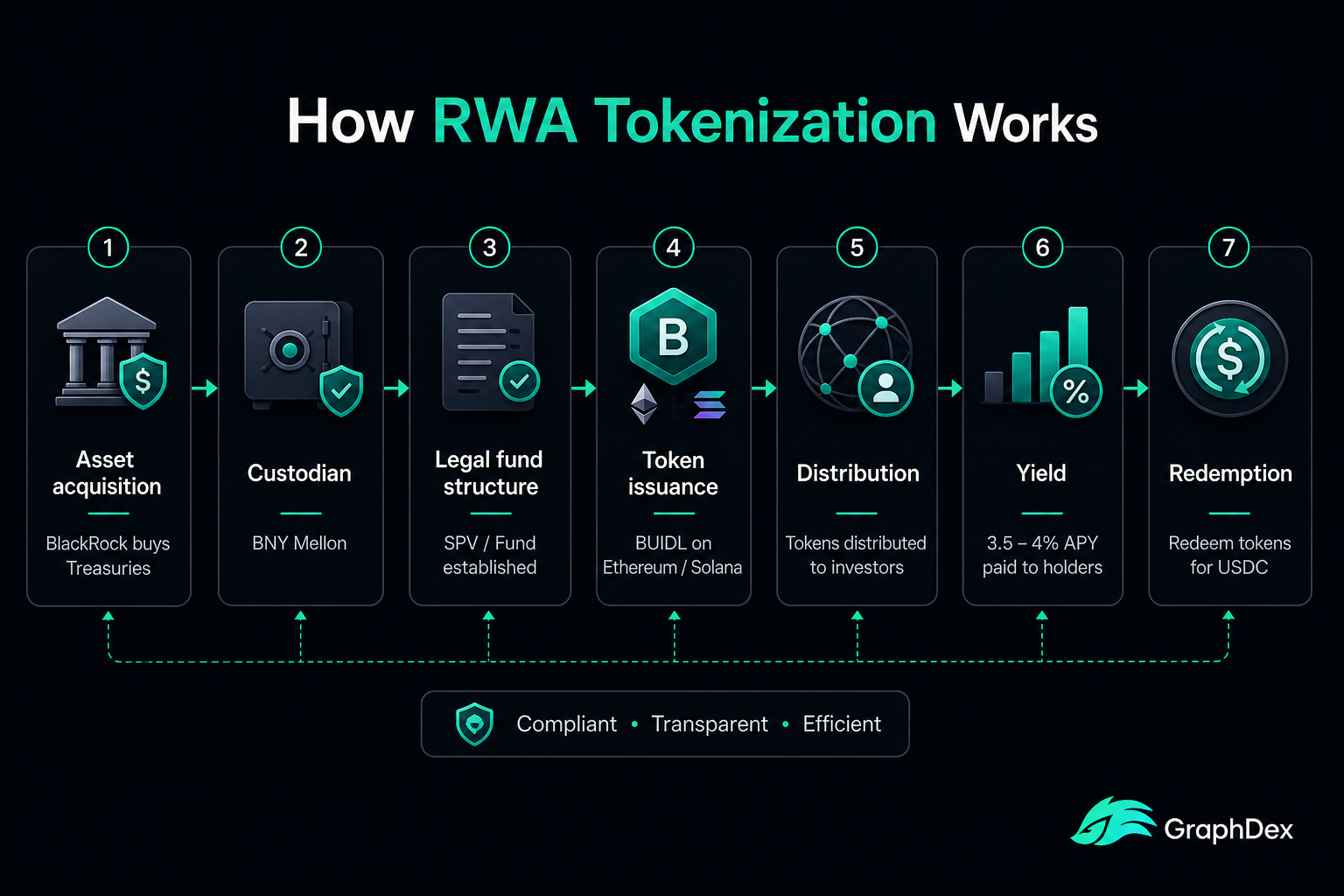
1. Asset acquisition. An issuer (BlackRock, Ondo, etc.) acquires the underlying asset — Treasuries, gold, equities, real estate.
2. Custodian arrangement. A regulated custodian (Bank of New York Mellon, Brink's, similar institutions) holds the physical or financial asset off-chain.
3. Legal structuring. The issuer creates a legal vehicle (typically a fund or special-purpose entity) that owns the asset and issues tokens representing fractional ownership claims.
4. Token issuance. Blockchain tokens are minted representing shares in the fund. Standards vary — some use ERC-20 (Ethereum), some use SPL (Solana), some use specialized standards.
5. Distribution and trading. Tokens are sold to investors (often KYC'd for compliance) and can be traded on supported platforms.
6. Yield distribution. Income from underlying assets (Treasury coupons, dividends, rent) is distributed to token holders through smart contracts.
7. Redemption. Token holders can redeem tokens for the underlying asset's value through the issuer's process — typically settled in USDC or other stablecoins.
This creates programmable financial assets: traditional securities that benefit from blockchain rails (instant settlement, 24/7 trading, composability with DeFi protocols, fractional ownership) while maintaining the legal and economic structure of regulated traditional assets.
Why RWAs Matter (And the Trade-Offs)
RWA tokenization solves real problems — but it's not without trade-offs.
The advantages:
- 24/7 settlement. Traditional Treasury trades settle in days; tokenized Treasuries settle in seconds, anytime.
- Global access. Anyone with a wallet can access US Treasury yields, regardless of geography or bank account.
- Fractional ownership. $100 buys a fraction of a Treasury fund; $1,000 buys a fraction of a property.
- Composability with DeFi. Tokenized RWAs can be used as collateral on lending protocols, in DEX pools, in yield strategies.
- Transparency. On-chain holdings and transactions are publicly verifiable.
- Lower intermediation costs. Cutting out traditional brokers and processors reduces fees.
The trade-offs:
- Centralization at the asset layer. The underlying asset is held by a centralized custodian. If they fail, your token's backing is at risk.
- Regulatory uncertainty. RWA tokens typically fall within securities classifications. Rules vary by jurisdiction and continue evolving.
- KYC requirements. Many institutional RWAs require KYC verification — limiting the permissionless aspect of DeFi.
- Issuer counterparty risk. Your token is only as good as the issuer's promise to honor redemptions.
- Smart contract risk. Like all blockchain tokens, RWAs carry smart contract risk in addition to TradFi risks.
The net assessment: for institutional-grade products from reputable issuers (BlackRock, Franklin Templeton), RWAs offer real value — TradFi yields on blockchain rails. For users prioritizing permissionless access and minimal regulation, RWAs trade some of these properties for the connection to traditional assets.
The Regulatory Landscape
RWAs sit at the intersection of crypto and securities law — making regulation a critical factor.
United States. Most institutional RWAs are issued through securities frameworks (Reg D, Reg S, etc.) and require accredited investor status or KYC. The CLARITY Act is nearing Senate markup as of 2026, which would provide clearer rules. The US House Financial Services Committee held its most significant hearing ever on real-world asset tokenization in 2026.
Europe (MiCA). The Markets in Crypto-Assets regulation provides comprehensive crypto rules including for tokenized financial instruments.
GENIUS Act (US). Signed July 2025 with implementation rules due July 18, 2026 — focused on stablecoins but with implications for the broader RWA ecosystem.
The trend: Regulatory clarity is improving rapidly. Institutional adoption (BlackRock, JPMorgan, Franklin Templeton) signals that traditional finance views the regulatory direction as favorable enough to invest meaningfully. Rules continue to evolve — always check current regulations for your jurisdiction.
RWAs on Solana
Solana has become a significant chain for RWA deployment, alongside Ethereum.
Major Solana RWA deployments:
- BlackRock BUIDL is live on Solana (alongside Ethereum, Polygon, Arbitrum, Avalanche, Optimism, Aptos)
- Ondo Finance products are accessible on Solana
- Tokenized stocks and other RWAs are increasingly Solana-deployed
Why Solana for RWAs: Solana's near-zero fees and sub-second finality make RWA transactions economically viable that aren't on Ethereum L1. Settlement matters in institutional contexts; Solana's stress-test performance (during October 2025's largest crypto liquidation event, median fees stayed at $0.007 while ETH/Arbitrum spiked to $100) supports institutional confidence.
For Solana users, accessing RWA yields is increasingly straightforward — established Solana DEXs and trading interfaces support major RWA tokens, letting you hold tokenized Treasuries alongside SOL, stablecoins, and other assets.
How GraphDex Fits In
GraphDex is built natively for Solana, leveraging Solana's growing RWA ecosystem alongside its strengths in DEX trading, prediction markets, and active trading.
For users interested in stable yields, GraphDex offers up to 17% APY on stablecoins and SOL through a fee-based model — substantially higher than tokenized Treasury yields (3.5-4%). The difference: GraphDex's yield comes from real platform trading fees, while tokenized Treasuries provide pure exposure to government bond yields.
These are complementary rather than competitive. Sophisticated users might hold tokenized Treasuries (BUIDL, OUSG) for stable, regulated TradFi exposure AND use GraphDex for fee-based yield, integrated trading, prediction markets, and the Pulse feed for token discovery. Both approaches earn yield from real sources; they capture different value streams.
For Solana-native users specifically, GraphDex consolidates Solana DEX trading, prediction markets via Polymarket, copytrading, AI signals, and staking — all in one non-custodial terminal via Privy. As RWAs continue growing on Solana, terminals like GraphDex naturally integrate these products into the broader trading experience.
Trade Solana RWAs and tokens on GraphDex
Frequently Asked Questions
What is RWA in crypto? RWA stands for Real-World Assets — tokenized versions of traditional financial assets (US Treasuries, gold, equities, real estate, private credit) issued on a blockchain. The tokens represent legal claims on the underlying assets, which are held by regulated custodians off-chain. The market exceeded $32B in 2026 (excluding stablecoins).
What are the best RWA tokens to invest in? Top institutional-grade products include BlackRock BUIDL (Treasuries, $2.4B+ AUM), Ondo OUSG (retail-accessible Treasury exposure), Franklin Templeton BENJI (money market fund), PAX Gold (PAXG, tokenized gold), and Tether Gold (XAUT). Choice depends on your goals — Treasury yield, gold exposure, or other asset classes. This is not investment advice.
How does RWA tokenization work? An issuer (BlackRock, Ondo, etc.) acquires real assets and holds them with a regulated custodian. They create a legal vehicle owning the assets, mint blockchain tokens representing fractional ownership, and distribute them to investors. Yield from underlying assets is distributed to token holders, and tokens can be redeemed for asset value through the issuer's process.
What yields do tokenized Treasuries offer? Tokenized US Treasury products like BlackRock BUIDL offer 3.5-4%+ APY (depending on prevailing rates), reflecting the underlying Treasury yield minus management fees. This is comparable to traditional Treasury yields but accessible 24/7 on-chain with global reach. Higher yields are available in other RWA categories (private credit) at higher risk.
Are RWAs safe? Major institutional RWAs (BlackRock BUIDL, Franklin BENJI) have the same risk profile as their underlying assets plus blockchain smart contract risk. Tokenized Treasuries carry US government credit risk (very low) plus issuer counterparty risk (custodian, asset manager) plus smart contract risk. Smaller or less-established RWA products carry higher risk. Always assess the issuer and underlying asset.
Where are RWAs deployed? Originally Ethereum-dominant, RWAs now span multiple chains. BlackRock BUIDL is live on Ethereum, Solana, Polygon, Arbitrum, Avalanche, Optimism, and Aptos. Solana has become a significant chain for RWAs due to its low fees and fast settlement. Most institutional products start on Ethereum and expand to other chains.
How big will the RWA market get? McKinsey projects $2-4 trillion by 2030; the BCG-Ripple report gives an $18.9 trillion estimate. The market exceeded $32B in 2026 (excluding stablecoins) and tripled in one year. Institutional adoption (BlackRock, JPMorgan, Franklin Templeton) plus regulatory clarity (MiCA, CLARITY Act, GENIUS Act) point to continued strong growth, though projections are speculative.
About This Guide
This guide is published by the GraphDex Research team — analysts and traders building the infrastructure for digital asset trading on Solana. Our content is based on live RWA data, current institutional developments, and publicly available information.
Sources & data: Market figures, AUM data, and projections reflect publicly available information as of 2026 and change continuously. RWAs carry risks including underlying asset risk, custodian risk, and smart contract risk. This guide is educational and not financial or legal advice — always do your own research.
GraphDex is the infrastructure for digital asset trading — trade, predict, and earn in one place. Learn more at graphdex.io.
Last reviewed: May 2026 · GraphDex Research
The infrastructure for digital asset trading. Trade, predict, stake, repeat. graphdex.io