By GraphDex Research · Reviewed for accuracy May 2026
Quick Answer
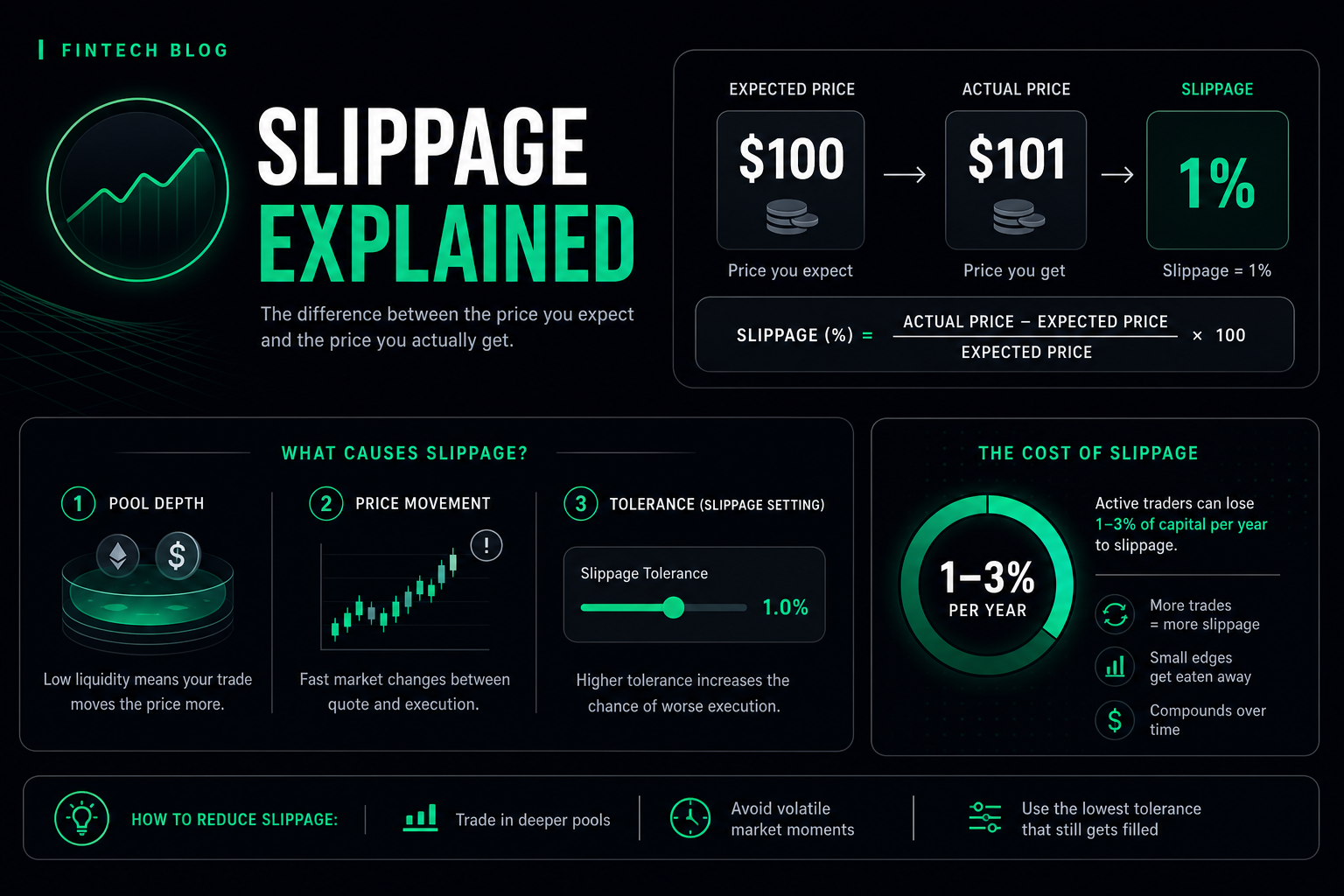
Slippage is the difference between the price you expected and the price your trade actually executes at. Key points:
- Why it happens: pool depth, price moving during execution, and the slippage tolerance you set
- Slippage tolerance is the maximum price difference you'll accept — set too low, the trade fails; too high, you risk a bad fill and MEV attacks
- Recommended settings: 0.5-1% for stablecoins/major tokens, 1-2% for altcoins, 2-3% for low-liquidity tokens
- Solana advantage: 400ms block times mean less price movement during execution than Ethereum's 12-second blocks
- Danger: slippage above 5% makes you a prime target for MEV sandwich bots
Set slippage as low as practical, use MEV protection, and trade deep-liquidity tokens.
Trade with MEV protection on GraphDex
Key Takeaways
- Slippage is the gap between expected and actual execution price; it silently costs active traders 1-3%/year.
- Slippage tolerance sets the max acceptable price move — too low fails the trade, too high invites bad fills and MEV.
- Recommended: 0.5-1% for major tokens, 1-2% for altcoins, 2-3% for low-liquidity tokens.
- Solana's fast blocks reduce slippage versus slower chains; high slippage makes you an MEV target.
What Is Slippage?
Slippage in crypto is the difference between the price you expected and the price your trade actually executes at. It sounds minor until you realize it directly affects what you pay when buying, what you receive when selling, and whether a trade idea still makes sense after execution.
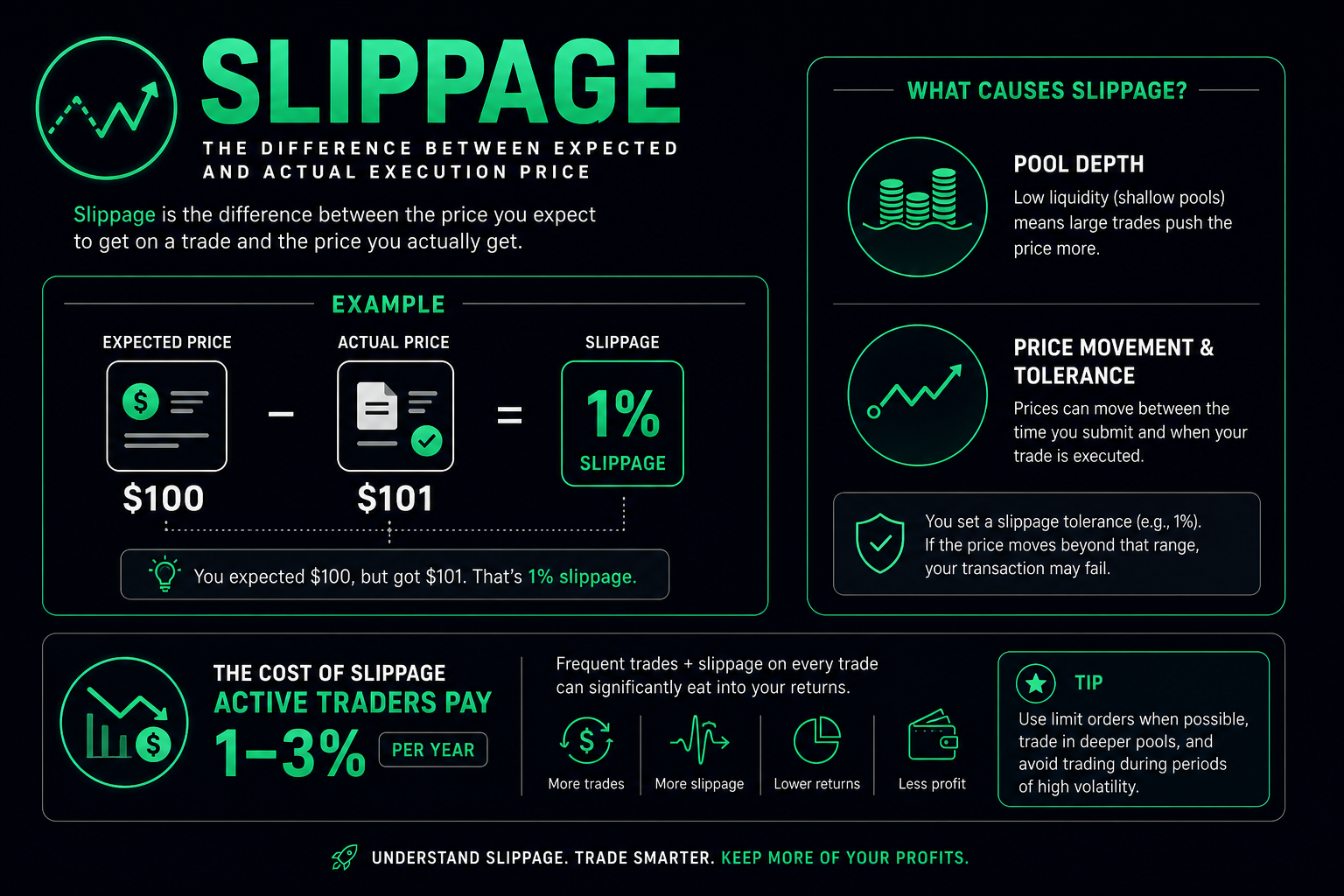
A simple example: you place a market buy for a token at $100, but it fills at $101. That $1 difference is slippage — and it cost you 1% before you even checked the chart. On a $10,000 position, that's $100 gone instantly.
This matters on both centralized and decentralized exchanges, but the mechanics differ. On a CEX, slippage comes from walking through the order book — large orders consume multiple price levels. On a DEX, it comes from pool depth, price movement during execution, and the slippage tolerance you allow. Either way, the result is the same: the final fill isn't the price you thought you were getting.
Slippage can technically work for or against you (you might occasionally get a better price), but in practice, especially with market orders in volatile conditions, it usually works against you. Over a year of active trading, slippage silently eats 1-3% in hidden execution losses — often more than technical analysis ever makes back.
Why Slippage Happens
Several factors cause slippage. Understanding them helps you control it.
Pool depth / liquidity. On a DEX using an automated market maker (AMM), your trade moves along the pricing curve. The less liquidity in the pool relative to your trade size, the more the price moves against you. Big trades in shallow pools cause large slippage.
Price movement during execution. Between when you submit a trade and when it confirms, the price can move. The longer the block time, the more time for the price to shift. This is especially acute during pumps — you submit a buy, the token moons 15% while you wait for block inclusion, and your trade reverts because slippage exceeded your tolerance.
Order book depth (CEX). On centralized exchanges, large orders walk through multiple order book levels, filling progressively worse as they consume available liquidity.
Volatility. In fast-moving markets, the quote can change before your trade executes. High volatility amplifies all the above.
Your slippage tolerance. The higher you set it, the more price movement you accept — and the worse your potential fill.
Slippage Tolerance Explained
Slippage tolerance is the maximum price difference you're willing to accept for a trade — usually set as a percentage when swapping on a DEX or in a wallet.
Here's how it works: if you set 1% slippage tolerance buying SOL at $100, you're accepting a final price anywhere between $99 and $101. If the price moves outside that range before confirmation, your wallet or DEX automatically cancels the trade to protect you from a worse deal.
This creates a trade-off:
- Too low: your transaction may fail if the price moves even slightly — and on a failed transaction, you still pay the network fee (a small SOL amount on Solana) without getting the tokens.
- Too high: you accept significant price movement against you, risking a much worse fill — and you become a target for MEV bots.
The goal is finding the sweet spot for each trade based on the token's liquidity, volatility, and how many people are trading it simultaneously.
Recommended Slippage Settings
There's no universal "best" slippage — it depends on the token's liquidity, volatility, and current trading conditions. But here are practical starting ranges based on real trading:
| Token Type | Recommended Slippage |
|---|---|
| Stablecoins (USDC, USDT) | 0.1-0.5% |
| Major tokens (SOL, ETH, BTC) | 0.5-1% |
| Established altcoins | 1-2% |
| Lower-liquidity altcoins | 2-3% |
| New/volatile memecoins | 3-10% (with caution) |
| High-demand launches | Higher, but high MEV risk |
The principle: set slippage as low as the token's liquidity allows. For deep, liquid markets, 0.5-1% works. For thin or volatile tokens, you may need more, but every percentage point above ~2-3% is risk you're accepting — both worse fills and MEV exposure.
Avoid the temptation to set 20%+ slippage to "force" a trade through. On illiquid tokens, this can mean buying at a dramatically worse price, and it paints a target on your back for sandwich bots.
The Hidden Danger: Slippage and MEV
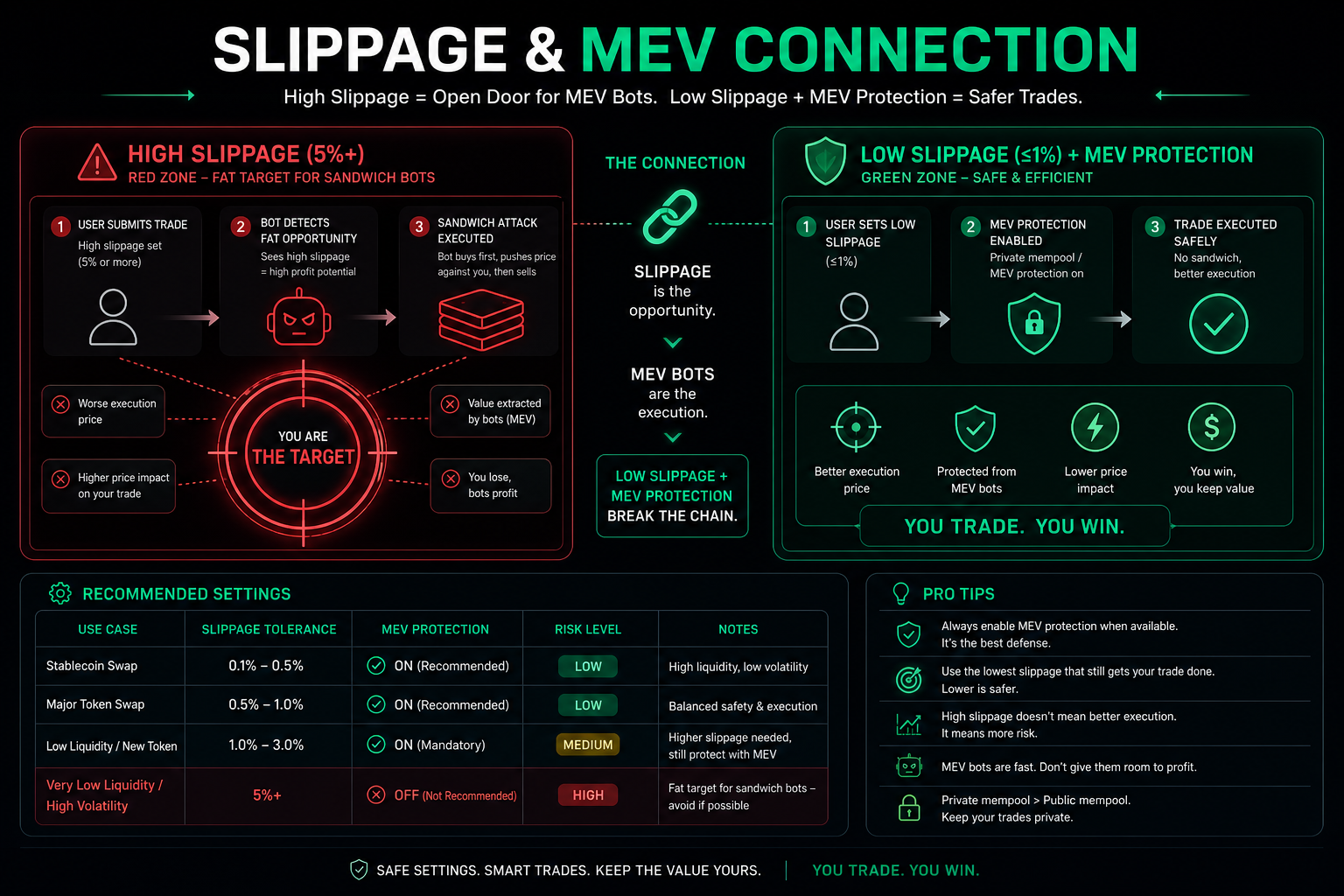
High slippage tolerance isn't just about bad fills — it directly enables MEV attacks, costing traders money.
When you set high slippage (5%+), you tell the network you'll accept a fill up to 5% worse than expected. MEV sandwich bots specifically target traders with high slippage, because that gap is their profit margin. The bot front-runs your trade (buying first to push the price up), lets your trade fill at the inflated price within your generous slippage tolerance, then sells right after — pocketing the difference.
This is why the single most effective defense against sandwich attacks is keeping slippage as low as practical. A smaller slippage window reduces the profit available to attackers, making your trade less attractive to sandwich. Bots specifically hunt trades with slippage above 5%.
The combined defense:
- Keep slippage low — reduces both bad fills and MEV profitability
- Use MEV-protected routing — private mempools or relays (Jito on Solana, Flashbots on Ethereum) hide your trade from bots
- Use DEX aggregators — route through multiple pools for better prices and often built-in protection
This is a key reason quality trading terminals build in MEV protection alongside slippage controls — the two work together to protect your execution.
Get built-in MEV protection and smart routing on GraphDex
Why Solana Has a Slippage Advantage
Solana's architecture gives traders a genuine slippage advantage over slower chains.
The key factor is block time. Ethereum blocks come every ~12 seconds on average; Solana every ~400 milliseconds. That gap matters enormously: the longer the block time, the more time for the price to move between when you submit a trade and when it executes. Solana's near-instant confirmation dramatically reduces the window for slippage to occur.
This is why Solana traders complain less about slippage than Ethereum traders during normal conditions — faster blocks mean less price movement during execution. Combined with Solana's low fees, this makes high-frequency and active trading far more viable: you can execute quickly, with minimal slippage, without fees eroding returns.
That said, Solana isn't immune. During memecoin launches and high-demand spikes, thousands of transactions rush the same pool, congestion rises, and slippage increases. Low-liquidity tokens — common in the memecoin space — still cause significant slippage regardless of block speed. The Solana advantage reduces slippage from price movement during execution, but it can't eliminate slippage from shallow liquidity or your own large trade size.
How to Reduce Slippage
Practical steps to minimize slippage losses:
Use limit orders instead of market orders. The single most effective way to eliminate slippage is to stop using market orders except for urgent entries/exits. A limit order executes only at your specified price or better, eliminating negative slippage (though it may not fill). Many Solana wallets and DEXs support limit orders.
Set slippage tolerance appropriately. Low enough to protect you, high enough to fill. Match it to the token's liquidity — 0.5-1% for major tokens, more only as liquidity demands.
Trade deep-liquidity tokens and pools. Slippage is driven by liquidity. Deeper pools and higher-volume tokens mean less price impact from your trade.
Use DEX aggregators. Tools like Jupiter (Solana's largest aggregator) route your trade across multiple pools to find the best price, minimizing slippage and market impact.
Split large trades. Breaking a big trade into smaller pieces reduces the price impact of each, lowering total slippage.
Use MEV protection. Protected routing prevents bots from exploiting your slippage tolerance via sandwich attacks.
Trade on fast chains. Solana's 400ms blocks inherently reduce slippage from execution delay versus slower chains.
Avoid trading during extreme volatility unless necessary — major news, whale moves, and crashes create unavoidable slippage.
How GraphDex Helps Minimize Slippage
For Solana traders, GraphDex integrates several slippage-reducing features in one terminal:
- MEV protection — built-in protected routing prevents sandwich bots from exploiting your slippage tolerance
- Smart routing — finds efficient execution paths across Solana liquidity
- Solana's speed — trading on Solana's 400ms blocks inherently reduces execution-delay slippage
- Token safety via Bubble Maps — avoid the thin-liquidity scam tokens that cause the worst slippage
Because GraphDex combines these with the Pulse feed, copytrading, and staking up to 17% APY, you trade in an environment designed to protect execution quality. For active traders making many trades, controlling slippage and MEV directly improves net returns — and having protection built in beats manually configuring it for every trade.
Trade with protected execution on GraphDex
Frequently Asked Questions
What is slippage in crypto trading? Slippage is the difference between the price you expected and the price your trade actually executes at. It happens due to pool depth, price movement during execution, and your slippage tolerance setting. For example, expecting to buy at $100 but filling at $101 is 1% slippage. It silently costs active traders 1-3% per year.
What slippage tolerance should I set? Set it as low as the token's liquidity allows: 0.1-0.5% for stablecoins, 0.5-1% for major tokens (SOL, ETH, BTC), 1-2% for established altcoins, and 2-3% for lower-liquidity tokens. New volatile memecoins may need more, but high slippage (5%+) risks bad fills and makes you a target for MEV bots.
Why does my transaction fail with low slippage? If the price moves beyond your slippage tolerance before your trade confirms, the trade reverts to protect you from a worse fill. On Solana, you still pay a small network fee for the failed transaction. During volatile or congested conditions, you may need slightly higher slippage for trades to fill.
Does high slippage attract MEV bots? Yes. Sandwich bots specifically target traders with slippage above 5%, because your generous tolerance is their profit margin. They front-run your trade, let it fill at an inflated price within your slippage, then sell after. Keeping slippage low is the single most effective defense against sandwich attacks.
Why is slippage lower on Solana than Ethereum? Solana's ~400ms block times versus Ethereum's ~12 seconds mean far less time for the price to move between trade submission and execution. Faster confirmation reduces the slippage window. Combined with low fees, this makes Solana well-suited for active trading, though low-liquidity tokens still cause slippage.
How can I avoid slippage entirely? You can't entirely, but you can minimize it: use limit orders (which fill only at your price or better, eliminating negative slippage), trade deep-liquidity tokens, use DEX aggregators like Jupiter, split large trades, use MEV protection, and trade on fast chains like Solana. Limit orders are the most effective single tool.
What's the difference between slippage and fees? Fees are explicit costs charged by the platform/network for a trade. Slippage is the implicit cost of your fill price differing from expected. Both reduce returns, but slippage is often larger and less visible for active traders. Controlling slippage can save more than minimizing fees alone.
About This Guide
This guide is published by the GraphDex Research team — analysts and traders building the infrastructure for digital asset trading on Solana. Our content is based on live platform data, current market conditions, and hands-on experience.
Sources & data: Slippage figures and recommended settings reflect publicly available information as of 2026 and vary by market conditions. Trading carries risk. This guide is educational and not financial advice — always do your own research.
GraphDex is the infrastructure for digital asset trading — trade, predict, and earn in one place. Learn more at graphdex.io.
Last reviewed: May 2026 · GraphDex Research
The infrastructure for digital asset trading. Trade, predict, stake, repeat. graphdex.io