Quick Answer
AI is transforming prediction markets in three ways:
- AI agents trade autonomously — analyzing data and executing 24/7 without human intervention
- AI estimates probability — ingesting news, prices, and signals to find mispriced markets
- AI powers market making — adjusting liquidity in real time around fast-moving events
The result: AI agents now outperform most human traders. The competitive response for humans is to use AI-powered tools — copytrading proven performers (including AI agents), and terminals with AI signal analysis like GraphDex.
Trade prediction markets with AI-powered tools on GraphDex
The Stat That Changes Everything
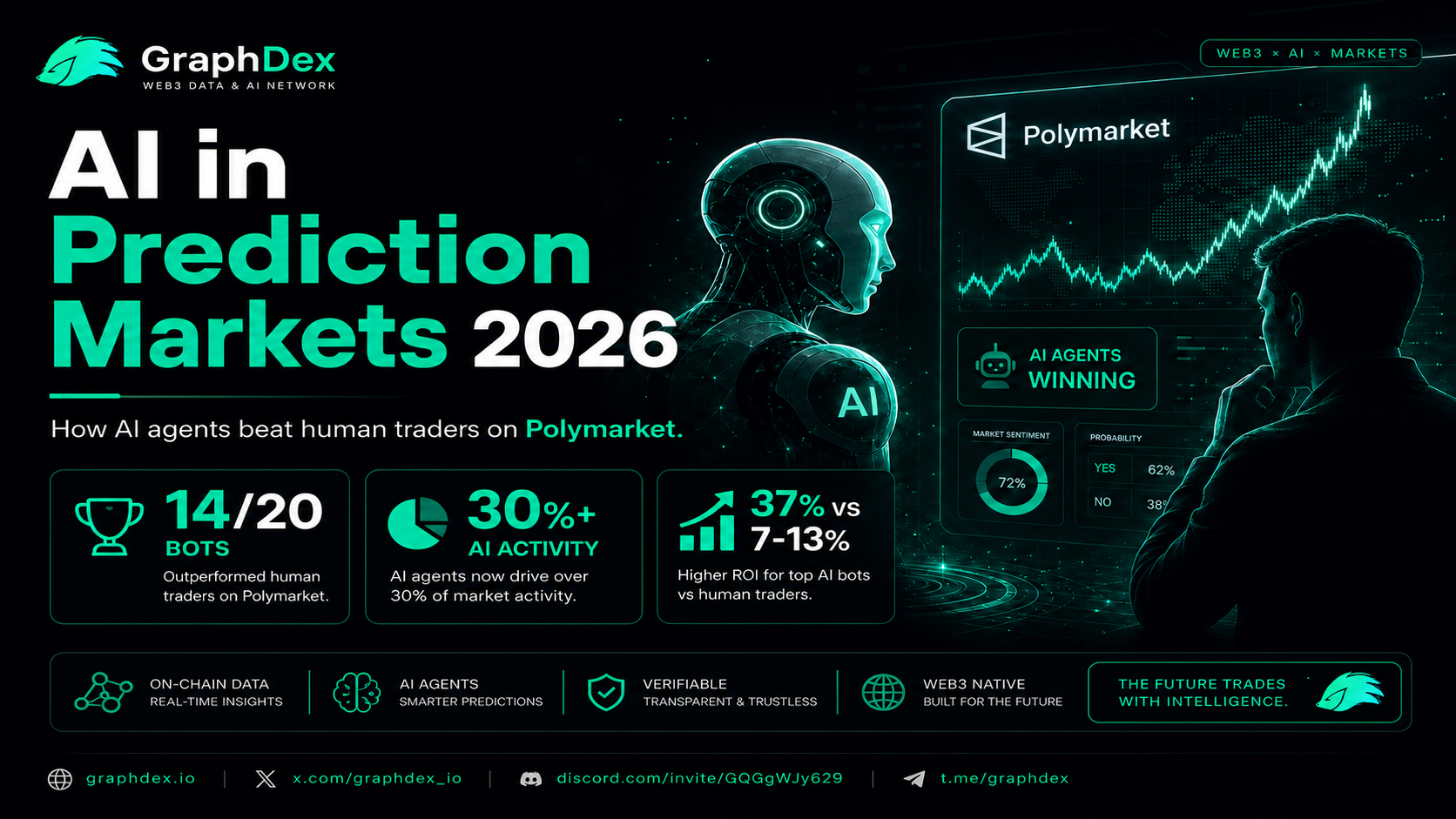
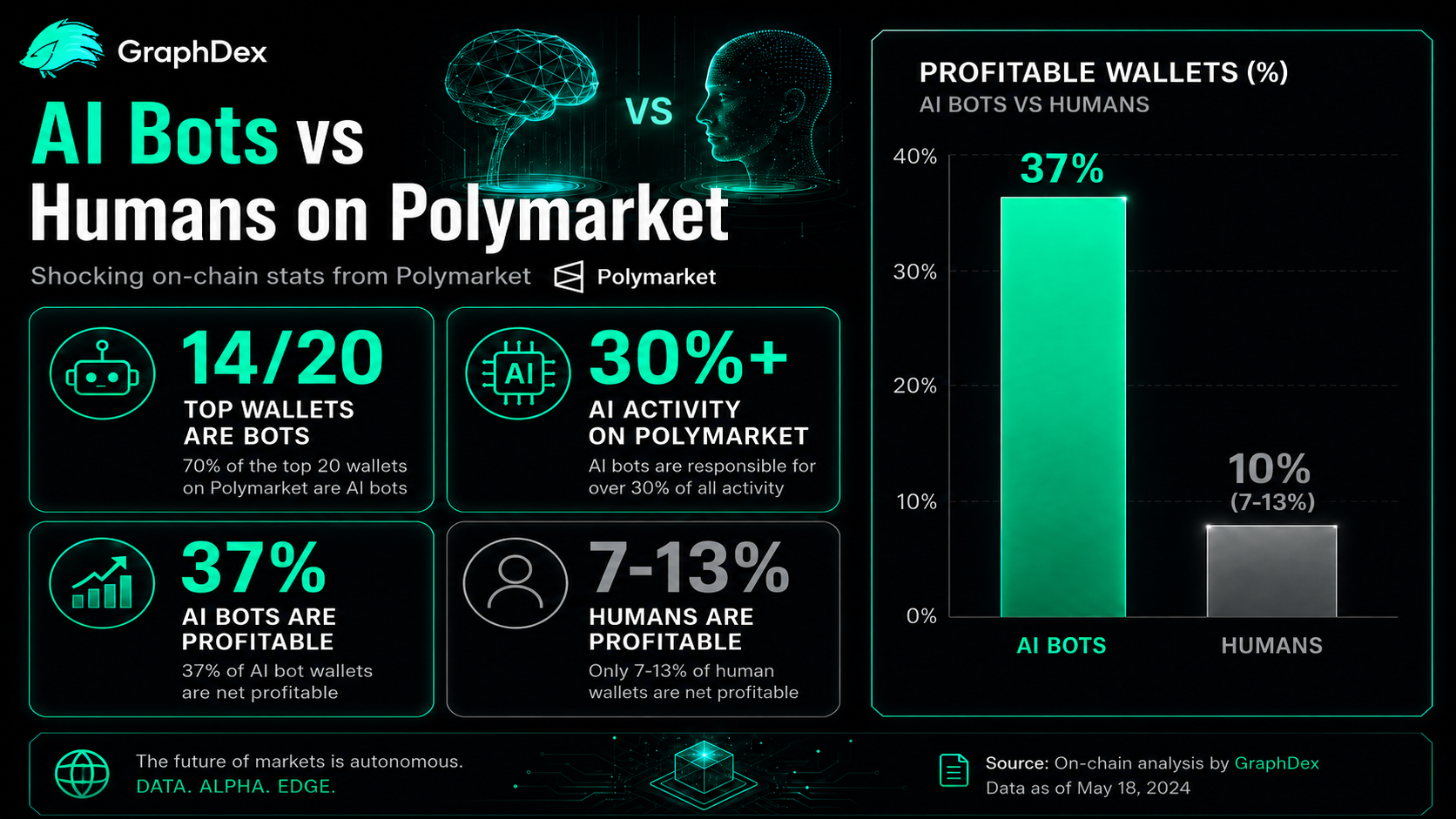
A review of Polymarket's public leaderboard found something striking: 14 of the 20 most profitable wallets are bots. AI agents now represent over 30% of wallet activity on the platform, and more than 37% of those agents report positive profit and loss.
Compare that to human traders, where only 7% to 13% consistently turn a profit. The gap isn't subtle — it's structural, and it's widening every month as autonomous agents get faster, smarter, and cheaper to deploy.
This is the defining shift in prediction markets in 2026. The markets that began as a way to aggregate human wisdom are increasingly driven by machines. For human traders, this is both a threat and an opportunity — depending on whether you compete against the machines or trade alongside them.
What Is an AI Agent in Prediction Markets?
An AI agent in the prediction market context is an autonomous software system that analyzes data, forms probability estimates about real-world events, and executes trades without human intervention.
Unlike simple scripted bots that follow fixed rules, modern AI agents use natural language processing and machine learning. They ingest vast amounts of information — news, price data, social signals, on-chain activity — form probability estimates, and act on mispricings faster than any human could.
The most visible example is Polystrat, an autonomous trading agent built on the Olas protocol, launched on Polymarket in early 2026. Unlike script-based bots, Polystrat uses natural language processing to let users set high-level goals in plain text. The agent then autonomously selects markets across sports, politics, and economics using live data and on-chain liquidity.
Within its first month, Polystrat executed over 4,200 trades with single-trade returns as high as 376%. Its agents achieve win rates between 59% and 64% in technology-specific markets — roughly two to three times the success rate of human traders on the same platform.
How AI Agents Trade Prediction Markets
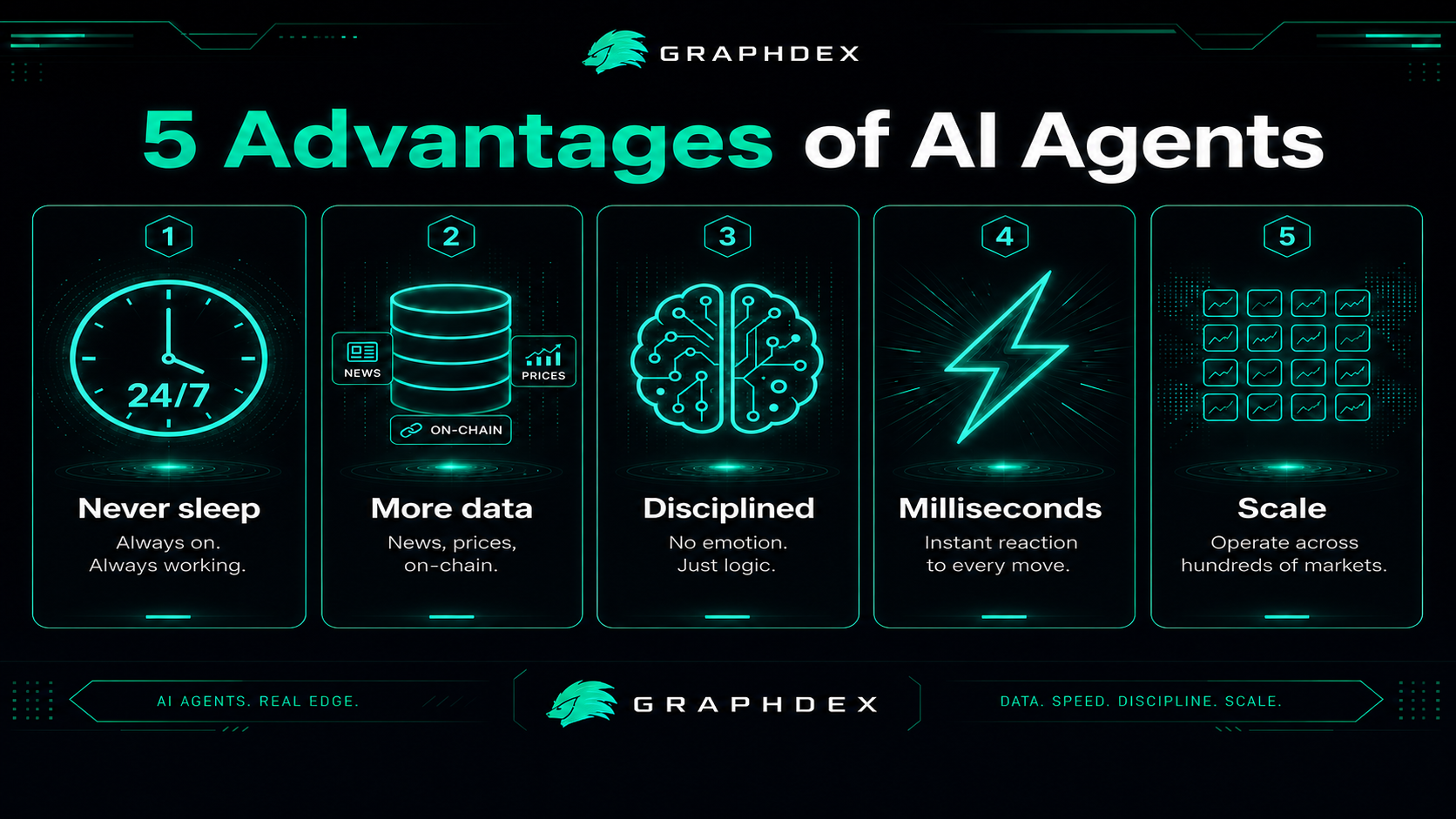
AI agents have structural advantages over human traders that explain their outperformance.
They never sleep. Markets move 24/7. News breaks at 3 AM. An AI agent reacts instantly while human traders sleep, work, or lose focus. As Polystrat's creators put it: while humans sleep, work or lose focus, the agent keeps trading.
They process more data. AI systems ingest news, price data, and alternative signals to estimate event probabilities and identify mispricings far faster than humans can read and analyze.
They're disciplined. Humans deviate from good strategies due to emotion — fear, greed, tilt after losses. AI agents follow disciplined, data-driven approaches without emotional interference.
They react in milliseconds. Traditional analyst reports take weeks and arrive obsolete. AI-powered prediction markets price the future in milliseconds, reacting to news and announcements the moment they break.
They scale. One human trades a few markets at once. An AI agent monitors and trades hundreds simultaneously.
These advantages compound. The combination of speed, data processing, discipline, and scale is why AI agents now dominate the profitable end of Polymarket's leaderboard.
How AI Powers Probability Estimation
Beyond autonomous trading, AI is reshaping how probabilities themselves are estimated.
AI systems ingest news, price data, and alternative signals to estimate event probabilities and identify mispricings. For example, in markets predicting AI model releases, AI tools analyze developer forums, code commits, and hype cycles to inform odds. In early 2026, traders used AI sentiment analysis to predict major AI model release timing, with market probabilities shifting based on leaked benchmarks and social buzz.
This creates a feedback loop. AI agents estimate probabilities, trade on them, and their trades move prices toward more accurate values. The result is prediction markets that are even more accurate than the human-only version — because machine analysis is now part of the price.
For markets like "Which company has the best AI model this month?" or "Will Tesla sell a Cybercab for $30k or less in 2026?", AI agents process supply chain data, regulatory filings, and technical signals to inform their positions — analysis no human could perform at the same speed or scale.
How AI Powers Market Making
AI also operates on the liquidity side. AI-powered market makers adjust liquidity spreads in real time based on information flow, helping maintain orderly markets around fast-moving events.
On decentralized platforms, AI agents can route orders across chains, rebalance collateral, and reconcile oracle signals — the infrastructure work that keeps markets liquid and functioning. This automated market making improves the trading experience for everyone, tightening spreads and ensuring liquidity even during volatile, news-driven moments.
The Challenge for Human Traders
If AI agents profit at 37% while humans manage 7-13%, where does that leave human traders?
The honest answer: competing head-to-head against AI agents on speed and data processing is a losing battle. A human cannot react in milliseconds, monitor hundreds of markets, or process developer forums and regulatory filings in real time.
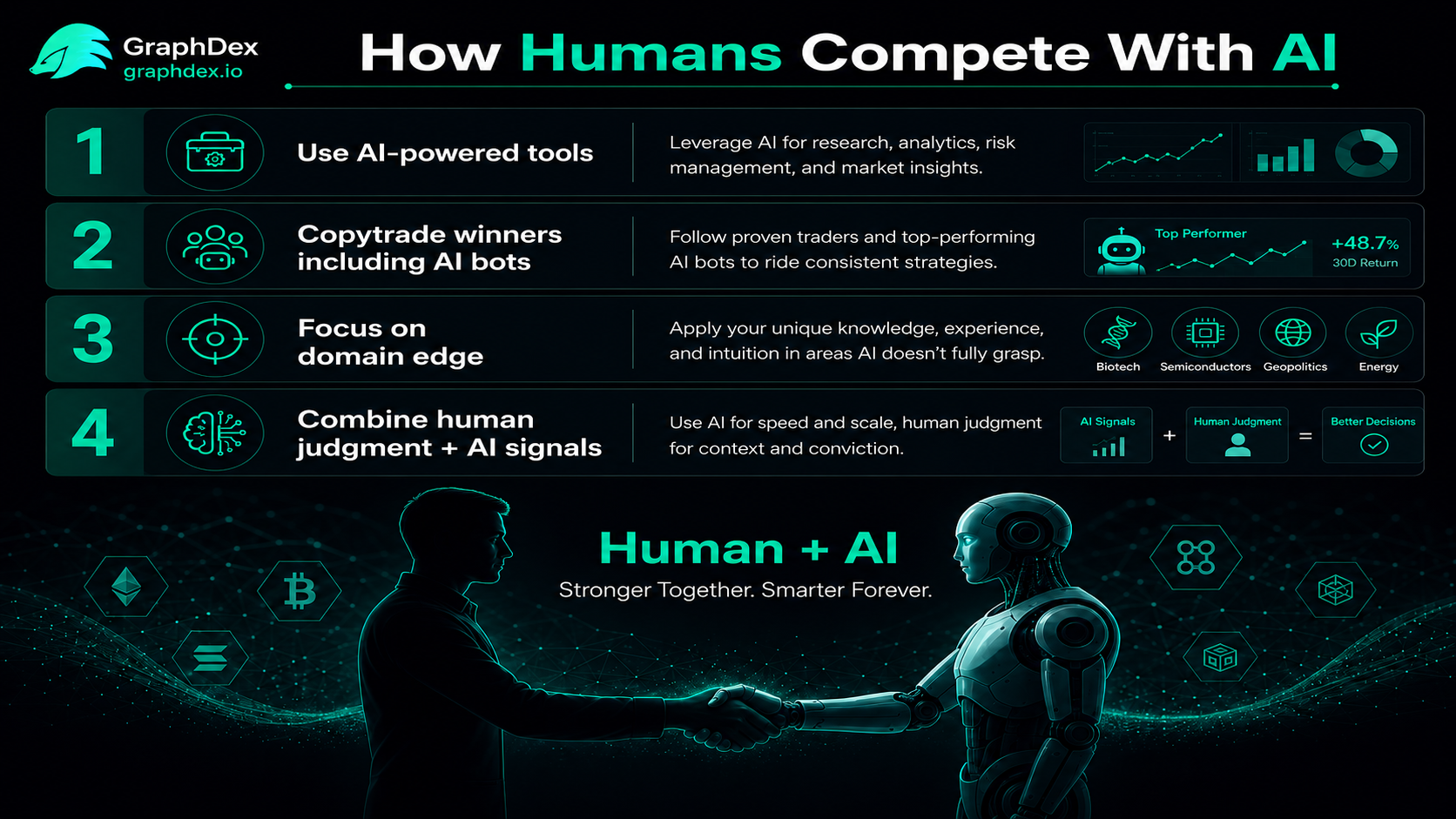
But this doesn't mean humans are obsolete. It means the winning human strategy has changed. Instead of competing against the machines, smart human traders now:
- Use AI-powered tools themselves — leveling the playing field
- Copytrade proven performers — including the profitable AI agents
- Focus on edge AI lacks — deep domain knowledge, understanding of nuanced or novel situations
- Combine human judgment with AI signals — using AI for speed and data, human judgment for context
The traders who thrive in 2026 aren't fighting the AI tide. They're riding it.
How Humans Stay Competitive: Copytrading and AI Signals
The most accessible way for human traders to stay competitive is to stop trading manually against machines and start leveraging the same advantages.
Copytrade the winners — including AI agents. Since the most profitable wallets are often bots, following them through copytrading lets you capture their edge. GraphDex copytrading ranks forecasters by PnL and win rate — whether those top performers are humans or AI agents, you can mirror their positions automatically.
Use AI signal analysis. Rather than processing data manually, use tools that bring AI analysis to you. GraphDex's AI signal layer processes on-chain activity, social momentum, and market data simultaneously — giving human traders machine-speed analysis in their decision-making.
Let automation handle execution. The speed gap is real. Copytrading and automated mirroring close it by removing the manual execution delay that costs human traders the edge.
This is the core competitive response: don't try to out-compute the machines. Use tools that give you machine-grade analysis and let you follow the machines that are already winning.
Use AI signals and copytrading on GraphDex
The Risks of AI in Prediction Markets
The rise of AI agents isn't without concerns.
Concentration of edge. If AI agents capture most of the profit, casual human traders may find it increasingly hard to win trading manually. This pushes humans toward copytrading and AI tools.
Edge decay. As more AI agents deploy similar strategies, their collective edge may compress — the same dynamic that affects any crowded strategy.
Market structure risks. A CertiK report cautioned that prediction markets face challenges including wash trading and hybrid security risks as the sector grows. AI agents operating at scale could amplify some structural risks.
Oracle and resolution risk. AI agents depend on accurate data feeds and market resolution. Manipulated oracles or ambiguous resolutions affect agents and humans alike.
The accessibility question. As AI raises the bar for profitable trading, the gap between sophisticated participants (with AI tools) and casual ones (without) widens. Access to good tools becomes the great equalizer.
Understanding these risks reinforces the strategic conclusion: human traders benefit most from tools that bring AI capabilities within reach, rather than trading unaided against an increasingly automated market.
The Future of AI in Prediction Markets
The trajectory is clear. As AI and decentralized finance continue merging, prediction markets could become one of the most advanced forms of algorithmic trading in Web3.
Several trends will define the next phase:
Agent economies — projects like Olas aim to build economies where user-owned AI agents generate value, trading on behalf of their owners who retain self-custody.
Democratized AI access — as AI trading tools become cheaper and easier to use, the advantage shifts from "having an AI agent" to "using the best tools," accessible to ordinary traders.
Human-AI collaboration — the winning model is increasingly hybrid: AI handles data processing, speed, and execution; humans provide judgment, context, and strategic direction.
Integration with broader trading — AI-powered prediction markets won't stay siloed. Terminals like GraphDex that integrate prediction markets with crypto trading and AI signals point toward a future where AI analysis spans all of a trader's activity.
The traders and platforms that invest early in AI-powered tools will gain a significant edge as prediction markets mature into a sophisticated, machine-driven asset class.
Get AI-powered prediction market tools on GraphDex
Frequently Asked Questions
Are AI agents really beating humans on Polymarket? Yes. A review of Polymarket's leaderboard found 14 of the 20 most profitable wallets are bots. AI agents make up over 30% of activity, with 37% profitable — compared to just 7-13% of human traders. The performance gap is structural and widening.
What is an AI agent in prediction markets? An AI agent is autonomous software that analyzes data, estimates event probabilities, and executes trades without human intervention. Modern agents like Polystrat use natural language processing, letting users set goals in plain text while the agent trades 24/7.
How do AI agents outperform human traders? AI agents trade 24/7, process vast data instantly, follow disciplined strategies without emotion, react in milliseconds, and monitor hundreds of markets simultaneously. These structural advantages compound into consistently higher profitability than human traders.
How can human traders compete with AI in prediction markets? Rather than competing on speed, human traders should use AI-powered tools, copytrade proven performers (including profitable AI agents), focus on domain knowledge AI lacks, and combine human judgment with AI signals. GraphDex offers copytrading and AI signal analysis for this purpose.
Can I copytrade AI agents on Polymarket? Yes, indirectly. Since many top Polymarket wallets are AI agents, copytrading tools that rank traders by PnL let you follow them. GraphDex copytrading ranks forecasters by performance regardless of whether they're human or AI, so you can mirror the winners.
What is Polystrat? Polystrat is an autonomous AI trading agent built on the Olas protocol, launched on Polymarket in early 2026. It uses natural language processing, trades 24/7 on behalf of self-custodial users, and achieved win rates of 59-64% in tech markets with single-trade returns up to 376%.
Will AI make prediction markets more accurate? Likely yes. AI agents estimate probabilities by processing more data faster than humans, and their trading moves prices toward accurate values. This makes AI-enhanced prediction markets potentially more accurate than human-only versions — machine analysis becomes part of the price.
The infrastructure for digital asset trading. Trade, predict, stake, repeat. graphdex.io