By GraphDex Research · Reviewed for accuracy May 2026
Quick Answer
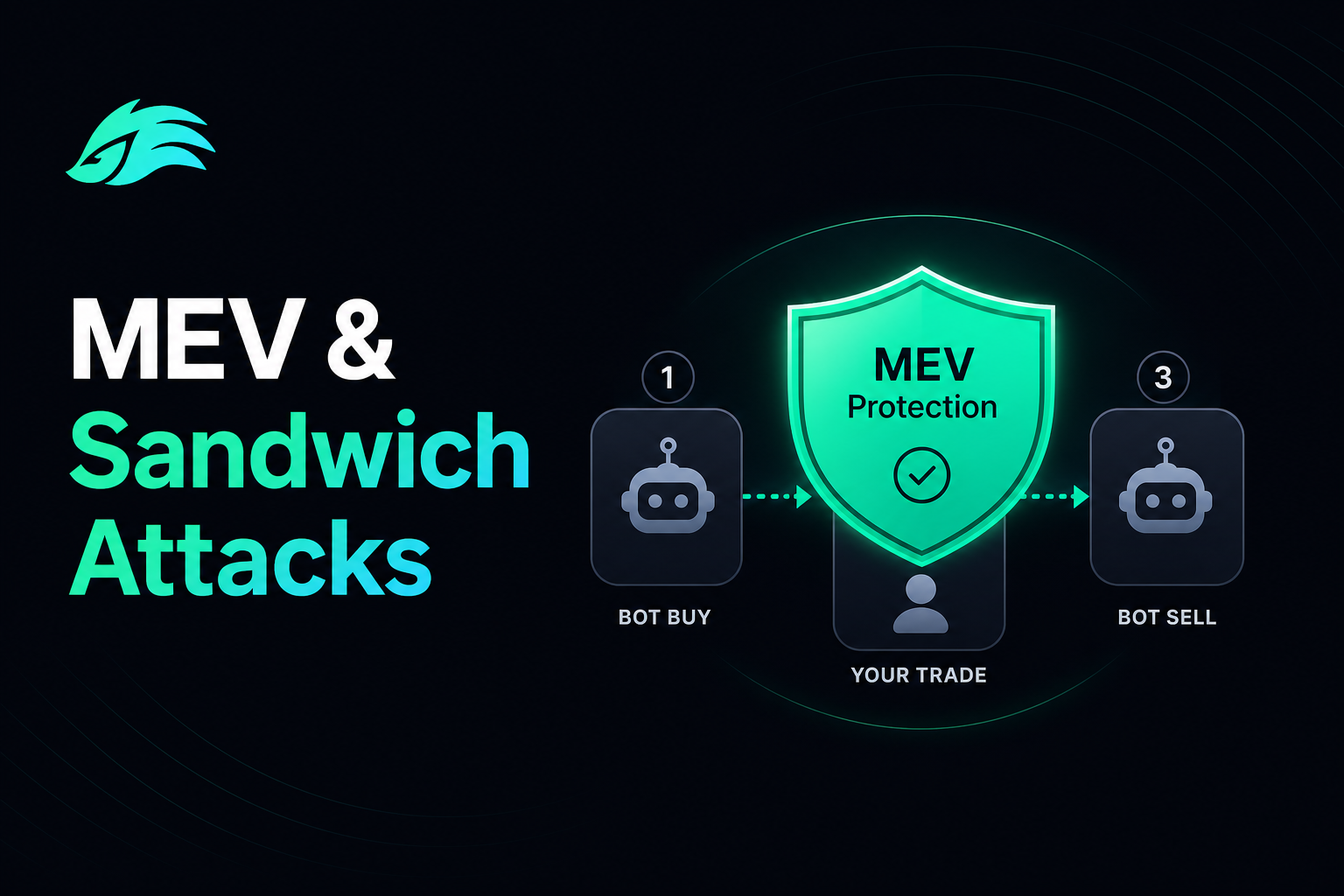
MEV (Maximal Extractable Value) is profit that bots extract by reordering, inserting, or manipulating transactions. The most common attack is the "sandwich":
- What MEV is: Value extracted from the ordering of transactions — bots profit from your trade by acting before and after it
- The sandwich attack: A bot sees your pending buy, buys just before you (pushing the price up), lets your trade execute at the higher price, then sells right after — pocketing the difference at your expense
- The cost to you: You get a worse price than expected — effectively an invisible tax on every unprotected trade
- How to protect yourself: Use MEV protection (private transaction routing), set tight slippage limits, trade with tools that defend against sandwiching, and avoid broadcasting large trades to the public mempool
The bottom line: Sandwich attacks are a real, common cost on unprotected DEX trades. MEV protection — routing your transactions privately so bots can't front-run them — is the primary defense. On fast-moving chains like Solana, this protection matters on every trade.
Trade with MEV protection on GraphDex
Key Takeaways
- MEV is value bots extract by reordering or inserting transactions around yours.
- The sandwich attack — buying before and selling after your trade — is the most common form.
- It costs you a worse price on nearly every unprotected DEX trade — an invisible tax.
- MEV protection (private transaction routing) plus tight slippage is the primary defense.
What Is MEV?
MEV stands for Maximal Extractable Value (originally "Miner Extractable Value"). It refers to the profit that can be extracted by controlling the ordering, inclusion, or exclusion of transactions within a block.
The basic idea: When you submit a transaction to a blockchain, it doesn't execute instantly — it waits in a public queue (the "mempool") before being included in a block. During this window, sophisticated bots can see your pending transaction and act on it — inserting their own transactions before or after yours to profit.
Why it exists: Blockchains order transactions, and whoever controls that ordering (validators, or those who pay them) can profit from arranging transactions advantageously. This creates opportunities to extract value from ordinary traders' transactions.
Common forms of MEV:
- Sandwich attacks: Buying before and selling after your trade (the most common — explained below)
- Front-running: Placing a transaction ahead of yours to profit from an anticipated price move
- Back-running: Placing a transaction right after yours to capture a resulting opportunity
- Arbitrage: Capturing price differences (a more benign form)
- Liquidations: Racing to liquidate undercollateralized positions
Why it matters to you: Most MEV is extracted at the expense of ordinary traders. The sandwich attack in particular directly costs you money on trades — you get a worse price because a bot manipulated the price around your transaction. Understanding MEV is the first step to protecting against it.
How Sandwich Attacks Work
The sandwich attack is the most common MEV attack affecting everyday traders. Understanding it shows why protection matters.
The step-by-step attack:
-
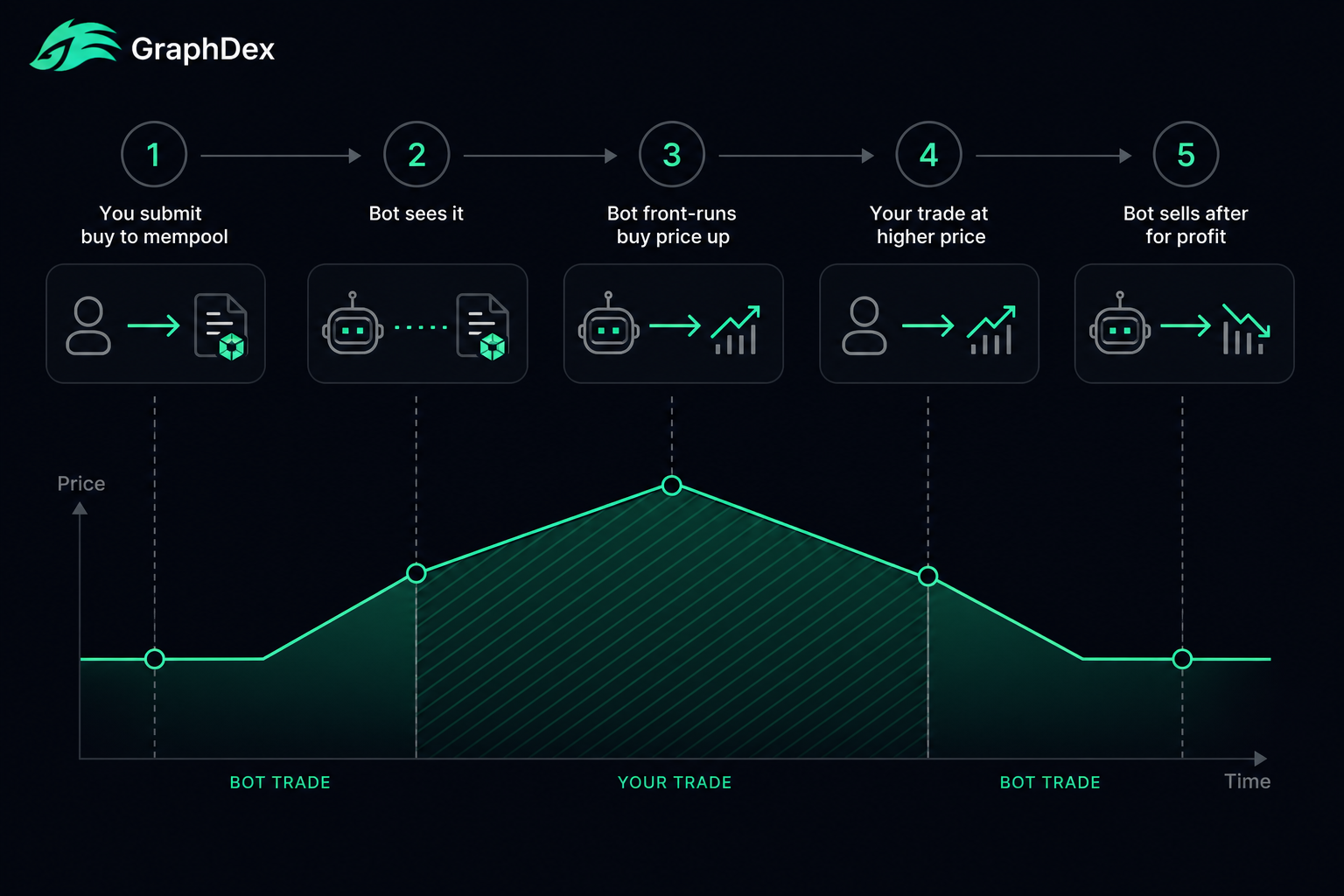
You submit a buy order. You want to buy a token, and your transaction enters the public mempool, visible to bots.
-
The bot sees your pending trade. A sandwich bot spots your buy order waiting to execute.
-
The bot front-runs you (the first slice of bread). The bot quickly buys the same token just before your trade, paying a small fee to ensure its transaction executes first. This buying pushes the price up.
-
Your trade executes at the higher price (the filling). Because the bot just pushed the price up, your buy now executes at a worse (higher) price than you expected.
-
The bot sells right after (the second slice of bread). Immediately after your trade, the bot sells the tokens it just bought — at the elevated price your trade helped create — pocketing the difference.
The result: You "bought high" because the bot manipulated the price around your transaction. The bot profits from the price movement it engineered, and you paid more than you should have. You've been "sandwiched" — your trade is the filling between the bot's buy and sell.
Why it's called a sandwich: Your transaction is sandwiched between the bot's two transactions (buy before, sell after). The bot's trades are the bread; yours is the filling.
The cost: The difference between the price you expected and the price you got is the bot's profit — and your loss. On unprotected trades, this happens constantly, functioning as an invisible tax.
Why Sandwich Attacks Cost You Money
The concrete impact on your trading.
The direct cost: Every sandwiched trade costs you the difference between your expected price and your actual (worse) price. Individually, this might be small; across many trades, it adds up significantly.
Who's most affected:
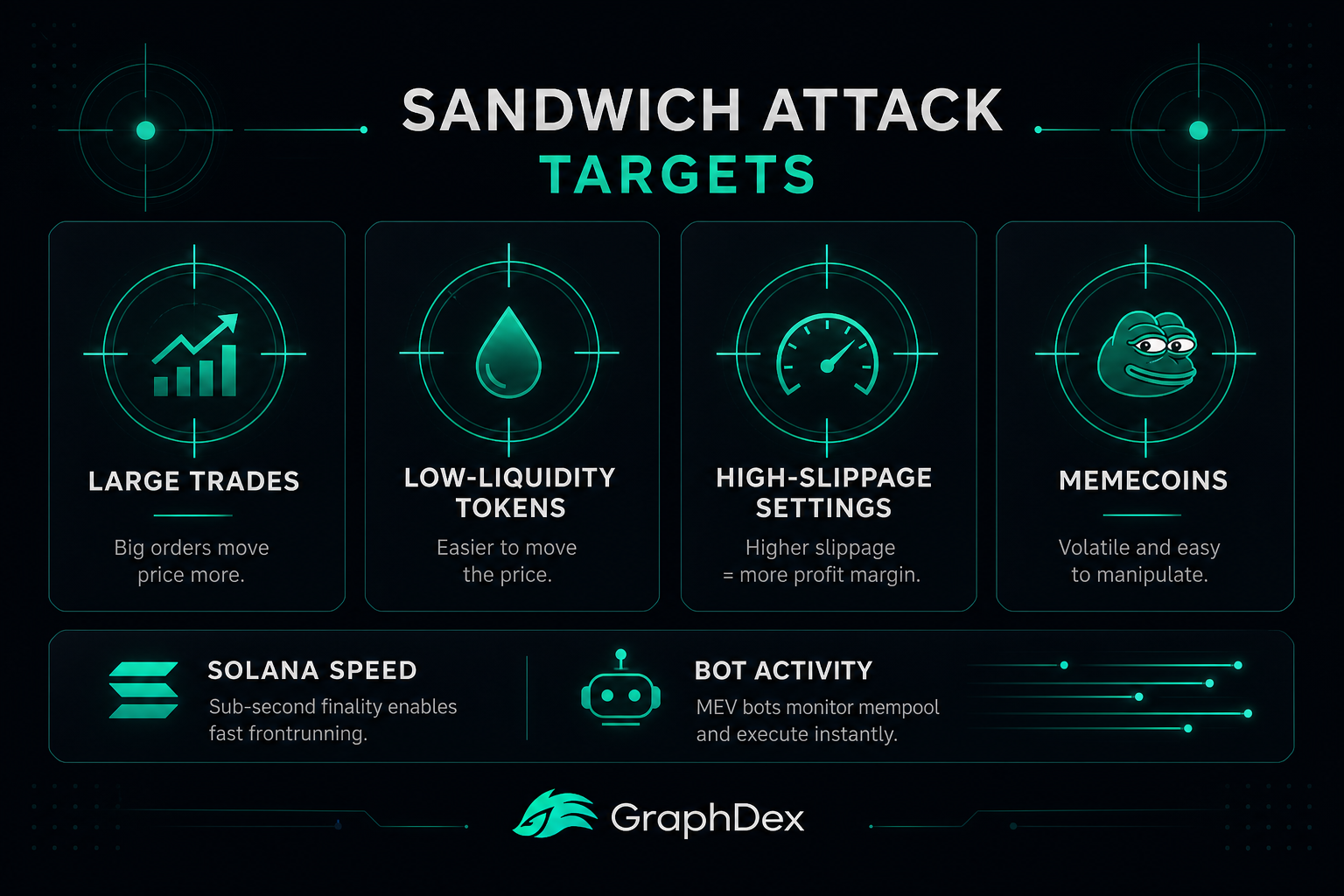
- Large trades: Bigger trades move the price more, creating more profit opportunity for bots — making them prime targets
- Low-liquidity tokens: Thin liquidity means your trade (and the bot's manipulation) moves the price more
- High-slippage settings: If you set high slippage tolerance, you give bots more room to sandwich you profitably
- Memecoins: Fast-moving, often low-liquidity tokens are frequent sandwich targets
The invisible nature: Most traders don't realize they're being sandwiched. The trade executes; you get your tokens; you just paid more than you should have. Without analyzing the transaction, the loss is invisible — which is why sandwich attacks are so pervasive.
The Solana context: Solana's speed and high trading activity — especially in memecoins — make it an active environment for MEV. Fast blocks and heavy bot activity mean sandwich attacks are a real concern on Solana DEX trades, particularly for the fast, low-liquidity memecoin trades that are common there.
The cumulative impact: For active traders, unprotected trading means paying this invisible tax repeatedly. Over hundreds of trades, sandwich losses can meaningfully erode returns — which is why protection is essential for serious traders.
How to Protect Against Sandwich Attacks
The good news: sandwich attacks are preventable with the right protections. Here's how to defend your trades.
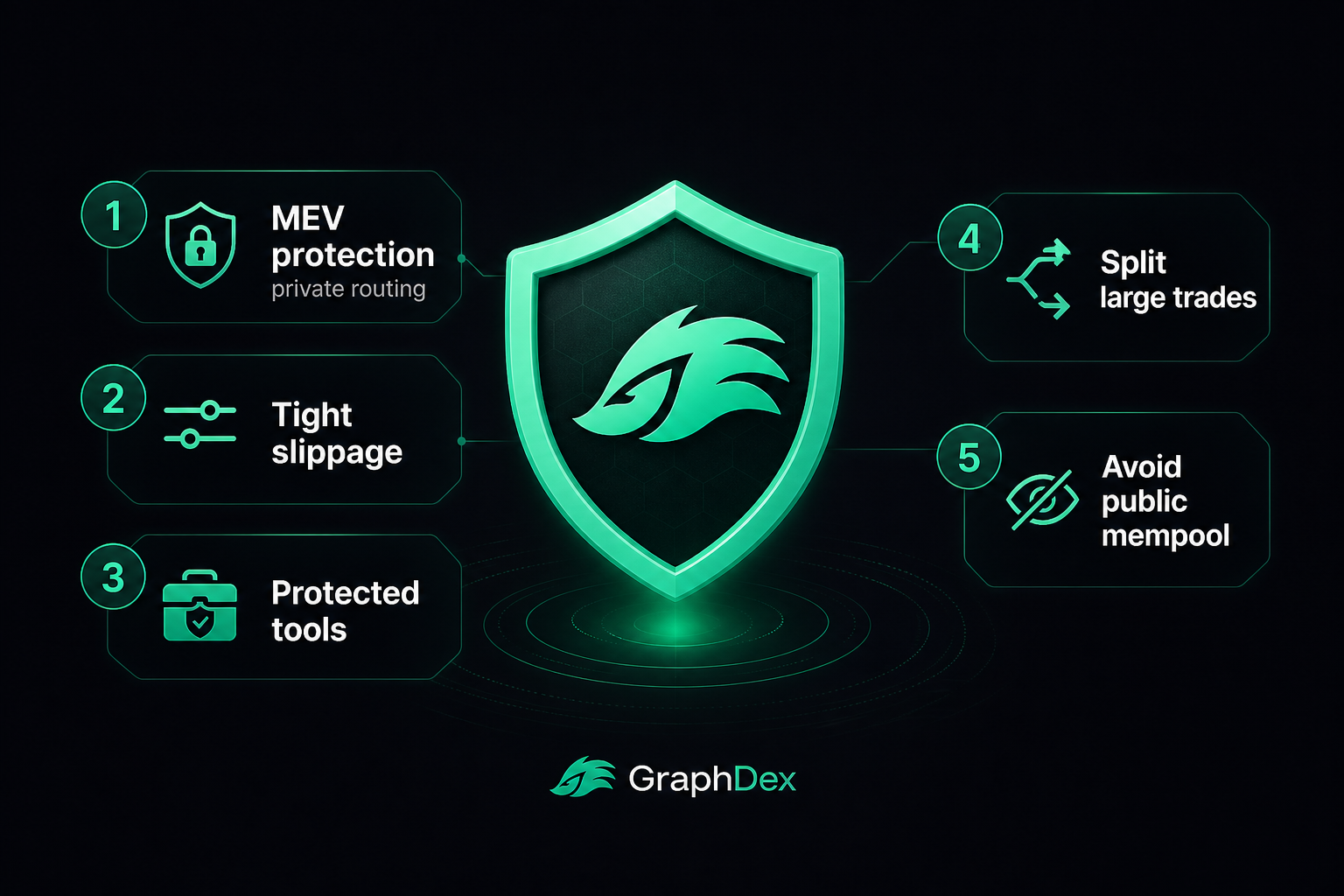
1. Use MEV Protection (Private Routing)
The primary defense: route your transactions privately so bots can't see them in the public mempool.
How it works: MEV protection services route your transaction through a private channel (rather than the public mempool) to the validator. Because bots can't see your pending transaction, they can't front-run or sandwich it. Your trade executes without being manipulated.
Why it's the best defense: If bots can't see your transaction, they can't sandwich it. Private routing addresses the root cause — public visibility of pending trades. This is the most effective protection.
2. Set Tight Slippage Limits
Slippage tolerance is how much price movement you'll accept. Tight slippage limits the room bots have to sandwich you.
How it helps: If you set low slippage (e.g., 1%), your trade will fail rather than execute at a much worse price. This limits how profitably a bot can sandwich you — often making the attack not worth it. Setting high slippage (e.g., 20%) gives bots room to sandwich you within that tolerance.
The trade-off: Too tight, and legitimate trades may fail in volatile conditions; too loose, and you invite sandwiching. Find a balance for the token's volatility.
3. Trade With Protected Tools
Use trading terminals and tools with built-in MEV protection.
How it helps: Terminals that route transactions privately and defend against sandwiching protect every trade automatically — you don't have to configure protection manually each time. This is especially valuable for active traders and fast memecoin trades.
4. Be Careful With Large Trades
Large trades are prime sandwich targets.
How to help: Consider splitting large trades into smaller pieces (reducing the price impact bots can exploit), and always use MEV protection for significant trades. The bigger the trade, the more important protection.
5. Avoid Broadcasting to the Public Mempool
The public mempool is where bots hunt.
How to help: Any protection that keeps your transaction out of the public mempool (private routing) removes bots' ability to see and sandwich it. This is the core principle behind MEV protection.
Trade with built-in MEV protection on GraphDex
MEV Protection Methods Compared
| Method | How It Helps | Best For |
|---|---|---|
| Private routing (MEV protection) | Bots can't see your trade | The primary defense — all trades |
| Tight slippage | Limits bot profit room | Every trade (balance with volatility) |
| Protected tools/terminals | Automatic protection | Active traders, memecoins |
| Splitting large trades | Reduces price impact | Large trades |
| Avoiding public mempool | Removes bot visibility | The core principle |
The strongest defense combines private routing (MEV protection) with tight slippage.
Is All MEV Bad?
For balance, not all MEV is harmful — an honest nuance.
Harmful MEV (extracted from you):
- Sandwich attacks (directly cost you a worse price)
- Predatory front-running
These directly harm ordinary traders and are what MEV protection defends against.
More benign MEV:
- Arbitrage: Bots capturing price differences between venues can actually help align prices (though they profit doing so)
- Liquidations: Racing to liquidate undercollateralized positions is part of how lending protocols stay solvent
The nuance: MEV is a structural feature of how blockchains order transactions — some of it (arbitrage, liquidations) plays a functional role, while some (sandwiching, predatory front-running) purely extracts value from traders. The goal of MEV protection isn't to eliminate all MEV, but to protect you from the harmful, extractive kind — especially sandwich attacks.
On Solana specifically: Solana's MEV landscape includes infrastructure like Jito, which structures MEV in ways that can return value to stakers (via MEV rewards on staking). This is a more constructive approach than pure extraction — but as a trader, you still want protection against sandwiching on your DEX trades.
How GraphDex Protects Your Trades
GraphDex builds MEV protection directly into the trading terminal — defending your trades against sandwich attacks automatically.
For MEV protection:
- Built-in MEV protection — trades are protected against sandwich attacks, so bots can't front-run your transactions
- Integrated execution — protection applies automatically to your trades, no manual configuration each time
- Multi-DEX routing — trade across Raydium, Orca, Meteora, PumpSwap, and more with protection
- Non-custodial — your funds stay in your own wallet (Privy), sign in with Twitter, email, or Telegram
Plus the broader ecosystem:
- Bubble Maps for rug detection
- Pulse feed for discovery across all launchpads
- Prediction-market copytrading
- Up to 17% APY staking on idle capital
The value: Sandwich attacks are a real, invisible cost on unprotected DEX trades — especially for the fast, low-liquidity memecoin trades common on Solana. GraphDex's built-in MEV protection defends your trades automatically, so you're not paying the invisible sandwich tax on every trade. Combined with Bubble Maps rug detection, you trade both safely (no rugs) and protected (no sandwiching) in one terminal.
For active Solana traders, especially in memecoins, built-in MEV protection isn't a nice-to-have — it's essential to avoid the cumulative cost of sandwiching. GraphDex makes it automatic.
Trade protected against sandwich attacks on GraphDex
Frequently Asked Questions
What is MEV in crypto? MEV (Maximal Extractable Value) is profit extracted by controlling the ordering, inclusion, or exclusion of transactions in a block. When you submit a trade, it waits in a public queue (mempool) where bots can see it and insert their own transactions before or after yours to profit. Common forms include sandwich attacks, front-running, and arbitrage. Most MEV is extracted at ordinary traders' expense.
What is a sandwich attack? A sandwich attack is the most common MEV attack. A bot sees your pending buy order, buys the token just before you (pushing the price up), lets your trade execute at the higher price, then sells immediately after — pocketing the difference. Your transaction is "sandwiched" between the bot's buy and sell. You pay a worse price than expected, and the bot profits from the price movement it engineered.
How do I protect against sandwich attacks? The primary defense is MEV protection (private transaction routing) — routing your trade privately so bots can't see it in the public mempool and thus can't sandwich it. Also set tight slippage limits (limiting bot profit room), use trading tools with built-in MEV protection, split large trades, and avoid broadcasting to the public mempool. Combining private routing with tight slippage is the strongest defense.
How much do sandwich attacks cost traders? The cost per trade is the difference between your expected price and the worse price you actually get — individually often small, but cumulatively significant across many trades. Large trades, low-liquidity tokens, high-slippage settings, and memecoins are most affected. The loss is usually invisible (the trade executes; you just paid more), which is why sandwich attacks are so pervasive on unprotected trades.
Why are sandwich attacks common on Solana? Solana's speed (fast blocks) and heavy trading activity — especially in fast-moving, often low-liquidity memecoins — create an active MEV environment. Bots are highly active, and the low-liquidity memecoin trades common on Solana are prime sandwich targets (thin liquidity means trades move the price more). This makes MEV protection especially important for Solana DEX trading, particularly memecoins.
Is all MEV harmful? No. Sandwich attacks and predatory front-running directly harm traders (worse prices) and are what protection defends against. But some MEV is more benign — arbitrage can help align prices across venues, and liquidations keep lending protocols solvent. MEV is a structural feature of blockchain transaction ordering; the goal of protection isn't to eliminate all MEV, but to protect you from the harmful, extractive kind — especially sandwiching.
What is MEV protection and how does it work? MEV protection routes your transaction through a private channel (rather than the public mempool) to the validator. Because bots can't see your pending transaction, they can't front-run or sandwich it — your trade executes without manipulation. This addresses the root cause of sandwiching: public visibility of pending trades. It's the most effective defense, and terminals like GraphDex build it in automatically.
About This Guide
This guide is published by the GraphDex Research team — analysts and traders building the infrastructure for digital asset trading on Solana. Our content is based on direct experience, on-chain data, and 2026 market developments.
Sources & data: MEV mechanics and protection methods reflect publicly available information as of 2026 and may change. MEV protection reduces but doesn't always eliminate all extraction risk. Trading carries risk including loss of capital. This guide is educational and not financial advice — always do your own research.
GraphDex is the infrastructure for digital asset trading — trade, predict, and earn in one place. Learn more at graphdex.io.
Last reviewed: May 2026 · GraphDex Research
The infrastructure for digital asset trading. Trade, predict, stake, repeat. graphdex.io