By GraphDex Research · Reviewed for accuracy May 2026
Quick Answer
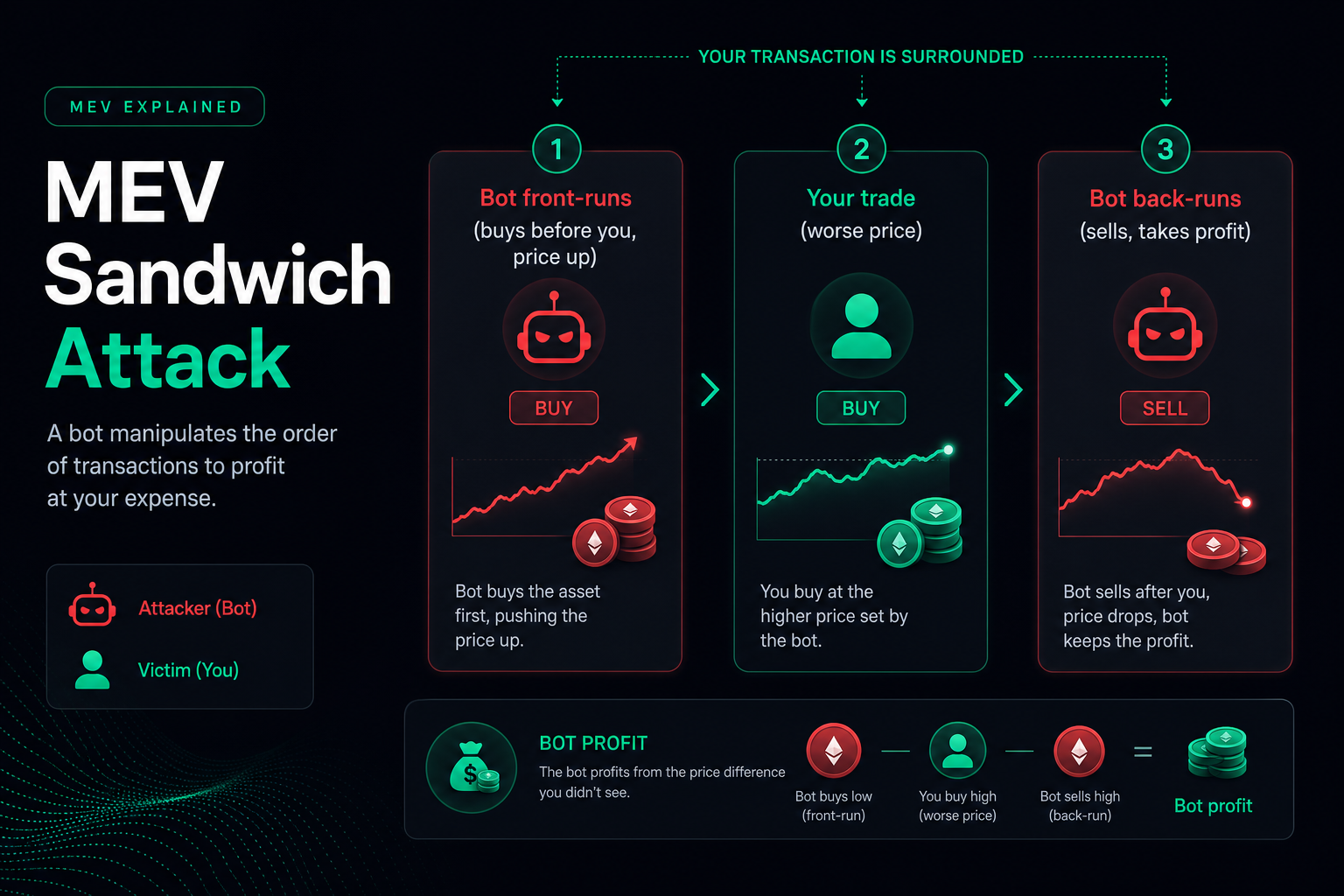
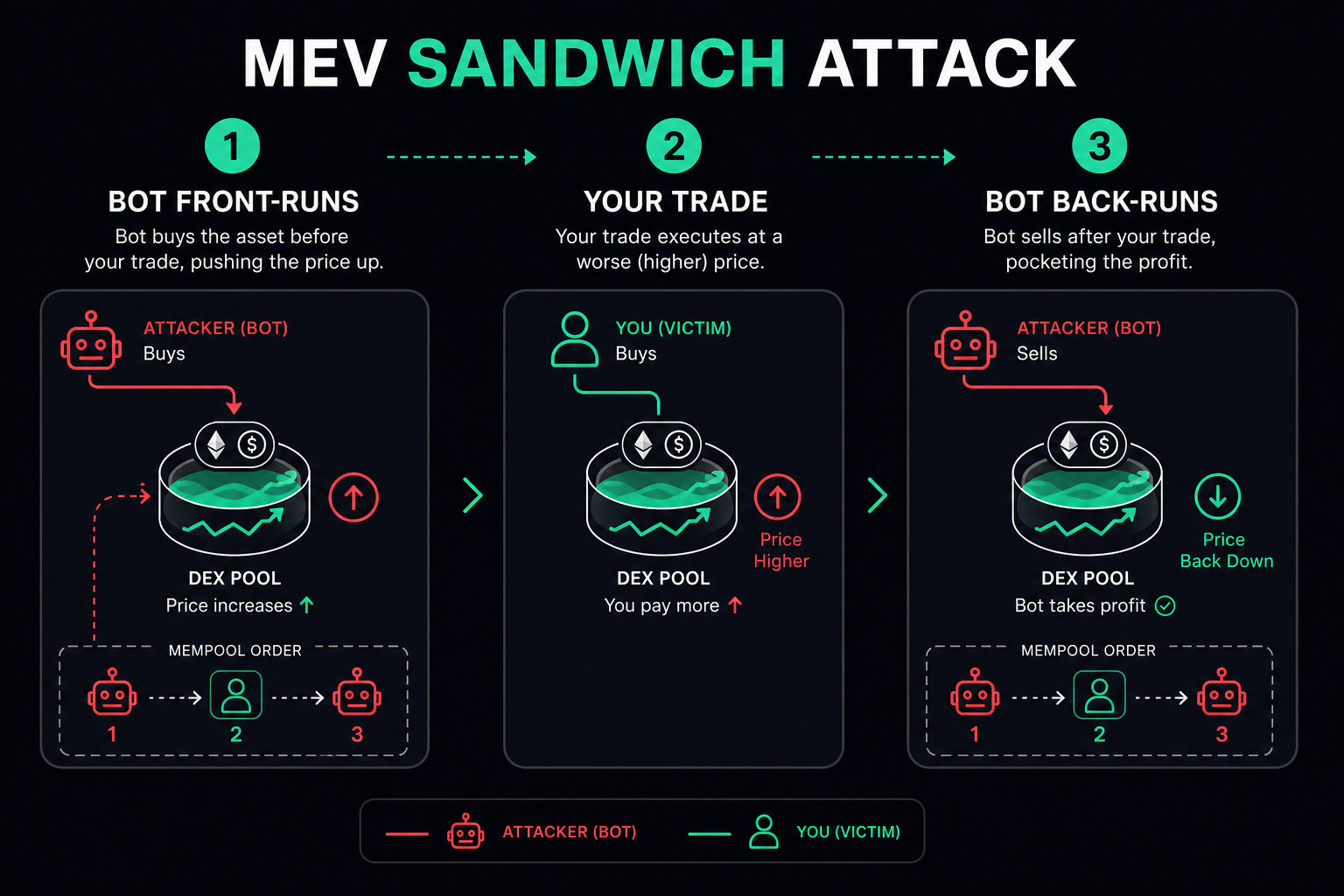
MEV (Maximal Extractable Value) is profit that validators or bots extract by controlling the order of transactions in a block. On Solana, the main threat is the sandwich attack:
- A bot detects your pending swap
- It buys the token just before you (front-run), pushing the price up
- Your trade executes at a worse price
- The bot sells right after (back-run), pocketing the difference
How to avoid it: use MEV-protected routing (private relays, Jito bundles), keep slippage as low as practical, avoid public RPC endpoints, and trade through tools with built-in MEV protection. Sandwich bots extracted an estimated $370-500M from Solana users over 16 months — protection is essential.
Trade with built-in MEV protection on GraphDex
Key Takeaways
- MEV is value extracted by controlling transaction ordering; sandwich attacks are the main threat to traders.
- Sandwich bots extracted an estimated $370-500M from Solana users over ~16 months.
- "Wide" sandwiches across validator slots now dominate (93%), evading older protections.
- Defenses: MEV-protected routing, low slippage, private relays — but no single defense is complete.
What Is MEV?
MEV stands for Maximal Extractable Value (originally "Miner" Extractable Value). It's the profit that can be extracted by controlling which transactions go into a block and in what order.
In a Proof-of-Stake network like Solana, the validator producing a block decides which transactions are included and their ordering. A profit-seeking validator — or a bot working with one — can reorder transactions, insert their own, or front-run users to capture value. This isn't a bug; it's a structural property of how blockchains order transactions.
Unlike Ethereum, Solana has no public mempool where pending transactions sit visible to all. But MEV still thrives on Solana through direct validator connections, private mempools, and specialized infrastructure. As Solana's DeFi activity boomed, so did MEV extraction — now estimated at roughly $45 million per month on Solana.
Not all MEV is harmful. Atomic arbitrage — bots correcting price differences across DEXs in a single transaction — actually improves price consistency across markets and is generally beneficial. The harmful variety, which directly costs you money, is the sandwich attack.
How Sandwich Attacks Work
A sandwich attack is the most common and harmful form of MEV for ordinary traders. Here's the mechanism:
A sandwich requires three steps executed around your trade:
- Front-run: The bot detects your pending swap (large enough to move the price), then buys the token just before you — pushing the price up
- Your trade: Your swap executes at the now-inflated price — you get fewer tokens than expected
- Back-run: The bot sells the token right after your trade, capturing the price difference it created
The result: you paid more (or received less) than you should have, and the bot pocketed the difference risk-free. The bot took no real market risk — it simply exploited its ability to position around your trade.
Sandwich bots are sophisticated. They simulate your transaction to calculate exact profitability before committing, attacking only when it's worth it. Large market orders on DEXs are the primary targets — the bigger your trade relative to pool liquidity, the more profit a front-runner extracts. But even moderate trades (a few hundred dollars) can be profitable to sandwich if the pool is shallow enough.
The scale is significant: sandwiching has become so prevalent on Solana that analyses have found at least 100 victims per hour, every day.
The New Threat: Wide Sandwiches
MEV on Solana has entered a new phase in 2026 — and it matters for how you protect yourself.
For over a year, MEV protection relied heavily on Jito bundles, which enforced "do-not-front-run" rules through trusted relays. But that's no longer enough. According to year-long analysis of Solana trades, "wide" (multi-slot) sandwiches — where the front-run and back-run occur across different validator slots — have exploded to account for 93% of all sandwiches, extracting over 529,000 SOL in the past year.
The key shift: MEV has moved from external bots in the mempool to the validator set itself. A handful of validators account for a disproportionate share of sandwich activity, using validator-level privileges that traditional relay-only systems (like basic Jito bundles) cannot fully mitigate.
This means older protection assumptions are outdated. Private relays don't help if the validator itself is malicious. Jito's do-not-front-run rules don't stop wide sandwiches split across slots. Modern MEV protection has to be leader-aware — routing transactions to avoid known high-risk validators — not just relay-based.
How Much Does MEV Cost Traders?
MEV is a real, quantified wealth transfer from ordinary traders to extractors.
| Metric | Figure |
|---|---|
| Solana MEV extraction | ~$45 million/month |
| Sandwich extraction (16 months) | ~$370-500 million |
| Wide sandwiches share | 93% of all sandwiches |
| SOL extracted via wide sandwiches (1 yr) | 529,000+ SOL |
| Sandwich victims | 100+ per hour |
For perspective, Ethereum MEV runs higher (~$180M/month), but Solana's is growing steadily as its DeFi ecosystem expands. The point for traders: MEV isn't a rare edge case — it's a structural tax on unprotected trades, transferring hundreds of millions per year from retail traders to bot operators and validators. European regulator ESMA has even classified sandwich attacks as potential market manipulation under EU law.
How to Avoid MEV: 6 Defenses
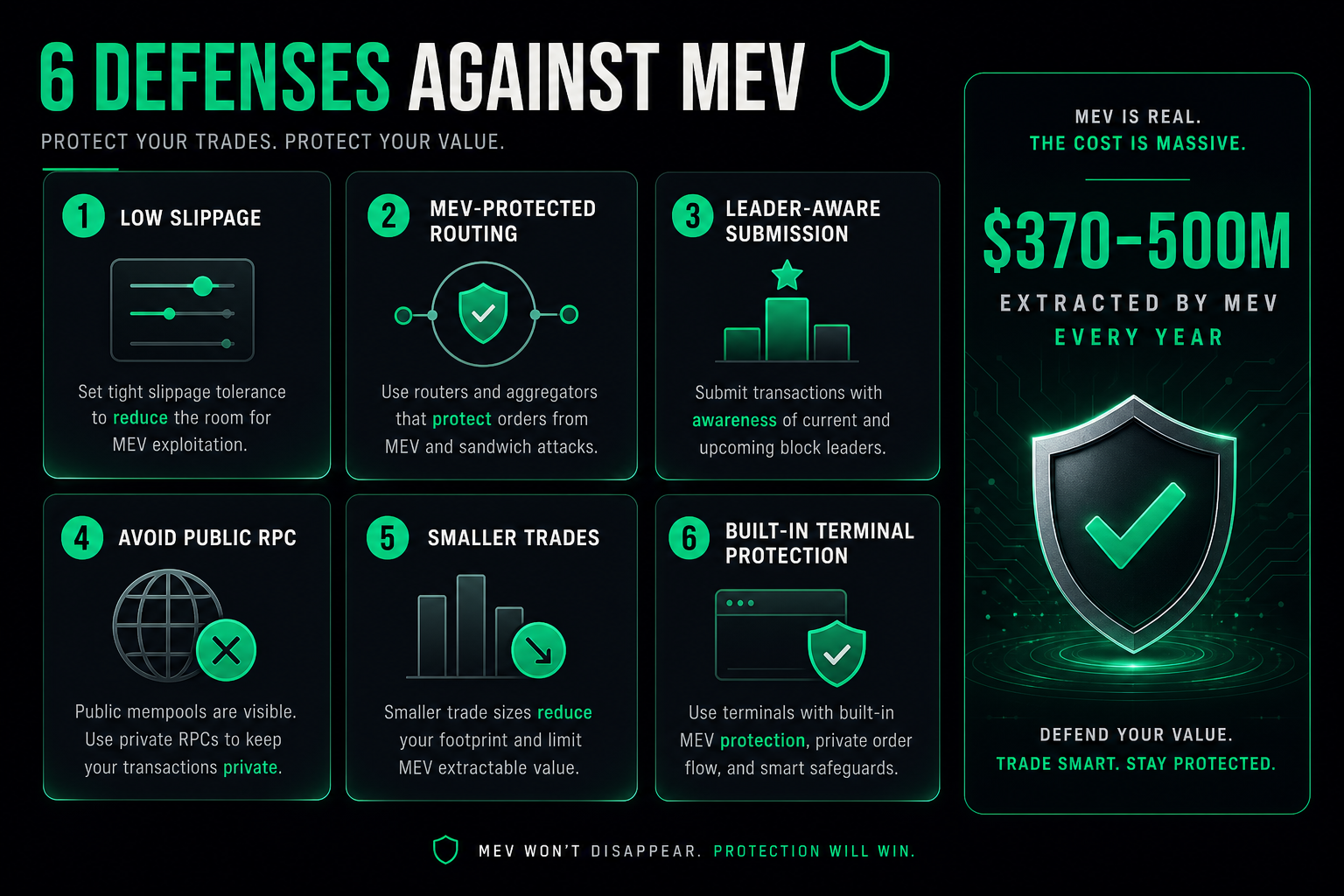
Protecting yourself from sandwich attacks requires layering several defenses — no single one is complete.
1. Keep Slippage as Low as Practical
The single most effective defense. A smaller slippage window reduces the profit margin available to attackers, making your trade less attractive to sandwich. Setting slippage to 10-20% to "force" a trade through hands bots a massive profit margin — keep it tight.
2. Use MEV-Protected Routing
Send transactions through MEV-protected RPC endpoints or Jito bundles rather than standard public RPC. This prevents searchers from seeing your trade before it lands. Public RPC endpoints are monitored 24/7 by bots — trading through them broadcasts your intentions.
3. Use Leader-Aware Submission
Because wide sandwiches exploit malicious validators, modern protection routes transactions to avoid known high-risk validator slots. This addresses the validator-level threat that relay-only protection misses.
4. Avoid Public RPC Endpoints
Standard wallets route through public nodes that bots monitor. Using a protected endpoint or a tool with built-in protection keeps your trade out of bot view.
5. Trade Smaller Relative to Liquidity
The bigger your trade relative to the pool, the more profitable to sandwich. Splitting large trades or trading deeper-liquidity tokens reduces your attractiveness as a target.
6. Use a Terminal With Built-In Protection
Rather than configuring your own nodes and relays, use a trading tool with MEV protection built in. Quality terminals enable protection with a toggle — no technical setup. This is the practical defense for most traders.
Get built-in MEV protection on GraphDex
The Limits of MEV Protection
It's important to be honest about what protection can and can't do.
Protection reduces, not eliminates, risk. MEV protection stops bots from front-running you, but it cannot prevent the price from moving if you're buying a large percentage of the available pool. If your trade itself moves the price (legitimate price impact), that's not MEV — it's market mechanics.
No single defense is sufficient. As the wide-sandwich threat shows, relay-based protection alone is incomplete. Effective protection layers slippage control, protected routing, and leader-aware submission.
Failed transactions are a trade-off. Tight slippage and protection can cause transactions to fail when the price moves beyond your limit or network congestion is high. This is the cost of protection — a failed trade is better than a sandwiched one, but it's friction.
The threat evolves. As Solana's infrastructure changes (e.g., Firedancer's arrival), the MEV landscape shifts. Protection that works today may need updating. Using a tool that maintains current protection saves you from tracking this yourself.
The realistic takeaway: good protection dramatically reduces your sandwich risk, but trading on Solana always involves some MEV exposure. The goal is making yourself an unattractive, costly target — not achieving perfect immunity.
How GraphDex Protects Your Trades
GraphDex includes MEV protection as a built-in feature, so you don't need to configure nodes, relays, or routing yourself. When you trade on GraphDex, transactions are routed to reduce sandwich exposure — protecting you from the front-running that costs unprotected traders hundreds of millions annually.
Combined with GraphDex's other features — the Pulse feed for token discovery, Bubble Maps for spotting rug risk, copytrading, and AI signals — MEV protection is part of a complete, safety-first trading environment. You get protected execution alongside the tools to find and evaluate tokens, all non-custodial via Privy.
For traders, the practical value is simple: you focus on finding good trades, and the protection works in the background to ensure you're not handing free profit to sandwich bots on every transaction. In a landscape where 100+ traders are sandwiched every hour, built-in protection isn't optional — it's essential.
Trade protected and non-custodially on GraphDex
Related Guides
- How to Avoid Rug Pulls on Solana in 2026: 8 Red Flags Every Trader Must Check
- Best Solana Trading Terminal in 2026: GraphDex vs Axiom vs GMGN vs Trojan vs BullX
- How to Trade Crypto Without a Seed Phrase in 2026: The Seedless Wallet Guide
Frequently Asked Questions
What is MEV in simple terms? MEV (Maximal Extractable Value) is profit extracted by controlling the order of transactions in a block. On Solana, the main harmful form is the sandwich attack: a bot buys before your trade (pushing the price up), lets your trade execute at the worse price, then sells after — pocketing the difference. It's a hidden tax on unprotected trades.
How do sandwich attacks work on Solana? A bot detects your pending swap, front-runs it by buying first (raising the price), lets your trade fill at the inflated price, then back-runs by selling right after. You get fewer tokens than expected; the bot captures the difference risk-free. Large trades in shallow pools are prime targets.
How much do traders lose to MEV on Solana? Sandwich bots extracted an estimated $370-500 million from Solana users over roughly 16 months, with at least 100 victims per hour. Solana MEV runs around $45 million per month overall. It's a structural wealth transfer from retail traders to bots and validators.
How can I protect myself from sandwich attacks? Keep slippage as low as practical (the most effective single defense), use MEV-protected RPC endpoints or Jito bundles instead of public RPC, use leader-aware routing to avoid malicious validators, trade smaller relative to pool liquidity, and use a terminal with built-in MEV protection like GraphDex that handles this automatically.
What is a wide sandwich attack? A wide (multi-slot) sandwich splits the front-run and back-run across different validator slots, rather than executing all in one slot. These now account for 93% of Solana sandwiches and evade traditional single-slot protections. They exploit malicious validators directly, requiring leader-aware protection to mitigate.
Does MEV protection guarantee I won't lose money? No. MEV protection stops bots from front-running you, but it can't prevent legitimate price movement if your trade is large relative to the pool. No single defense is complete — effective protection layers slippage control, protected routing, and leader-awareness. The goal is making yourself an unattractive target, not perfect immunity.
Is all MEV bad? No. Atomic arbitrage — bots correcting price differences across DEXs in one transaction — is generally beneficial, improving price consistency across markets. The harmful variety is the sandwich attack, which directly costs traders money by exploiting transaction ordering around their trades. Protection targets the harmful kind.
About This Guide
This guide is published by the GraphDex Research team — analysts and traders building the infrastructure for digital asset trading on Solana. Our content is based on live platform data, current security research, and hands-on experience.
Sources & data: MEV figures, attack statistics, and protection methods reflect publicly available information as of 2026 and evolve as infrastructure changes. No protection is perfect. This guide is educational and not financial advice — always do your own research.
GraphDex is the infrastructure for digital asset trading — trade, predict, and earn in one place. Learn more at graphdex.io.
Last reviewed: May 2026 · GraphDex Research
The infrastructure for digital asset trading. Trade, predict, stake, repeat. graphdex.io