By GraphDex Research · Reviewed for accuracy May 2026
Quick Answer
To find profitable Polymarket traders to copy, evaluate them on verifiable on-chain metrics:
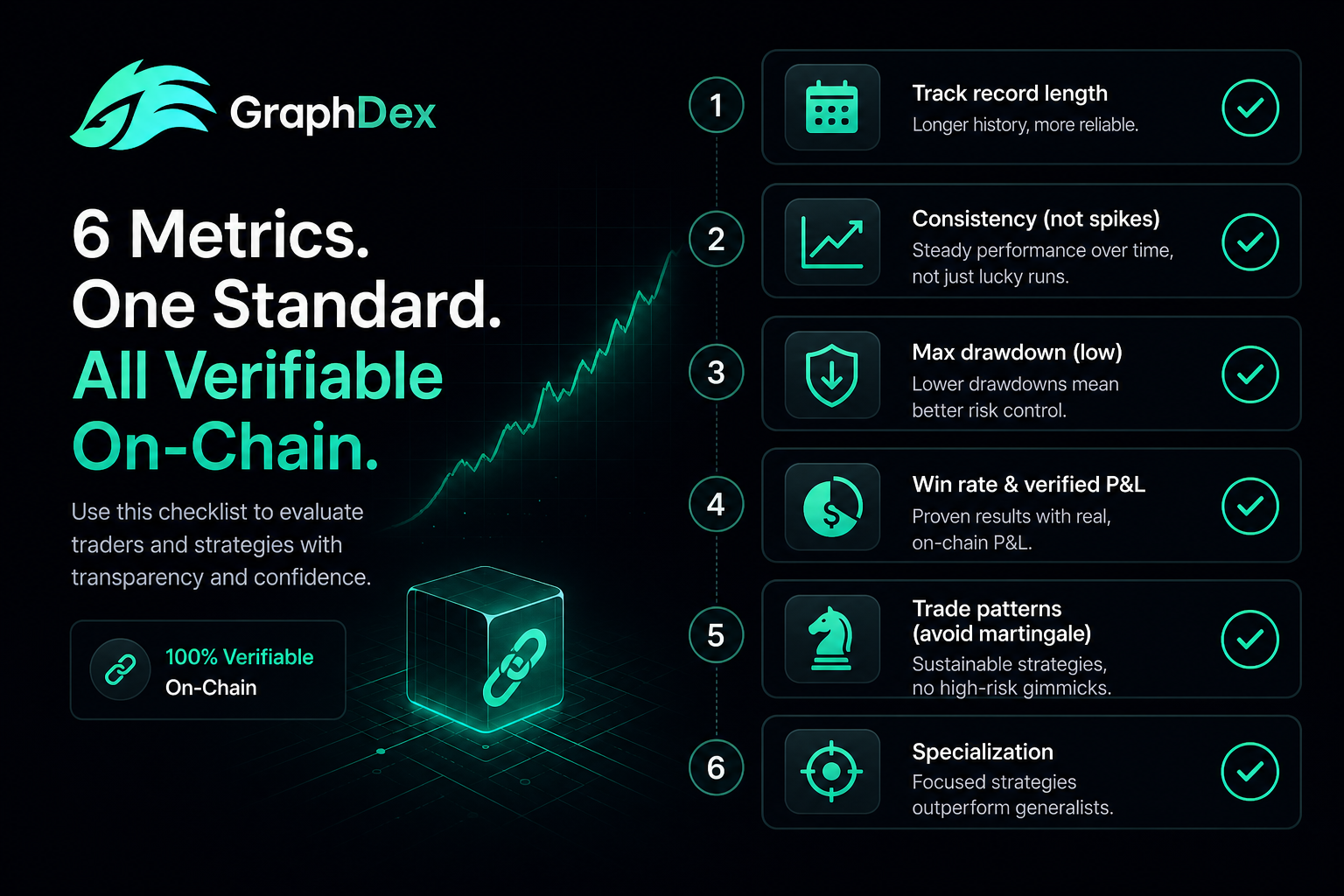
- Track record length — prefer traders with a substantial history (many months), not short lucky runs
- Consistency — steady performance beats volatile triple-digit spikes (which signal unsustainable risk)
- Maximum drawdown — the largest peak-to-trough loss; lower is safer
- Win rate + verified P&L — confirmed from on-chain data, not self-reported
- Trade patterns — avoid traders relying on risky grid/martingale (thousands of tiny positions)
- Specialization — domain expertise (sports, politics, crypto) and whether it's durable
The key advantage: Because Polymarket is on-chain, all of this is verifiable from blockchain data — unlike traditional copy trading where track records can be faked. Use tools that surface and rank traders by verified performance.
The honest caveat: Even the best selection doesn't guarantee profit — past performance doesn't predict the future, and you typically underperform the trader you copy. Diversify across several proven traders.
Find and copy verified Polymarket traders on GraphDex
Key Takeaways
- Trader selection is the single most important factor in copy trading success.
- Evaluate on: track record length, consistency, drawdown, verified win rate/P&L, trade patterns, and specialization.
- Polymarket's on-chain nature makes all these metrics verifiable — a major advantage.
- Even great selection doesn't guarantee profit; diversify across several proven traders.
Why Is Trader Selection Everything?
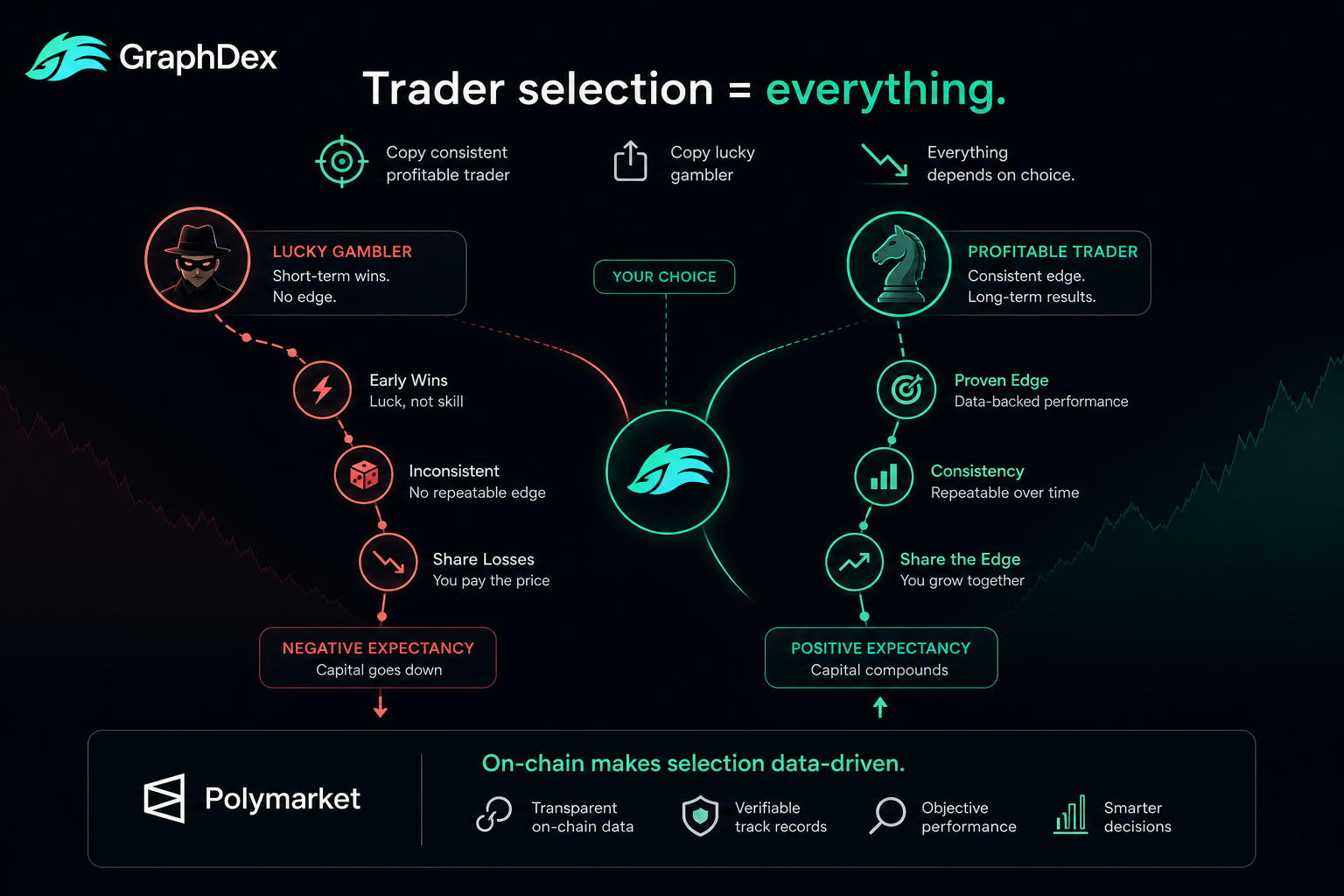
In copy trading, the trader you choose determines your outcome. This single decision matters more than any other factor.
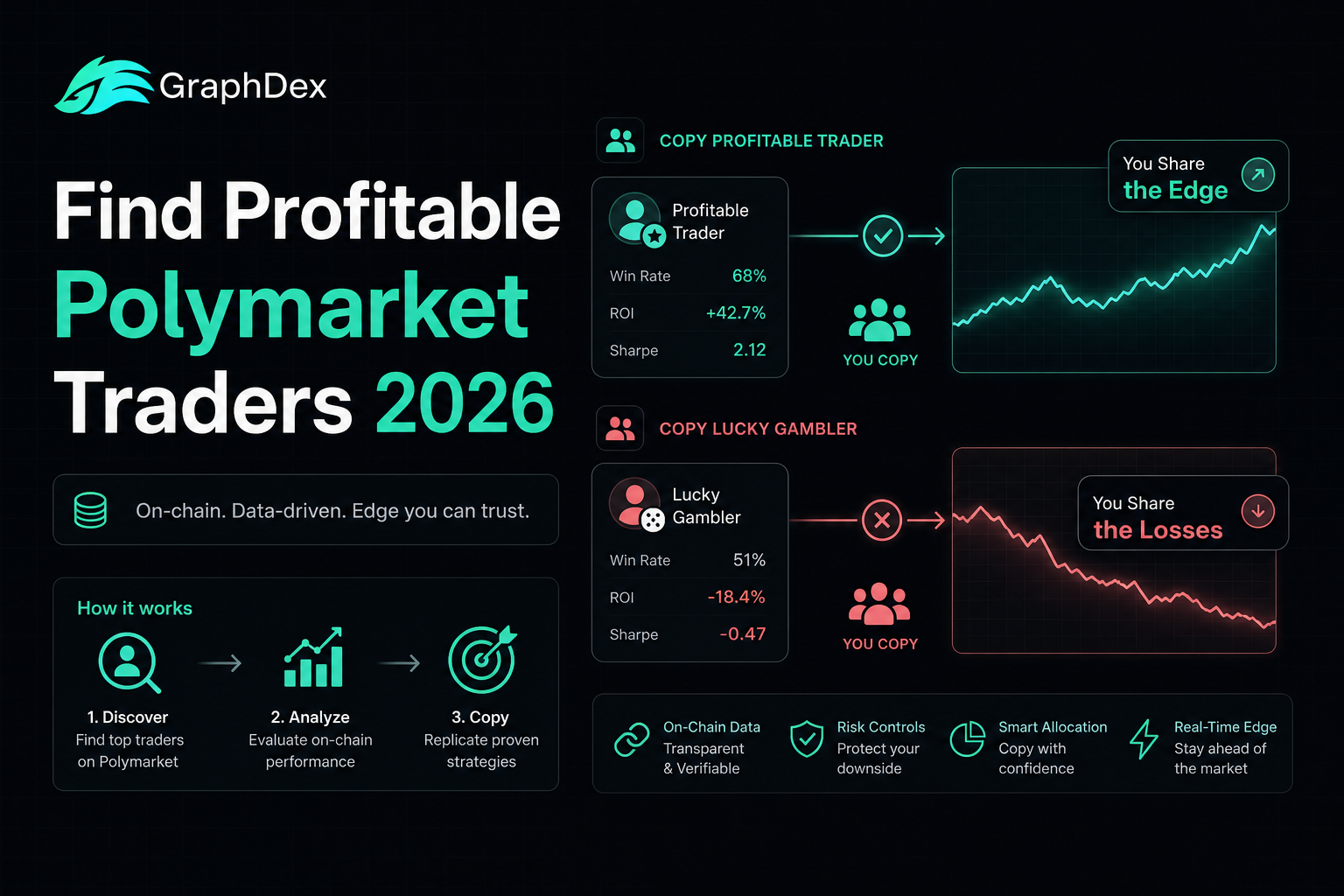
The logic: When you copy a trader, your returns mirror theirs (minus the underperformance gap from delays and fills). Copy a consistently profitable trader, and you share in their edge. Copy a poor or lucky trader, and you share in their losses. Everything hinges on selection.
Why it's hard:
- Leaderboards tempt you toward the highest returns — but those often signal unsustainable risk
- A short track record could be luck, not skill
- Some traders look great until a regime change wipes them out
- Marketing and hype obscure real performance
Why Polymarket makes it easier: Because Polymarket is on-chain, you can verify a trader's real performance from blockchain data — track record, P&L, win rate, drawdown. This eliminates the guesswork and fabrication risk of traditional copy trading. You evaluate provably real performance.
The mindset: Approach trader selection like hiring for a critical role. You wouldn't hire someone based on one impressive week — you'd review their full track record, consistency, and how they handle adversity. Apply the same rigor to choosing whom to copy. The on-chain data makes this rigorous evaluation possible.
Metric 1: Track Record Length
The foundation of trustworthy evaluation.
Why it matters: A trader's track record length determines how much you can trust their performance. A few profitable weeks could be luck; many months of consistent performance suggests genuine skill. The longer the verifiable history, the more reliable the signal.
What to look for:
- Prefer traders with substantial history (many months or more)
- Be skeptical of short track records, however impressive
- More data points = more reliable assessment
- On-chain data lets you verify the full history
The trap to avoid: A trader with a spectacular two-week return is tempting but risky — you can't distinguish skill from luck in such a short window. A trader with steady returns over many months is a more reliable choice, even if their headline numbers are lower.
The on-chain advantage: Polymarket's blockchain record lets you verify a trader's entire history — not just a cherry-picked recent period. Use this to assess the full track record, not marketing highlights.
Metric 2: Consistency Over Peak Returns
The metric that separates skill from gambling.
Why it matters: It's tempting to copy the trader with the highest percentage returns. But triple-digit gains in a short period often indicate unsustainable, high-risk behavior — the kind that produces spectacular results until it blows up. Consistency is a better signal of durable skill.
What to look for:
- Steady, consistent returns over time
- Reasonable returns without wild swings
- A pattern of sustainable performance, not lottery-like spikes
The reframe: A trader returning a steady, sustainable amount consistently is more valuable to copy than one with occasional massive spikes and deep crashes. The steady trader's edge is more likely durable; the spiky trader may be one bad bet from disaster.
Red flag: Extremely high short-term returns. If a trader shows 300% in a month, ask what risk produced that — it's likely unsustainable, and copying them means inheriting that risk. Sustainable consistency beats unsustainable spikes.
Metric 3: Maximum Drawdown
The risk metric most people ignore — and shouldn't.
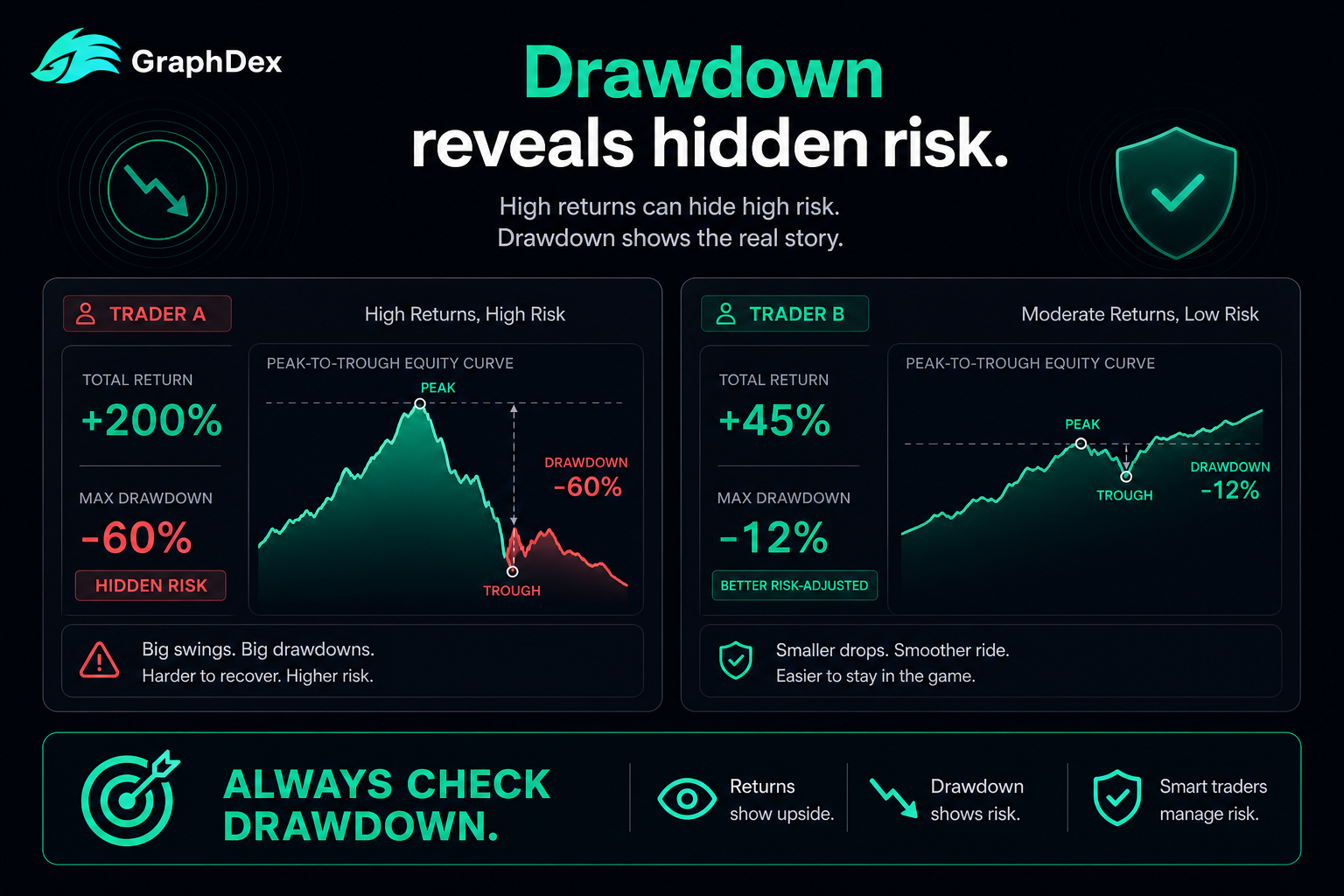
What it is: Maximum drawdown is the largest peak-to-trough decline in a trader's account. It reveals how much they've lost during their worst period — a direct measure of the risk you'd inherit by copying them.
Why it matters: A trader showing high returns but a massive drawdown is hiding significant risk. If someone returned 200% but had a 60% drawdown along the way, copying them means potentially enduring that 60% loss. Drawdown reveals the risk behind the returns.
What to look for:
- Lower maximum drawdown relative to returns (better risk-adjusted performance)
- Traders who protect capital during bad periods
- A reasonable relationship between returns and drawdown
The key insight: Anyone showing high returns without disclosing their drawdown is hiding the risk. Always check maximum drawdown — it tells you what you'd have to endure. A trader with moderate returns and low drawdown may be a better copy than one with high returns and catastrophic drawdown.
The on-chain advantage: Polymarket's on-chain data lets you verify actual drawdown from real trading history — not a self-reported or hidden figure.
Metric 4: Win Rate & Verified P&L
The core performance numbers — verifiable on Polymarket.
Win rate: The percentage of a trader's positions that were profitable. A high win rate suggests skill, though it must be balanced against position sizing (a trader can have a high win rate but lose on the few losses if they're large).
Verified P&L: The trader's actual profit and loss — confirmed from on-chain data. This is the bottom line: are they actually making money?
What to look for:
- A solid, verifiable win rate
- Consistent positive P&L over time
- The relationship between win rate and P&L (both matter)
The on-chain advantage — this is critical: On Polymarket, win rate and P&L are verifiable from blockchain data. Unlike forex or stock copy trading — where these numbers can be faked or exaggerated — Polymarket's on-chain record shows a trader's real performance. You know exactly how they've actually done. This verification is the foundation of trustworthy trader selection.
Metric 5: Trade Patterns & Strategy
Understanding how a trader actually operates.
Why it matters: Two traders with similar returns can have very different risk profiles based on how they trade. Understanding a trader's patterns reveals hidden risks.
Red flags to watch:
- Thousands of tiny positions held for minutes: Can signal risky grid or martingale strategies that produce steady small gains until a large loss wipes them out
- Over-concentration: Relying on a single market or narrow category — vulnerable to a regime change
- Erratic sizing: Inconsistent position sizing can signal undisciplined trading
What to look for:
- A coherent, understandable strategy
- Reasonable position sizing
- Diversification across markets (not all-in on one)
- Patterns consistent with genuine skill, not luck or risky mechanics
The on-chain advantage: Polymarket's blockchain record lets you examine a trader's actual trade patterns — how they size, how often they trade, what they concentrate in. This reveals the strategy behind the returns.
Metric 6: Specialization & Domain Expertise
The prediction-market-specific factor.
Why it matters: Top prediction market traders often have genuine domain expertise — political analysts, sports statisticians, crypto researchers. This expertise is their edge. Understanding a trader's specialization helps you assess whether their edge is durable and how to use them.
What to look for:
- Clear domain focus (sports, politics, crypto, economics)
- Performance consistent with genuine expertise in that domain
- Whether their edge is durable (deep expertise) or circumstantial (lucky in a hot category)
The diversification angle: Consider copying specialists across different domains — a sports expert for sports markets, a political analyst for elections. This diversifies your copy portfolio and leverages multiple experts' edges, rather than concentrating on one trader or domain.
The caution: A trader concentrated in one narrow area may not survive a shift in that area. Assess whether their specialization is a durable edge or a temporary hot streak.
Metrics Summary Table
| Metric | What to Look For | Red Flag |
|---|---|---|
| Track record length | Many months+ | Short, however impressive |
| Consistency | Steady returns | Triple-digit spikes |
| Max drawdown | Low relative to returns | High/undisclosed |
| Win rate & P&L | Solid, verified on-chain | Unverifiable claims |
| Trade patterns | Coherent, diversified | Grid/martingale, concentration |
| Specialization | Durable domain edge | Narrow, circumstantial |
All metrics are verifiable from Polymarket's on-chain data — the key advantage over traditional copy trading.
How Do You Put It Together and Diversify?
The complete approach to finding profitable Polymarket traders:
1. Use tools that rank traders by verified performance. Platforms that surface and rank Polymarket traders by on-chain verified metrics save you manual blockchain analysis.
2. Evaluate candidates on all metrics. Don't rely on one number — assess track record, consistency, drawdown, win rate/P&L, patterns, and specialization together.
3. Prioritize consistency and low drawdown. These signal durable, lower-risk edges over spectacular-but-fragile performers.
4. Diversify across several traders. Don't copy just one. Spread across several proven traders, ideally in different domains, to reduce the impact of any single one underperforming.
5. Start small and monitor. Test with modest allocations, monitor performance, and drop underperformers.
6. Accept the honest limits. Even great selection doesn't guarantee profit — past performance doesn't predict the future, and you typically underperform the traders you copy. Diversification and monitoring manage (not eliminate) this.
The bottom line: Finding profitable Polymarket traders to copy is about rigorous, data-driven evaluation — made possible by on-chain verification. Choose based on verified consistency and risk (not hype), diversify, and monitor. This gives you the best shot, though nothing is guaranteed.
Find and copy verified traders on GraphDex
How GraphDex Helps You Find & Copy Traders
GraphDex offers integrated prediction-market copytrading with the tools to find and evaluate traders using on-chain verified data.
For finding and copying traders:
- World's first integrated prediction-market copytrading — find, evaluate, and copy Polymarket traders in one place
- On-chain verified track records — evaluate traders on real, verifiable performance (not marketing claims)
- Analytics — Bubble Maps, AI signals, and whale/wallet tracking to inform trader selection
- Non-custodial — your funds stay in your own wallet (Privy), sign in with Twitter, email, or Telegram
- Flexible copy parameters — diversify across traders with custom ratios and limits
Plus the broader ecosystem:
- Direct Polymarket trading
- Solana DEX and memecoin trading
- Up to 17% APY staking on idle capital
- MEV protection
The value: GraphDex consolidates trader discovery, on-chain verified evaluation, and copytrading in one non-custodial terminal — so you can find profitable traders using real data, diversify across them, and copy them, without juggling separate tools or trusting unverifiable claims.
Remember: trader selection improves your odds but guarantees nothing. Copiers typically underperform the traders they copy, past performance doesn't predict the future, and no returns are guaranteed. GraphDex gives you the verified data and tools; the selection and monitoring are yours.
Try trader discovery and copytrading on GraphDex
Related Guides
- Is Prediction Market Copy Trading Profitable in 2026? An Honest Analysis
- Prediction Market Copy Trading in 2026: The Complete Guide
- Passive Income with Prediction Markets in 2026: Realistic Strategies
- Best Solana Trading Terminal in 2026: GraphDex vs Axiom vs GMGN vs Trojan vs BullX
Frequently Asked Questions
How do I find profitable Polymarket traders to copy? Evaluate traders on verifiable on-chain metrics: track record length (prefer many months), consistency (steady beats spiky), maximum drawdown (lower is safer), win rate and verified P&L, trade patterns (avoid grid/martingale), and specialization (durable domain edge). Because Polymarket is on-chain, all of this is verifiable from blockchain data. Use tools that rank traders by verified performance, and diversify across several.
What metrics matter most when choosing a trader to copy? Consistency and maximum drawdown are often most revealing. Consistency (steady returns) signals durable skill over lucky spikes; maximum drawdown reveals the risk behind the returns (a trader with high returns but massive drawdown is hiding risk). Combine these with track record length, verified win rate/P&L, trade patterns, and specialization. No single metric suffices — evaluate them together.
Why should I avoid traders with the highest returns? Because triple-digit gains in a short period often indicate unsustainable, high-risk behavior — spectacular results that blow up eventually. A trader showing 300% in a month likely took extreme risk you'd inherit by copying them. Consistency and low drawdown are better signals of durable skill. Prefer steady, sustainable performers over spiky ones, even if their headline returns are lower.
How does Polymarket's on-chain data help choose traders? It makes trader metrics verifiable. On Polymarket, every trade is on the blockchain, so a trader's real track record, P&L, win rate, drawdown, and trade patterns are verifiable — not self-reported or faked. In traditional copy trading (forex, stocks), these can be exaggerated, and people have lost money copying fabricated records. On-chain verification lets you evaluate provably real performance.
How many traders should I copy? Diversify across several proven traders rather than copying just one — this reduces the impact of any single trader underperforming. Consider copying specialists across different domains (a sports expert, a political analyst, a crypto researcher) to leverage multiple edges and spread risk. The exact number depends on your capital and platform, but diversification is key. Don't concentrate on a single trader.
Does choosing a good trader guarantee profit? No. Even rigorous selection using on-chain data doesn't guarantee profit. Past performance doesn't predict future results — even excellent traders have losing streaks and drawdowns. You also typically underperform the trader you copy (delays, worse fills). Good selection improves your odds and manages risk, but nothing is guaranteed. Diversify, monitor, and maintain realistic expectations.
What tools help find profitable Polymarket traders? Tools that surface and rank Polymarket traders by on-chain verified metrics (track record, P&L, win rate, drawdown) save you manual blockchain analysis. Analytics like whale/wallet tracking help identify sharp money. GraphDex integrates trader discovery, on-chain verified evaluation, and copytrading in one non-custodial terminal — letting you find, assess, and copy traders using real data rather than unverifiable claims.
About This Guide
This guide is published by the GraphDex Research team — analysts and traders building the infrastructure for digital asset trading on Solana. Our content is based on direct experience, current market data, and 2026 prediction market developments.
Sources & data: Trader evaluation metrics and Polymarket data reflect publicly available information as of 2026 and may change. Copy trading carries substantial risk including loss of capital; copiers typically underperform the traders they copy, and past performance doesn't predict future results. Prediction market legality varies by jurisdiction. This guide is educational and not financial advice.
GraphDex is the infrastructure for digital asset trading — trade, predict, and earn in one place. Learn more at graphdex.io.
Last reviewed: May 2026 · GraphDex Research
The infrastructure for digital asset trading. Trade, predict, stake, repeat. graphdex.io