By GraphDex Research · Reviewed for accuracy May 2026
Quick Answer
Prediction market copy trading can be profitable, but with important honest caveats:
- It can work: Copying consistently profitable, on-chain-verified traders can generate returns — you leverage their edge without developing your own
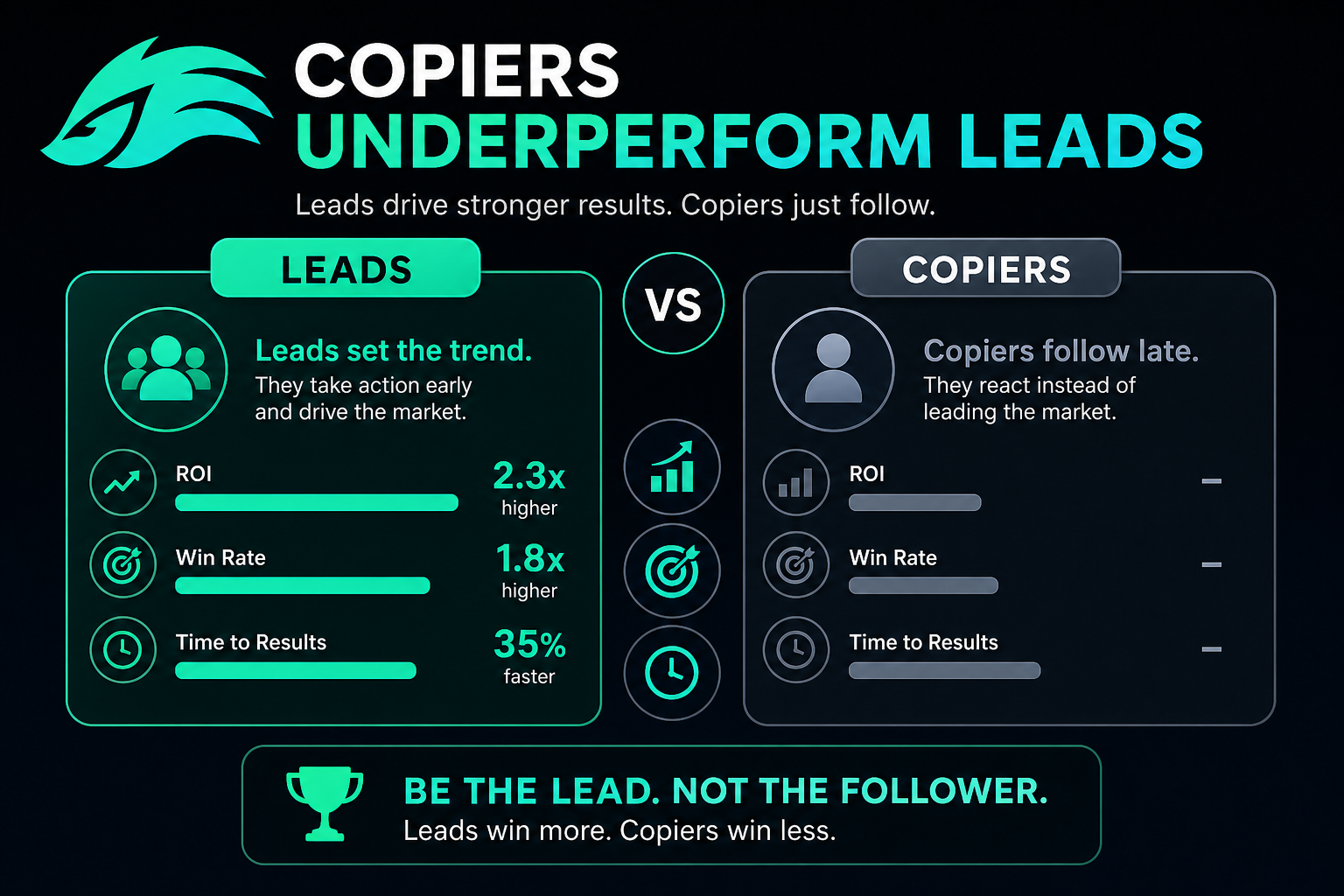
- But copiers underperform leads: Your orders fill on a slight delay at worse prices, so you typically earn less than the trader you copy — and this gap compounds during volatility
- Selection determines outcomes: Profitability depends heavily on choosing the right traders (consistency, low drawdown) and diversifying
- Nothing is guaranteed: Past performance doesn't predict future results; even great traders have losing streaks
The honest bottom line: Copy trading is a legitimate strategy that can be profitable for those who select traders well, diversify, and monitor — but it's not effortless free money. The realistic framing is "a monitored strategy with real potential and real risk," not "guaranteed passive income."
Try on-chain verified copytrading on GraphDex
Key Takeaways
- Copy trading can be profitable, but copiers typically underperform the traders they follow.
- Profitability depends heavily on trader selection, diversification, and discipline.
- On-chain verification (Polymarket) improves odds by letting you choose provably real performers.
- No returns are guaranteed; treat it as a monitored strategy, not effortless income.
Can You Actually Make Money Copy Trading?
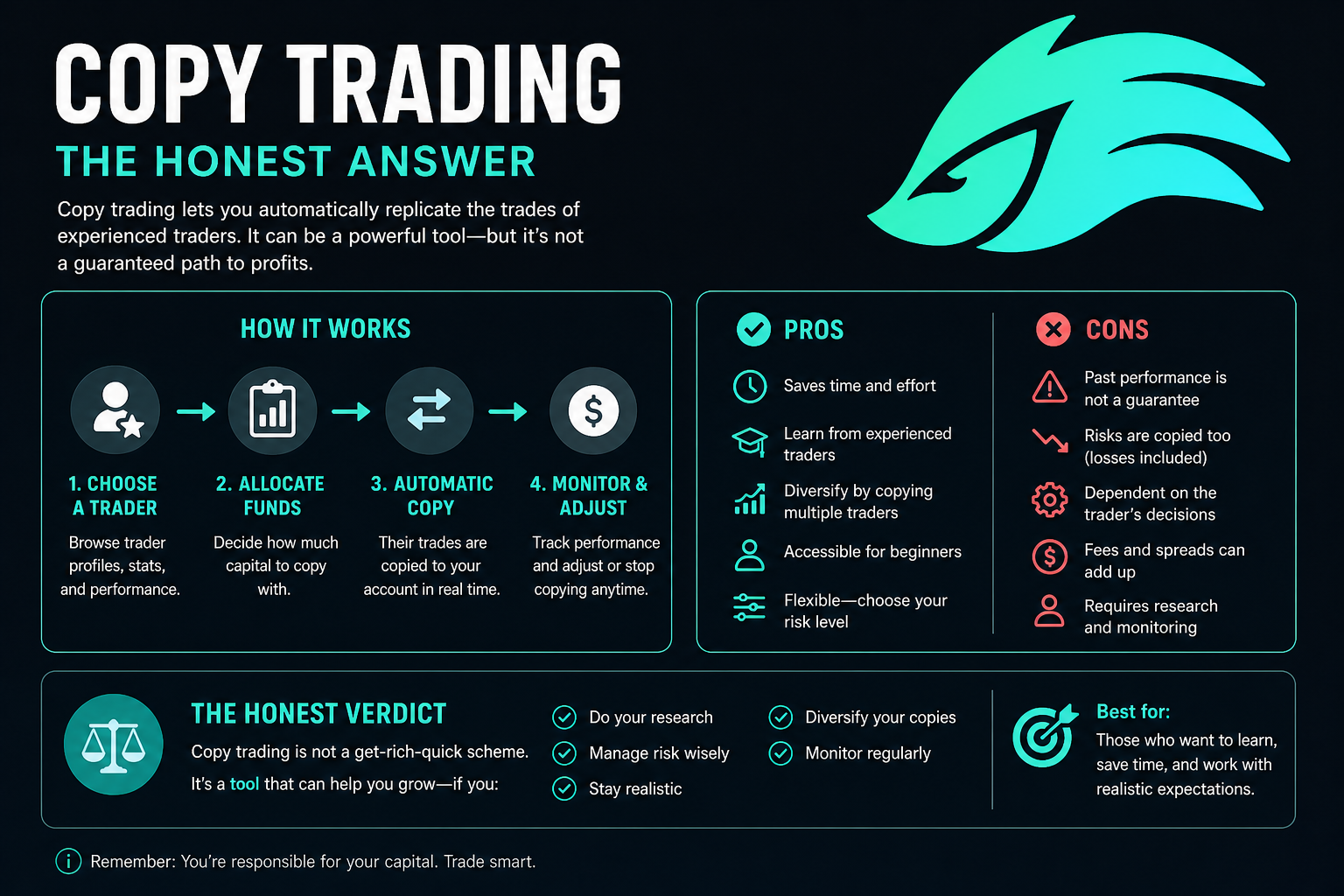
The honest answer: yes, copy trading can be profitable — but success is far from automatic, and the reality differs from the marketing.
The case for profitability:
- You leverage the edge of proven, profitable traders without developing your own expertise
- On prediction markets, you can copy traders with verified (on-chain) track records
- You gain exposure to specialists across domains (politics, sports, crypto) you couldn't master alone
- Automation captures opportunities you'd miss manually
The reality check:
- Copiers typically underperform the traders they follow (explained below)
- Results depend heavily on which traders you choose
- Many copiers break even or lose money, especially with poor selection
- No returns are guaranteed
What the evidence suggests: Copy trading is a legitimate way to potentially profit, particularly for those who treat it as a diversified, monitored strategy rather than a shortcut to wealth. Some achieve steady returns through disciplined approaches; others break even or lose money. The difference usually comes down to trader selection, diversification, and discipline.
The honest framing: Copy trading is neither "guaranteed riches" (as ads claim) nor "always a loss" (as skeptics claim). It's a real strategy with real potential and real risk, where your approach significantly affects your outcome.
Why Copiers Typically Underperform the Traders They Copy
A critical reality most guides skip: even if you copy a profitable trader, you'll likely earn less than they do. Understanding why is essential for realistic expectations.
The delay and fill gap: When the trader you copy enters a position, your order executes on a slight delay — and often at a slightly worse price. In fast-moving prediction markets that reprice within minutes, this delay means you get a worse entry than the lead trader. The same happens on exits.
The compounding effect: This gap between the lead trader's fills and yours compounds over time, especially during volatility. Many small differences add up, so your net return trails the trader you're copying.
Other drag factors:
- Fees: Platform fees reduce your net return
- Slippage: In thin markets, your copied trade may move the price against you
- Allocation differences: Your position sizing may differ from optimal
What this means practically:
- If a trader you copy returns 30%, you might realistically capture less (say 20-25%) after the underperformance gap
- The better the trader and the calmer the markets, the smaller the gap
- The more volatile the markets, the larger the gap
The honest takeaway: Don't expect to match the returns of the trader you copy. Budget for underperformance. A trader's advertised returns are a ceiling you'll fall short of, not a number you'll hit. This is normal and expected — plan for it.
What Determines Copy Trading Profitability
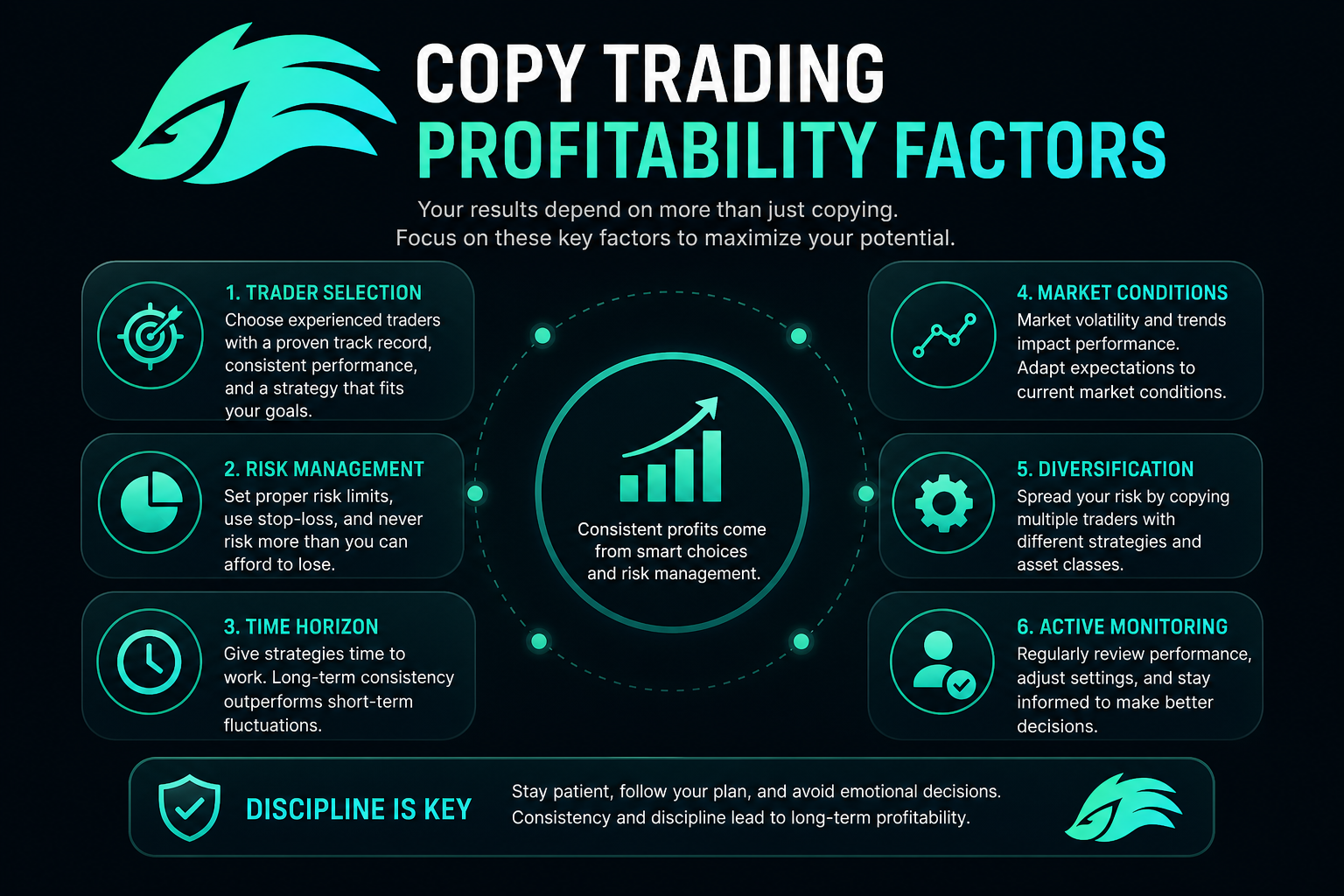
Several factors determine whether your copy trading is profitable. Most are within your control.
1. Trader Selection (The Biggest Factor)
Whom you copy matters more than anything. Copying consistently profitable, low-drawdown traders gives you a shot at profit; copying high-risk or lucky traders leads to losses. Selection is the single biggest determinant.
2. Diversification
Copying a single trader concentrates risk. Diversifying across several proven traders (ideally in different domains) smooths returns and reduces the impact of any one trader's bad period.
3. Discipline & Monitoring
"Set and forget" copy trading often underperforms. Monitoring performance, dropping underperformers, and adjusting improves results. Discipline — not chasing hot traders, not overreacting to short-term losses — matters.
4. Market Conditions
Copy trading results depend partly on market conditions. Some periods favor certain strategies; others don't. Even good traders have periods where their edge doesn't work.
5. Fees & Costs
Platform fees, slippage, and the underperformance gap all reduce net returns. Lower-cost, non-custodial platforms preserve more of your returns.
6. Realistic Expectations
Copiers who expect guaranteed riches make poor decisions (over-allocating, chasing spikes). Those with realistic expectations (monitored strategy, real risk) make better ones.
The controllable insight: Most profitability factors — selection, diversification, discipline, platform choice, expectations — are within your control. Copy trading profitability isn't luck; it's largely determined by how well you execute these factors.
How On-Chain Verification Improves Your Odds
Prediction markets like Polymarket offer a structural advantage that improves copy trading profitability odds: verifiable trader performance.
The problem it solves: In traditional copy trading, a trader's advertised performance can be faked. Copying a "trader" with a fabricated track record is a recipe for losses — and it happens. You're trusting unverifiable claims.
How on-chain verification helps: On Polymarket, every trade is recorded on the blockchain. A trader's real track record, P&L, win rate, and drawdown are verifiable from on-chain data. You copy provably real performers, not marketing claims.
Why this improves profitability odds:
- You select traders based on real, verified performance (better selection = better odds)
- You avoid the fabricated-track-record trap that causes losses
- You can verify consistency and drawdown (choosing lower-risk traders)
- You make data-driven decisions, not hype-driven ones
The honest limit: On-chain verification improves your odds by enabling better selection — but it doesn't guarantee profit. Even verified, consistently profitable traders can have losing streaks, and you still underperform them due to the delay gap. Verification is a significant advantage, not a guarantee.
The bottom line: On-chain verification makes prediction market copy trading more trustworthy and improves your selection odds versus traditional copy trading. It's one of the strongest reasons prediction markets are a better venue for copy trading — but it complements, not replaces, good selection and discipline.
Copy on-chain verified traders on GraphDex
Setting Realistic Expectations
The difference between profitable and unprofitable copy trading often comes down to expectations. Here's a realistic framework.
What's realistic:
- Copy trading can generate returns, especially with good selection and discipline
- You'll typically underperform the traders you copy (budget for this)
- Some periods will be profitable, others not — even good traders have drawdowns
- Meaningful returns require meaningful capital and time
- It's a monitored strategy, not effortless income
What's unrealistic (and signals scams):
- Guaranteed returns ("guaranteed 20% weekly")
- Effortless riches ("$5,000/week doing nothing")
- No risk ("can't lose")
- Matching or beating the traders you copy (you underperform them)
A healthy mindset:
- Treat copy trading as one strategy in a diversified approach
- Start small, verify, and scale what works
- Expect drawdowns and don't panic during them
- Monitor and adjust rather than "set and forget"
- Never invest more than you can afford to lose
The reframe: Approach copy trading like hiring a contractor for a long project — you wouldn't commit based on one week of work. Run due diligence (verified track records), start with a manageable scope (small allocation), and scale what proves itself. This mindset — patient, data-driven, risk-aware — is what separates profitable copy traders from those who lose chasing hype.
How GraphDex Approaches Profitable Copy Trading
GraphDex provides the tools for legitimate copy trading — on-chain verified data, non-custodial funds, and honest positioning — not guaranteed-return promises.
What GraphDex offers:
- World's first integrated prediction-market copytrading — copy proven Polymarket traders
- On-chain verified track records — select traders on real, verifiable performance (better selection = better odds)
- Non-custodial — your funds stay in your own wallet (Privy); lower cost preserves returns
- Flexible parameters — diversify across traders with custom ratios and limits
- Analytics — Bubble Maps, AI signals, and whale tracking to inform selection
- Up to 17% APY on idle capital — your reserves earn between copy trades
How this supports profitability: GraphDex improves your odds through the factors that matter — on-chain verified selection (choose provably real performers), diversification tools (spread risk across traders), non-custodial low cost (preserve returns), and analytics (data-driven decisions). Plus yield on idle capital makes your reserves productive between trades.
The honest positioning: GraphDex doesn't promise guaranteed returns — that would be a scam. Copy trading carries risk, copiers underperform the traders they copy, and no returns are guaranteed. What GraphDex provides is the infrastructure and verified data to pursue copy trading properly: better selection, diversification, low cost, and honest tools. The profitability depends on how well you use them.
For those seeking legitimate copy trading with realistic expectations and honest tools, GraphDex consolidates verified data, diversification, and execution in one non-custodial terminal.
Try honest, on-chain verified copytrading on GraphDex
Related Guides
- Prediction Market Copy Trading in 2026: The Complete Guide
- Passive Income with Prediction Markets in 2026: Realistic Strategies
- How to Find Profitable Polymarket Traders to Copy in 2026
- Mirror Trading on Polymarket in 2026: How to Automatically Follow Top Traders
Frequently Asked Questions
Is prediction market copy trading profitable? It can be, but with caveats. Copying consistently profitable, on-chain-verified traders can generate returns — you leverage their edge without developing your own. However, copiers typically underperform the traders they follow (delays, worse fills), profitability depends heavily on selection and discipline, and no returns are guaranteed. It's a legitimate strategy with real potential and real risk — not effortless free money.
Why do copiers earn less than the traders they copy? Because your orders fill on a slight delay and at slightly worse prices than the lead trader's. In fast-moving prediction markets that reprice within minutes, this delay means worse entries and exits. The gap compounds over time, especially during volatility. Add fees and slippage, and your net return trails the trader you copy. Budget for underperformance — a trader's returns are a ceiling you'll fall short of.
How much can I make copy trading prediction markets? It varies enormously based on trader selection, diversification, discipline, market conditions, and capital — and no amount is guaranteed. You'll typically capture less than the traders you copy (due to the delay gap). Some copiers achieve steady returns; others break even or lose money. Rather than a specific figure, expect a monitored strategy with real potential and real risk. Ignore anyone promising specific guaranteed returns.
What determines whether copy trading is profitable? Mainly controllable factors: trader selection (the biggest — choose consistent, low-drawdown, verified traders), diversification (spread across several traders), discipline and monitoring (drop underperformers, don't chase hype), platform costs (lower fees preserve returns), and realistic expectations. Market conditions also matter (even good traders have off periods). Most factors are within your control — profitability is largely about execution, not luck.
Does on-chain verification make copy trading more profitable? It improves your odds by enabling better trader selection. On Polymarket, trader track records are verifiable from blockchain data, so you copy provably real performers rather than fabricated claims — avoiding a major cause of losses. This improves selection (a key profitability factor) but doesn't guarantee profit: verified traders still have losing streaks, and you still underperform them due to delays. It's a significant advantage, not a guarantee.
Is copy trading a scam? Legitimate copy trading isn't a scam — it's a real strategy for leveraging others' expertise, with real risk. However, the space is full of scams: platforms promising guaranteed returns, "$5,000/week" screenshots, or no-risk claims are red flags. Legitimate copy trading acknowledges risk, doesn't guarantee returns, and (on prediction markets) offers verifiable track records. Distinguish real strategies (real risk, real potential) from scams (guaranteed riches).
Should I copy trade or trade myself? Depends on your expertise, time, and goals. Copy trading suits those who want to leverage others' expertise without developing their own, or who lack time to trade actively — accepting that you underperform the traders you copy. Trading yourself suits those who want full control and are willing to develop their own edge. Many combine both — copy trading for some capital, independent trading for the rest. Neither guarantees profit.
About This Guide
This guide is published by the GraphDex Research team — analysts and traders building the infrastructure for digital asset trading on Solana. Our content is based on direct experience, current market data, and 2026 prediction market developments.
Sources & data: Copy trading dynamics and market data reflect publicly available information as of 2026 and may change. Copy trading carries substantial risk including loss of capital; copiers typically underperform the traders they follow, and past performance doesn't predict future results. No returns are guaranteed. Prediction market legality varies by jurisdiction. This guide is educational and not financial advice.
GraphDex is the infrastructure for digital asset trading — trade, predict, and earn in one place. Learn more at graphdex.io.
Last reviewed: May 2026 · GraphDex Research
The infrastructure for digital asset trading. Trade, predict, stake, repeat. graphdex.io