By GraphDex Research · Reviewed for accuracy May 2026
Quick Answer
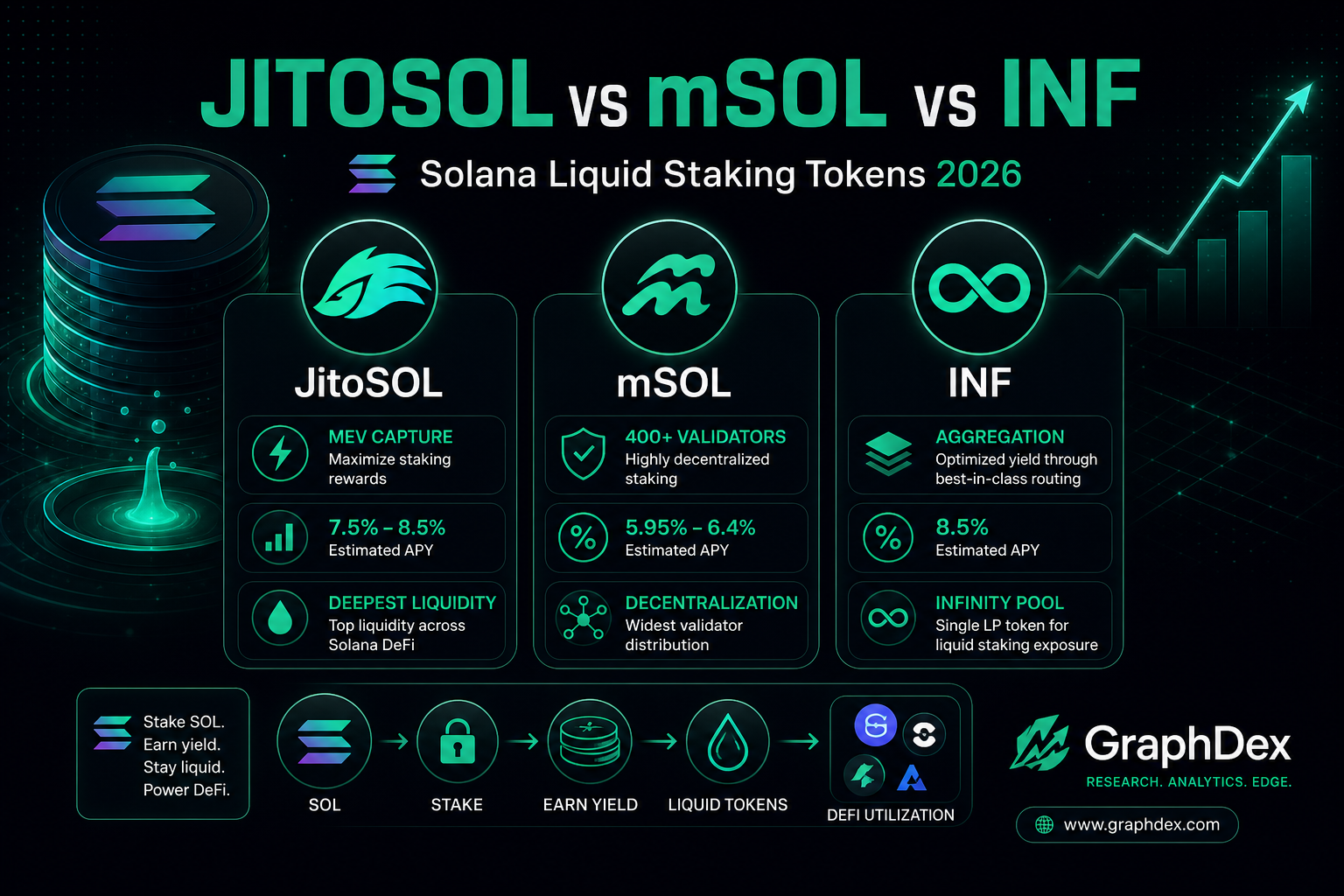
JitoSOL vs mSOL vs INF — the three leading Solana liquid staking tokens compared:
- JitoSOL (Jito): Highest yield among major LSTs (~7.5-8.5%) thanks to MEV capture. Largest LST by TVL, deepest DeFi liquidity, best for quick entry/exit. Charges a management fee.
- mSOL (Marinade): The original Solana LST (~5.95-6.4% after fees). Most decentralized (delegates across many validators), Stake Auction Marketplace captures validator competition. Best for decentralization.
- INF (Sanctum): Aggregates yields across multiple LSTs (~8.5% at points). Backed by Sanctum's Infinity pool for instant unstaking of any LST. Best for diversified LST exposure and liquidity aggregation.
The verdict: Choose JitoSOL for the highest MEV-boosted yield and deepest liquidity, mSOL for decentralization, or INF for diversified exposure and universal LST liquidity. All are non-custodial.
Earn yield on idle capital while trading on GraphDex
Key Takeaways
- JitoSOL leads on yield (~7.5-8.5%) via MEV capture; it's the largest LST with deepest liquidity.
- mSOL is the original LST, most decentralized, with a Stake Auction Marketplace; ~5.95-6.4% after fees.
- INF (Sanctum) aggregates multiple LSTs' yields and offers universal instant unstaking.
- All three are non-custodial; choose based on yield, decentralization, or diversification priorities.
What Are Liquid Staking Tokens (LSTs)?
Liquid staking tokens solve a core problem with native Solana staking: illiquidity. When you stake SOL natively, it's locked with a 2-3 day unstaking period, and it can't be used elsewhere. LSTs fix this.
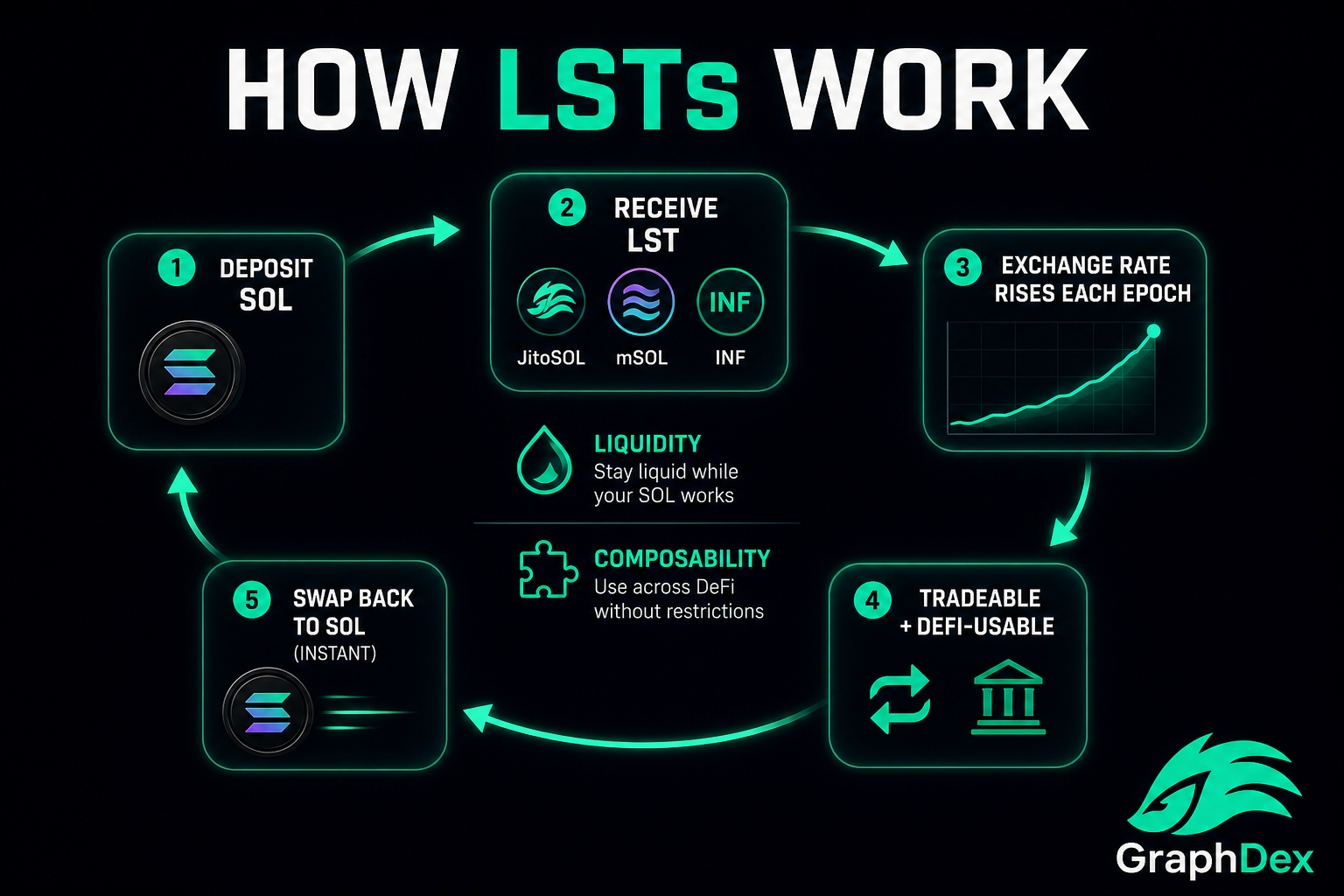
How LSTs work:
- You deposit SOL into a liquid staking protocol
- You receive an LST (JitoSOL, mSOL, or INF) representing your staked position
- The LST accrues value as staking rewards accumulate — its exchange rate versus SOL rises each epoch
- The LST remains tradeable and usable across DeFi (lending, collateral, liquidity provision)
- To exit, you swap the LST back to SOL (often instant via pools) or unstake directly
The key advantages:
- Liquidity: Your staked value stays tradeable — no 2-3 day lock
- DeFi composability: Use LSTs as collateral, in lending, or for liquidity — earning "stacked yield" on top of staking rewards
- Auto-compounding: Rewards accrue via the rising exchange rate — no manual claiming
- Self-custody: Your keys stay yours; smart contracts handle validator operations
The trade-off: LSTs add smart contract risk (the protocol's code) and LST liquidity risk (exit quality depends on pool depth). But for most active users, the liquidity and DeFi benefits outweigh these risks.
The growth: Liquid staking now represents ~13-14% of all staked SOL and is rising, as holders increasingly prefer keeping liquidity over native locking.
JitoSOL: The MEV-Powered Leader
Jito's JitoSOL is the largest and highest-yielding major LST, thanks to MEV capture.
How it works:
- You stake SOL and receive JitoSOL
- The token balance stays fixed while the exchange rate versus SOL rises as rewards accrue
- Jito's stake pool delegates across roughly 200 vetted validators running the Jito-Solana client
- Crucially, MEV tip revenue flows back to JitoSOL holders (not just validators)
Yield: ~7.5-8.5% — the highest among non-subsidized major LSTs, because JitoSOL captures MEV tips on top of base staking rewards.
The MEV differentiator: This is JitoSOL's key advantage. On many competing LSTs, MEV revenue flows to node operators rather than token holders. JitoSOL redistributes it to holders, structurally boosting yield by ~100-150 basis points over LSTs that don't capture MEV.
Fees: JitoSOL charges a management fee on rewards and a small direct withdrawal fee.
Pros:
- Highest yield among major LSTs (MEV capture)
- Largest LST by TVL (over $2 billion)
- Deepest DeFi liquidity — accepted as collateral on Kamino, Save, Drift, and most Solana money markets
- Cleanest exit (deep liquidity for quick swaps)
Cons:
- Yield compression as more SOL stakes (same MEV split across a larger base)
- Management fee
- Smart contract and LST liquidity risk
Best for: Holders wanting the highest MEV-boosted yield, deepest liquidity, and broad DeFi acceptance.
mSOL: The Decentralized Original
Marinade's mSOL is the original Solana LST, prioritizing decentralization.
How it works:
- You deposit SOL and receive mSOL
- mSOL represents your staked SOL in Marinade's stake pool and accrues value via the exchange rate
- Marinade delegates across many validators (400+), prioritizing decentralization
- The Stake Auction Marketplace lets validators bid for stake by offering commission back to delegators
Yield: ~5.95-6.4% after Marinade's protocol fee. This trails JitoSOL by ~100-150 basis points because Marinade doesn't enforce the Jito-Solana client and captures less MEV.
The decentralization differentiator: Marinade pioneered Solana liquid staking in 2021 and spreads stake across hundreds of validators, supporting network decentralization. The Stake Auction Marketplace is unique — validators compete for stake by returning commission to delegators, so mSOL holders capture validator competition that other LSTs absorb as protocol revenue.
Pros:
- Most decentralized major LST (400+ validators)
- Established track record (original Solana LST, since 2021)
- Stake Auction Marketplace captures validator competition
- Also offers Marinade Native (direct delegation, no smart contract risk)
- Accepted as collateral on Kamino, MarginFi, Save, Drift
Cons:
- Lower yield than JitoSOL (~100-150 bps less, due to less MEV capture)
- Smart contract risk (for mSOL; Marinade Native avoids this)
Best for: Holders who prioritize decentralization and an established track record, and who value supporting validator diversity.
INF: The Yield Aggregator
Sanctum's INF aggregates yields across multiple LSTs and offers universal liquidity.
How it works:
- INF aggregates yields across multiple Solana staking strategies
- It's backed by Sanctum's Infinity pool, which aggregates liquidity across all Solana LSTs
- This enables instant unstaking regardless of which LST you hold
- INF holders get diversified exposure while maintaining liquidity advantages
Yield: ~8.5% at points — competitive with or exceeding JitoSOL, through diversified yield aggregation.
The aggregation differentiator: Sanctum's Infinity pool solves a major pain point — previously, unstaking an LST required finding DEX liquidity or waiting. Sanctum provides instant exit liquidity for all LSTs. INF itself aggregates yields across multiple strategies, giving diversified exposure rather than single-protocol concentration.
Pros:
- Competitive/high yield through aggregation (~8.5% at points)
- Diversified exposure (not concentrated in one protocol)
- Backed by Sanctum's universal LST liquidity (Infinity pool)
- Access to the entire Solana LST ecosystem
Cons:
- Newer and more complex than JitoSOL/mSOL
- Aggregation adds a layer of abstraction
- Smart contract risk (Sanctum's infrastructure)
Best for: Holders wanting diversified LST exposure, the highest aggregated yields, and access to Sanctum's universal liquidity infrastructure.
Head-to-Head Comparison
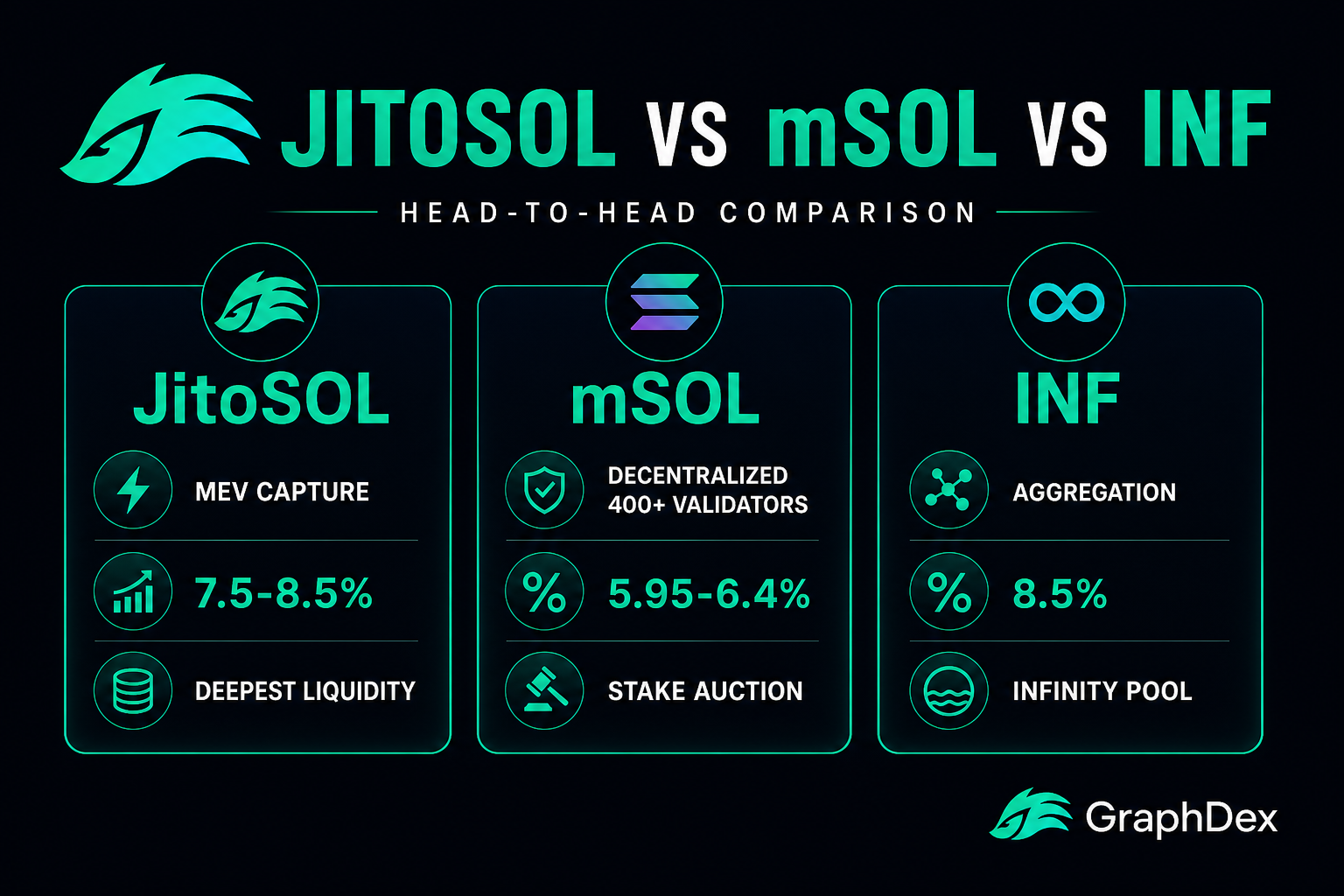
| Feature | JitoSOL | mSOL | INF |
|---|---|---|---|
| Protocol | Jito | Marinade | Sanctum |
| Yield (2026) | ~7.5-8.5% | ~5.95-6.4% | ~8.5% (at points) |
| Key differentiator | MEV capture | Decentralization | Yield aggregation |
| Validators | ~200 (Jito client) | 400+ | Aggregated |
| Liquidity | Deepest (largest TVL) | Strong | Universal (Infinity pool) |
| Custody | Non-custodial | Non-custodial | Non-custodial |
| Best for | Highest yield + liquidity | Decentralization | Diversified exposure |
Yields reflect 2026 ranges and compress over time as Solana's inflation schedule reduces.
How to Choose Between JitoSOL, mSOL & INF
Match the LST to your priorities:
Choose JitoSOL if you:
- Want the highest yield among major LSTs (MEV capture)
- Value the deepest DeFi liquidity and broadest collateral acceptance
- Want the cleanest, fastest exit
- Prioritize yield and liquidity over maximum decentralization
Choose mSOL if you:
- Prioritize decentralization (400+ validators)
- Value an established track record (original Solana LST)
- Want the Stake Auction Marketplace's validator competition benefits
- Might use Marinade Native (direct delegation, no smart contract risk)
Choose INF if you:
- Want diversified LST exposure (not single-protocol)
- Value the highest aggregated yields
- Want access to Sanctum's universal LST liquidity (instant unstaking of any LST)
- Are comfortable with a newer, more complex product
Consider a mix if you:
- Want to diversify across LSTs to spread smart contract risk
- Value different LSTs' strengths for different purposes
The practical reality: JitoSOL is the default choice for most — highest yield, deepest liquidity, broadest acceptance. mSOL suits decentralization-focused holders. INF suits those wanting diversification and universal liquidity. All are non-custodial and established enough for serious use.
Complement your LST strategy with GraphDex yield
Risks to Understand
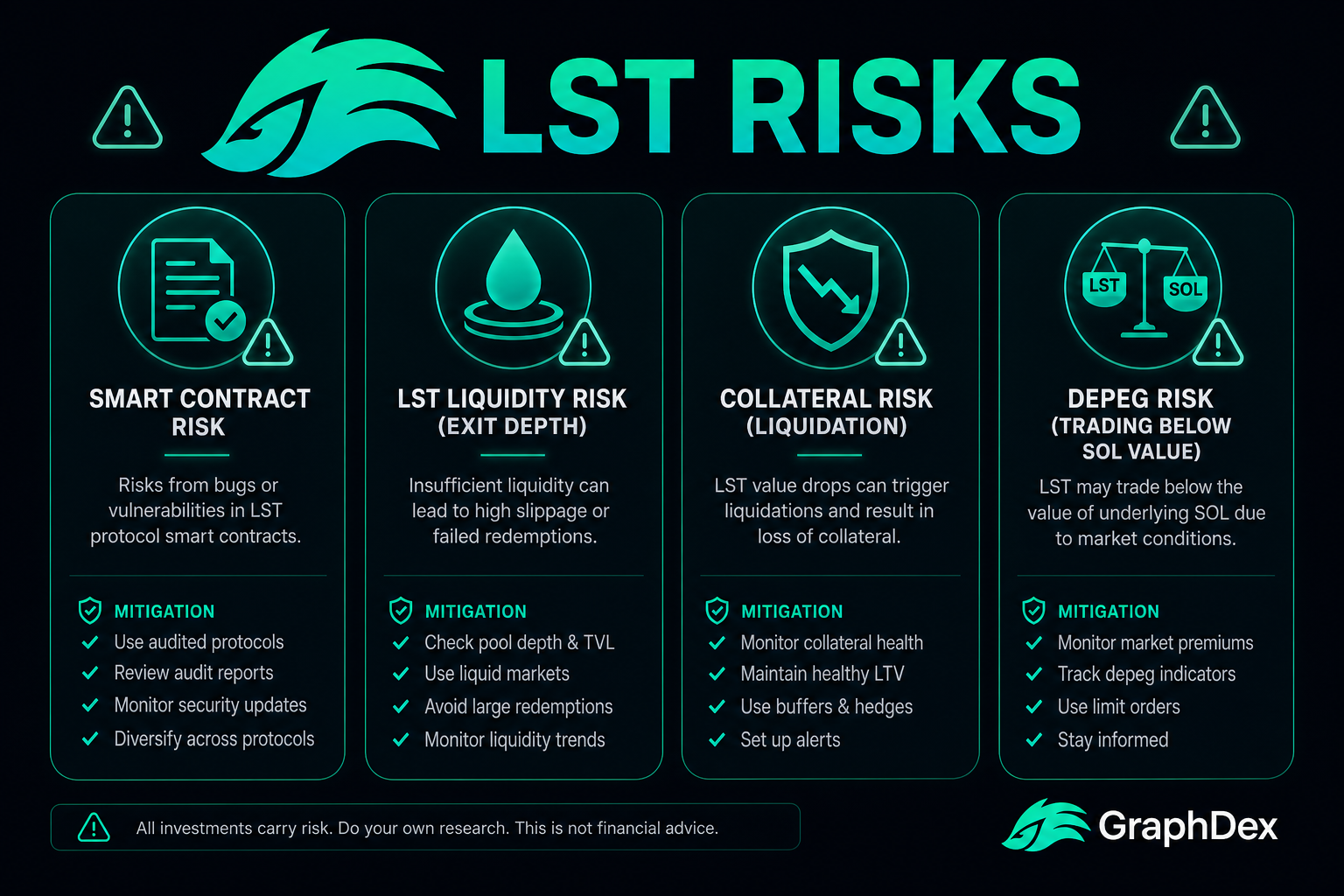
All LSTs carry risks native staking doesn't. Understand them before committing.
Smart contract risk. Each LST relies on the protocol's code. A bug or exploit could affect funds. Established LSTs (JitoSOL, mSOL) have audits and track records, but the risk is real.
LST liquidity risk. During market stress, the LST's exit quality depends on pool depth. In extreme conditions, you might face wider spreads swapping back to SOL. JitoSOL's deep liquidity mitigates this; smaller LSTs face more risk.
Collateral risk. If you use LSTs as DeFi collateral (for stacked yield), you add liquidation risk on top of LST risk. Depeg events (LST trading below its SOL value) can trigger liquidations.
Depeg risk. LSTs should track their underlying SOL value, but during stress, they can temporarily trade below it. This affects exit value and collateral positions.
The mitigation: Use established LSTs with deep liquidity, understand the risks before using LSTs as collateral, and don't overleverage. For those uncomfortable with smart contract risk, native staking (or Marinade Native) avoids it.
How GraphDex Fits Your Yield Strategy
While GraphDex isn't a liquid staking protocol, it integrates yield into a broader trading terminal — complementing your LST strategy.
The GraphDex yield approach:
- Up to 17% APY on idle capital (SOL and stablecoins) between trades
- Integrated — earn yield in the same terminal where you trade Solana tokens and prediction markets
- Non-custodial — funds stay in your own wallet (Privy), sign in with Twitter, email, or Telegram
- No idle capital — trading reserves earn yield rather than sitting dormant
How it complements LSTs: LSTs (JitoSOL, mSOL, INF) are ideal for SOL you hold long-term and want to keep liquid and DeFi-usable. GraphDex's integrated yield is ideal for trading capital — the reserves you keep for memecoin trades and prediction opportunities, which can earn yield between trades rather than sitting idle. Together, they ensure your capital works whether held long-term (LSTs) or reserved for trading (GraphDex yield).
The complete picture: For active traders, GraphDex consolidates memecoin trading (across all launchpads), prediction-market copytrading, and yield on idle capital — all non-custodial, in one terminal.
Put idle trading capital to work on GraphDex
Related Guides
- Best Solana Staking in 2026: Native, Liquid & Stablecoin Options Compared
- What Is Liquid Staking in 2026? The Complete Guide
- Stablecoin Yield 2026: Best USDC/USDT APY (3–17%) Compared
Frequently Asked Questions
What's the difference between JitoSOL, mSOL, and INF? JitoSOL (Jito) offers the highest yield (~7.5-8.5%) via MEV capture and has the deepest liquidity. mSOL (Marinade) is the original LST, most decentralized (400+ validators), yielding ~5.95-6.4% after fees. INF (Sanctum) aggregates yields across multiple LSTs (~8.5% at points) and provides universal instant unstaking. Choose JitoSOL for yield/liquidity, mSOL for decentralization, INF for diversification.
Which Solana LST has the highest yield? JitoSOL typically leads among major single LSTs (~7.5-8.5%) due to MEV capture — it redistributes MEV tips to holders, boosting yield ~100-150 basis points over LSTs that don't. INF (Sanctum) reaches ~8.5% at points through yield aggregation across multiple strategies. Both exceed mSOL (~5.95-6.4%). Note that yields compress over time as Solana's inflation schedule reduces.
Why does JitoSOL yield more than mSOL? JitoSOL captures MEV (Maximal Extractable Value) tips through Jito's validator infrastructure and redistributes them to JitoSOL holders — adding ~100-150 basis points on top of base staking rewards. mSOL trails because Marinade doesn't enforce the Jito-Solana client and captures less MEV. The MEV difference is the primary reason for the yield gap between them.
Is JitoSOL, mSOL, or INF safer? All are non-custodial and established, but each carries smart contract risk (the protocol's code) and LST liquidity risk. JitoSOL has the deepest liquidity (mitigating exit risk) and largest TVL. mSOL has the longest track record (since 2021) and offers Marinade Native (direct delegation, no smart contract risk). INF is newer with an added aggregation layer. For zero smart contract risk, native staking or Marinade Native is safest.
Can I use LSTs in DeFi? Yes — that's a key advantage. JitoSOL, mSOL, and INF are usable across Solana DeFi as collateral, in lending, and for liquidity provision — earning "stacked yield" on top of staking rewards. JitoSOL has the broadest acceptance (Kamino, Save, Drift, and most money markets). However, using LSTs as collateral adds liquidation and depeg risk on top of LST risk.
What is Sanctum's Infinity pool? Sanctum's Infinity pool aggregates liquidity across all Solana LSTs, enabling instant unstaking regardless of which LST you hold — solving the problem where unstaking previously required finding DEX liquidity or waiting. INF is Sanctum's own LST that aggregates yields across multiple strategies. The Infinity pool provides universal exit liquidity for the entire Solana LST ecosystem.
Should I choose one LST or several? Most holders use one (JitoSOL is the common default for yield and liquidity). However, diversifying across LSTs spreads smart contract risk — if one protocol has an issue, you're not fully exposed. Some holders split across JitoSOL (yield), mSOL (decentralization), and INF (aggregation). The trade-off is added complexity for reduced single-protocol risk.
About This Guide
This guide is published by the GraphDex Research team — analysts and traders building the infrastructure for digital asset trading on Solana. Our content is based on direct experience, current market data, and 2026 staking developments.
Sources & data: LST yields, mechanics, and figures reflect publicly available information as of 2026 and may change. LSTs carry smart contract risk, liquidity risk, depeg risk, and (if used as collateral) liquidation risk. Yields compress over time. This guide is educational and not financial advice — always do your own research.
GraphDex is the infrastructure for digital asset trading — trade, predict, and earn in one place. Learn more at graphdex.io.
Last reviewed: May 2026 · GraphDex Research
The infrastructure for digital asset trading. Trade, predict, stake, repeat. graphdex.io