By GraphDex Research · Reviewed for accuracy May 2026
Quick Answer
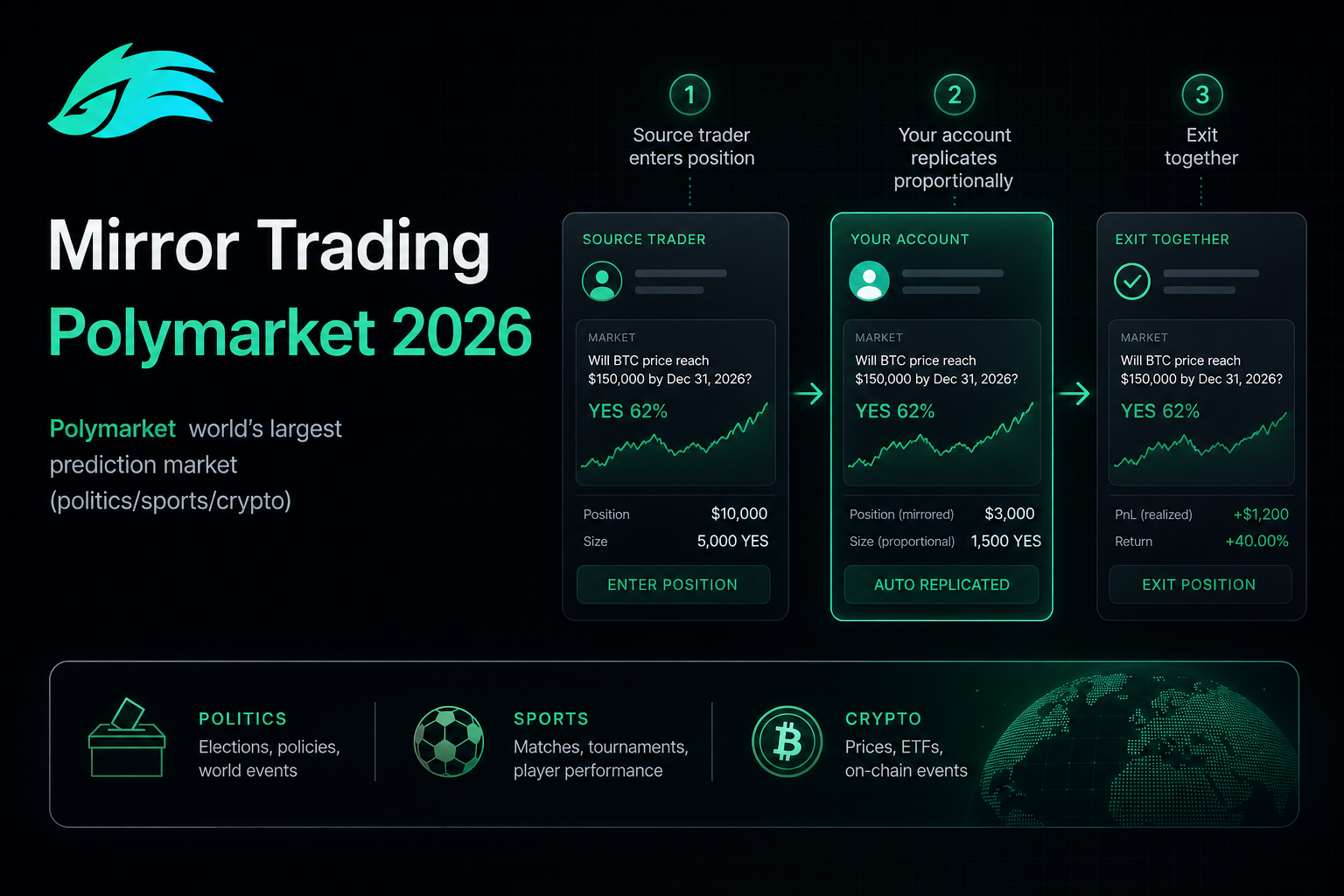
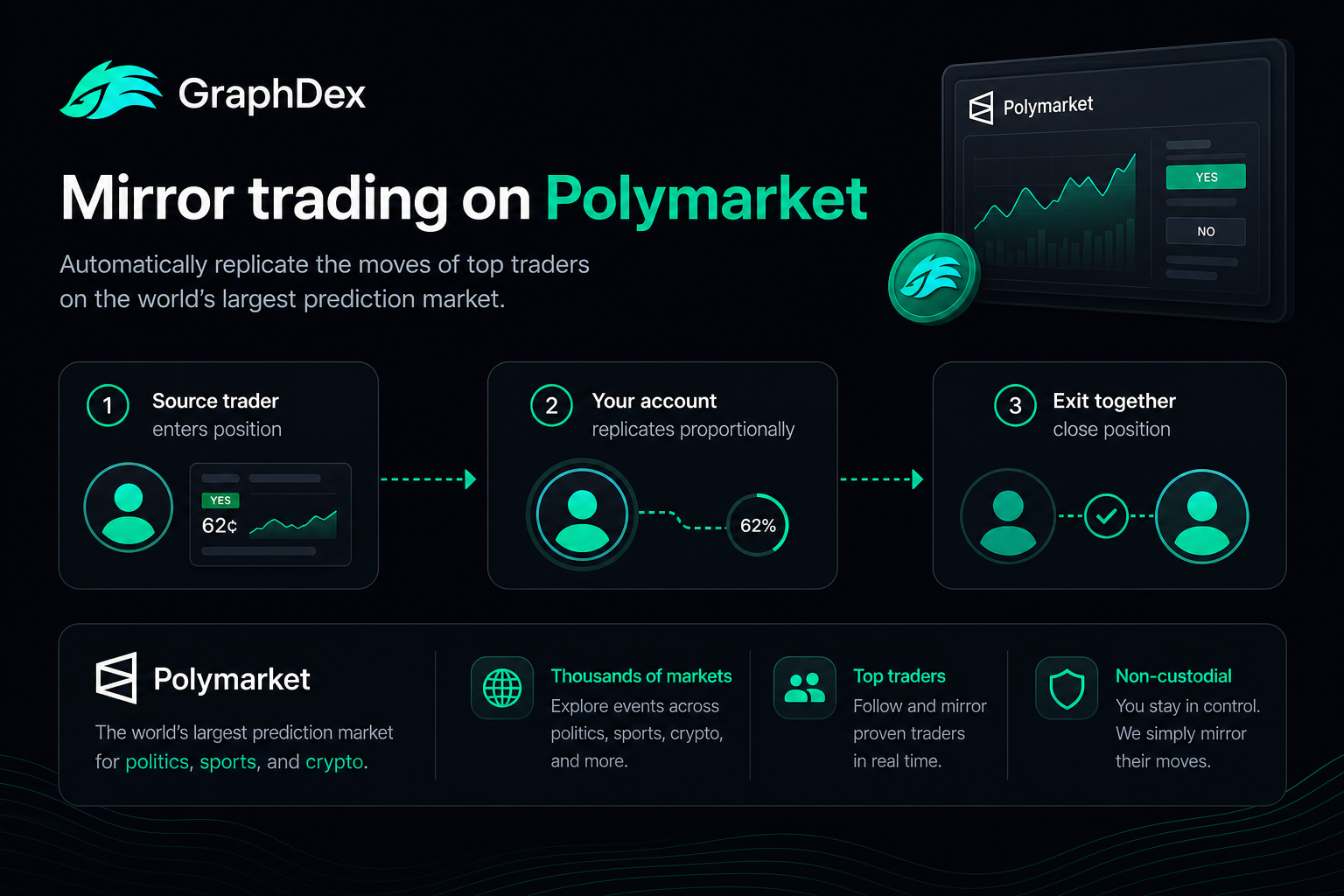
Mirror trading on Polymarket means automatically replicating a top trader's positions in your own account:
- How it works: When a trader you follow enters a position, your account automatically enters a proportional one; when they exit, yours does too
- The Polymarket advantage: Because Polymarket is on-chain, a trader's entire P&L history is publicly verifiable — you can confirm their real performance before mirroring
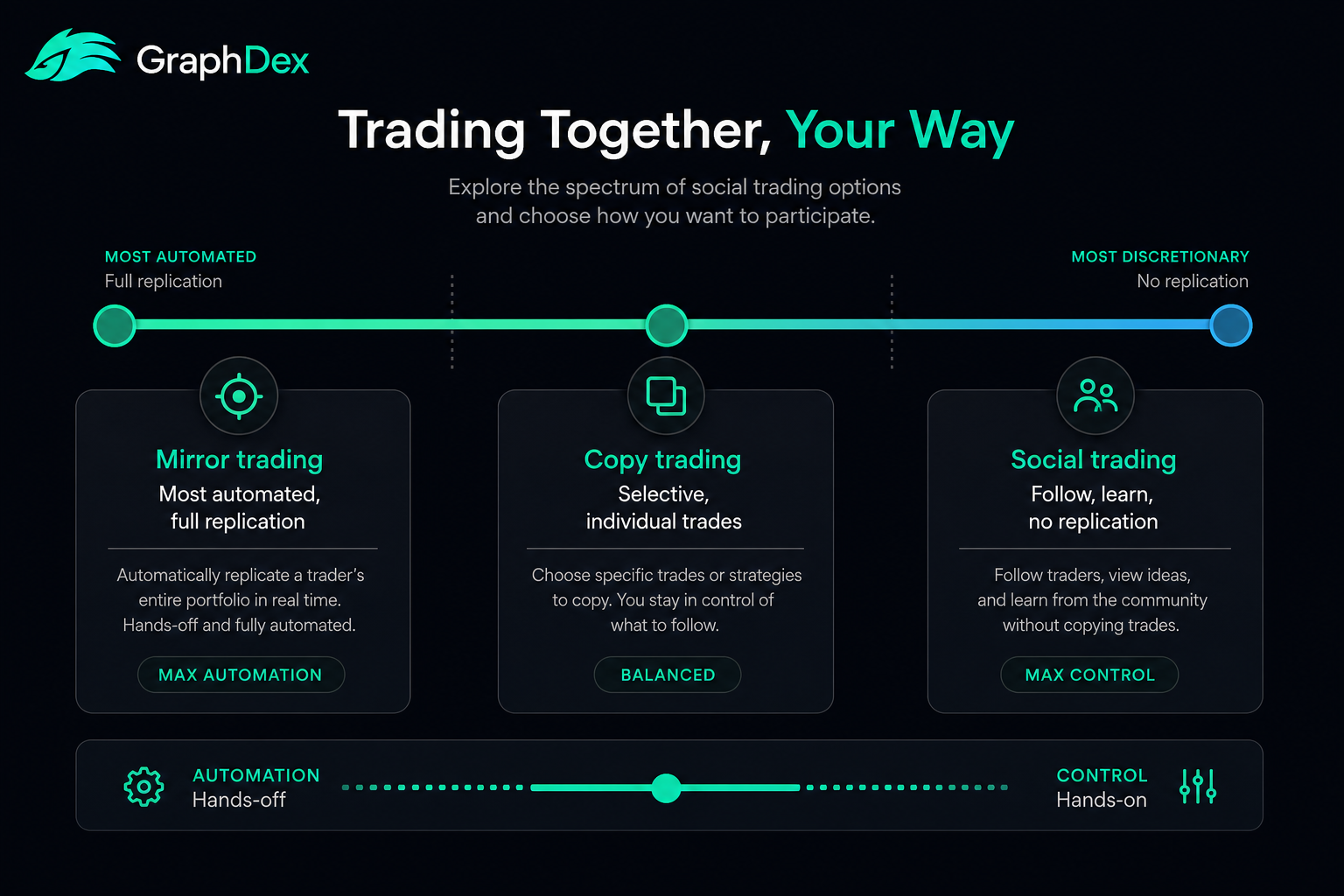
- Mirror vs copy vs social: Mirror trading is the most automated (full replication); copy trading is more selective; social trading is following/learning without replicating
- Why it works on prediction markets: Top Polymarket traders often have domain expertise (politics, sports, crypto); mirroring lets you leverage it across thousands of markets
The honest reality: Mirror trading isn't guaranteed profit. You typically underperform the trader you mirror (delays, worse fills), returns aren't guaranteed, and choosing whom to mirror is critical. On-chain verification helps you choose, but risk remains.
Try prediction market mirror trading on GraphDex
Key Takeaways
- Mirror trading automatically replicates a trader's positions in your account, scaled to your capital.
- Polymarket's on-chain nature makes trader track records provably real — a key advantage.
- Mirror trading is the most automated form; copy trading is selective; social trading is following/learning.
- You typically underperform the mirrored trader; selection and monitoring remain essential.
What Is Mirror Trading on Polymarket?
Mirror trading is an investment strategy where you automatically replicate — or "mirror" — the trades of an experienced trader in your own account. When the source trader buys, your account buys; when they sell, your account sells. The goal is to capture the returns of a proven strategy without needing the expertise, time, or infrastructure to develop one yourself.
On Polymarket specifically: Polymarket is the world's largest prediction market, with hundreds of millions in volume across politics, sports, crypto, and culture. But with thousands of active markets, finding profitable opportunities is overwhelming. Mirror trading solves this — you follow a proven trader and their positions replicate in your account automatically.
How it works step by step:
- You identify a top Polymarket trader with a verified track record
- You set up mirroring (allocate capital, set parameters)
- When they enter a position, your account mirrors it — scaled to your capital
- When they exit, your position closes automatically
- You monitor and adjust over time
The origin of mirror trading: The concept originated in the early 2000s on institutional forex desks, where brokerages let retail clients connect to professional strategies. It evolved through eToro's "social trading" in the 2010s and crypto exchange copy trading. Now it's come to prediction markets — bringing automated replication to Polymarket.
Why prediction markets are a natural fit: Prediction markets work differently from stocks or crypto — you're trading binary or multi-outcome contracts that resolve based on real-world events, not continuous price charts. This event-driven structure, combined with domain-expert traders and on-chain verification, makes mirror trading especially powerful on Polymarket.
Mirror Trading vs Copy Trading vs Social Trading
These terms overlap but have distinct meanings. Understanding the spectrum helps you choose your approach.
Mirror trading (most automated): You fully replicate a trader's strategy automatically. When they trade, you trade — hands-off, complete replication. Best for those wanting maximum automation.
Copy trading (selective): You copy individual trades, often selectively — choosing which of a trader's moves to replicate from a feed. More control, less full automation. Best for those wanting some discretion.
Social trading (follow/learn): You follow top traders to see and learn from their moves — without necessarily replicating them. Best for those wanting to learn or make their own decisions informed by others.
The spectrum: These exist on a spectrum of automation and control. Mirror trading is the most automated (least control); social trading is the least automated (most control); copy trading sits between. Many platforms support all three — you can passively mirror, selectively copy, or simply follow and learn.
Which to choose:
- Mirror trading: You trust a proven trader and want full automation
- Copy trading: You want to leverage a trader but retain some selection
- Social trading: You want to learn and make informed decisions yourself
For most seeking "passive" leverage of expertise, mirror trading (full automation) is the go-to — but it requires the most trust in your chosen trader, making trader selection critical.
Mirror verified Polymarket traders on GraphDex
Why Polymarket's On-Chain Nature Matters
The single most important advantage of mirror trading on Polymarket: verifiability.
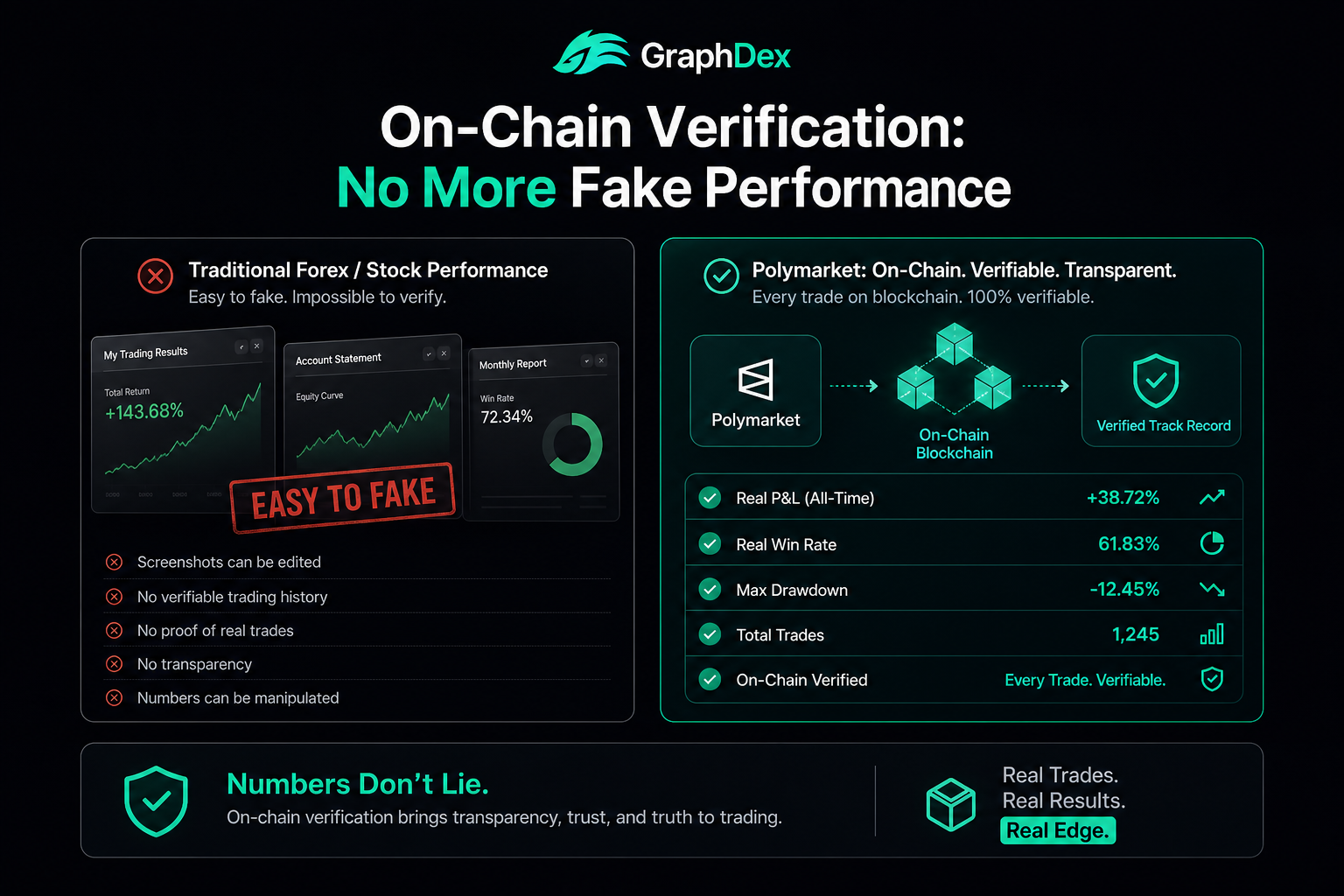
The problem with traditional mirror trading: In forex or stock mirror trading, a trader's advertised performance can be faked or exaggerated. You're often trusting screenshots or platform-reported numbers, with no way to independently verify. This has led to people mirroring "traders" whose track records were fabricated — and losing money.
How Polymarket solves it: Polymarket is on-chain, meaning every trade is publicly recorded on the blockchain. A trader's entire history — every position, every outcome, their real P&L — is verifiable from on-chain data. You can confirm exactly how a trader has actually performed before mirroring them.
What this enables:
- Verified track records: Confirm real performance, not marketing claims
- Transparent P&L: See actual profit and loss from blockchain data
- Real win rates: Verify how often they've actually been right
- Drawdown history: See their real peak-to-trough losses
Why it's a game-changer: On-chain verification eliminates the biggest risk of traditional mirror trading — following someone whose track record is fake. On Polymarket, the numbers don't lie. You mirror traders with provably real performance, making mirror trading far more trustworthy than in traditional markets.
The practical benefit: Before mirroring any Polymarket trader, you can verify their track record from on-chain data — track record length, consistency, drawdown, and P&L. This verification is the foundation of choosing whom to mirror well.
How to Start Mirror Trading on Polymarket
A practical framework.
Step 1: Choose a Platform or Terminal
You need a platform offering Polymarket mirror trading. Look for:
- On-chain verified trader track records
- Non-custodial architecture (funds stay in your wallet)
- Flexible mirroring parameters (ratios, limits)
- Quality trader analytics
- Integrated execution
GraphDex offers the world's first integrated prediction-market copytrading, letting you mirror Polymarket traders within a non-custodial terminal.
Step 2: Identify Traders to Mirror
Using on-chain verified data, evaluate traders on:
- Track record length (longer = more reliable)
- Consistency (steady beats volatile spikes)
- Maximum drawdown (lower = safer)
- Win rate and verified P&L
- Domain specialization (sports, politics, crypto)
Step 3: Set Mirroring Parameters
- Allocation (how much capital)
- Copy ratio (proportional to their positions)
- Limits (per position, daily, total)
- Categories (mirror all trades or specific domains)
Step 4: Start Small and Monitor
- Begin with a modest allocation to test
- Monitor performance over time
- Mirror multiple traders to diversify
- Drop underperformers
Step 5: Manage Risk
- Never allocate more than you can afford to lose
- Diversify across traders and domains
- Remember past performance doesn't guarantee future results
- Keep monitoring — mirror trading isn't fully "set and forget"
The Honest Risks of Mirror Trading
Mirror trading is often hyped as effortless income. The honest reality matters.
You typically underperform the trader you mirror. Your orders fill on a slight delay and at slightly worse prices than the source trader's. This gap compounds, especially during volatility. Even mirroring a profitable trader, you'll likely earn less than they do.
Past performance doesn't guarantee future results. A verified track record shows what happened, not what will happen. Even excellent traders have losing streaks and drawdowns.
No returns are guaranteed. Mirror trading can lose money. Following someone doesn't eliminate risk.
Trader selection is critical. Choosing whom to mirror is the key skill. Mirror the wrong trader (high-risk, lucky rather than skilled, or about to hit a bad streak) and you lose.
It's not fully passive. Despite "set and forget" marketing, effective mirror trading requires monitoring and adjusting.
Scam warning: Ignore platforms promising guaranteed returns or showing "$5,000/week" screenshots. These are red flags. Legitimate mirror trading offers real potential with real risk.
The balanced view: Mirror trading on Polymarket is made more trustworthy by on-chain verification (real track records), but it remains a risk-bearing strategy where you typically underperform the trader you follow. Approach it with realistic expectations, careful trader selection (using on-chain data), diversification, and monitoring.
How GraphDex Enables Polymarket Mirror Trading
GraphDex offers the world's first integrated prediction-market copytrading — bringing mirror trading to Polymarket within a non-custodial terminal.
For mirror traders:
- World's first integrated prediction-market copytrading — mirror Polymarket traders automatically
- On-chain verified — trader track records are verifiable from blockchain data, so you mirror provably real performance
- Non-custodial — your funds stay in your own wallet (Privy), sign in with Twitter, email, or Telegram
- Flexible parameters — set mirror ratios and limits to match your risk tolerance
- Integrated analytics — Bubble Maps, AI signals, and whale tracking to inform trader selection
Plus the broader ecosystem:
- Direct Polymarket prediction market trading
- Solana DEX and memecoin trading
- Up to 17% APY staking on idle capital between opportunities
- MEV protection
The value: GraphDex makes Polymarket mirror trading trustworthy and accessible — on-chain verified traders, non-custodial funds, flexible settings, and analytics to choose whom to mirror. Instead of trusting sketchy bots with unrealistic promises, you get integrated mirror trading in a non-custodial terminal, with honest tools.
Remember: mirror trading carries risk, you typically underperform the trader you mirror, and no returns are guaranteed. GraphDex provides the infrastructure; trader selection and monitoring are up to you.
Try Polymarket mirror trading on GraphDex
Related Guides
- Is Prediction Market Copy Trading Profitable in 2026? An Honest Analysis
- Prediction Market Copy Trading in 2026: The Complete Guide
- How to Find Profitable Polymarket Traders to Copy in 2026
- Best Solana Trading Terminal in 2026: GraphDex vs Axiom vs GMGN vs Trojan vs BullX
Frequently Asked Questions
What is mirror trading on Polymarket? Mirror trading on Polymarket means automatically replicating a top trader's positions in your own account. When they enter a position, yours mirrors it (scaled to your capital); when they exit, yours closes. It lets you capture a proven trader's strategy without developing your own expertise. Because Polymarket is on-chain, you can verify a trader's real track record before mirroring — a key advantage over traditional mirror trading.
How is mirror trading different from copy trading? They exist on a spectrum. Mirror trading is the most automated — full replication of a trader's strategy (when they trade, you trade). Copy trading is more selective — you copy individual trades from a feed, retaining some choice. Social trading is the least automated — following and learning without necessarily replicating. Mirror trading offers the most automation but requires the most trust in your chosen trader.
Why is mirror trading better on Polymarket than forex? On-chain verification. Polymarket records every trade on the blockchain, so a trader's real track record, P&L, and win rate are verifiable — you can confirm actual performance before mirroring. In forex or stock mirror trading, performance can be faked or exaggerated, and people have lost money mirroring fabricated track records. On Polymarket, the numbers don't lie, making mirror trading far more trustworthy.
Can I make money mirror trading on Polymarket? Possibly, but it's not guaranteed. You typically underperform the trader you mirror (orders fill on a delay at worse prices), past performance doesn't guarantee future results, and you can lose money. Success requires choosing whom to mirror well (using on-chain verified data), diversifying, and monitoring. It's a legitimate way to leverage expertise, but a risk-bearing strategy — not guaranteed income.
How do I choose which Polymarket traders to mirror? Use on-chain verified data to evaluate: track record length (longer is better), consistency (steady beats volatile spikes), maximum drawdown (lower is safer), win rate and verified P&L, and domain specialization. Filter for consistency, not just high returns — triple-digit short-term gains often signal unsustainable risk. Diversify across several proven traders. Polymarket's on-chain nature lets you verify all of this.
Is mirror trading on Polymarket safe? The on-chain verification makes it more trustworthy than traditional mirror trading (real track records, not faked). Non-custodial platforms keep your funds in your wallet. However, mirror trading always carries risk — you can lose money, you underperform the trader you mirror, and past performance doesn't guarantee results. Avoid platforms promising guaranteed returns. Choose non-custodial, on-chain-verified platforms with realistic expectations.
Is mirror trading passive income? Not fully passive. While trades replicate automatically once set up, effective mirror trading requires choosing traders well and monitoring (dropping underperformers, adjusting). Fully "set and forget" mirroring often underperforms. You also typically earn less than the trader you mirror. It's lower-effort than active trading, but not effortless or risk-free. Treat it as a monitored strategy, not guaranteed passive income.
About This Guide
This guide is published by the GraphDex Research team — analysts and traders building the infrastructure for digital asset trading on Solana. Our content is based on direct experience, current market data, and 2026 prediction market developments.
Sources & data: Mirror trading mechanics and Polymarket data reflect publicly available information as of 2026 and may change. Mirror trading carries substantial risk including loss of capital; you typically underperform the trader you mirror, and past performance doesn't predict future results. Prediction market legality varies by jurisdiction. This guide is educational and not financial advice.
GraphDex is the infrastructure for digital asset trading — trade, predict, and earn in one place. Learn more at graphdex.io.
Last reviewed: May 2026 · GraphDex Research
The infrastructure for digital asset trading. Trade, predict, stake, repeat. graphdex.io