By GraphPay Research · Reviewed for accuracy May 2026
Quick Answer
Virtual vs physical crypto cards serve different needs and map to different KYC levels:
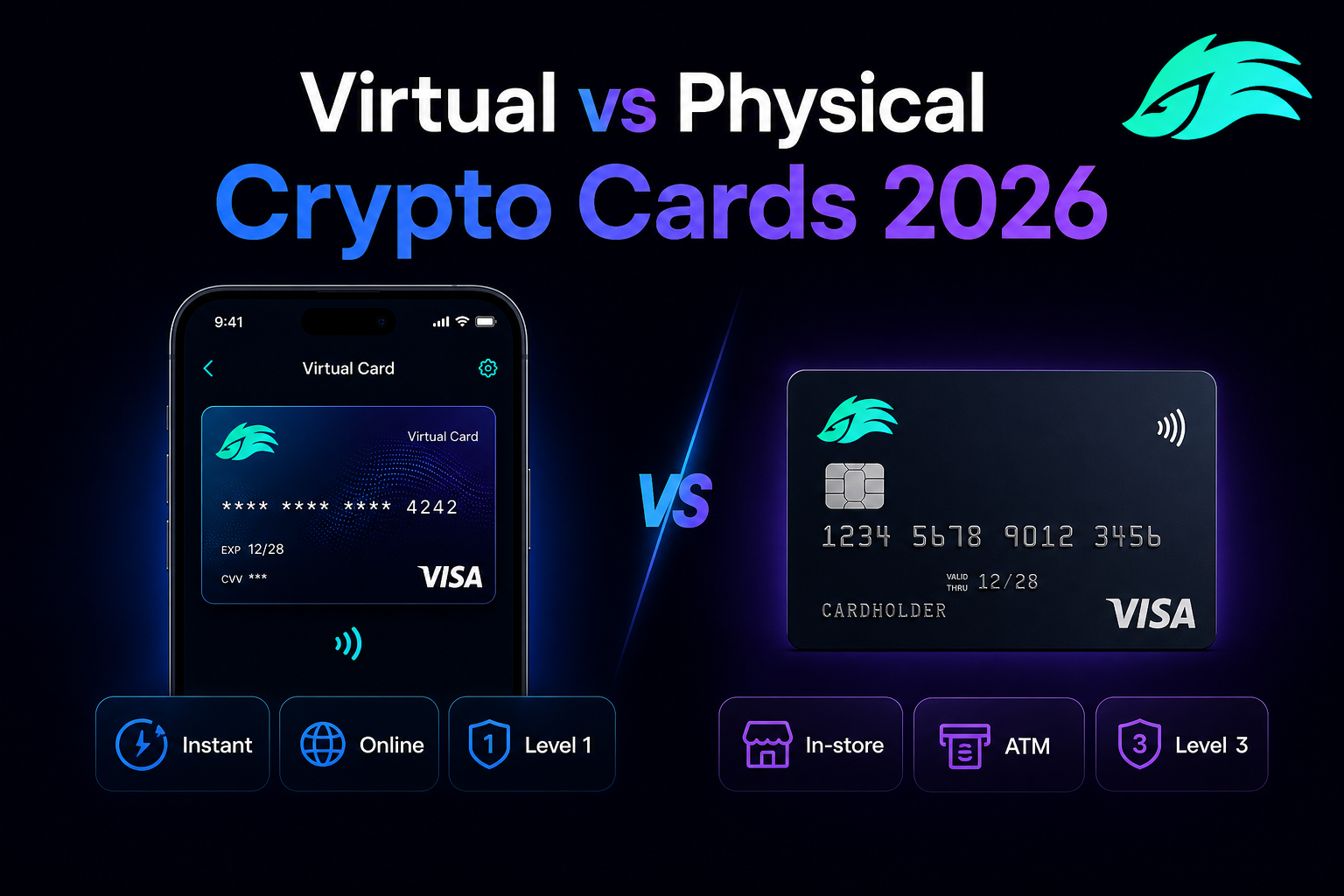
- Virtual cards: Instant issuance, online spending, mobile pay (Apple Pay / Google Pay). Available at lower KYC levels (often Level 1). Best for online purchases, subscriptions, and testing a card fast.
- Physical cards: In-store tap-to-pay, ATM withdrawals, full in-person acceptance. Require full verification (KYC Level 3). Best for everyday primary spending and cash access.
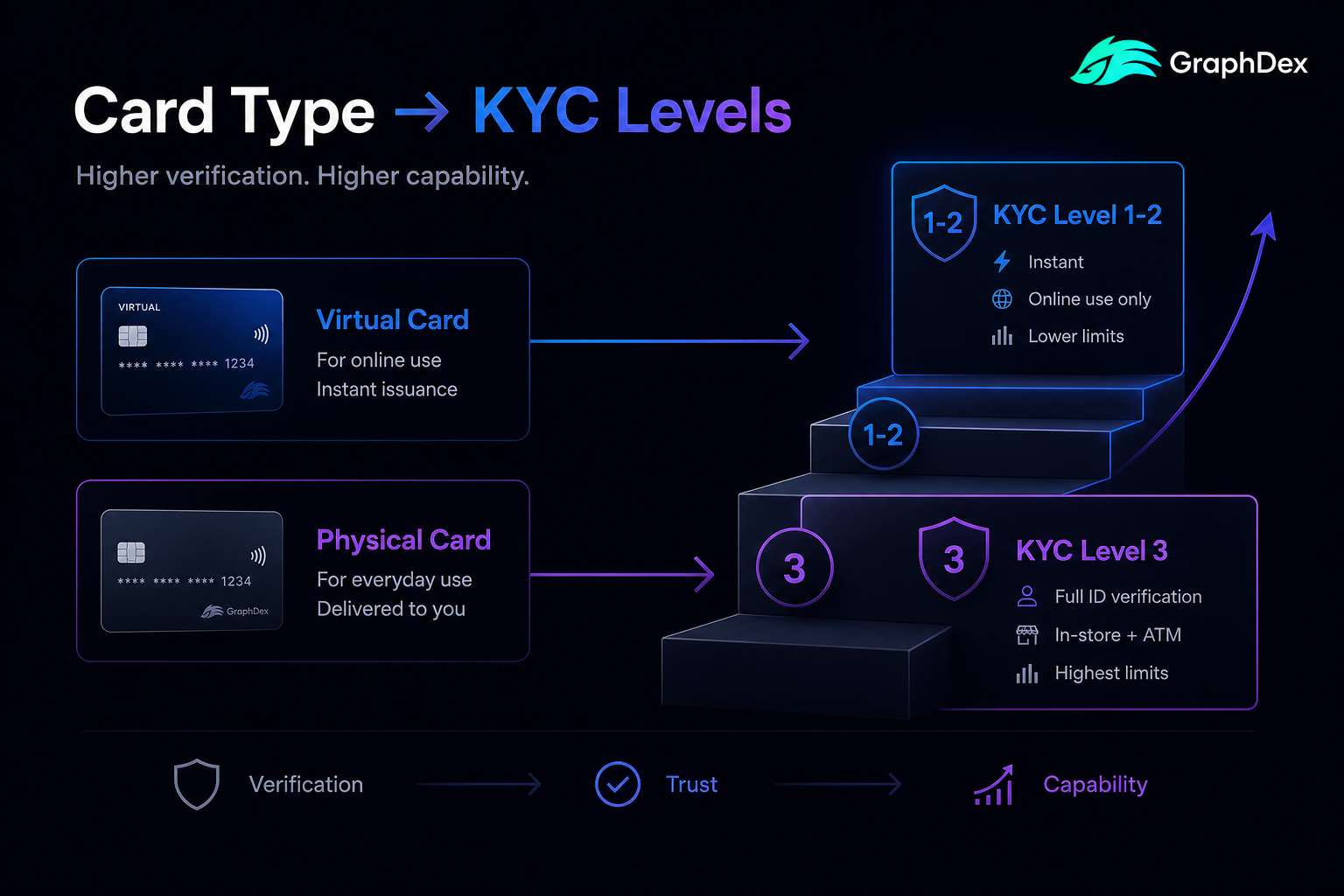
How they map to KYC: Virtual cards are typically available at KYC Level 1 (simplified). Physical cards almost always require KYC Level 3 (full verification), since physical cards and ATM access carry higher limits and risk.
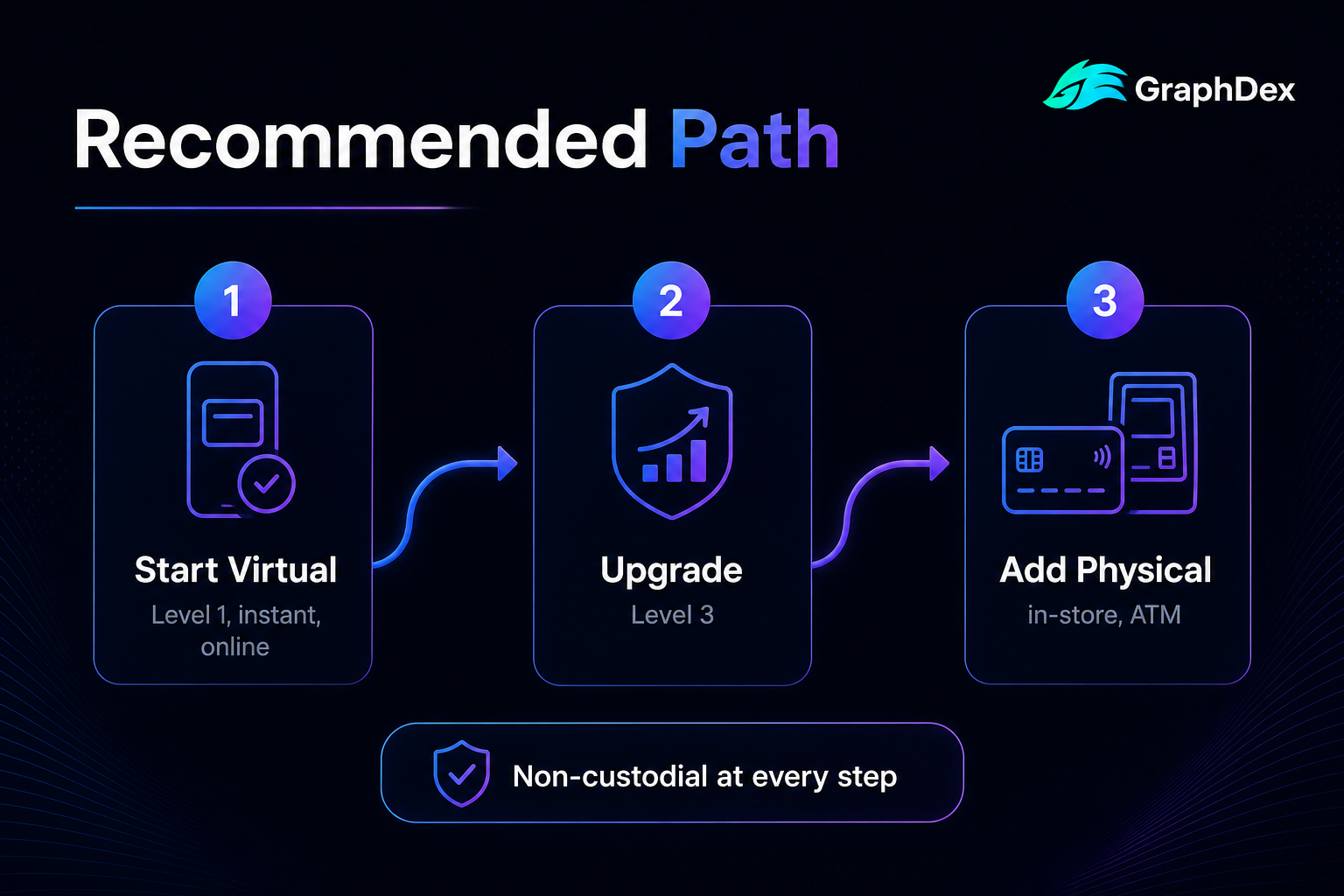
The smart approach: Start with a virtual card (Level 1) to test and spend online immediately, then add a physical card (Level 3) when you want in-store and ATM use. With a non-custodial card like GraphPay, your funds stay in your wallet for both.
Get a GraphPay virtual card in minutes
Key Takeaways
- Virtual cards are instant, online-focused, and available at lower KYC levels (often Level 1).
- Physical cards enable in-store tap-to-pay and ATM access but require full KYC (Level 3).
- Most users benefit from starting virtual and adding physical as their needs grow.
- Non-custodial cards keep funds in your wallet for both virtual and physical.
What's the Difference Between Virtual and Physical Crypto Cards?
Both virtual and physical crypto cards let you spend crypto at regular merchants — the difference is in form, capability, and verification requirements.
Virtual cards exist only digitally — a card number, expiry, and CVV you use for online payments or add to a mobile wallet (Apple Pay, Google Pay). There's no plastic. They're issued instantly and are ideal for online spending.
Physical cards are the plastic (or metal) cards you carry — for tapping at store terminals, swiping, or withdrawing cash at ATMs. They require shipping and full verification, but unlock in-person capabilities virtual cards can't offer.
The core distinction:
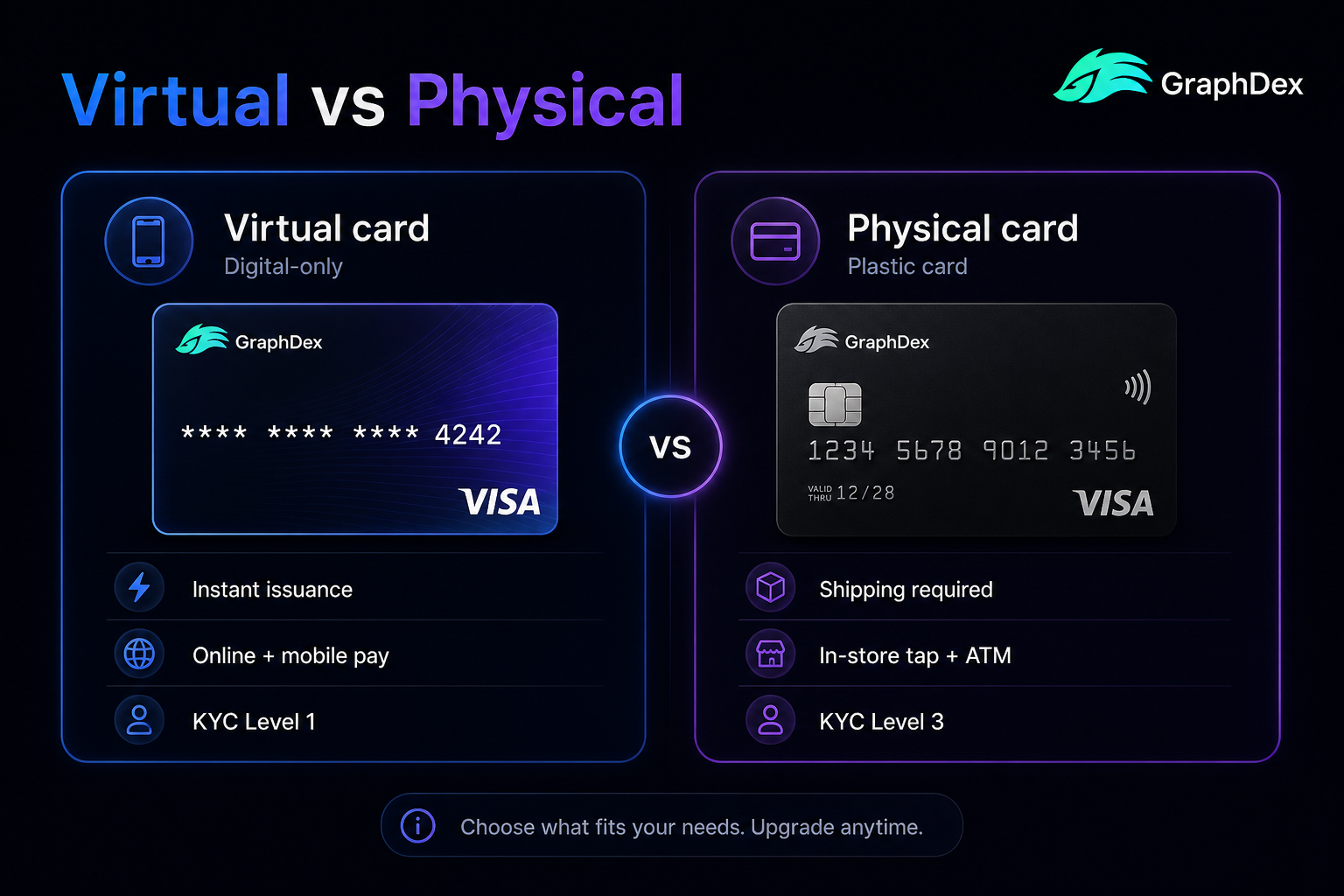
- Virtual: Digital-only, instant, online-focused, lower verification
- Physical: Tangible, requires shipping, in-person + ATM capable, full verification
Many crypto card providers offer both — often a virtual card first (available immediately), with a physical card as an upgrade once you complete full KYC.
Virtual Crypto Cards: Strengths & Use Cases
Virtual cards are the fast, accessible entry point to crypto spending.
Strengths:
- Instant issuance: Available in minutes — no waiting for shipping
- Lower KYC: Often available at Level 1 (simplified verification)
- Online spending: Perfect for e-commerce, subscriptions, digital services
- Mobile pay: Add to Apple Pay / Google Pay (at appropriate verification levels) for tap-to-pay via your phone
- Privacy for online use: Some providers let you generate virtual cards for specific purposes
- No physical loss risk: Can't be physically stolen or lost
Best use cases:
- Online shopping and e-commerce
- Recurring subscriptions (streaming, software)
- Digital services and apps
- Testing a crypto card before committing to full KYC
- Immediate spending when you can't wait for a physical card
Limitations:
- No physical card for in-store terminals that don't accept mobile pay
- Often no ATM access (cash withdrawals usually require a physical card)
- Lower limits at lower KYC levels
Who virtual cards suit: Anyone who primarily spends online, wants to start immediately, or is testing a card. For online-first spenders, a virtual card may be all they need.
Physical Crypto Cards: Strengths & Use Cases
Physical cards unlock full in-person spending and cash access.
Strengths:
- In-store tap-to-pay: Use at any physical terminal (even those without mobile pay)
- ATM withdrawals: Access cash (subject to limits)
- Full acceptance: Works everywhere the network (Visa/Mastercard) is accepted, in person
- Higher limits: Physical cards come with full KYC (Level 3), unlocking the highest limits
- Everyday primary use: Suitable as your main payment method
- Tangible backup: Works when your phone is dead or mobile pay isn't accepted
Best use cases:
- Everyday in-person spending (groceries, restaurants, retail)
- Travel (where mobile pay isn't universally accepted)
- ATM cash access
- Using the card as your primary payment method
- Situations requiring a physical card (some rentals, deposits)
Limitations:
- Requires full KYC (Level 3) — government ID, selfie, proof of address
- Shipping time (days to a couple of weeks)
- Physical loss/theft risk (though cards can be frozen)
Who physical cards suit: Anyone using a crypto card as their everyday primary payment method, who needs in-store and ATM access, or who travels. For full real-world spending, a physical card is essential.
How Virtual & Physical Map to KYC Levels
A key relationship: card type is tied to verification level.
Virtual cards → often KYC Level 1-2:
- Virtual cards are typically available at lower verification levels
- Level 1 (simplified) often gets you a virtual card instantly
- Lower limits, but immediate access for online spending
Physical cards → almost always KYC Level 3:
- Physical cards require full verification (government ID, selfie, proof of address)
- This is because physical cards and ATM access carry higher limits and risk
- Full KYC unlocks the highest limits alongside the physical card
Why the difference: Verification scales with capability and risk. A virtual card for small online payments needs less verification (Level 1). A physical card with high limits and ATM cash access needs full verification (Level 3). This tiered structure is the compliant standard.
The practical path:
- Start at Level 1 — get a virtual card instantly, spend online
- Upgrade to Level 3 when you want a physical card
- Receive your physical card for in-store and ATM use
This progression lets you start immediately (virtual) and add full capability (physical) as your needs grow — without over-verifying before you need to.
Comparison Table
| Feature | Virtual Card | Physical Card |
|---|---|---|
| Form | Digital only | Plastic/metal |
| Issuance | Instant | Shipping (days-weeks) |
| KYC level | Often Level 1-2 | Level 3 (full) |
| Online spending | Yes | Yes |
| Mobile pay | Yes (at appropriate level) | Yes |
| In-store terminals | Via mobile pay only | Yes (tap/swipe) |
| ATM withdrawals | Usually no | Yes |
| Limits | Lower (at lower KYC) | Highest (full KYC) |
| Best for | Online, testing, fast start | Everyday, in-store, ATM |
Should You Get Virtual, Physical, or Both?
Match your choice to how you spend:
Get a virtual card if you:
- Primarily spend online
- Want to start immediately (no shipping wait)
- Prefer lower verification (Level 1)
- Are testing a crypto card
- Use mobile pay for most in-person needs
Get a physical card if you:
- Spend in-person frequently
- Need ATM cash access
- Want a crypto card as your primary payment method
- Travel where mobile pay isn't universal
- Are comfortable with full KYC (Level 3)
Get both if you:
- Want online convenience (virtual) plus in-person capability (physical)
- Use different cards for different purposes
- Want maximum flexibility
The recommended path for most users: Start with a virtual card at Level 1 — instant, online-ready, minimal verification. Use it to test the card and spend online. Then upgrade to Level 3 and add a physical card when you want in-store and ATM access. This gives you immediate access plus room to grow, without over-verifying upfront.
Start with a GraphPay virtual card
How GraphPay Handles Virtual & Physical Cards
GraphPay offers both virtual and physical cards across its tiered KYC structure — all non-custodial.
The GraphPay approach:
- Virtual card (start at Level 1): Instant issuance, online spending, minimal verification — test and spend immediately
- Physical card (Level 3): Full verification unlocks a physical card for in-store tap-to-pay, ATM access, and the highest limits
- Seamless upgrade: Move from virtual (Level 1) to physical (Level 3) as your needs grow
Non-custodial for both:
- Your crypto stays in your own wallet whether using virtual or physical
- The card converts crypto to fiat only when you spend
- No third-party custody at any level
Plus:
- Multi-chain funding (BNB Chain, Ethereum, TRON with USDT/USDC)
- Visa and Mastercard for global acceptance
- MiCA-aligned tiered KYC
The value: GraphPay lets you start with a virtual card in minutes (Level 1), then add a physical card (Level 3) when you want full in-person and ATM capability — with your funds staying in your wallet throughout. Start online, grow to everyday use, keep custody.
Get your GraphPay virtual card now
Related Guides
- How to Get a Crypto Card in 2026: Step-by-Step Guide by KYC Level
- Best Crypto Cards for Travel in 2026: Spend Abroad Without the FX Fees
- Are Crypto Cards Safe in 2026? A Complete Security Guide
Frequently Asked Questions
What's the difference between a virtual and physical crypto card? A virtual card is digital-only (card number, expiry, CVV) for online spending and mobile pay — issued instantly with lower verification. A physical card is the plastic/metal card you carry for in-store tap-to-pay and ATM withdrawals — it requires full KYC (Level 3) and shipping. Virtual is fast and online-focused; physical unlocks in-person and cash capabilities.
Do I need KYC for a virtual crypto card? Usually less than for a physical card. Virtual cards are often available at KYC Level 1 (simplified — email, sometimes phone), giving you a card instantly for online spending. Physical cards almost always require KYC Level 3 (full verification — government ID, selfie, proof of address). Start with a virtual card at Level 1 if you want minimal verification.
Can I use a virtual crypto card in stores? Yes, via mobile pay. Add your virtual card to Apple Pay or Google Pay (at appropriate verification levels), and you can tap to pay at any terminal accepting mobile payments. However, for terminals that don't accept mobile pay, or for ATM withdrawals, you need a physical card. Virtual + mobile pay covers most in-person needs, but not all.
Why do physical crypto cards require more verification? Because physical cards carry higher limits and enable ATM cash withdrawals — higher capability and risk that regulations require more verification for. A virtual card for small online payments needs less verification (Level 1); a physical card with high limits and cash access needs full KYC (Level 3). This tiered structure scales verification to capability and risk.
Should I get a virtual or physical crypto card? Depends on how you spend. Get a virtual card if you spend mostly online, want to start immediately, or prefer lower verification. Get a physical card if you spend in-person frequently, need ATM access, or want a primary payment method. Many users start virtual (Level 1, instant) and add physical (Level 3) later — getting immediate access plus room to grow.
How long does it take to get a physical crypto card? The verification (KYC Level 3) is often completed in minutes on modern platforms, but the physical card itself requires shipping — typically days to a couple of weeks depending on your location. If you need to spend immediately, get a virtual card first (instant), then order a physical card for when it arrives. This way you're not waiting to start spending.
Are virtual and physical crypto cards both non-custodial? With a non-custodial provider like GraphPay, yes — both virtual and physical cards keep your crypto in your own wallet, converting only when you spend. The card type (virtual vs physical) affects capability and verification, not custody. Whether you use a virtual card online or a physical card in-store, your funds stay under your control with a non-custodial card.
About This Guide
This guide is published by the GraphPay Research team — building non-custodial crypto payment infrastructure. Our content is based on current card industry practices, regulatory frameworks, and 2026 market data.
Sources & data: Card features, verification requirements, and capabilities reflect publicly available information as of 2026 and may change. Specific terms vary by provider and jurisdiction. This guide is educational and not financial or legal advice — always verify current terms with your provider.
GraphPay is non-custodial crypto payment infrastructure — your crypto, your pay. Learn more at graphpay.io.
Last reviewed: May 2026 · GraphPay Research