By GraphPay Research · Reviewed for accuracy May 2026
Quick Answer
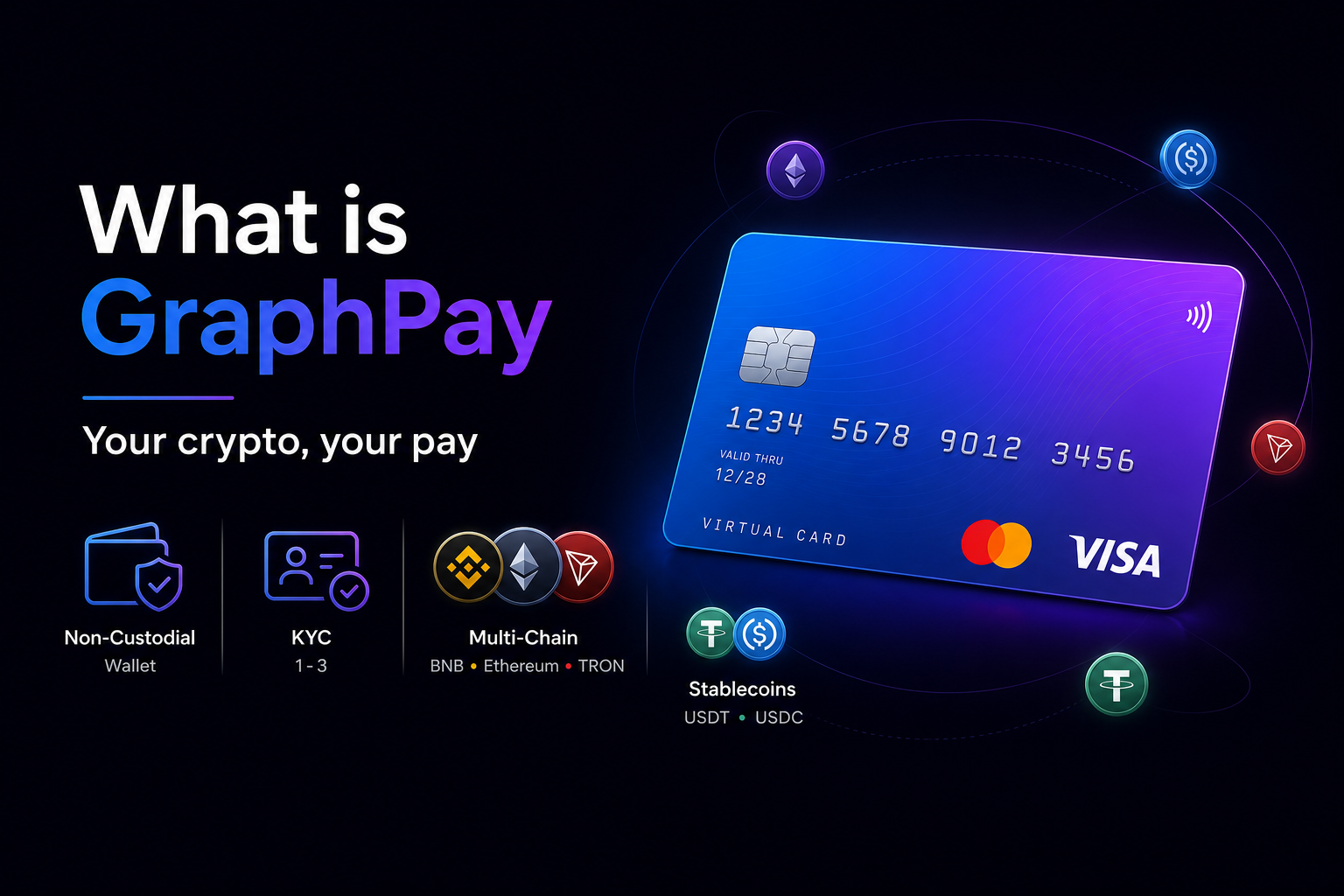
GraphPay is a non-custodial crypto card platform that lets you spend crypto in the real world while keeping control of your funds:
- What it is: A non-custodial crypto card — spend your crypto anywhere Visa or Mastercard is accepted, with your funds staying in your own wallet
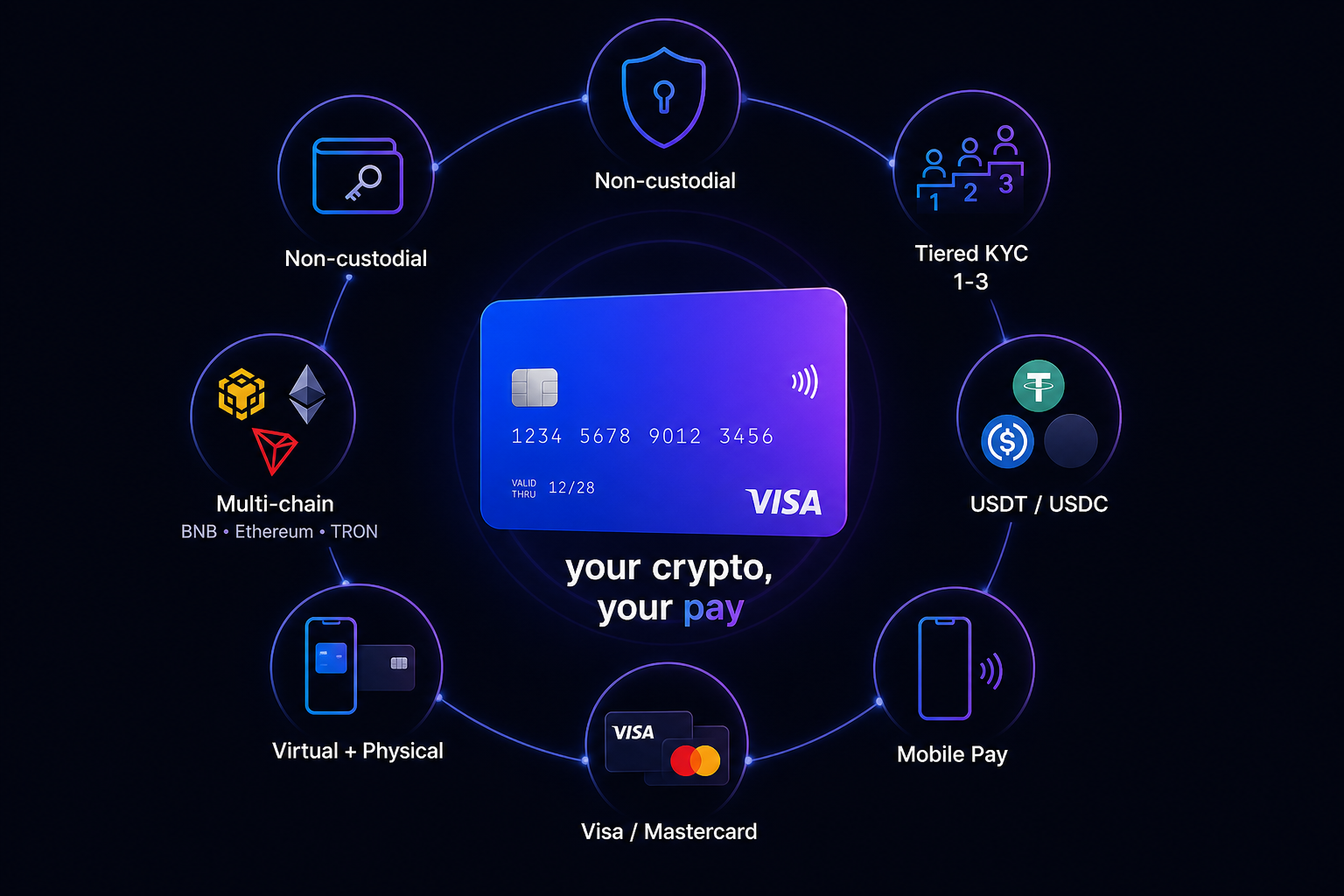
- Core features: Non-custodial architecture, tiered KYC (Level 1-3), multi-chain support (BNB Chain, Ethereum, TRON), USDT/USDC spending, Visa & Mastercard acceptance, virtual and physical cards, and mobile pay (Apple Pay / Google Pay)
- Custody: Non-custodial (Web3) — your crypto stays in your wallet, converting to fiat only when you spend
- Who it's for: Crypto holders who want to spend their crypto in daily life without giving up self-custody, with the flexibility of tiered verification
The one-line summary: GraphPay is non-custodial crypto payment infrastructure — "your crypto, your pay" — letting you spend crypto globally while keeping your funds in your own control.
Key Takeaways
- GraphPay is a non-custodial crypto card — spend crypto via Visa/Mastercard while funds stay in your wallet.
- It offers tiered KYC (Level 1-3), multi-chain support (BNB Chain, Ethereum, TRON), and USDT/USDC spending.
- It supports virtual and physical cards, plus mobile pay (Apple Pay / Google Pay).
- Non-custodial means your crypto stays in your control, converting to fiat only when you spend.
What Is GraphPay?
GraphPay is a non-custodial crypto card platform built for spending cryptocurrency in the real world. It lets you use your crypto anywhere Visa or Mastercard is accepted — while keeping your funds in your own wallet rather than handing them to a custodian.
The core idea: Spending crypto in daily life has traditionally been cumbersome — you'd convert crypto on an exchange, withdraw to a bank, then spend. GraphPay removes this friction with a crypto card that spends directly from your crypto holdings, converting to fiat at the point of sale. And critically, it does this non-custodially — your funds stay in your control throughout.
GraphPay's tagline: "Your crypto, your pay." This captures its core value — spending your crypto, on your terms, while keeping control of your funds.
What makes it distinctive:
- Non-custodial (Web3): Your crypto stays in your own wallet, not held by GraphPay
- Tiered KYC: Start light (Level 1) and upgrade as needed (Level 3) — flexible verification
- Multi-chain: Fund from BNB Chain, Ethereum, or TRON
- Stablecoin spending: Spend USDT or USDC for predictable value
- Global acceptance: Visa and Mastercard, accepted worldwide
GraphPay positions itself as "non-custodial crypto payment infrastructure" — bridging crypto holdings and real-world spending, without sacrificing self-custody.
What Can You Do With GraphPay?
GraphPay enables several ways to spend and manage crypto for payments.
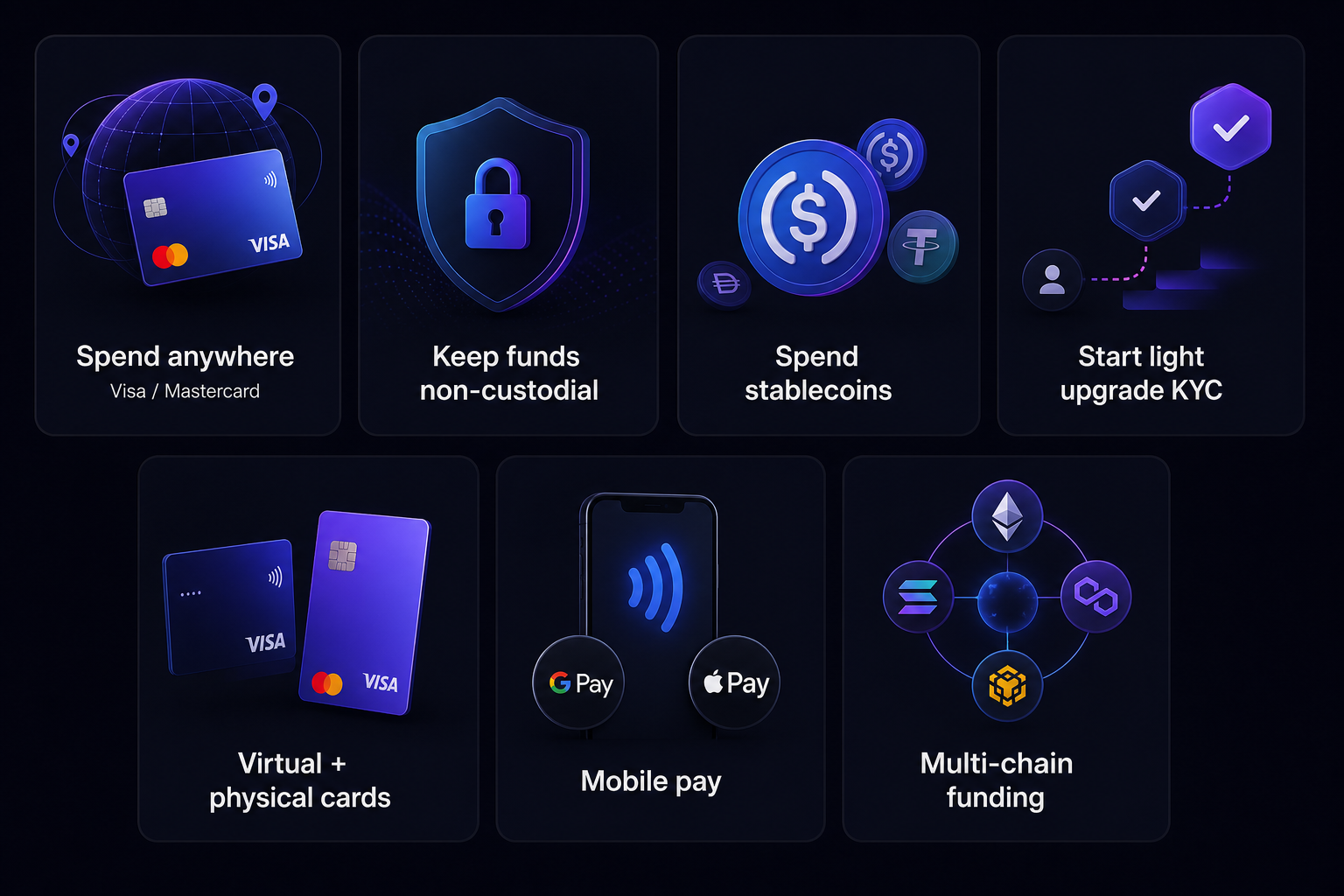
Spend Crypto Anywhere Visa/Mastercard Is Accepted
Use your crypto card at tens of millions of merchants worldwide — anywhere Visa or Mastercard is accepted — with your crypto converting to fiat at the point of sale.
Keep Your Funds Non-Custodial
Your crypto stays in your own wallet (Web3, non-custodial). GraphPay doesn't hold your funds — they convert only when you spend, keeping you in control.
Spend Stablecoins for Predictable Value
Spend USDT or USDC — stablecoins that hold a steady value — so you know exactly what your spending power is worth, and minimize taxable gains compared to spending appreciated volatile crypto.
Start Light, Upgrade as Needed (Tiered KYC)
Begin with a Level 1 virtual card (minimal verification), and upgrade to Level 2 or Level 3 as your needs grow — unlocking higher limits, a physical card, and mobile pay.
Use Virtual and Physical Cards
Get a virtual card instantly for online spending, and a physical card (Level 3) for in-store tap-to-pay and ATM access.
Pay With Your Phone (Mobile Pay)
Add your card to Apple Pay or Google Pay (Level 2+) to tap-to-pay with your phone anywhere contactless is accepted.
Fund From Multiple Chains
Fund your card from BNB Chain, Ethereum, or TRON — choosing the most efficient chain for the stablecoin you hold.
The combination: GraphPay lets you spend crypto globally, non-custodially, with the flexibility of tiered verification and multi-chain funding — bridging your crypto holdings and everyday spending.
GraphPay's Key Features Explained
A closer look at what defines GraphPay.
Non-custodial (Web3) architecture. Your crypto stays in your own wallet. GraphPay doesn't take custody — funds convert to fiat only at the point of sale. This is fundamentally different from custodial cards where a company holds your funds.
Tiered KYC (Level 1-3). Flexible, progressive verification: Level 1 (simplified — email/phone, virtual card, lowest limits), Level 2 (standard — higher limits, mobile pay), Level 3 (full — government ID, physical card, highest limits). Start light, upgrade as needed.
Multi-chain support. Fund from BNB Chain, Ethereum, or TRON — flexibility to use the most efficient chain.
USDT & USDC spending. Spend either major stablecoin for predictable value and minimal taxable gains.
Visa & Mastercard. Accepted at tens of millions of merchants worldwide — spend crypto anywhere these networks work.
Virtual & physical cards. A virtual card for online spending (instant), and a physical card (Level 3) for in-store and ATM use.
Mobile pay. Add to Apple Pay or Google Pay (Level 2+) for phone tap-to-pay.
MiCA-aligned compliance. Aligned with the EU's MiCA framework (mandatory for CASPs by July 1, 2026) — compliant infrastructure.
The integrated whole: These features combine to let you spend crypto globally, non-custodially, with flexible verification — bridging crypto and real-world payments while keeping you in control.
How Does GraphPay Work?
Understanding how GraphPay operates.
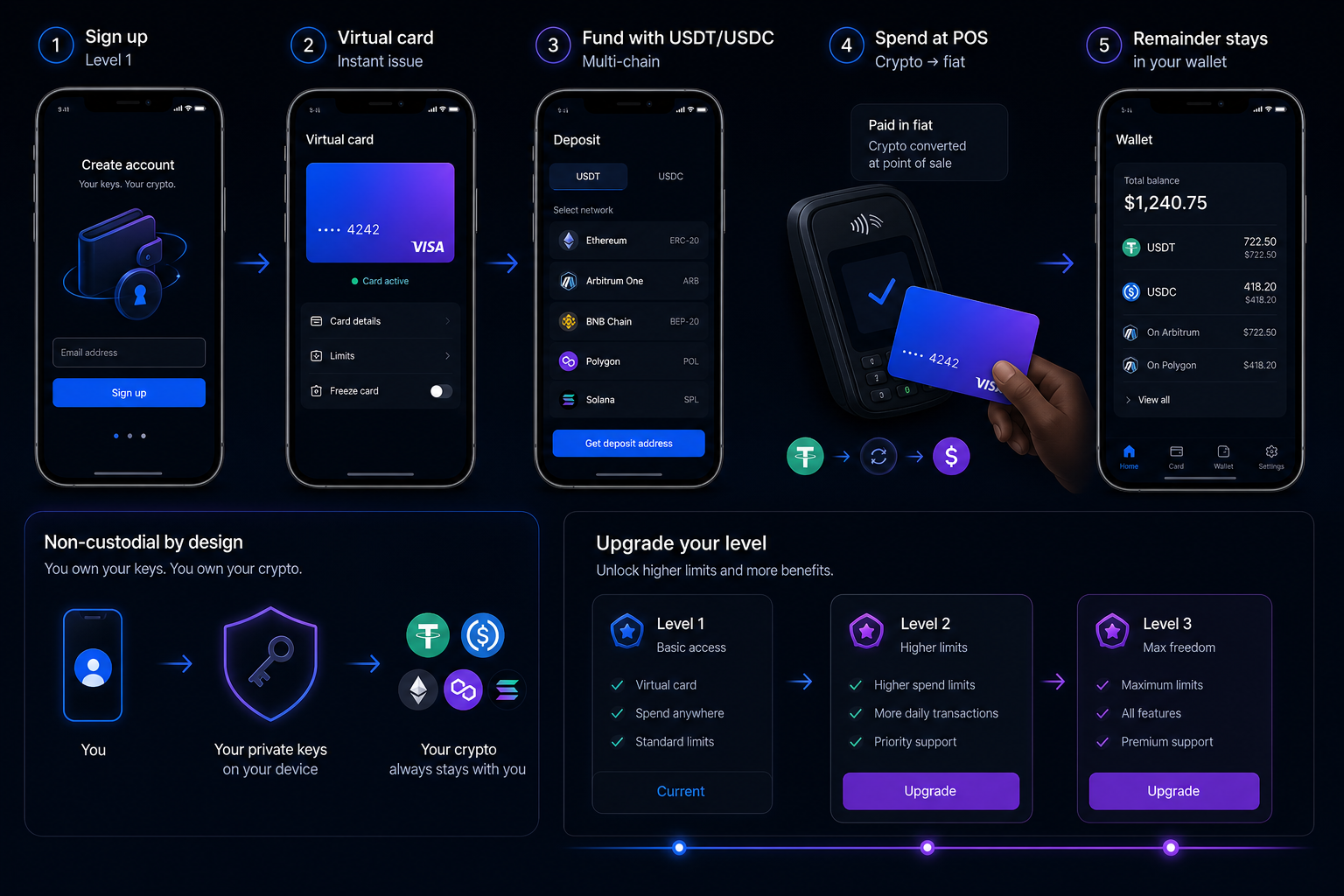
Getting started:
- Sign up and complete Level 1 verification (minimal — email/phone)
- Get a virtual card instantly for online spending
- Fund your card from your wallet (USDT/USDC on BNB Chain, Ethereum, or TRON)
Spending:
- Use your card (virtual online, or physical in-store at Level 3) anywhere Visa/Mastercard is accepted
- At the point of sale, your crypto converts to fiat — the merchant receives a normal payment
- Your remaining crypto stays in your own wallet (non-custodial)
Upgrading (as needed):
- Upgrade to Level 2 (higher limits, mobile pay) or Level 3 (physical card, highest limits) by completing progressively more verification
The non-custodial flow: Throughout, your crypto stays in your own wallet. GraphPay converts only what you spend, at the moment you spend it — you never hand your funds to a custodian. This is the "your crypto, your pay" model: spend your crypto on your terms while keeping control.
Who Is GraphPay For?
GraphPay serves several types of crypto users.
Crypto holders who want to spend. Anyone holding crypto who wants to spend it in daily life — on everyday purchases, online, or in-store — without the friction of manual conversions.
Self-custody-focused users. Those who value keeping their funds in their own control appreciate GraphPay's non-custodial architecture — spending crypto without handing funds to a custodian.
Stablecoin spenders. Users who want to spend stable value (USDT/USDC) for predictable spending power and minimal taxable gains, while keeping volatile crypto invested.
Global users. Those who want to spend crypto worldwide via Visa/Mastercard acceptance, across multiple chains.
Users who value flexibility. Those who appreciate starting light (Level 1 virtual card) and upgrading as needed (Level 3 physical card), rather than being forced into full verification upfront.
The common thread: GraphPay is for crypto holders who want to spend their crypto in the real world while keeping self-custody — combining the convenience of a Visa/Mastercard card with the control of non-custodial architecture.
How GraphPay Compares to Alternatives
Understanding where GraphPay fits among crypto cards.
vs custodial crypto cards: Many crypto cards are custodial — a company holds your funds, adding risk (if it fails or is hacked, your funds are affected). GraphPay is non-custodial — your funds stay in your wallet, eliminating this custodial risk.
vs converting and using a bank: Without a crypto card, spending crypto means converting on an exchange and withdrawing to a bank — slow and cumbersome. GraphPay spends directly from your crypto, converting at the point of sale.
vs no-KYC cards: Some cards market themselves as anonymous/no-KYC, which carries regulatory and reliability risks. GraphPay uses legitimate tiered KYC (Level 1-3) — compliant and reliable, while still flexible (start light).
GraphPay's distinctive edge: Non-custodial architecture (funds in your wallet) combined with tiered KYC flexibility, multi-chain support, and MiCA-aligned compliance. It offers self-custody without sacrificing the convenience and compliance of a mainstream card.
The honest note: Different users have different needs, and other cards have their own strengths (rewards, specific regional features). GraphPay's edge is non-custodial control plus flexible, compliant tiered verification. Evaluate it against your specific needs.
How to Get Started With GraphPay
Getting started is straightforward:
- Visit graphpay.io and sign up
- Complete Level 1 verification (minimal — email/phone) and get a virtual card instantly
- Fund your card from your wallet (USDT/USDC on BNB Chain, Ethereum, or TRON)
- Start spending online anywhere Visa/Mastercard is accepted
- Upgrade as needed — to Level 2 (mobile pay, higher limits) or Level 3 (physical card, ATM access, highest limits)
A note on considerations: Spending crypto may have tax implications in your jurisdiction (spending crypto can be a taxable disposal), and crypto values can be volatile (spending stablecoins minimizes this). GraphPay provides the spending infrastructure, but always understand your local tax rules and consider consulting a professional.
Frequently Asked Questions
What is GraphPay? GraphPay is a non-custodial crypto card platform that lets you spend crypto anywhere Visa or Mastercard is accepted, while keeping your funds in your own wallet. Its features include non-custodial (Web3) architecture, tiered KYC (Level 1-3), multi-chain support (BNB Chain, Ethereum, TRON), USDT/USDC spending, virtual and physical cards, and mobile pay (Apple Pay / Google Pay). Its tagline is "your crypto, your pay."
Is GraphPay non-custodial? Yes. GraphPay is non-custodial (Web3) — your crypto stays in your own wallet, not held by GraphPay. Funds convert to fiat only at the point of sale, when you spend. This is fundamentally different from custodial crypto cards where a company holds your funds (adding risk if it fails or is hacked). With GraphPay, you keep control of your funds throughout.
What can you do with GraphPay? With GraphPay you can: spend crypto anywhere Visa/Mastercard is accepted, keep your funds non-custodial, spend stablecoins (USDT/USDC) for predictable value, start with a Level 1 virtual card and upgrade to Level 3 (physical card) as needed, use mobile pay (Apple Pay / Google Pay), and fund from multiple chains (BNB Chain, Ethereum, TRON). It bridges your crypto holdings and real-world spending.
Does GraphPay require KYC? GraphPay uses tiered KYC (Level 1-3) — flexible, progressive verification. You start with Level 1 (minimal — email/phone) for a virtual card with lower limits, and upgrade to Level 2 or Level 3 (government ID, physical card, highest limits) as your needs grow. This tiered approach is compliant and reliable, while still letting you start light rather than completing full verification upfront.
What crypto can I spend with GraphPay? GraphPay supports spending stablecoins USDT and USDC, funded from multiple chains (BNB Chain, Ethereum, TRON). Spending stablecoins gives predictable value (they hold a steady $1) and minimizes taxable gains compared to spending appreciated volatile crypto. Many users keep volatile crypto (BTC, ETH) invested and spend stablecoins via their card for everyday purchases.
How do I get started with GraphPay? Visit graphpay.io, sign up, complete Level 1 verification (minimal — email/phone), and get a virtual card instantly. Fund it from your wallet (USDT/USDC on BNB Chain, Ethereum, or TRON), then spend online anywhere Visa/Mastercard is accepted. Upgrade to Level 2 (mobile pay, higher limits) or Level 3 (physical card, ATM access) as needed. Your funds stay in your control throughout.
Is GraphPay safe to use? GraphPay is built with control in mind — it's non-custodial (your funds stay in your own wallet, eliminating custodial risk), uses legitimate tiered KYC (compliant, not risky anonymous cards), and is MiCA-aligned (compliant infrastructure). It runs on Visa/Mastercard rails (meeting network standards). As with any financial tool, understand the terms, keep your account secure, and be aware that spending crypto may have tax implications in your jurisdiction.
About This Guide
This guide is published by the GraphPay Research team — building non-custodial crypto payment infrastructure. Our content is based on the platform and 2026 market data.
Sources & data: Features and details reflect the platform as of 2026 and may change. Spending crypto may have tax implications that vary by jurisdiction. Crypto values can be volatile; stablecoins minimize this. This guide is educational and not financial, tax, or legal advice — always do your own research and consult professionals for your situation.
GraphPay is non-custodial crypto payment infrastructure — your crypto, your pay. Learn more at graphpay.io.
Last reviewed: May 2026 · GraphPay Research