By GraphDex Research · Reviewed for accuracy May 2026
Quick Answer
AI crypto trading signals are automated alerts that flag potential trading opportunities using machine learning and on-chain data analysis:
- How they work: AI models scan market data (price, volume, on-chain activity, holder patterns, social signals) to detect patterns and flag potential opportunities in real time
- What they analyze: New token launches, volume spikes, smart money movements, holder growth, and technical patterns — far faster than a human could
- What they're good for: Surfacing candidates from thousands of tokens, spotting emerging activity early, and filtering noise
- What they can't do: Guarantee profits, predict the future, or replace your own judgment and risk management
The honest reality: AI signals are a discovery and analysis tool — they surface opportunities worth investigating, not guaranteed winners. Used well (as one input among many, with your own verification), they add real value. Treated as guaranteed profit, they lose money. Ignore anyone promising "AI that can't lose."
Key Takeaways
- AI trading signals flag potential opportunities by analyzing market and on-chain data in real time.
- They excel at surfacing candidates from thousands of tokens and spotting activity early.
- They can't guarantee profits or replace your judgment — they're a tool, not a crystal ball.
- Use signals as one input, verify independently, and ignore "guaranteed profit" claims.
What Are AI Crypto Trading Signals?
AI crypto trading signals are automated alerts, generated by machine learning models, that flag potential trading opportunities. Instead of manually scanning charts and on-chain data, you receive signals when the AI detects patterns or conditions worth attention.
The core idea: Crypto markets — especially Solana memecoins — move fast and generate enormous data. Thousands of tokens launch daily; prices, volumes, and on-chain activity shift constantly. No human can monitor it all. AI signals process this data at scale, surfacing opportunities a human would miss.
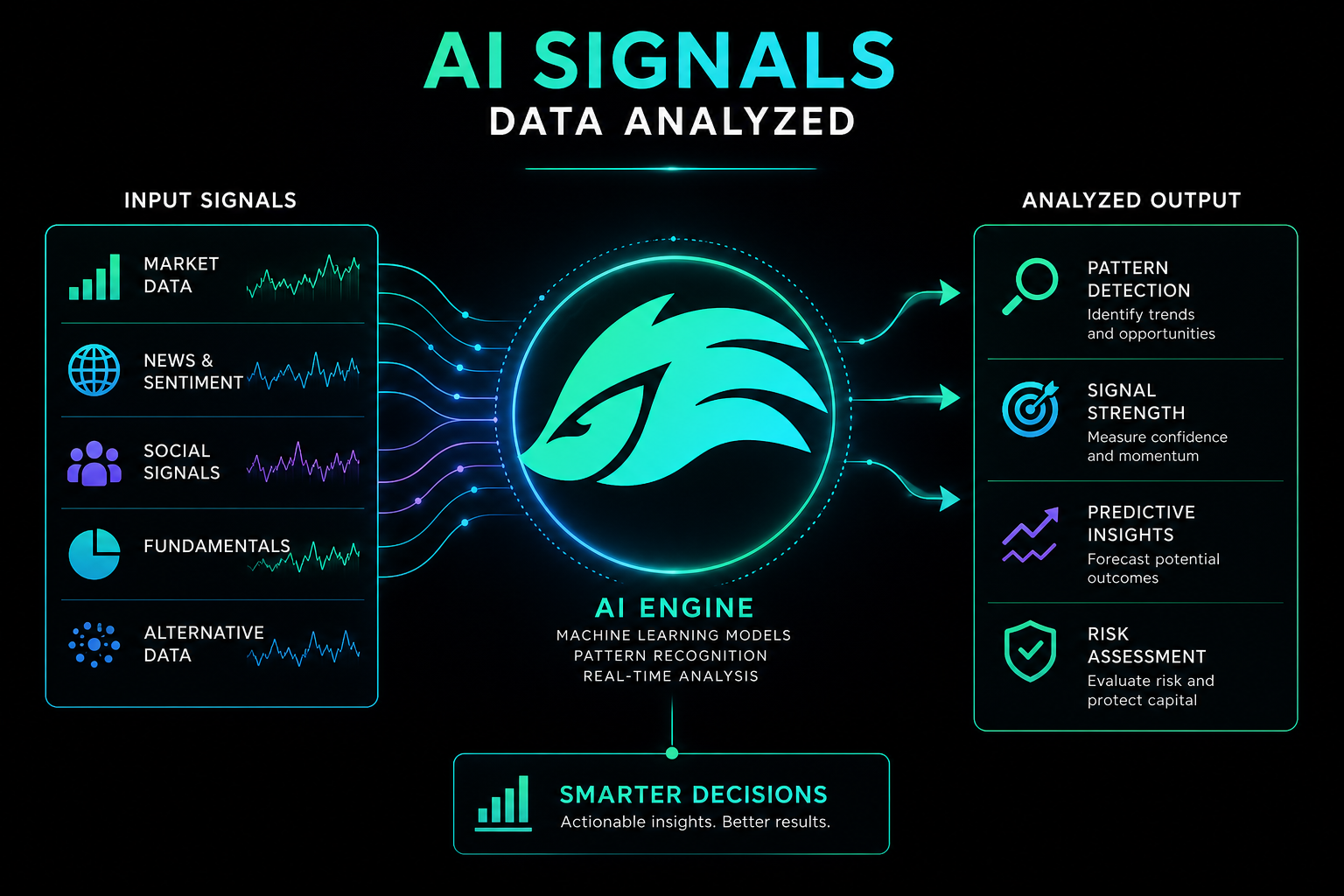
What generates a signal: AI models analyze many data types together:
- Price and volume: Sudden moves, volume spikes, momentum
- On-chain activity: New launches, holder growth, liquidity changes
- Smart money movements: Wallets with strong track records entering positions
- Holder patterns: Distribution, concentration, growth
- Social signals: Emerging narratives and mentions (with skepticism)
- Technical patterns: Chart formations and indicators
When the model detects a combination suggesting a potential opportunity, it generates a signal — alerting you to investigate.
What a signal is (and isn't): A signal is a flag saying "this token/setup matches patterns worth attention" — not a command to buy or a guarantee of profit. It's a starting point for your own analysis, not a finished decision.
How AI Trading Signals Actually Work
Understanding the mechanics helps you use signals wisely and spot overblown claims.
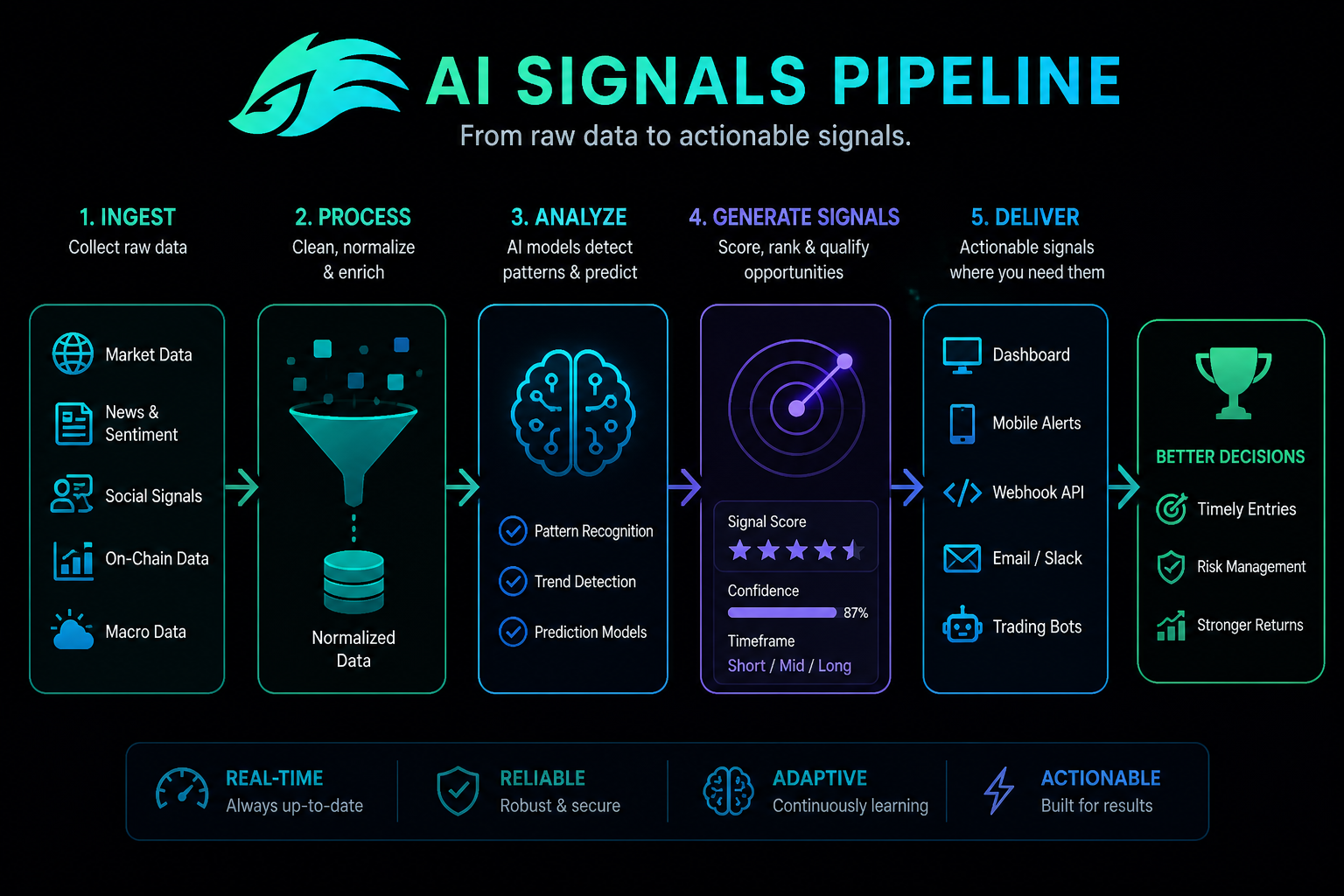
Data Collection
AI signal systems ingest vast amounts of data in real time:
- On-chain data (transactions, holders, liquidity, launches)
- Market data (prices, volumes across DEXs)
- Wallet activity (smart money movements)
- Social data (mentions, narratives)
The breadth of data is a key advantage — AI processes far more than a human can monitor.
Pattern Detection
Machine learning models identify patterns in the data:
- Recognizing conditions that historically preceded moves
- Detecting anomalies (unusual volume, holder growth)
- Identifying smart money accumulation
- Spotting emerging momentum
The models learn from historical data to recognize patterns associated with opportunities.
Signal Generation
When patterns match certain criteria, the system generates a signal — an alert flagging the token or setup. Signals may include context (why it's flagged, relevant data) to inform your analysis.
Real-Time Delivery
Speed matters in fast markets. AI signals are delivered in real time, so you can act on opportunities before they're gone — a key advantage over manual analysis.
The honest mechanics: AI signals are pattern-recognition tools trained on data. They're powerful at processing scale and speed, but they're not predicting the future — they're flagging conditions that match learned patterns. Sometimes those patterns lead to opportunities; sometimes they don't. Understanding this prevents over-reliance.
What AI Signals Are Good For
Used well, AI signals add genuine value. Here's where they excel.
Surfacing candidates from noise. With thousands of tokens launching daily, finding the few worth attention is overwhelming. AI signals filter the flood, surfacing candidates matching promising patterns — saving you from manual scanning.
Spotting activity early. AI can detect volume spikes, holder growth, and smart money movements as they happen — flagging opportunities before they trend publicly. This early awareness is valuable in fast markets.
Processing scale. AI monitors far more tokens, wallets, and data points than any human. It won't miss activity in a corner of the market you're not watching.
Reducing emotional bias. Signals are data-driven, not emotional. They can counterbalance the FOMO and fear that drive poor manual decisions (though you still control whether to act).
Speed. In markets where tokens move in seconds, AI's real-time processing captures timing a human can't match.
Complementing your analysis. Signals surface opportunities; you apply judgment. Together, AI's scale and your judgment can be more effective than either alone.
The realistic value: AI signals are best understood as a powerful discovery and analysis tool — they surface opportunities worth investigating faster and at greater scale than you could manually. That's genuine value, when used as intended.
What AI Signals Can't Do (The Honest Limits)
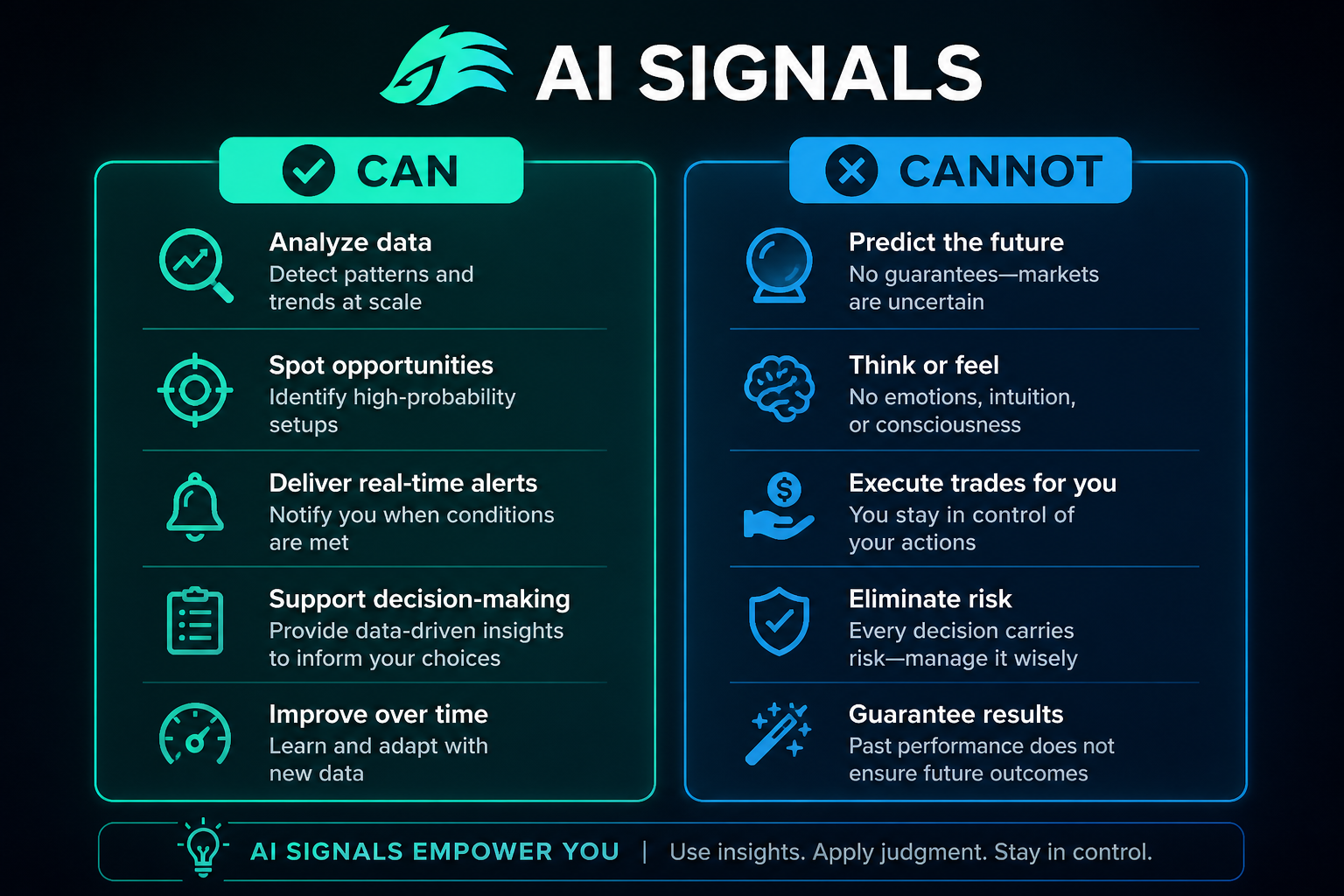
For balance — and to protect you from scams — here's what AI signals can't do.
They can't guarantee profits. No AI can guarantee trading profits. Markets are influenced by unpredictable factors. Any signal service promising guaranteed profits is a scam.
They can't predict the future. AI recognizes patterns from historical data, but past patterns don't guarantee future outcomes. A signal flags a possibility, not a certainty.
They can't replace judgment. Signals surface candidates; they don't do your risk management, position sizing, or final decision-making. Blindly following signals without judgment loses money.
They can't eliminate risk. Even good signals lead to losing trades sometimes. Crypto trading is risky regardless of the tools used.
They can be wrong. AI signals produce false positives (flagging tokens that don't pan out) and miss opportunities. No system is perfect.
They can be gamed. In some cases, manipulators create patterns to trigger signals (fake volume, coordinated activity) to lure signal-followers. Verification remains essential.
The scam warning: The AI signal space is full of overblown claims — "AI that can't lose," "guaranteed 90% win rate," "let AI trade for you risk-free." These are red flags. Legitimate AI signals are analysis tools with real limits, not magic money machines. Be deeply skeptical of guaranteed-profit promises.
The honest framing: AI signals are a tool that improves your discovery and analysis — not a replacement for judgment, risk management, or your own verification. Used as one input among many, they add value. Treated as guaranteed profit, they lose money.
How to Use AI Signals Well
The difference between profiting from and losing with AI signals comes down to how you use them.
1. Treat signals as candidates, not commands. A signal means "investigate this," not "buy this." Always do your own analysis before acting.
2. Verify independently. Cross-check signals with your own analysis — safety checks (holder concentration, liquidity), the setup, and your strategy. Never act on a signal alone.
3. Combine with safety analysis. Especially for memecoins, run rug-detection checks (bubble maps, holder concentration) on any signal before trading. A flagged token can still be a rug.
4. Apply risk management. Signals don't size your positions or set your stops. Apply your own risk management — position sizing, limits, diversification.
5. Use signals as one input. Combine AI signals with other tools (smart money tracking, your own analysis) rather than relying on them alone.
6. Track performance honestly. Monitor how signals actually perform for you. Adjust how you use them based on real results, not hype.
7. Ignore guaranteed-profit claims. Any signal service promising guaranteed wins is a scam. Legitimate signals are tools with limits.
The disciplined approach: AI signals work best as a discovery and analysis aid within a disciplined process — surfacing candidates that you verify, vet for safety, size appropriately, and trade with risk management. This combines AI's scale with your judgment.
Use AI signals as part of your toolkit on GraphDex
How GraphDex Approaches AI Signals
GraphDex integrates AI signals into a broader terminal — as one tool among many for discovery and analysis, with honest positioning.
For AI-assisted trading:
- AI signals — high-conviction opportunity identification across the Solana ecosystem
- Bubble Maps — verify flagged tokens for holder concentration and rug risk
- Pulse feed — real-time discovery across all launchpads
- Wallet/social tracking — follow smart money to complement signals
- MEV protection — execute on vetted opportunities without getting sandwiched
- Non-custodial — your funds stay in your own wallet (Privy), sign in with Twitter, email, or Telegram
The integrated advantage: AI signals are most valuable combined with verification and safety tools. GraphDex integrates signals alongside Bubble Maps (rug detection), smart money tracking, and MEV protection — so when a signal surfaces a candidate, you can immediately verify its safety, check smart money, and execute protected, all in one terminal.
The honest positioning: GraphDex's AI signals are a discovery and analysis tool — not guaranteed profits. They surface opportunities worth investigating, which you then verify and trade with your own judgment and risk management. No AI guarantees profits, and GraphDex doesn't claim otherwise. What it offers is signals integrated with the verification and execution tools to use them properly.
For traders who want AI-assisted discovery within a disciplined, safety-focused workflow, GraphDex consolidates signals, verification, and protected execution in one non-custodial terminal.
Try AI signals with integrated verification on GraphDex
Related Guides
- Best Solana Trading Terminal in 2026: GraphDex vs Axiom vs GMGN vs Trojan vs BullX
- Best Solana Trading Terminal in 2026: Top Platforms Compared
- Best AI Crypto Trading Bots in 2026: Top 10 Ranked & Compared
- Best Solana Memecoin Bots 2026: GraphDex, Trojan & BONKbot Ranked
- How to Find Memecoins Early on Solana (2026 Guide)
Frequently Asked Questions
What are AI crypto trading signals? AI crypto trading signals are automated alerts, generated by machine learning models, that flag potential trading opportunities. The AI scans market and on-chain data (price, volume, holder patterns, smart money movements, social signals) to detect patterns and flag tokens or setups worth attention — far faster and at greater scale than a human. A signal is a starting point for your analysis, not a guaranteed winner or a command to buy.
How do AI trading signals work? AI signal systems ingest vast real-time data (on-chain activity, market data, wallet movements, social signals), use machine learning to detect patterns associated with opportunities, and generate alerts when conditions match. Signals are delivered in real time so you can act quickly. They're pattern-recognition tools trained on historical data — powerful at scale and speed, but flagging possibilities, not predicting the future with certainty.
Do AI trading signals actually work? They work as a discovery and analysis tool — surfacing candidates from thousands of tokens, spotting activity early, and processing more data than a human could. That's genuine value. But they don't guarantee profits, predict the future, or replace judgment. Used well (as one input, with independent verification and risk management), they add value. Treated as guaranteed profit, they lose money. Ignore "AI that can't lose" claims.
Can AI trading signals guarantee profits? No. No AI can guarantee trading profits — markets are influenced by unpredictable factors, and AI recognizes patterns from historical data that don't guarantee future outcomes. Any signal service promising guaranteed profits, "90% win rates," or "risk-free AI trading" is a scam. Legitimate AI signals are analysis tools with real limits, not magic money machines. Be deeply skeptical of guaranteed-profit promises.
How should I use AI trading signals? Treat signals as candidates to investigate, not commands to buy. Verify each independently (your own analysis), combine with safety checks (bubble maps, holder concentration for memecoins), apply your own risk management (position sizing, limits), use signals as one input among several tools, and track real performance. The disciplined approach combines AI's scale with your judgment — never blindly following signals.
Are AI trading signals safe to follow? Signals themselves are just information — the safety depends on how you use them. Blindly following signals without verification is risky (signals can be false positives, or manipulators can game them with fake activity). Safe use means verifying each signal, running safety checks (especially rug detection for memecoins), applying risk management, and never acting on a signal alone. Signals inform decisions; they don't make safe decisions for you.
What data do AI trading signals analyze? AI signals analyze multiple data types together: price and volume (moves, spikes, momentum), on-chain activity (launches, holder growth, liquidity), smart money movements (proven wallets entering positions), holder patterns (distribution, concentration), social signals (narratives, mentions), and technical patterns. Processing these together at scale and in real time is the AI's advantage — surfacing combinations a human monitoring manually would miss.
About This Guide
This guide is published by the GraphDex Research team — analysts and traders building the infrastructure for digital asset trading on Solana. Our content is based on direct experience, market data, and 2026 developments.
Sources & data: AI signal mechanics reflect publicly available information as of 2026 and may change. AI signals do not guarantee profits and carry no assurance of accuracy; trading carries substantial risk including loss of capital. Be deeply skeptical of guaranteed-return claims. This guide is educational and not financial advice — always do your own research and apply risk management.
GraphDex is the infrastructure for digital asset trading — trade, predict, and earn in one place. Learn more at graphdex.io.
Last reviewed: May 2026 · GraphDex Research
The infrastructure for digital asset trading. Trade, predict, stake, repeat. graphdex.io