By GraphDex Research · Reviewed for accuracy May 2026
Quick Answer
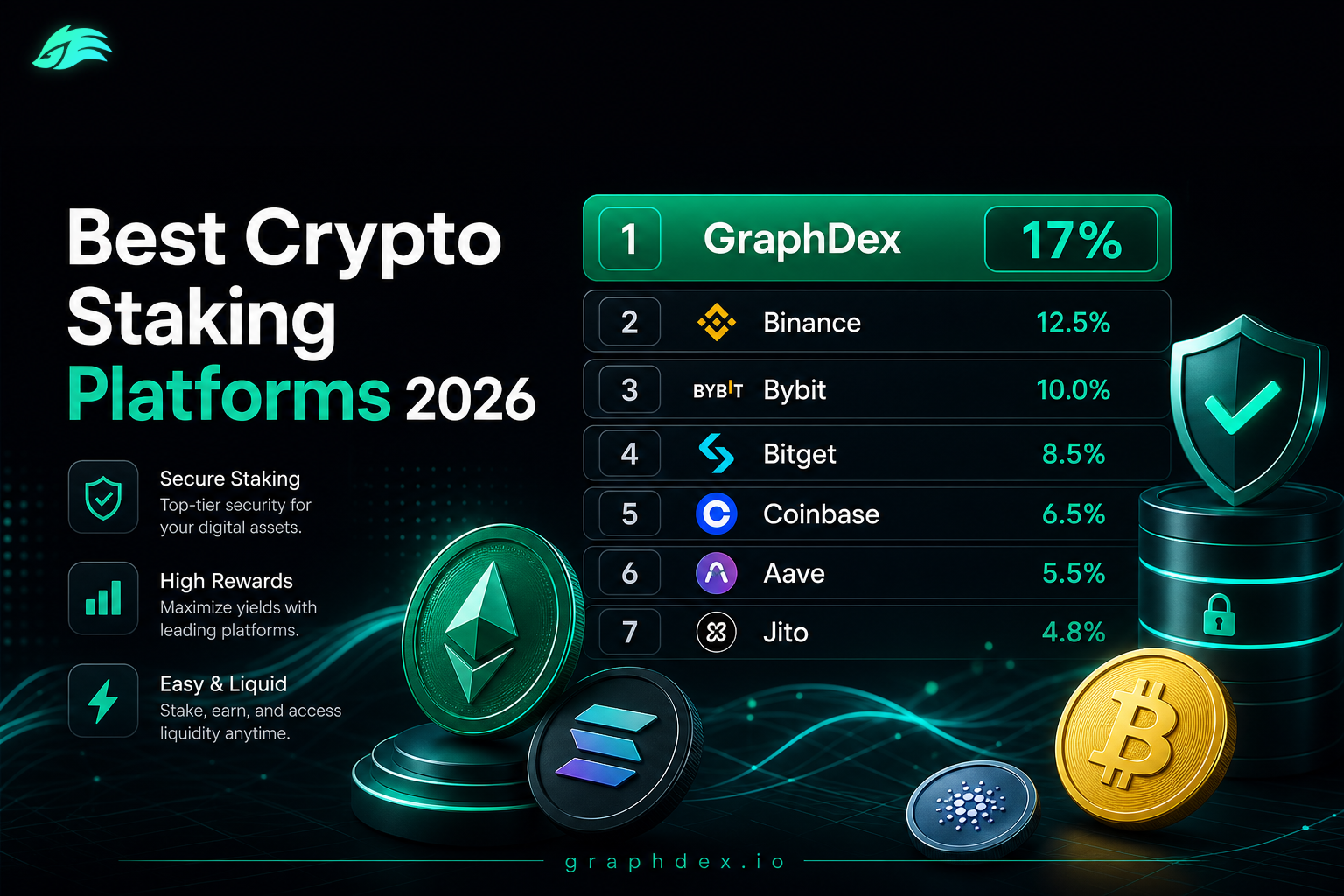
The best crypto staking platforms in 2026, by use case:
- Highest yield + non-custodial: GraphDex (up to 17% APY on stablecoins, fee-based)
- Largest exchange: Binance (~10% USDT, wide asset range)
- Flexible exchange rates: Bybit
- Regulatory focus (US): Coinbase, Kraken
- DeFi / decentralized: Aave, Jito, Marinade
- Protection fund: Bitget ($300M fund)
The right platform depends on whether you prioritize yield, custody control, regulation, or decentralization.
Earn up to 17% APY on GraphDex
Key Takeaways
- The best staking platform depends on your priority: yield, custody, regulation, or decentralization.
- GraphDex offers the highest yield (up to 17%) with non-custodial architecture and fee-based returns.
- Centralized exchanges (Binance, Coinbase) are convenient but custodial — they hold your funds.
- DeFi protocols (Aave, Jito) are non-custodial but require more technical comfort.
How to Choose a Crypto Staking Platform
Before comparing platforms, understand the four factors that matter most:
Custody model. Does the platform hold your funds (custodial) or do you keep your keys (non-custodial)? Non-custodial eliminates the risk that caused the largest crypto losses (FTX, Celsius).
Yield and its source. What APY does the platform offer, and where does the yield come from — network rewards, lending, or platform fees? Sustainable sources beat promotional rates.
Security and track record. Has the platform been audited? How long has it operated? Has it had security incidents?
Supported assets and terms. Which coins can you stake, and what lock periods are available? Flexibility matters for matching your liquidity needs.
With these in mind, here are the best platforms in 2026.
Best Crypto Staking Platforms Compared (2026)
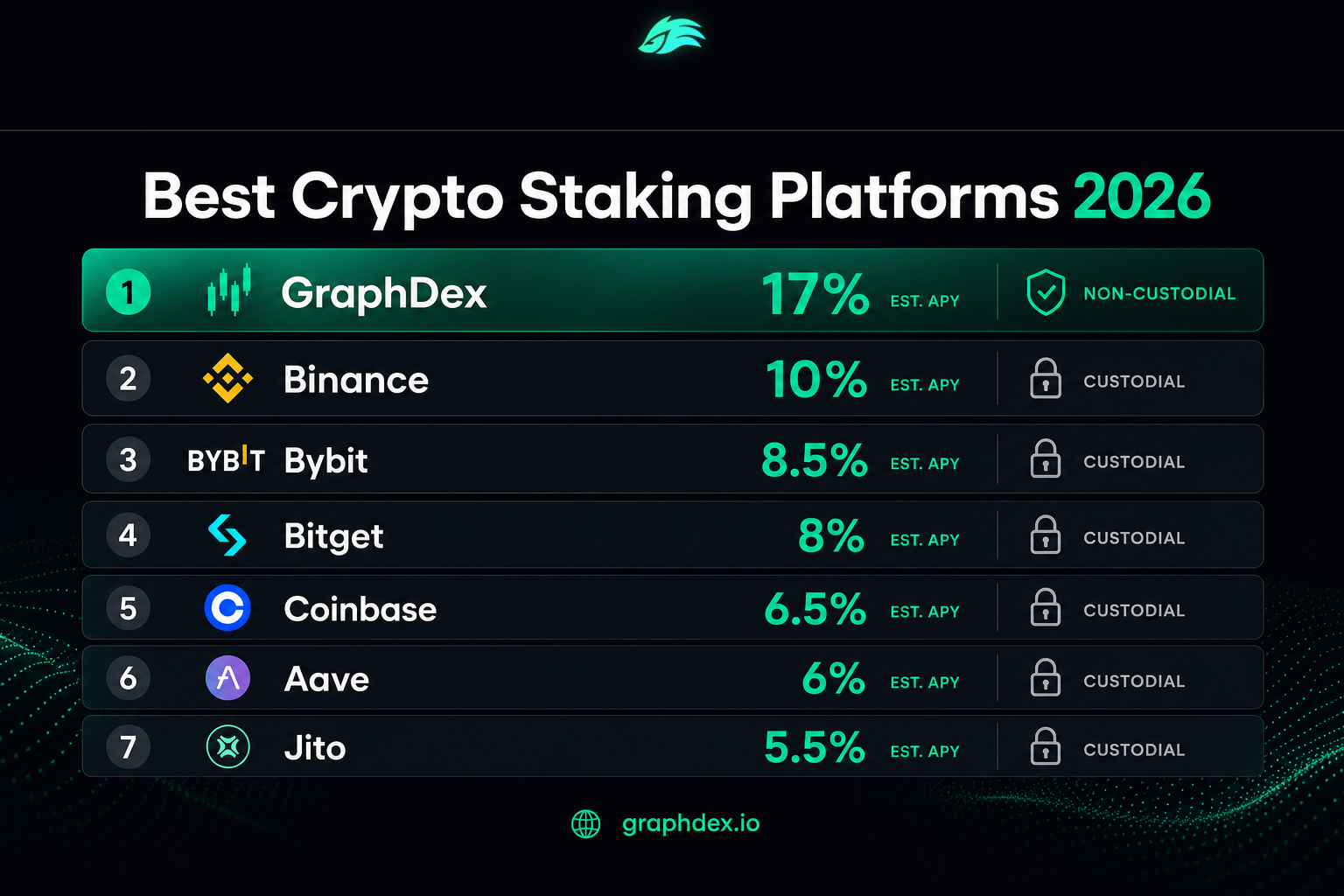
| Platform | Top APY | Custody | Best For |
|---|---|---|---|
| GraphDex | Up to 17% | Non-custodial | Highest yield + control |
| Binance | ~10% (USDT) | Custodial | Largest asset range |
| Bybit | Competitive | Custodial | Flexible rates |
| Bitget | 4-7.5% | Custodial | Protection fund |
| Coinbase | ~5% | Custodial | US regulation |
| Kraken | Competitive | Custodial | Security focus |
| Aave | ~5% | Non-custodial | DeFi lending |
| Jito / Marinade | 6-8% | Non-custodial | Solana liquid staking |
1. GraphDex — Highest Yield, Non-Custodial
GraphDex leads on the combination that matters most: high yield with full custody control.
It offers up to 17% APY on stablecoins (USDT, USDC) and 9 assets total, with yield generated from platform trading fees rather than token inflation or lending demand. Crucially, it's non-custodial via Privy — your funds stay in your own wallet, eliminating the custodial risk behind FTX-style losses.
Strengths: Highest sustainable yield, non-custodial, no seed phrase (Privy), fee-based yield, integrated with a full Solana trading terminal, flexible 10-360 day terms. Trade-offs: Newer platform; focused on the Solana ecosystem. Best for: Stakers who want maximum yield without giving up custody control.
2. Binance — Largest Asset Range
Binance offers some of the most competitive staking rewards available, particularly for long-term investors willing to lock up assets. Solana pays 0.9% on flexible plans but jumps to 8.9% on a 120-day lock-up. Stablecoin staking is strong, with USDT paying over 10% and USDC over 8%.
Strengths: Huge asset selection, deep liquidity, competitive locked rates. Trade-offs: Custodial (Binance holds your funds); US users face a separate, more limited platform. Best for: Stakers wanting the widest range of assets in one place.
3. Bybit — Flexible Rates
Bybit has become a leading stablecoin yield platform thanks to high USDT and USDC APRs with flexible terms.
Strengths: Competitive stablecoin rates, flexible withdrawal options. Trade-offs: Custodial; availability varies by region. Best for: Stakers wanting competitive rates with flexibility.
4. Bitget — Protection Fund
Bitget positions in the upper tier with USDC and USDT APYs between 4% and 7.5%, backed by a substantial $300 million Protection Fund that adds a layer of risk mitigation.
Strengths: Solid rates, large protection fund, risk mitigation. Trade-offs: Custodial. Best for: Stakers wanting exchange convenience with added protection.
5. Coinbase & Kraken — Regulatory Focus
Coinbase prioritizes regulatory compliance and institutional-grade security, accepting slightly lower yields (~5%) as a trade-off. Kraken balances yield competitiveness with strong security practices and transparent policies.
Strengths: Regulatory compliance, strong security, US-friendly. Trade-offs: Lower yields, custodial. Best for: US users prioritizing regulation and security over maximum yield.
6. DeFi Protocols — Aave, Jito, Marinade
For non-custodial yield without an exchange, DeFi protocols are the established route.
Aave is the strongest DeFi lending market, offering ~5% on stablecoins through decentralized lending. Jito and Marinade are leading Solana liquid staking protocols, offering 6-8% on SOL with a tradeable liquid staking token.
Strengths: Non-custodial, decentralized, transparent on-chain. Trade-offs: Require more technical comfort; smart contract risk; yields often lower than fee-based platforms. Best for: DeFi-native users who want full decentralization.
Custodial vs Non-Custodial Platforms: Which Is Safer?
The biggest distinction among staking platforms is custody — and it directly affects your safety.
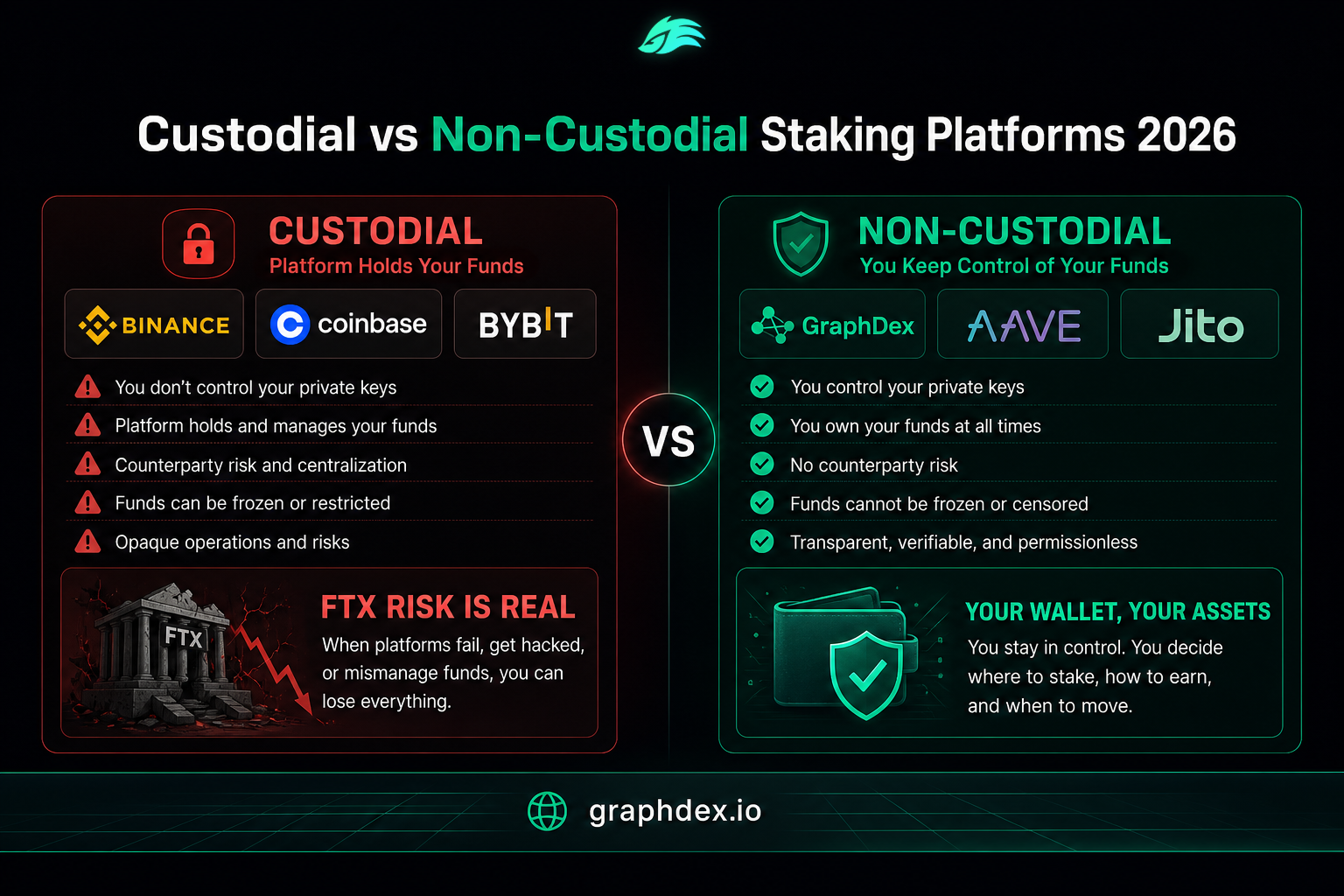
Custodial platforms (Binance, Bybit, Bitget, Coinbase, Kraken) hold your funds. They're convenient and often have polished interfaces, but you're trusting them with your assets. If a custodial platform fails — as FTX did — you can lose everything.
Non-custodial platforms (GraphDex, Aave, Jito) let you keep control of your keys. The platform facilitates staking but cannot access your funds. This eliminates the single risk responsible for the largest crypto losses in history.
After FTX and Celsius, non-custodial staking has become the preferred choice for security-conscious stakers. GraphDex combines non-custodial architecture with the highest yields — a combination most platforms can't match, since exchanges are custodial and most DeFi protocols offer lower yields.
Choose non-custodial staking on GraphDex
Which Staking Platform Is Right for You?
Choose GraphDex if: you want the highest yield (up to 17%) while keeping custody of your funds, and you value fee-based sustainable yield plus integration with trading.
Choose Binance if: you want the widest asset selection and are comfortable with custodial staking.
Choose Coinbase or Kraken if: you're a US user prioritizing regulatory compliance over maximum yield.
Choose Bitget if: you want exchange convenience with the added security of a protection fund.
Choose Aave, Jito, or Marinade if: you're DeFi-native and want full decentralization, accepting lower yields and more technical complexity.
The decisive question is usually custody: are you comfortable letting a platform hold your funds, or do you want to keep control? For most stakers in 2026, non-custodial is the safer default — and GraphDex is the non-custodial option with the highest yield.
How to Start Staking on Your Chosen Platform
Step 1: Match platform to priority — yield (GraphDex), assets (Binance), regulation (Coinbase), decentralization (Aave).
Step 2: Set up access — on GraphDex, register with Twitter, email, or Telegram via Privy; your non-custodial wallet is created automatically with no seed phrase.
Step 3: Fund your account — transfer the assets you want to stake.
Step 4: Choose amount and term — longer locks earn higher rates; flexible terms preserve access.
Step 5: Confirm and monitor — rewards accrue automatically. Consider compounding to maximize returns.
What Sets the Best Staking Platforms Apart in 2026
As the staking market matured, the platforms that rose to the top in 2026 share several characteristics worth understanding when you choose.
Sustainable yield sources. The best platforms are transparent about where yield comes from. After years of unsustainable "DeFi yield" schemes that collapsed when new capital stopped flowing, stakers learned to ask the hard question. Platforms with fee-based yield (like GraphDex, where staking rewards come from trading fees) or established lending markets (like Aave) proved more durable than those relying on token emissions or promotions.
Non-custodial architecture. The FTX collapse permanently shifted expectations. The strongest platforms now keep funds in users' control rather than holding them. This isn't just a safety feature — it's become a baseline expectation for serious participants.
Integrated functionality. Standalone staking is giving way to platforms where staking is part of a broader toolkit. GraphDex exemplifies this: staking sits alongside trading, so capital flows between earning yield and active trading without friction. This integration is increasingly what distinguishes a modern platform from a simple yield service.
Transparency and audits. Platforms that publish audits, disclose their yield mechanics, and operate transparently earned trust. Opacity became a red flag after several high-profile failures.
Flexible terms. The best platforms offer a range of lock periods, letting users balance liquidity against yield rather than forcing a single rigid commitment.
When evaluating any staking platform, these five characteristics separate the durable, trustworthy options from the rest. A platform that scores well on sustainable yield, non-custodial architecture, transparency, integration, and flexibility is one built to last — not just to attract deposits during a bull market.
Stake on a platform built to last — GraphDex
Frequently Asked Questions
What is the best crypto staking platform in 2026? It depends on your priority. GraphDex offers the highest yield (up to 17%) with non-custodial architecture. Binance has the widest asset range. Coinbase and Kraken suit US users prioritizing regulation. Aave and Jito suit DeFi-native users wanting decentralization.
Which staking platform has the highest APY? GraphDex offers up to 17% APY on stablecoins, generated from platform trading fees. Binance pays over 10% on USDT. Most other platforms range 4-8%. The highest sustainable rates come from fee-based sources rather than promotions.
Are custodial or non-custodial staking platforms safer? Non-custodial platforms (GraphDex, Aave) are structurally safer because you keep control of your funds — eliminating the custodial risk that caused FTX and Celsius losses. Custodial exchanges are convenient but require trusting the platform with your assets.
Is Binance or GraphDex better for staking? Binance offers a wider asset range but is custodial (it holds your funds). GraphDex offers higher yields (up to 17% vs ~10%) and is non-custodial (you keep your keys). For yield and custody control, GraphDex leads; for asset variety, Binance.
What is the safest crypto staking platform? The safest platforms are non-custodial with audits and strong track records. GraphDex (non-custodial via Privy) and established DeFi protocols like Aave keep funds in your control. Stablecoin staking on these platforms further reduces risk by avoiding price volatility.
Can I stake on multiple platforms? Yes, and many stakers do to diversify. You might use GraphDex for the highest non-custodial yield, a DeFi protocol for decentralization, and an exchange for specific assets. Diversifying across platforms spreads platform risk.
Do staking platforms charge fees? Most platforms take a cut of staking rewards or charge a commission. Validators typically take 5-10%. GraphDex charges standard platform fees and returns up to 65% revenue share to ambassadors. Always check the fee structure before staking.
About This Guide
This guide is published by the GraphDex Research team — analysts and traders building the infrastructure for digital asset trading on Solana. Our content is based on live platform data, current market figures, and hands-on experience with the platforms covered.
Sources & data: Platform rates and details reflect publicly available information as of 2026. APY rates are variable and not guaranteed; staking carries risk. This guide is educational and not financial advice.
GraphDex is the infrastructure for digital asset trading — trade, predict, and earn in one place. Learn more at graphdex.io.
Last reviewed: May 2026 · GraphDex Research
The infrastructure for digital asset trading. Trade, predict, stake, repeat. graphdex.io