By GraphDex Research · Reviewed for accuracy May 2026
Quick Answer
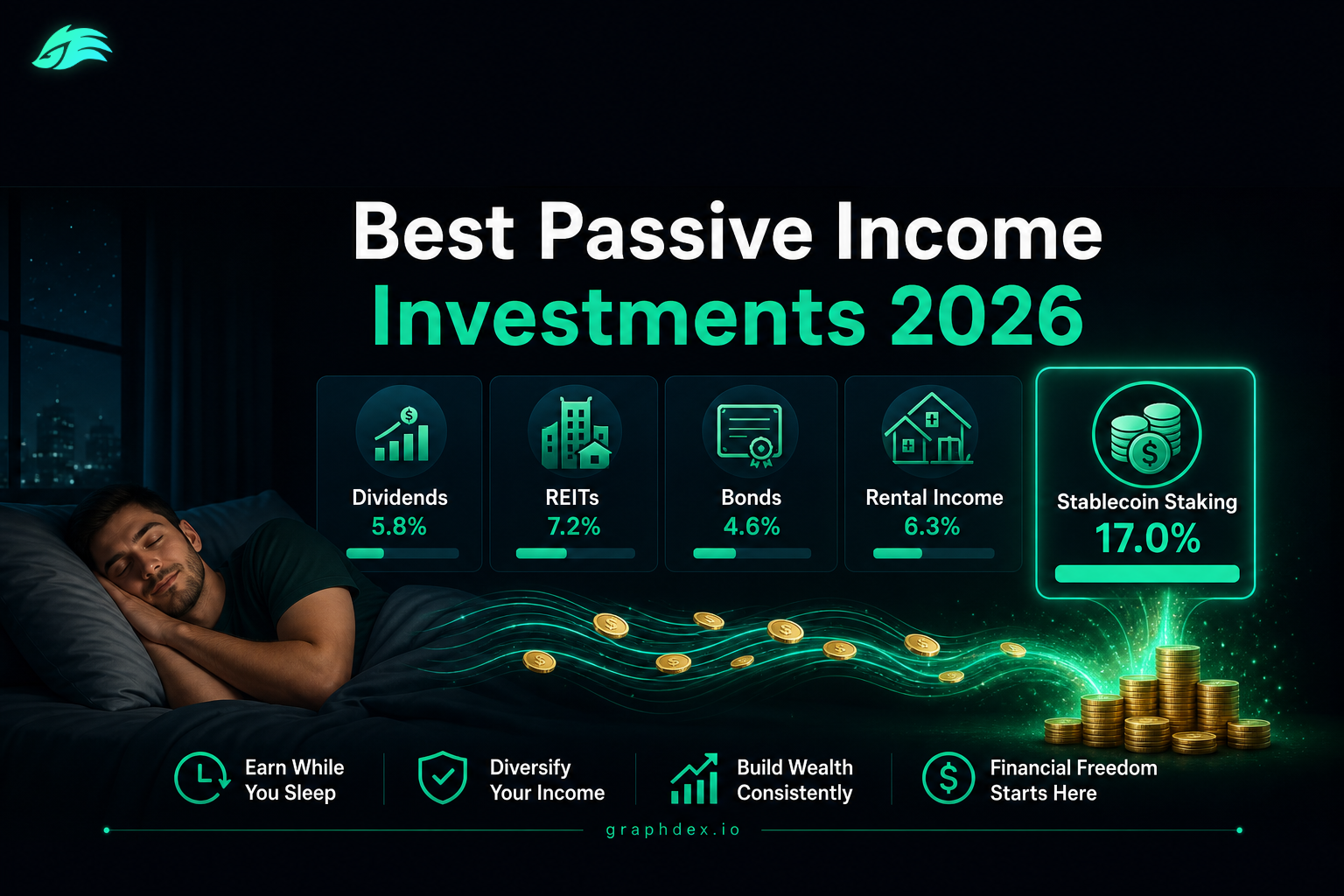
The best passive income investments in 2026:
- Dividend stocks: 3-9% yield, the classic passive income choice
- High-yield savings / money market: 4-5%, lowest risk
- Bonds / Treasuries: 4-6%, steady and safe
- REITs: 5-10%, real estate income without owning property
- Rental real estate: 5-12%, higher effort and capital
- Stablecoin staking: up to 17%, highest yield, platform risk
The best mix depends on your capital, risk tolerance, and how truly hands-off you want to be. Stablecoin staking offers the highest passive yield with dollar-stable principal.
Earn up to 17% passive income on GraphDex
Key Takeaways
- Passive income flows from investments generating interest, dividends, rent, or yield with minimal effort.
- Returns range from 4% (savings) to up to 17% (stablecoin staking); higher yield means more risk.
- Stablecoin staking offers the highest passive yield while keeping principal pegged to the dollar.
- The most reliable passive income comes from diversifying across several income sources.
What Is Passive Income?
Passive income refers to earnings that require minimal day-to-day effort to maintain. Unlike wages or salary, passive income flows from investments that generate interest, dividends, rent, or profit sharing.
The appeal is straightforward: your money works for you. Passive income can provide retirement cash flow, reduce dependence on active employment, and allow reinvestment for compound growth. The start can take effort or capital, but the goal is earning with little ongoing involvement.
True passive income exists on a spectrum. Some sources are nearly effortless (savings interest, staking yield); others require upfront work or ongoing oversight (rental property, dividend stock selection). This guide ranks them by both return and how genuinely hands-off they are.
Best Passive Income Investments Compared (2026)
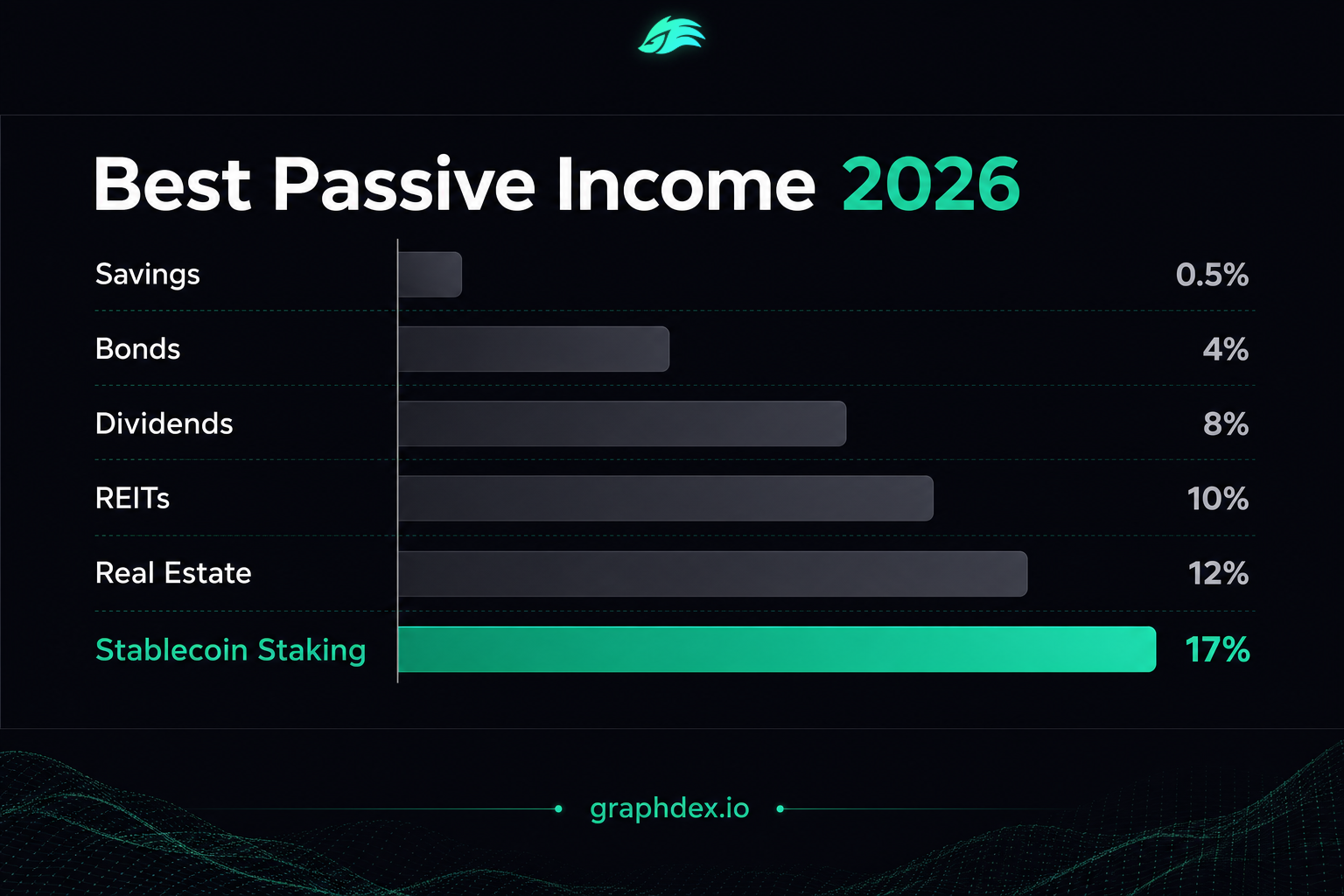
| Investment | Yield | Effort | Risk | Capital Needed |
|---|---|---|---|---|
| High-yield savings | 4-5% | Very low | Very low | $1+ |
| Money market funds | ~5% | Very low | Low | $100+ |
| Treasuries | ~4% | Low | Very low | $100+ |
| Bonds | 4-6% | Low | Low-moderate | $100+ |
| Dividend stocks | 3-9% | Moderate | Moderate | Price of 1 share |
| REITs | 5-10% | Low | Moderate | Price of 1 share |
| Rental real estate | 5-12% | High | Moderate-high | Substantial |
| Stablecoin staking | Up to 17% | Very low | Platform risk | $50+ |
1. Dividend Stocks — The Classic Choice
Dividend-paying stocks remain the gold standard of passive income investing. They distribute part of a company's earnings to shareholders regularly (usually quarterly), providing steady income plus potential capital appreciation.
Yield: 3-9% (top dividend payers reach 6.8-9.4%) Effort: Moderate — researching companies, monitoring dividend sustainability. Best for: Investors wanting income plus long-term growth who can do some research.
The best dividend stocks increase payouts over time, growing your income. You can also reinvest dividends to compound returns. The catch: dividends can be cut, and stock prices fluctuate.
2. High-Yield Savings and Money Market Funds
The simplest passive income. High-yield savings accounts pay 4-5% in 2026, while money market funds yield around 5% by investing in short-term, high-quality debt.
Yield: 4-5% Effort: Very low — deposit and earn. Best for: Emergency funds and the lowest-risk portion of your portfolio.
The downside: interest is taxed as ordinary income, and returns barely beat inflation, meaning minimal real growth.
3. Bonds and Treasuries
Bonds pay periodic interest and return principal at maturity. Treasuries are government-backed and among the safest options; corporate bonds pay more to compensate for default risk. Bond funds spread risk across many bonds.
Yield: 4-6% Effort: Low. Best for: Stabilizing a portfolio and steady, predictable income.
4. REITs — Real Estate Income Without Owning Property
REITs invest in income-producing properties — apartments, shopping centers, offices — and must distribute most taxable income as dividends. They offer yields higher than many stocks or bonds, with property market and interest rate risk.
Yield: 5-10% Effort: Low — buy like a stock, no property management. Best for: Real estate income with stock-like liquidity and no landlord duties.
REITs are how most people get passive real estate income without the capital and effort of direct ownership.
5. Rental Real Estate
Direct real estate ownership provides rental income that can outpace inflation, plus potential property appreciation.
Yield: 5-12% (plus appreciation) Effort: High — tenants, maintenance, management (unless you hire a manager). Best for: Investors with substantial capital wanting a tangible inflation hedge.
The trade-off: real estate is illiquid, capital-intensive, and management-heavy. Returns can be strong but the "passive" label is generous unless you pay for property management.
6. Stablecoin Staking — The Highest Passive Yield
A newer entrant rapidly attracting passive income seekers: staking stablecoins. You deposit dollar-pegged stablecoins (USDT, USDC) and earn yield generated from lending or platform fees — up to 17% APY on GraphDex.
Yield: Up to 17% Effort: Very low — deposit and earn, like a savings account. Best for: Passive income seekers wanting the highest yield on dollar-stable assets.
Crypto staking has become a recognized passive income strategy, appearing alongside dividends and REITs in mainstream passive income guides. Because stablecoins hold their dollar value, you get the high yield without crypto price volatility. The trade-off versus a savings account: no FDIC insurance, and platform risk (minimized by using non-custodial platforms like GraphDex where funds stay in your wallet).
Start earning up to 17% passive income on GraphDex
Which Passive Income Is Truly Hands-Off?
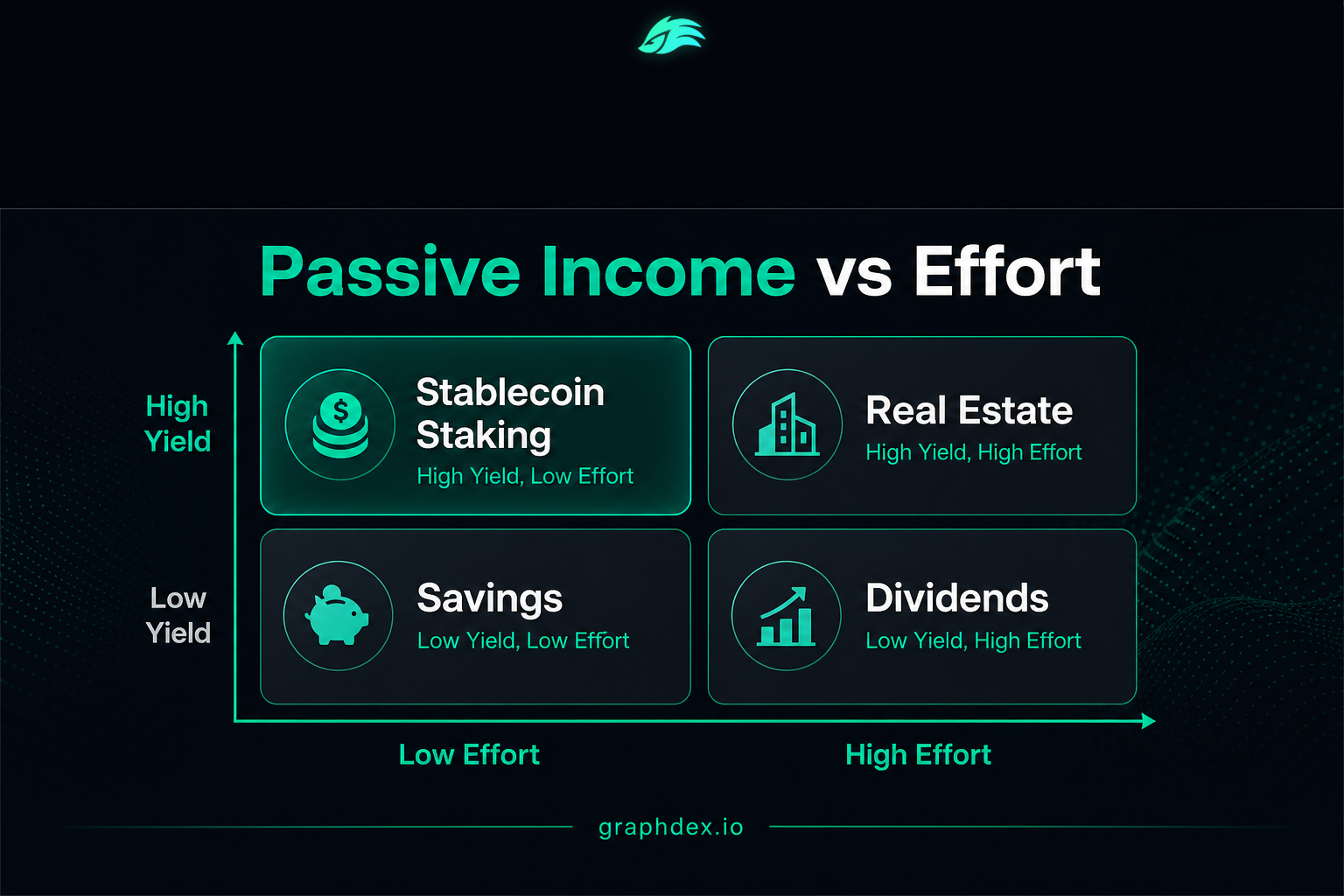
Not all "passive" income is equally hands-off. Ranked by how little ongoing effort each requires:
Truly passive (set and forget):
- High-yield savings, money market funds
- Stablecoin staking
- Treasuries (hold to maturity)
Mostly passive (occasional attention):
- REITs, bonds, bond funds
- Dividend stocks (periodic review)
Semi-passive (real ongoing work):
- Rental real estate (unless professionally managed)
For genuinely hands-off income, savings, money market funds, and stablecoin staking top the list. Stablecoin staking stands out by combining minimal effort with the highest yield — you deposit once and earn up to 17% with no ongoing management.
How Do You Build a Passive Income Portfolio?
The most reliable passive income comes from diversifying across sources, not relying on one.
A balanced passive income portfolio might include:
- Emergency reserve in high-yield savings (4-5%, instant access)
- Core income from dividend stocks and bonds (3-6%, moderate risk)
- Real estate exposure via REITs (5-10%, no management)
- A high-yield allocation in stablecoin staking (up to 17%, dollar-stable)
This spreads risk: if one source underperforms, others continue. It also blends liquidity levels and risk profiles. The stablecoin staking allocation boosts overall portfolio yield significantly while the insured and traditional holdings provide stability.
The key principle: match each allocation to its purpose. Insured savings for what you can't risk, growth assets for the long term, and high-yield options like staking for the portion that can tolerate platform risk in exchange for superior returns.
Add a high-yield allocation with GraphDex
How Much Capital Do You Need for Passive Income?
A common question from people starting out: how much money does it actually take to generate meaningful passive income? The answer depends on the yield and your income goal.
The math is straightforward. To generate $1,000 a month ($12,000 a year) in passive income:
- At 4% (savings): you need about $300,000
- At 8% (dividend stocks/REITs): you need about $150,000
- At up to 17% (stablecoin staking): you need about $70,000
This illustrates why yield matters so much for passive income. The higher the sustainable yield, the less capital you need to reach your income goal. At up to 17%, stablecoin staking requires less than a quarter of the capital that a savings account would need for the same income.
Of course, higher yield carries more risk, so the right approach blends sources. But the principle holds: yield efficiency dramatically affects how much capital you need. This is why passive income seekers increasingly include higher-yield options like stablecoin staking alongside traditional dividends and REITs — it accelerates the path to meaningful income.
For those starting with less, the key is consistency and compounding. Reinvesting passive income — whether dividends, interest, or staking rewards — compounds your capital over time, steadily growing both your principal and the income it produces. Starting small and reinvesting beats waiting until you have a large sum.
Accelerate your passive income with GraphDex
Frequently Asked Questions
What is the best passive income investment in 2026? It depends on your goals. Dividend stocks are the classic choice (3-9%); REITs offer real estate income (5-10%); stablecoin staking offers the highest yield (up to 17%) with dollar-stable principal. The best approach diversifies across several for reliable, balanced income.
What investment gives the highest passive income? Among low-volatility options, stablecoin staking offers the highest passive yield at up to 17% APY, versus 4-5% for savings and 5-10% for REITs. Rental real estate and dividend stocks can return more over time but with higher effort or volatility.
What is the most hands-off passive income? High-yield savings, money market funds, and stablecoin staking are the most genuinely passive — you deposit and earn with no ongoing management. Stablecoin staking combines this hands-off simplicity with the highest yield (up to 17%).
Is crypto staking real passive income? Yes. Crypto staking now appears in mainstream passive income guides alongside dividends and REITs. You deposit assets and earn yield with minimal effort. Stablecoin staking specifically offers dollar-stable principal, making it comparable to high-yield savings but with much higher returns.
How much money do I need for passive income? You can start small: stablecoin staking from $50, dividend stocks from one share's price, money market funds from $100. Meaningful income requires more capital, but low minimums let you begin building and compounding immediately.
Is passive income taxed? Yes, in most jurisdictions. Interest, dividends, rent, and staking rewards are generally taxable as income, though rates and treatment vary by type and country. Keep records and consult a tax professional. This is general information, not tax advice.
Can I lose money with passive income investments? Yes — all except FDIC-insured savings carry some risk. Stocks and REITs can fall, bonds have interest rate risk, real estate has market risk, and staking has platform risk. Diversifying across sources reduces the impact of any single loss.
About This Guide
This guide is published by the GraphDex Research team — analysts building the infrastructure for digital asset trading on Solana. Our content is based on live platform data and current market figures.
Sources & data: Return figures reflect publicly available information as of 2026 and are estimates based on market conditions. All investments carry risk; returns are not guaranteed. Stablecoin staking is not FDIC-insured. This guide is educational and not financial advice — consult a financial advisor for your situation.
GraphDex is the infrastructure for digital asset trading — trade, predict, and earn in one place. Learn more at graphdex.io.
Last reviewed: May 2026 · GraphDex Research
The infrastructure for digital asset trading. Trade, predict, stake, repeat. graphdex.io