By GraphPay Research · Reviewed for accuracy May 2026
Quick Answer
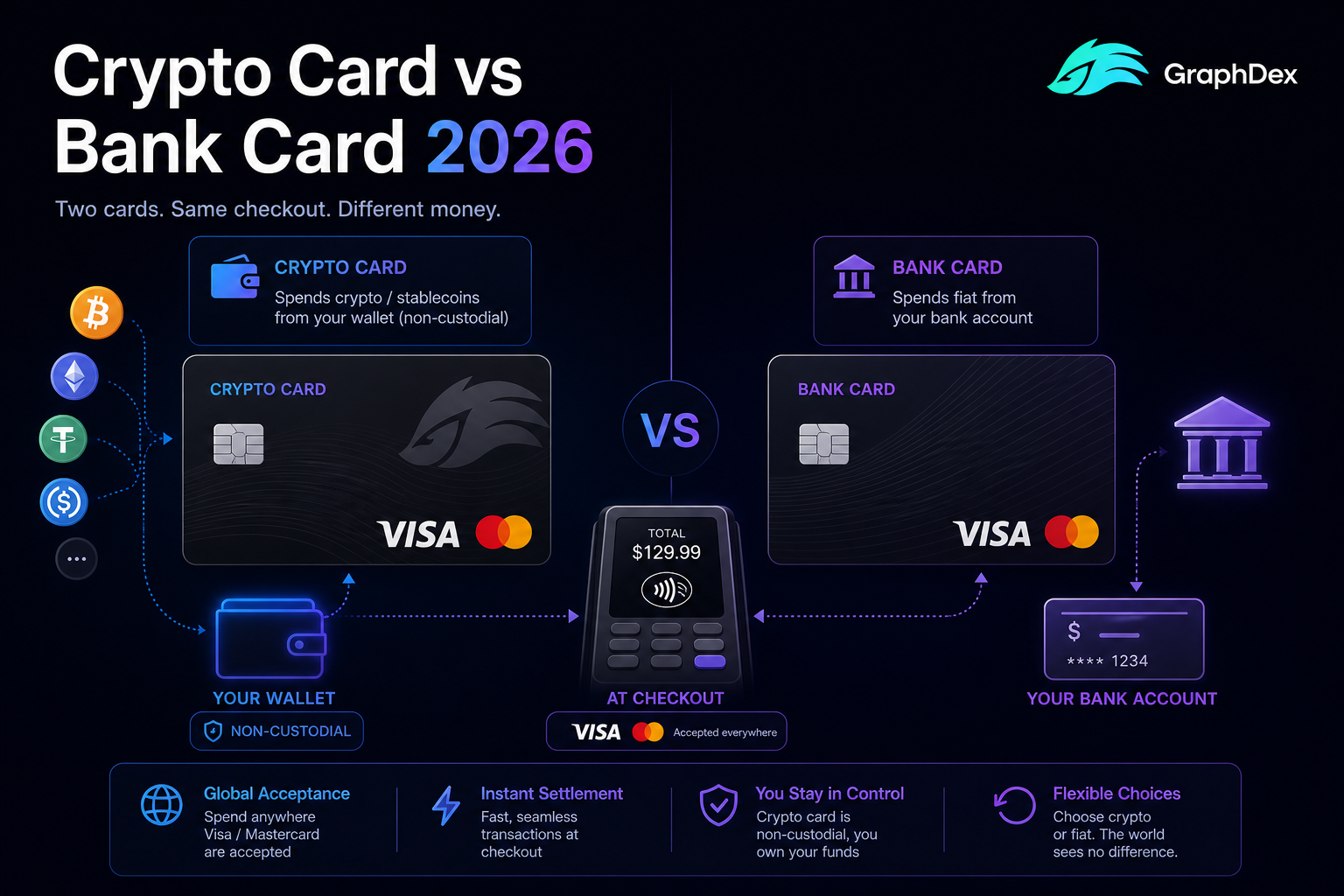
Crypto cards vs bank cards — the key differences in 2026:
- Funding source: Crypto cards spend from your crypto/stablecoins; bank cards spend from your fiat bank account
- Custody: Non-custodial crypto cards keep funds in your wallet; bank cards hold funds at the bank
- Foreign fees: The best crypto cards charge 0% FX; bank cards often charge 2-4%
- Global spending: Crypto cards excel abroad (low FX); bank cards are tied to your home banking system
- Setup: Crypto cards can start with minimal KYC (Level 1); bank cards require full bank onboarding
- Rewards: Both offer rewards; crypto cards may offer crypto/token cashback
The verdict: Bank cards are established and integrated with traditional finance; crypto cards offer better international spending, self-custody (non-custodial), and access for the crypto-native. Many people use both — a bank card for domestic banking needs, a crypto card for spending crypto and traveling.
Spend your crypto with a GraphPay card
Key Takeaways
- Crypto cards spend from crypto/stablecoins; bank cards spend from fiat bank accounts.
- Non-custodial crypto cards keep funds in your wallet; bank cards hold funds at the bank.
- Crypto cards often win on foreign transaction fees (0% vs 2-4%) and crypto access.
- Many people use both — bank cards for domestic banking, crypto cards for crypto spending and travel.
Crypto Cards vs Bank Cards: The Core Difference
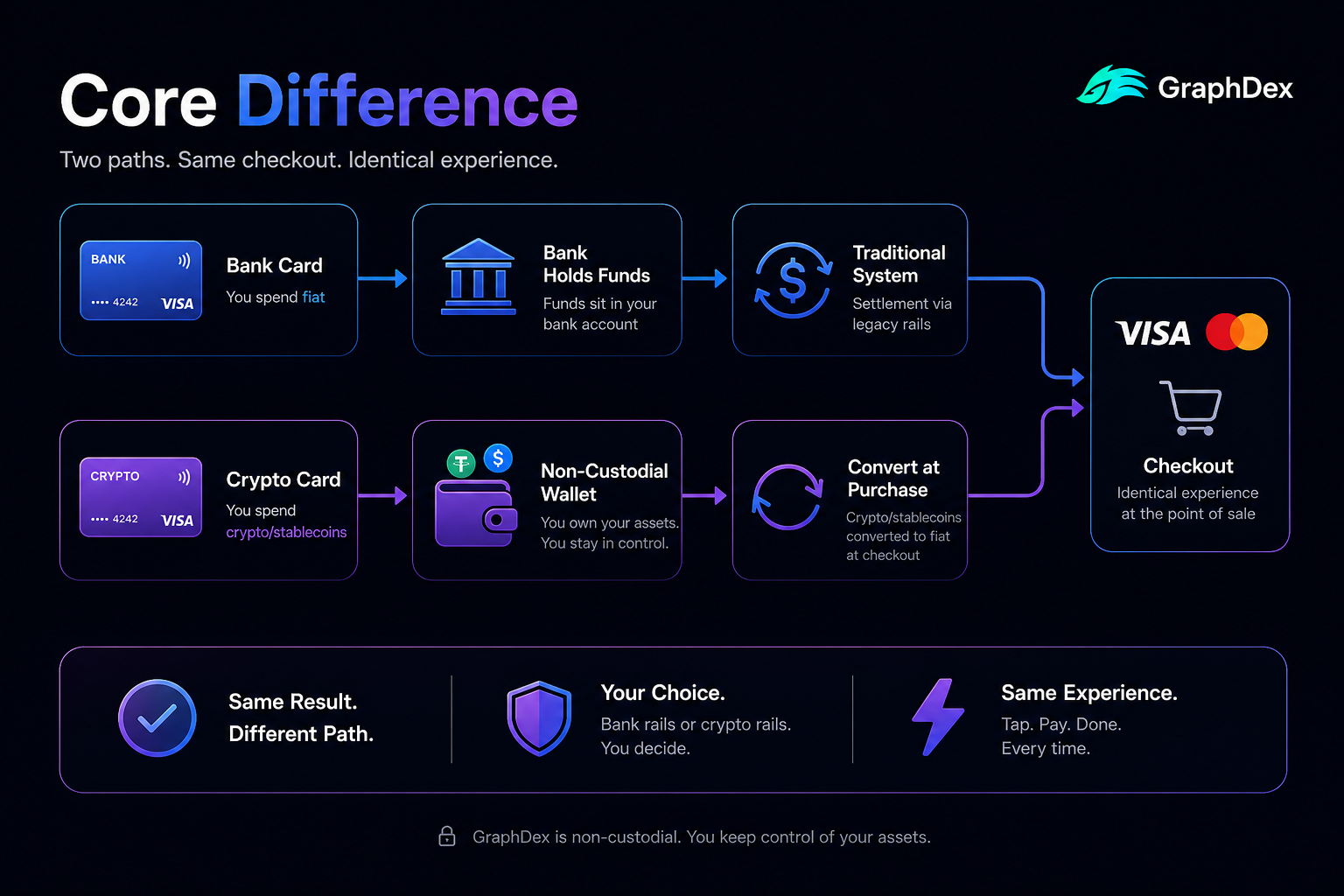
At the checkout, a crypto card and a bank card work identically — both run on Visa or Mastercard, both tap or swipe. The difference is what happens behind the scenes.
Bank cards draw from a fiat account held at a bank. When you spend, the money comes from your checking or credit account. The bank holds your funds, manages the account, and operates within the traditional financial system.
Crypto cards draw from your crypto holdings. When you spend, crypto (or stablecoins) is converted to fiat at the point of sale. With a non-custodial crypto card, your crypto stays in your own wallet until you spend — the card converts only what you need, when you need it.
The fundamental distinction:
- Bank card: Spends fiat, funds held by the bank, tied to traditional banking
- Crypto card: Spends crypto, funds in your wallet (non-custodial), tied to your crypto holdings
This difference cascades into everything else — fees, custody, global spending, and setup. Neither is universally "better"; they suit different needs, and increasingly, people use both.
Fees Compared
Cost is a major differentiator, especially internationally.
Bank Card Fees
- Foreign transaction fees: Typically 2-4% on purchases in foreign currencies
- ATM fees: Fees for out-of-network or international withdrawals
- Account fees: Monthly maintenance, overdraft, and other account fees (varies)
- Exchange rates: Banks apply their own rates, often with markups
Crypto Card Fees
- Foreign transaction fees: The best crypto cards charge 0% FX
- Top-up fees: A fee when loading crypto (commonly 1-3%)
- Exchange-rate spread: The hidden cost when converting crypto to fiat (0.5-1.5%)
- ATM fees: For physical cards (plus operator fees)
The comparison:
- For domestic spending: Bank cards may be cheaper (no top-up fee, no crypto conversion)
- For international spending: Crypto cards often win (0% FX vs 2-4% on bank cards) — but watch the exchange-rate spread
- The nuance: Crypto card total cost depends on top-up fee + spread; bank card cost depends on FX fees + account fees. Calculate for your usage.
The travel advantage: For international spending, crypto cards' 0% FX (versus bank cards' 2-4%) is a meaningful saving — provided the exchange-rate spread is tight.
Custody & Control
A fundamental philosophical and practical difference.
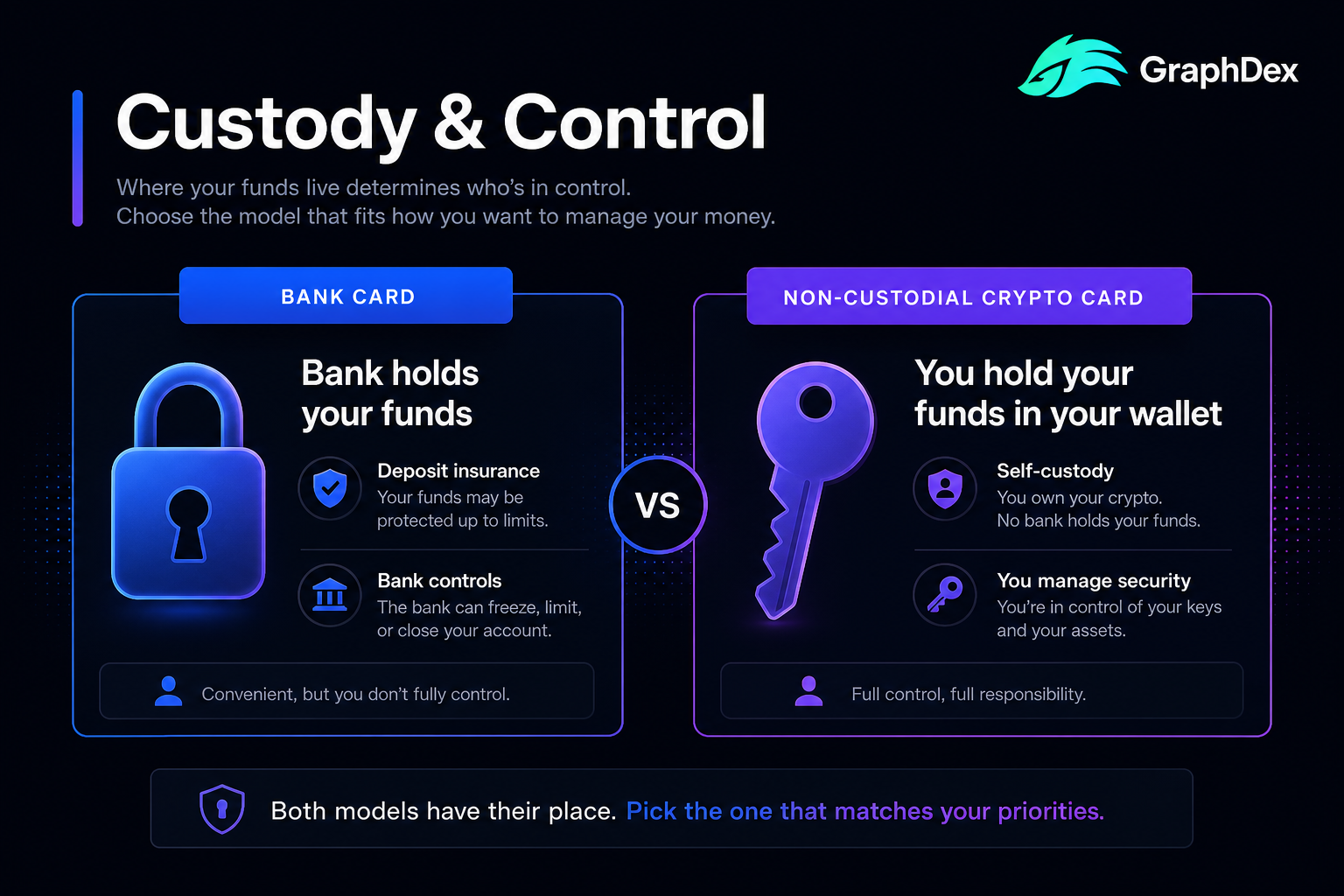
Bank Cards: Bank Holds Your Funds
- The bank holds your money
- You trust the bank's solvency (though deposit insurance protects up to limits in many countries)
- The bank can freeze accounts, decline transactions, or impose restrictions
- You operate within the bank's rules and the traditional financial system
Crypto Cards: You Can Hold Your Funds
- Non-custodial crypto cards: Your crypto stays in your own wallet; the card converts only when you spend. You control your funds.
- Custodial crypto cards: The issuer holds your crypto (adding risk similar to trusting a bank, but often without deposit insurance)
The key insight: Non-custodial crypto cards offer something bank cards can't — true self-custody. Your funds stay under your control, not held by an institution. This appeals to those who value financial sovereignty or don't want to trust a custodian.
The trade-off:
- Bank cards: Convenience and deposit insurance, but the bank controls your funds
- Non-custodial crypto cards: You control your funds, but you're responsible for your wallet security
For the crypto-native and those valuing self-custody, non-custodial crypto cards align with the "your keys, your coins" principle. For those preferring institutional backing and deposit insurance, bank cards offer that structure.
Comparison Table
| Feature | Crypto Card | Bank Card |
|---|---|---|
| Funding source | Crypto/stablecoins | Fiat bank account |
| Custody | Non-custodial option (your wallet) | Bank holds funds |
| Foreign transaction fees | Often 0% | Typically 2-4% |
| Setup | Minimal KYC option (Level 1) | Full bank onboarding |
| Global spending | Excellent (low FX) | Tied to home banking |
| Deposit insurance | No (non-custodial = self-responsible) | Often yes (up to limits) |
| Rewards | Sometimes crypto/token cashback | Points, miles, cashback |
| Best for | Crypto spending, travel, self-custody | Domestic banking, established use |
Global Spending: Where Crypto Cards Shine
International spending is where crypto cards often have a clear edge.
Bank cards abroad:
- 2-4% foreign transaction fees on every purchase
- Bank exchange rates with markups
- Tied to your home banking system
- Potential for account freezes on "unusual" foreign activity
Crypto cards abroad:
- Often 0% foreign transaction fees
- Near-market exchange rates (with tight-spread cards)
- Global Visa/Mastercard acceptance
- Not tied to a home banking system's restrictions
The traveler's math: On a $3,000 international trip, bank card foreign transaction fees alone could cost $60-120+. A crypto card with 0% FX could eliminate this (though factor the exchange-rate spread). For frequent travelers or those spending significant amounts abroad, this is a meaningful advantage.
The caveat: Crypto cards' international advantage depends on a tight exchange-rate spread. "0% FX" with a wide spread erodes the benefit. The best travel crypto cards minimize both.
Where Bank Cards Still Win
For balance, bank cards retain genuine advantages.
Established integration. Bank cards are deeply integrated with the traditional financial system — direct deposit, bill pay, and banking services all connect seamlessly.
Deposit insurance. In many countries, bank deposits are insured up to limits, protecting against bank failure. Non-custodial crypto cards put security responsibility on you.
No crypto knowledge required. Bank cards don't require understanding wallets, crypto, or stablecoins. They're accessible to everyone.
Credit building. Credit cards help build credit history — crypto cards typically don't.
Chargebacks and disputes. Traditional cards have established dispute and chargeback processes. Crypto card protections vary.
No conversion needed. For those without crypto, bank cards spend fiat directly — no need to acquire or convert crypto.
The honest assessment: For someone without crypto, who spends mostly domestically, and who values traditional banking integration and deposit insurance, a bank card remains the practical choice. Crypto cards shine for the crypto-native, international spenders, and those valuing self-custody.
Why Many People Use Both
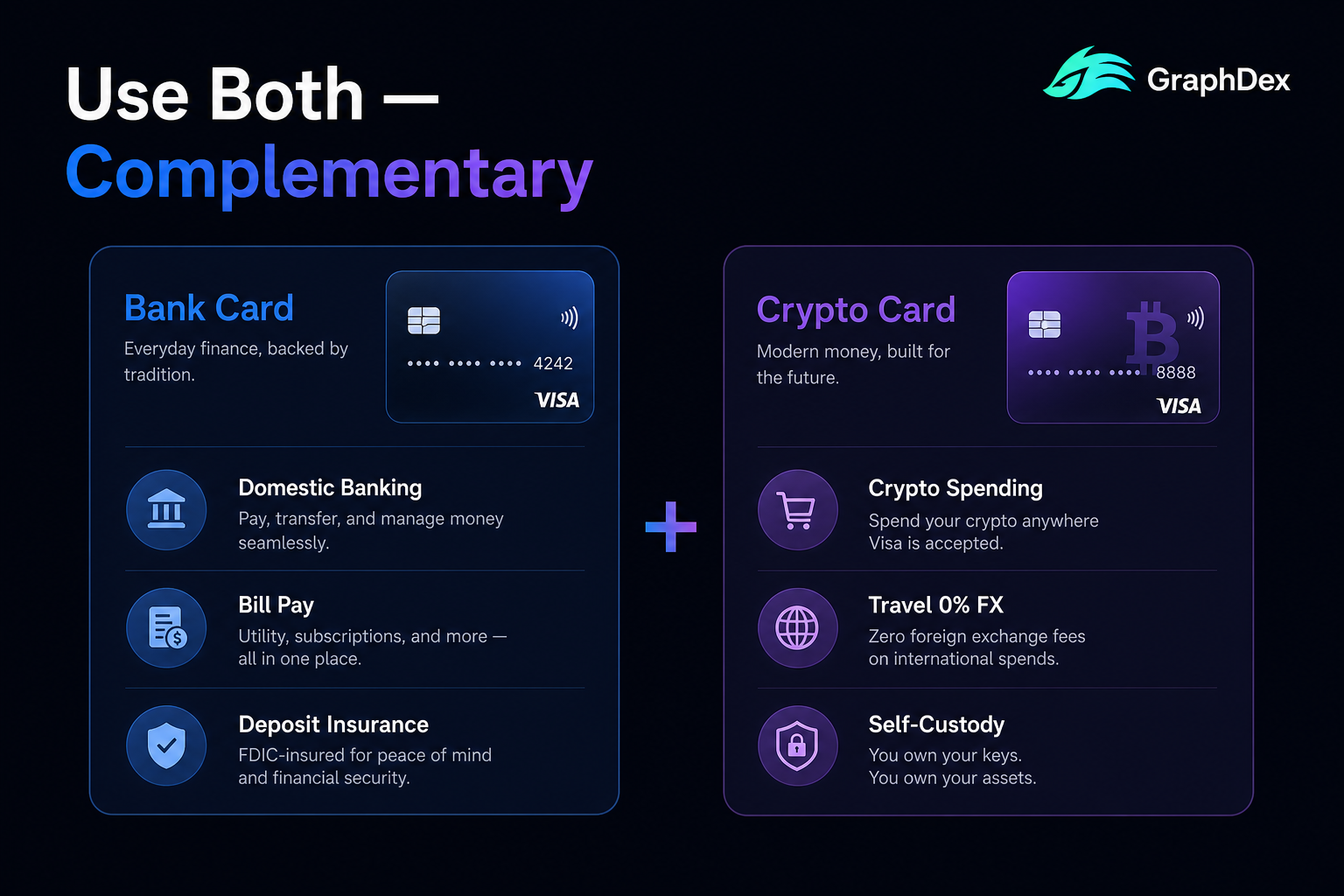
The practical reality in 2026: crypto cards and bank cards aren't mutually exclusive. Many people use both, leveraging each for its strengths.
A common setup:
- Bank card for domestic banking needs, bill pay, direct deposit, and situations requiring traditional banking
- Crypto card for spending crypto, international travel (0% FX), and keeping funds self-custodied
Why this works:
- You get traditional banking integration (bank card) plus crypto spending and travel advantages (crypto card)
- You spend crypto without selling it (via the crypto card) while keeping fiat banking for what it does best
- You optimize costs — bank card domestically, crypto card abroad
The complementary approach: Rather than "crypto card vs bank card," think "crypto card AND bank card." Use each where it excels. For crypto holders especially, a crypto card adds the ability to spend crypto in daily life — complementing, not replacing, traditional banking.
Add a non-custodial GraphPay card
How GraphPay Complements Your Wallet
GraphPay is a non-custodial crypto card that lets you spend crypto while keeping it in your own wallet — complementing traditional banking.
What GraphPay offers:
- Non-custodial: Your crypto stays in your own wallet — spend without surrendering custody (unlike a bank holding your funds)
- Spend crypto directly: Convert to fiat only at the point of sale — spend your crypto without selling it first
- 0% FX potential: Global spending on Visa/Mastercard rails
- Tiered KYC: Start at Level 1 (virtual card, minimal verification), upgrade to Level 3 (physical card)
- Multi-chain: Load from BNB Chain, Ethereum, or TRON with USDT/USDC
How it complements a bank card: GraphPay isn't trying to replace your bank — it adds crypto spending to your financial toolkit. Use your bank card for domestic banking and your GraphPay card for spending crypto, traveling (0% FX), and keeping funds self-custodied. Together, they cover both traditional and crypto-native needs.
The crypto holder's advantage: If you hold crypto, GraphPay lets you spend it in daily life — at any Visa/Mastercard merchant — while it stays in your wallet until you spend. That's something a bank card can't do: spend your crypto directly, non-custodially, anywhere.
Add crypto spending with a GraphPay card
Related Guides
- How to Spend Crypto Without Selling It in 2026: Complete Guide
- Best Crypto Cards for Travel in 2026: Spend Abroad Without the FX Fees
- How to Get a Crypto Card in 2026: Step-by-Step Guide by KYC Level
Frequently Asked Questions
What's the difference between a crypto card and a bank card? A crypto card spends from your crypto/stablecoin holdings (converting to fiat at purchase), while a bank card spends from your fiat bank account. Non-custodial crypto cards keep your funds in your own wallet; bank cards hold funds at the bank. Both run on Visa/Mastercard and work identically at checkout — the difference is the funding source and custody model.
Are crypto cards cheaper than bank cards? It depends on usage. For international spending, crypto cards often win — the best charge 0% FX versus 2-4% on bank cards (though watch the exchange-rate spread). For domestic spending, bank cards may be cheaper (no top-up fee or crypto conversion). Calculate total cost for your pattern: crypto card (top-up + spread) vs bank card (FX fees + account fees).
Is a crypto card safer than a bank card? Different safety models. Bank cards offer deposit insurance (protecting against bank failure up to limits) but the bank controls your funds. Non-custodial crypto cards keep funds in your wallet (no custodian risk) but put security responsibility on you (no deposit insurance). Neither is universally safer — it depends on whether you value institutional backing or self-custody.
Can a crypto card replace my bank card? For some uses, yes — but most people benefit from using both. Crypto cards excel at spending crypto, international travel (0% FX), and self-custody. Bank cards excel at domestic banking integration, deposit insurance, credit building, and not requiring crypto. Many people use a bank card for banking needs and a crypto card for crypto spending and travel — complementary, not either/or.
Do crypto cards work everywhere bank cards do? Largely yes — crypto cards on Visa/Mastercard rails are accepted at the same tens of millions of merchants as bank cards, worldwide, online and in-store. The merchant sees a normal card payment. However, some crypto cards have regional availability restrictions (where the card can be issued/used), so verify your card works in your location and destinations.
Why use a crypto card if I have a bank card? Key reasons: to spend crypto directly (without selling it first), to save on international spending (0% FX vs 2-4%), to keep funds self-custodied (non-custodial cards), and to access spending for the crypto-native. If you hold crypto, a crypto card lets you spend it in daily life while it stays in your wallet — something a bank card can't do.
Do crypto cards build credit like credit cards? Generally no. Crypto cards are typically prepaid/debit-style (you spend your own crypto), not credit products, so they usually don't build credit history the way traditional credit cards do. If building credit is a goal, a traditional credit card serves that purpose. Crypto cards serve different goals — spending crypto, self-custody, and international savings.
About This Guide
This guide is published by the GraphPay Research team — building non-custodial crypto payment infrastructure. Our content is based on current card industry practices, fee structures, and 2026 market data.
Sources & data: Fee ranges, features, and comparisons reflect publicly available information as of 2026 and may change. Specific terms vary by provider, bank, and jurisdiction. Deposit insurance and protections vary by country. This guide is educational and not financial advice — always verify current terms.
GraphPay is non-custodial crypto payment infrastructure — your crypto, your pay. Learn more at graphpay.io.
Last reviewed: May 2026 · GraphPay Research