By GraphDex Research · Reviewed for accuracy May 2026
Quick Answer
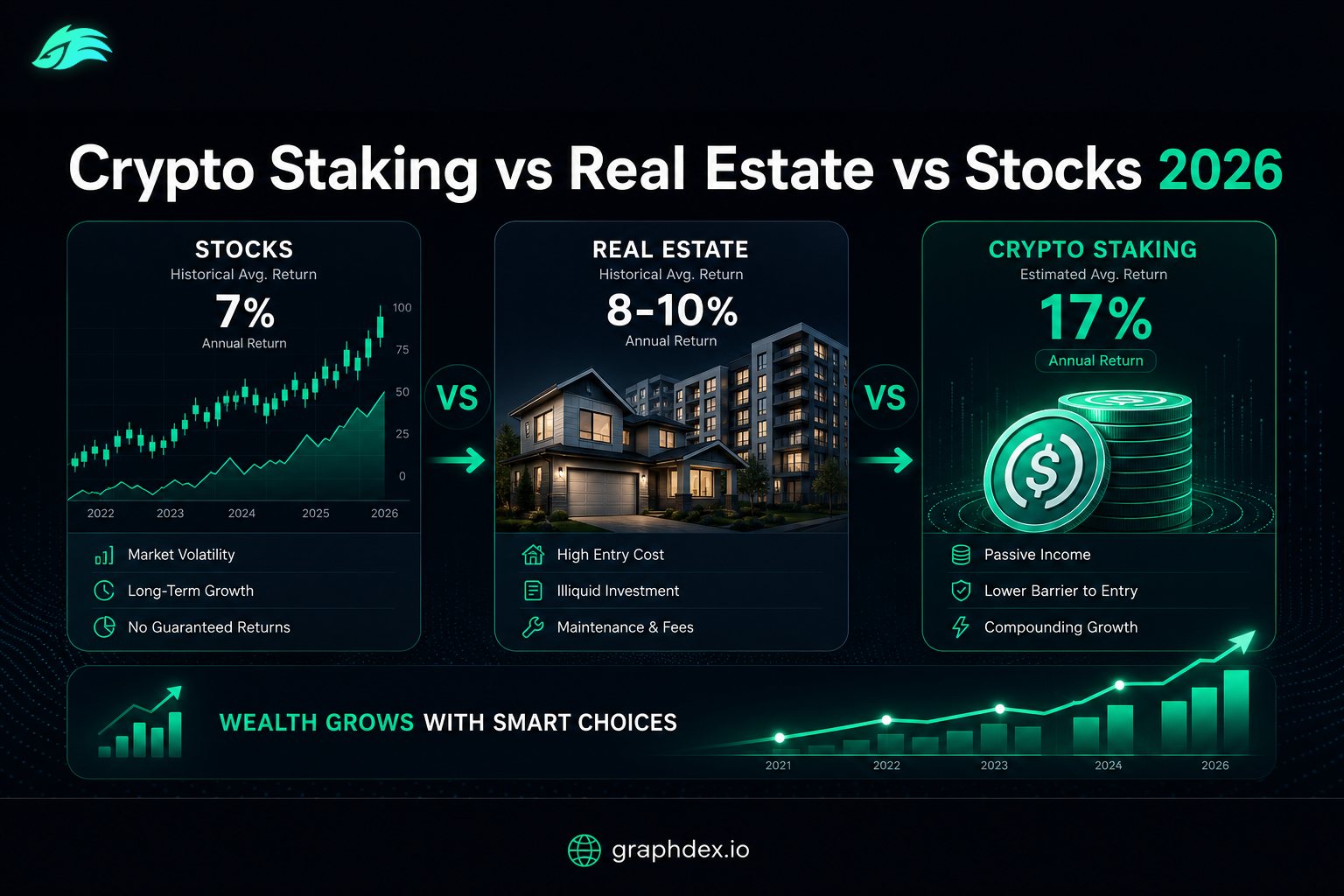
How the three compare in 2026:
- Stocks: ~7-10% average long-term return, high liquidity, market volatility
- Real estate: 5-12% rental yield plus appreciation, low liquidity, high capital and effort
- Crypto stablecoin staking: up to 17% yield, high liquidity, dollar-stable, platform risk
Stocks offer growth, real estate offers a tangible inflation hedge, and stablecoin staking offers the highest predictable yield. The best wealth-building approach usually combines them rather than choosing one.
Earn up to 17% with stablecoin staking on GraphDex
Key Takeaways
- Stocks, real estate, and crypto staking each build wealth differently — growth, tangible income, and high yield.
- Stocks average ~7-10% long-term; real estate 5-12% plus appreciation; stablecoin staking up to 17%.
- Real estate requires the most capital and effort; staking and stocks are far more accessible.
- Diversifying across all three balances growth, inflation protection, and high yield.
How Do These Three Build Wealth?
Each of these asset classes builds wealth through a different mechanism:
Stocks build wealth through capital appreciation (share prices rising) plus dividends. Over the long term, broad stock indices have averaged around 7-10% annually, though with significant year-to-year volatility.
Real estate builds wealth two ways: rental income (5-12% yield) and property appreciation over time. It's a tangible asset and a traditional inflation hedge, but requires substantial capital and ongoing effort.
Crypto stablecoin staking builds wealth through yield — up to 17% APY on dollar-pegged stablecoins. There's no appreciation (stablecoins stay at $1) but the yield is far higher and more predictable than the others, with dollar-stable principal.
Understanding these different mechanisms is key: stocks and real estate offer growth plus income, while stablecoin staking offers pure high yield without price exposure.
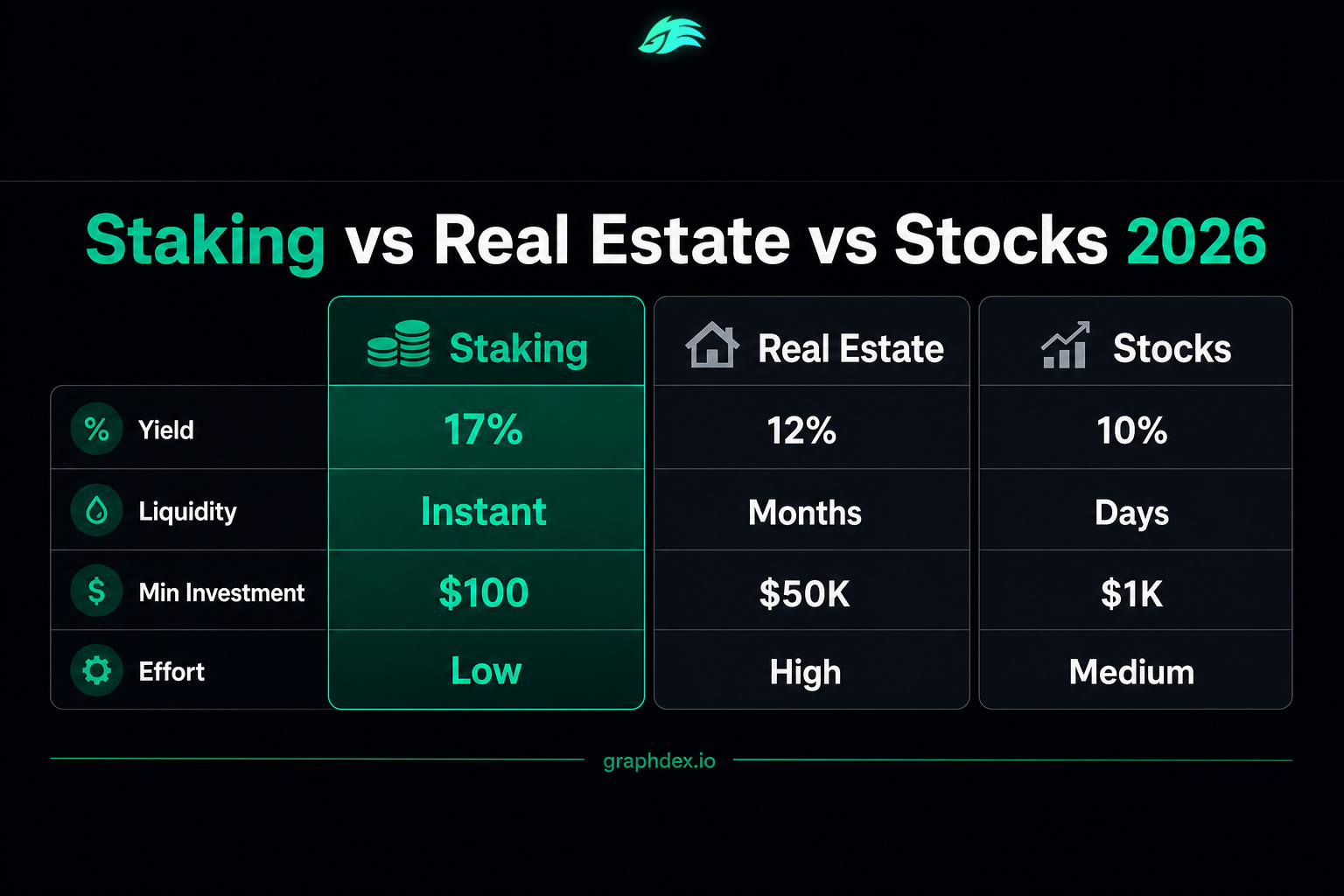
Crypto Staking vs Real Estate vs Stocks: Full Comparison
| Factor | Stocks | Real Estate | Stablecoin Staking |
|---|---|---|---|
| Typical return | 7-10% (long-term avg) | 5-12% + appreciation | Up to 17% |
| Return type | Growth + dividends | Rent + appreciation | Yield only |
| Volatility | High | Moderate | None (dollar-pegged) |
| Liquidity | High | Very low | Moderate-high |
| Capital needed | Low (1 share) | High | Low ($50+) |
| Effort | Low-moderate | High | Very low |
| Inflation hedge | Partial | Strong | Via high yield |
| Insured? | No (SIPC partial) | No | No |
Why Choose Stocks: Growth Plus Dividends
Stocks are the default wealth-building vehicle for most people, and for good reason.
Strengths:
- Strong long-term growth (~7-10% average for broad indices)
- High liquidity — buy and sell instantly
- Low barrier (price of one share, or fractional shares)
- Dividends provide income on top of growth
- Easy diversification via ETFs and index funds
Weaknesses:
- High short-term volatility — values can drop sharply
- Requires emotional discipline through downturns
- Returns not guaranteed; individual stocks can go to zero
Best for: Long-term wealth building where you can ride out volatility for growth. The foundation of most portfolios.
Real Estate: Tangible Income and Appreciation
Real estate has built more lasting wealth than perhaps any other asset class — but it demands the most.
Strengths:
- Rental income can outpace inflation
- Property appreciation over time
- Tangible asset you control
- Strong inflation hedge
- Leverage potential (mortgages amplify returns)
Weaknesses:
- High capital requirement (down payment, closing costs)
- Very low liquidity — selling takes months
- Ongoing effort: tenants, maintenance, management
- Property market and interest rate risk
- Concentration risk (one property is a large, undiversified bet)
Best for: Investors with substantial capital wanting a tangible inflation hedge and willing to handle (or pay for) management. REITs offer a liquid, low-effort alternative for real estate exposure.
Crypto Stablecoin Staking: The Highest Predictable Yield
The newest of the three, stablecoin staking has rapidly gained recognition as a legitimate wealth-building tool.
Strengths:
- Highest predictable yield (up to 17% on GraphDex)
- No price volatility — principal stays dollar-pegged
- Very low effort — deposit and earn
- Low barrier ($50+)
- High liquidity (with flexible terms)
- 24/7 access
Weaknesses:
- No appreciation (stablecoins stay at $1 — yield only)
- Not FDIC-insured
- Platform and smart contract risk
- Newer and less familiar than stocks or real estate
- Regulatory landscape still evolving
Best for: The portion of your portfolio where you want high, predictable yield without volatility, and can tolerate platform risk instead of insurance.
How does GraphDex pay up to 17% when banks pay 4-5%? The yield comes from platform trading fees rather than the thin margins banks pass through. The trade-off is platform risk instead of government insurance.
Learn how GraphDex staking works
Which Builds Wealth Faster?
The honest answer: it depends on time horizon, capital, and risk tolerance.
Over the long term (10+ years): Stocks and real estate have historically built the most wealth through compounding growth and appreciation, despite volatility. A diversified stock portfolio reinvesting dividends, or real estate with appreciation and leverage, can produce substantial long-term wealth.
For predictable, high current yield: Stablecoin staking at up to 17% produces more reliable annual income than the others, without volatility. It doesn't appreciate, but the high yield compounds steadily if reinvested.
The reality: these aren't mutually exclusive. The fastest wealth-building usually combines them:
- Stocks for long-term growth
- Real estate (or REITs) for tangible income and inflation protection
- Stablecoin staking for high, predictable yield on the cash portion
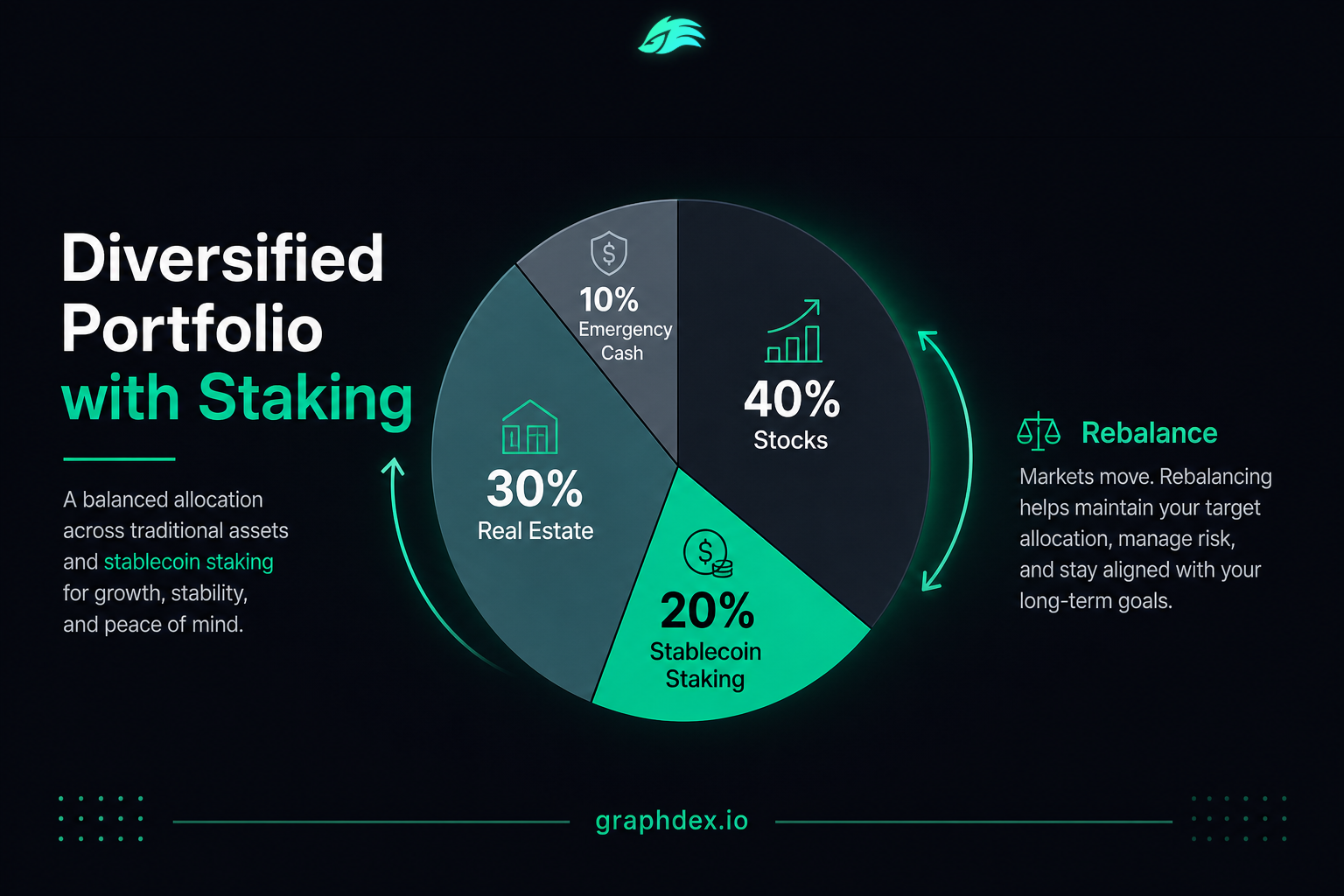
A $100,000 portfolio might allocate $50,000 to stocks, $30,000 to real estate exposure, and $20,000 to stablecoin staking — capturing growth, inflation protection, and high yield simultaneously. The staking portion alone, at up to 17%, could generate up to $3,400 a year versus about $900 if that $20,000 sat in a savings account.
Which One Matches Your Situation?
Choose stocks if: you're building long-term wealth, can tolerate volatility, and want growth plus liquidity.
Choose real estate if: you have substantial capital, want a tangible inflation hedge, and can handle management (or use REITs for a hands-off version).
Choose stablecoin staking if: you want the highest predictable yield without volatility, on capital that can tolerate platform risk for a portion of your portfolio.
Choose all three (recommended) if: you want a diversified portfolio that captures growth, inflation protection, and high yield — which describes most serious wealth-builders.
The goal isn't picking a winner. It's allocating each portion of your capital to the approach that fits its purpose, building wealth through multiple complementary engines.
Add high-yield staking to your portfolio with GraphDex
How to Combine All Three in a Portfolio
The most effective wealth-building strategy rarely relies on a single asset class. Combining stocks, real estate, and stablecoin staking captures the strengths of each while smoothing their individual weaknesses.
A growth-focused allocation (younger investors, long horizon) might weight stocks heavily for compounding growth, add REITs for real estate exposure, and keep a stablecoin staking allocation for high-yield cash that's ready to deploy into opportunities.
A balanced allocation (mid-career) might split more evenly — stocks for growth, direct real estate or REITs for tangible income and inflation protection, and a meaningful stablecoin staking position for steady high yield.
An income-focused allocation (near or in retirement) might emphasize dividend stocks, REITs, and stablecoin staking — all income-producing — while reducing volatile growth holdings. The up-to-17% staking yield is particularly valuable here for generating reliable cash flow.
The principle across all three profiles: each asset class does a job. Stocks compound growth over decades. Real estate provides tangible, inflation-resistant income. Stablecoin staking generates the highest predictable yield on the cash portion without volatility.
Rebalancing periodically — trimming what's grown and adding to what's lagged — keeps the allocation aligned with your goals. And reinvesting income from all three (dividends, rent, staking rewards) compounds wealth faster than spending it.
This is how serious wealth-builders think: not "which single asset is best," but "how do I combine complementary engines to build wealth through multiple paths at once." The stablecoin staking allocation, accessible and high-yielding, has become an increasingly common part of that mix.
Add the high-yield engine to your portfolio with GraphDex
Frequently Asked Questions
Is crypto staking better than stocks or real estate? Not universally — they serve different purposes. Stocks offer long-term growth (~7-10%), real estate offers tangible income plus appreciation, and stablecoin staking offers the highest predictable yield (up to 17%) without volatility. The best approach combines all three rather than choosing one.
Which has the highest return: staking, stocks, or real estate? Stablecoin staking offers the highest predictable annual yield (up to 17%), but no appreciation. Stocks (~7-10%) and real estate (5-12% plus appreciation) can build more total wealth long-term through growth. Highest current yield goes to staking; highest long-term growth potential to stocks and real estate.
Is crypto staking safer than real estate or stocks? Different risks. Stocks and real estate have price/market risk; stablecoin staking has no price volatility (dollar-pegged) but carries platform and smart contract risk, and isn't insured. Non-custodial stablecoin staking minimizes platform risk by keeping funds in your wallet.
Can I invest in all three at once? Yes — and most serious wealth-builders do. A diversified portfolio might combine stocks for growth, REITs or property for real estate exposure, and stablecoin staking for high yield. Diversification across all three balances their different strengths and risks.
How much money do I need to start? Stocks and stablecoin staking have low barriers (one share or $50). Real estate requires substantial capital for direct ownership, though REITs let you start with the price of one share. You can begin building all three with modest amounts and scale over time.
Why does crypto staking pay more than real estate or dividend stocks? Stablecoin staking yield (up to 17%) comes from platform fees or lending demand, passing through more than banks or the dividend yields of most stocks. The trade-off is platform risk and no appreciation, versus the growth potential of stocks and real estate.
Is stablecoin staking a good long-term investment? It's excellent for high, predictable yield on the cash portion of a portfolio, but it doesn't appreciate like stocks or real estate. For long-term wealth building, most investors combine staking's yield with the growth of stocks and real estate rather than relying on staking alone.
About This Guide
This guide is published by the GraphDex Research team — analysts building the infrastructure for digital asset trading on Solana. Our content is based on live platform data and current market figures.
Sources & data: Return figures reflect publicly available information as of 2026 and are estimates based on market conditions. All investments carry risk; returns are not guaranteed. Stablecoin staking is not FDIC-insured. This guide is educational and not financial advice — consult a financial advisor for your situation.
GraphDex is the infrastructure for digital asset trading — trade, predict, and earn in one place. Learn more at graphdex.io.
Last reviewed: May 2026 · GraphDex Research
The infrastructure for digital asset trading. Trade, predict, stake, repeat. graphdex.io