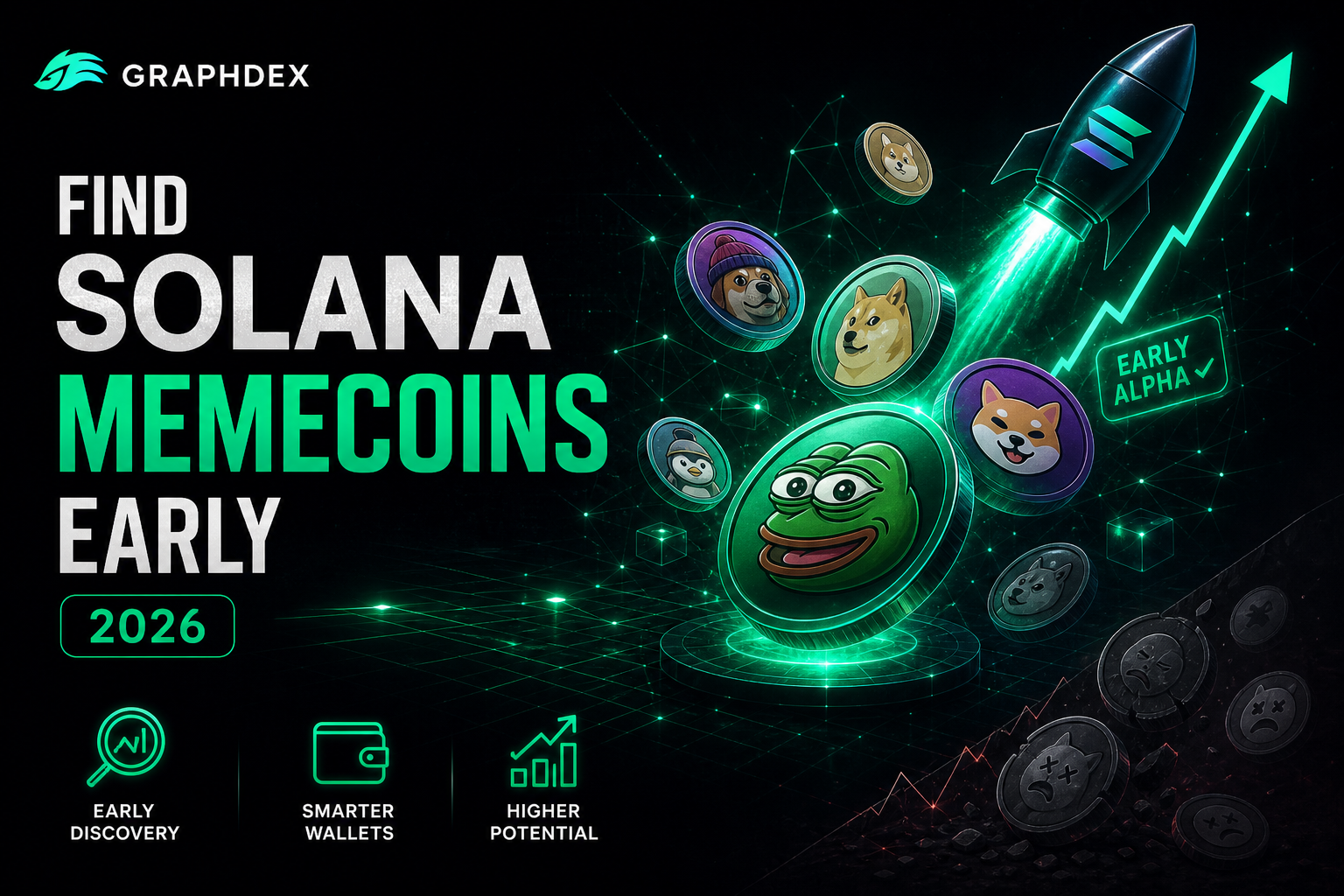
Quick Answer
To find Solana memecoins early in 2026:
- Monitor Pump.fun and launchpads for fresh launches at creation
- Use a real-time Pulse feed that surfaces tokens before aggregators index them
- Track smart money wallets that consistently enter early
- Verify holder distribution with Bubble Maps before buying
- Check the developer wallet history to avoid serial ruggers
The single biggest edge is speed: finding tokens at creation, not after they trend.
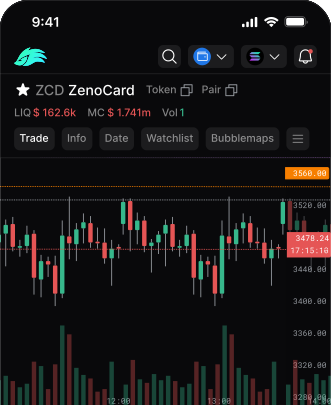
Find new Solana memecoins early with GraphDex Pulse feed
Key Takeaways
- Most Solana memecoins fail; edge comes from discovery at creation plus pre-trade verification.
- Combine launchpad monitoring, Pulse feeds, smart-money wallets, and Bubble Maps holder checks.
- Developer wallet history helps filter serial ruggers before you size a position.
- Speed from signal to execution matters more than any single standalone scanner.
Why Finding Memecoins Early Matters
The Solana memecoin ecosystem is the most chaotic and statistically brutal corner of crypto. Pump.fun lets anyone create a memecoin in under sixty seconds for about $2 in fees — no coding, no presale, no team allocation. The result: thousands of new tokens launch daily, most go to zero, and a tiny fraction generate life-changing returns.
The math is unforgiving. For every story of turning $50 into $50,000, there are a thousand quieter stories of tokens that rugged within minutes. The difference between the two outcomes usually comes down to two things: how early you found the token, and whether you checked its structure before buying.
Early discovery is the entire game. A token you find at creation is a different opportunity than the same token after it has 5x'd and hit Dexscreener's trending list. By then, the early buyers are looking for exits.
Understanding the Pump.fun Bonding Curve
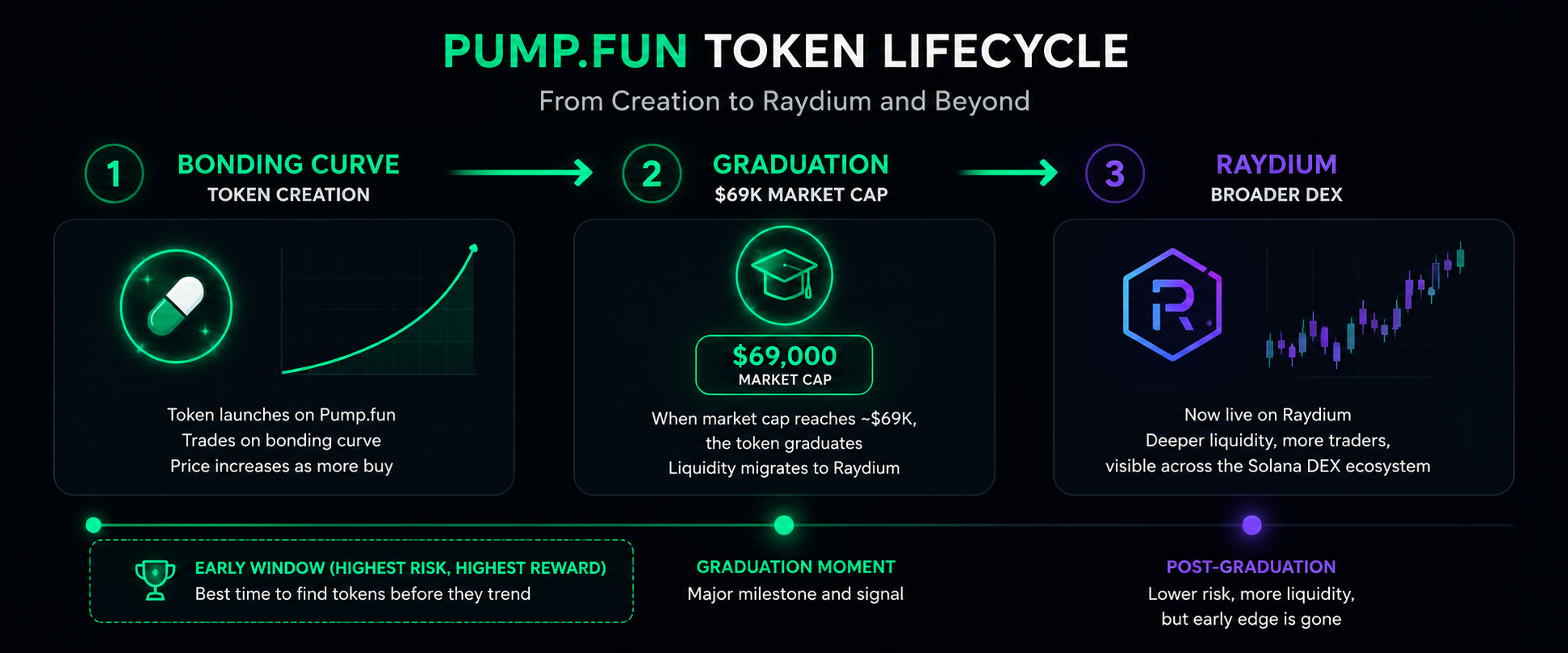
Most Solana memecoins launch on Pump.fun using a bonding curve model. Understanding it is essential to finding tokens early.
When a token launches, it trades on a bonding curve — the price increases automatically as more people buy. When the token reaches approximately $69,000 market cap, it "graduates": liquidity migrates to Raydium, and the token becomes tradeable on the broader Solana DEX ecosystem.
The key windows:
Pre-graduation (bonding curve): The earliest window. Highest risk, highest potential reward. Most tokens die here.
Graduation moment: When a token migrates to Raydium. This is a significant signal — it means enough buying pressure existed to push through the curve. Many traders watch for graduations specifically.
Post-graduation: The token is on Raydium with deeper liquidity. Lower risk than the bonding curve, but you have missed the earliest entry.
Finding memecoins early means catching them on the bonding curve or at graduation — before they trend.
Method 1: Real-Time Token Discovery (Pulse Feed)
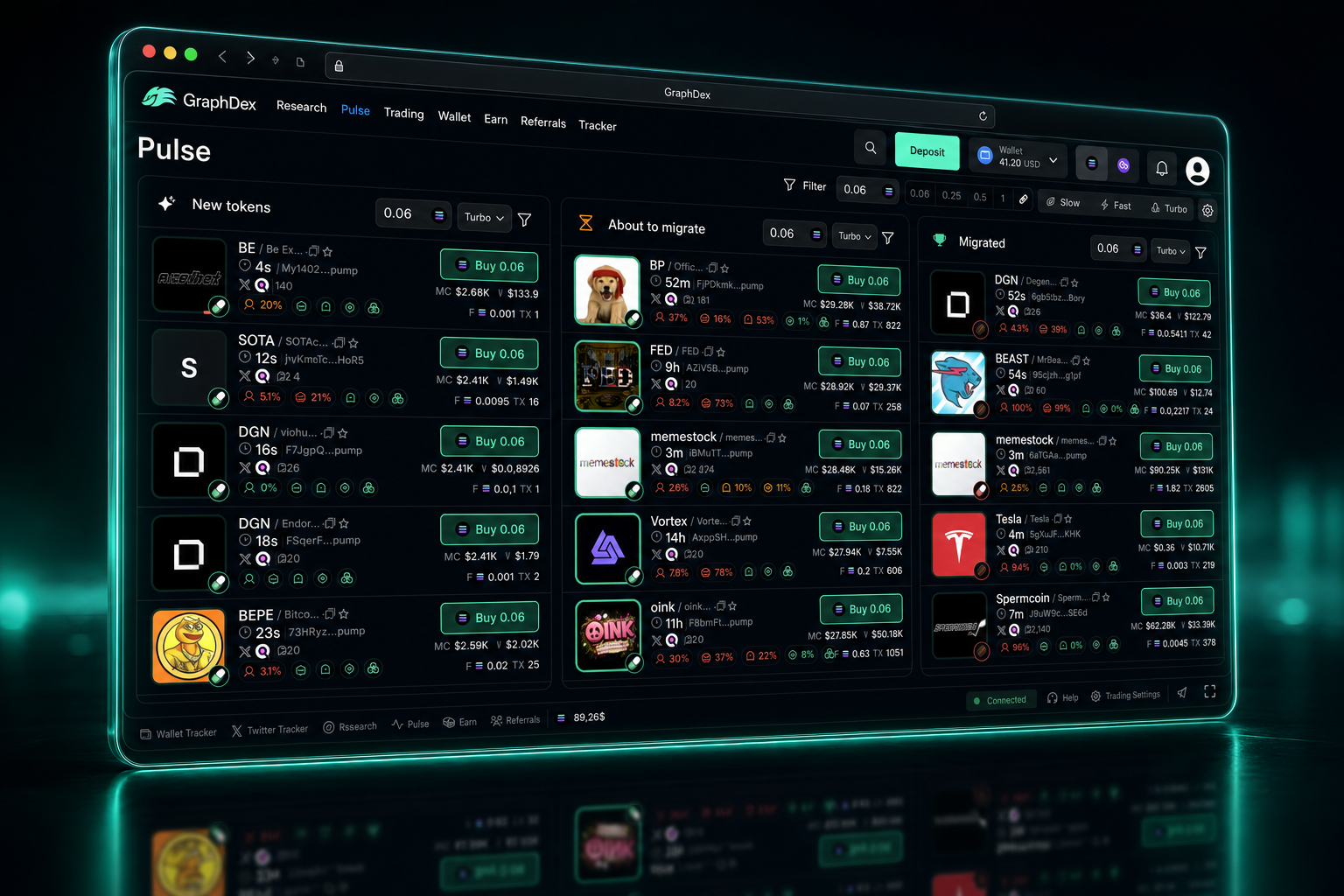
The most direct way to find Solana memecoins early is a real-time discovery feed that surfaces tokens the moment they appear on-chain.
Most traders watch Pump.fun for fresh launches, then confirm momentum on Dexscreener and Birdeye. The problem: by the time a token appears on Dexscreener's hot list, the earliest window has closed.
A Pulse feed solves this by monitoring the blockchain directly. GraphDex's Pulse feed surfaces newly created tokens the moment liquidity is added — before Dexscreener, before Birdeye, before the trending pages. You see the token at creation, not after it trends.
How to use a Pulse feed effectively:
- Filter by minimum liquidity to avoid tokens too thin to trade
- Check holder concentration immediately
- Look for developer wallet flags
- Cross-reference with social signals and wallet activity
Access real-time Solana token discovery on GraphDex
Method 2: Smart Money Wallet Tracking
Instead of scanning every new launch, follow wallets with proven track records and enter when they do.
The best memecoin traders consistently appear among the early buyers of tokens that later run. Their wallets are public on-chain. If you track them, you see their entries in real time.
How to identify smart money wallets:
- Consistent early entries across multiple winning tokens over months
- Profitable exit behavior, not just early entries
- Diverse successful positions, not one lucky trade
- Entry timing in the first minutes to hours of a token's life
Using wallet tracking on GraphDex: Add any Solana wallet to a watchlist and receive alerts when it makes significant trades. When a tracked smart money wallet buys a new memecoin, you see it immediately — in the same interface where you can execute your own entry.
The strongest signal is confluence: a token appearing in the Pulse feed at the same time a tracked wallet buys it. Both signals in one interface, on GraphDex, without switching tools.
Method 3: Social Signal Monitoring
Memecoins run on attention. The product is virality — absurd humor, internet culture, community momentum. Social signals on Twitter often precede price movement.
What to watch:
- Sudden spikes in mentions of a specific token
- KOLs with track records of early calls starting to post
- Narrative formation around a new meta (AI memecoins, specific themes)
- Community growth velocity on Telegram and Discord
GraphDex's Twitter monitoring surfaces tokens gaining genuine organic momentum, filtered from bot activity and coordinated shilling. Running alongside the Pulse feed, it lets you see social and on-chain signals together.
Method 4: Verify Before You Buy (Bubble Maps)
Finding a memecoin early is only half the job. The other half is not buying a rug.
Before entering any memecoin, check its holder structure. Tokens where a few wallets control most of the supply are structured for coordinated dumps — the insiders sell into your buy.
What to check with Bubble Maps:
- Holder concentration: Is supply spread across many wallets or held by a few?
- Wallet clustering: Do groups of wallets move together, suggesting one entity controls many?
- Developer holdings: How much does the deployer wallet hold?
GraphDex integrates Bubble Maps directly. When you find a token on the Pulse feed, you check its holder distribution without leaving the terminal.
Verify the contract address. Always verify contract addresses before buying on DEXs to avoid scam tokens. Scam tokens copy the name and ticker of legitimate projects with different contract addresses.
Method 5: Check Developer Wallet History
Developers who have previously launched tokens that were abandoned or rugged are statistically likely to repeat. Before buying, check the developer's track record.
GraphDex surfaces developer wallet migration rates and history alongside new token discoveries. A developer with a history of successful graduations is a different risk profile than one with a string of dead tokens.
The Tools Most Solana Traders Use (and Why One Is Better)
| Tool | What it does | Speed |
|---|---|---|
| Pump.fun | See launches on the launchpad | Fast |
| Dexscreener | Track trending tokens | Slow — after trending |
| Birdeye | Token analytics | Slow — after indexing |
| Photon | Fast execution + discovery | Fast |
| BullX | Multi-chain execution | Fast |
| GraphDex | Pulse + wallet + social + Bubble Maps + execution | Fastest — all in one |
The problem with using separate tools is delay. Watching Pump.fun in one tab, Dexscreener in another, a wallet tracker in a third — every switch costs time. On memecoins where the early window is minutes, that delay is the difference between early and late.
GraphDex consolidates discovery, wallet tracking, social signals, holder analysis, and execution into one interface. Signal to execution without switching tabs.
Trade Solana memecoins faster with GraphDex
The Solana Launchpad Landscape in 2026
While Pump.fun dominates, several launchpads compete:
Pump.fun — the dominant launchpad, ~57% market share, bonding curve to Raydium graduation at $69K market cap.
LetsBONK.fun — built by the BONK community with Raydium. In its first three days it generated over $800K in fees and launched more than 2,700 tokens, with liquidity integration on Raydium and Jupiter.
Others — various smaller launchpads competing on fees, features, and ecosystem reinvestment.
GraphDex's Pulse feed monitors token creation across the Solana ecosystem, not just one launchpad — so you see new tokens regardless of where they launch.
Building Your Memecoin Discovery Workflow
The traders who consistently find Solana memecoins early do not rely on one method. They build a workflow combining all of them.
Morning setup: Review your wallet watchlist for overnight activity. Smart money often positions in new tokens during low-activity hours. Check which tracked wallets made new entries.
Active monitoring: Keep the Pulse feed running throughout your trading session. New tokens appear constantly — the feed surfaces them at creation. Set liquidity filters to cut noise.
Signal confluence: When a token appears on the Pulse feed, immediately check three things: is a tracked wallet buying it, is there social momentum forming, and what does the holder distribution look like? When all three align, you have a high-conviction early entry.
Rapid verification: Before buying, run the thirty-second check — holder concentration via Bubble Maps, developer wallet history, contract address verification. This routine prevents most rug losses.
Execution: Enter with a predetermined position size and exit plan. In memecoins, the discipline of the exit matters more than the precision of the entry.
The entire workflow runs inside GraphDex without switching tools. The Pulse feed, wallet tracking, social signals, Bubble Maps, and execution share one interface — which is what makes the confluence approach practical rather than theoretical.
Build your memecoin workflow on GraphDex
Common Mistakes When Finding Solana Memecoins
Buying after the token trends By the time a token hits Dexscreener trending, the early window has closed. Use real-time discovery to find tokens before they trend.
Skipping the holder check High holder concentration predicts coordinated dumps. The Bubble Maps check takes thirty seconds and prevents many losses.
Ignoring developer history Serial ruggers repeat. Check the deployer wallet before buying.
Not verifying contract addresses Scam tokens impersonate legitimate ones. Always verify the contract from official sources.
Using too many separate tools Every tab switch is delay. Delay is cost. Consolidate to one terminal.
Confusing early with safe Finding a token early improves your entry price. It does not make the token safe. Position sizing and exit discipline still determine outcomes.
A Realistic Approach to Memecoin Trading
Memecoins are the highest-risk corner of crypto. Most go to zero. A realistic approach:
- Only risk what you can afford to lose entirely
- Find tokens early using real-time discovery
- Always verify holder structure and contract address
- Set exit targets before entering
- Take profits on the way up — do not wait for the top
- Treat it as high-risk speculation, not investment
The tools in this guide improve your edge. They do not eliminate the risk. Memecoin trading is statistically brutal even with the best tools.
Frequently Asked Questions
How do I find Solana memecoins before they pump? Use a real-time Pulse feed that surfaces tokens at creation, before aggregators like Dexscreener index them. Combine it with smart money wallet tracking and social signal monitoring. GraphDex integrates all three in one terminal.
What is the best tool to find new Solana memecoins in 2026? The fastest tools surface tokens at on-chain creation rather than after they trend. GraphDex's Pulse feed monitors token creation across the Solana ecosystem and combines it with wallet tracking, Bubble Maps, and execution in one interface.
What is the Pump.fun bonding curve? Pump.fun tokens launch on a bonding curve where price rises automatically as people buy. At approximately $69,000 market cap, the token graduates and liquidity migrates to Raydium. Finding tokens early means catching them on the curve or at graduation.
How do I avoid memecoin rugs on Solana? Check holder concentration with Bubble Maps, verify the developer wallet history, confirm the contract address from official sources, and avoid tokens where a few wallets control most of the supply. GraphDex integrates these checks into the terminal.
What is the difference between finding a token early and safely? Finding a token early improves your entry price. It does not make the token safe. Even early entries can be rugs. Always verify holder structure and developer history regardless of how early you find a token.
Which launchpads should I monitor for new Solana memecoins? Pump.fun dominates with around 57% market share, but LetsBONK.fun and others also launch tokens. GraphDex's Pulse feed monitors token creation across the ecosystem rather than a single launchpad.
The infrastructure for digital asset trading. Trade, predict, stake, repeat. graphdex.io