By GraphDex Research · Reviewed for accuracy May 2026
Quick Answer
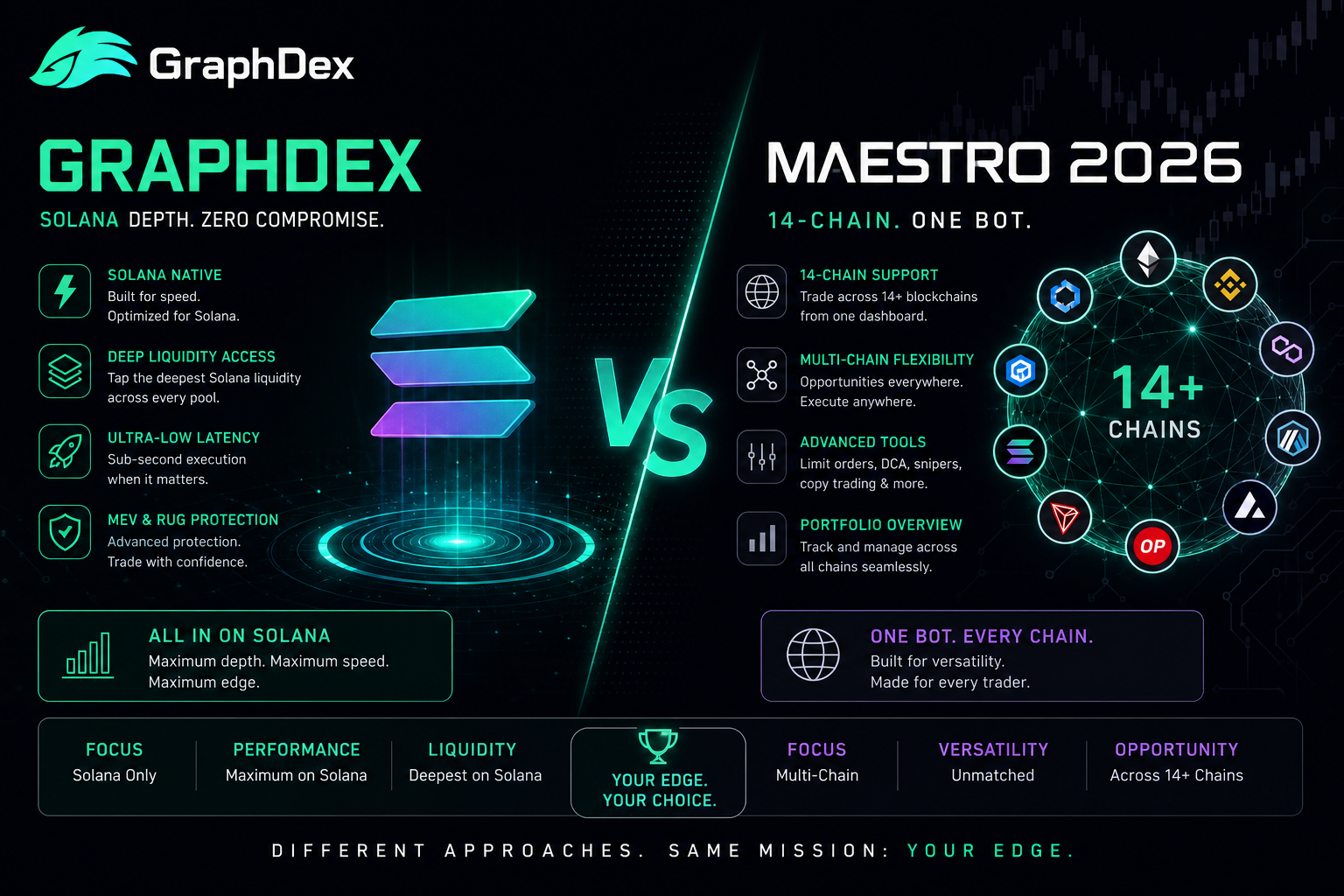
GraphDex and Maestro take different approaches:
- Maestro is the most multi-chain trading bot — covering 14 chains (ETH, BNB, SOL, Base, ARB, and more), with patented anti-rug protection and advanced copytrading. Telegram-only, with a monthly subscription on top of per-trade fees. Best for traders who need broad chain coverage.
- GraphDex is a Solana-focused integrated terminal — DEX trading plus prediction market copytrading, AI signals, and staking up to 17% APY. Best for Solana traders who want prediction markets and earning.
Maestro's strength is unmatched chain breadth and anti-rug protection; GraphDex's is Solana depth with prediction markets and staking. The choice depends on whether you need many chains or an integrated Solana terminal.
Try GraphDex's integrated terminal
Key Takeaways
- Maestro covers 14 chains — the broadest multi-chain reach of any major trading bot.
- GraphDex is Solana-focused with prediction market copytrading and staking up to 17%.
- Maestro is Telegram-only with a monthly subscription on top of per-trade fees.
- The choice depends on whether you need broad chain coverage or an integrated Solana terminal.
GraphDex vs Maestro: At a Glance
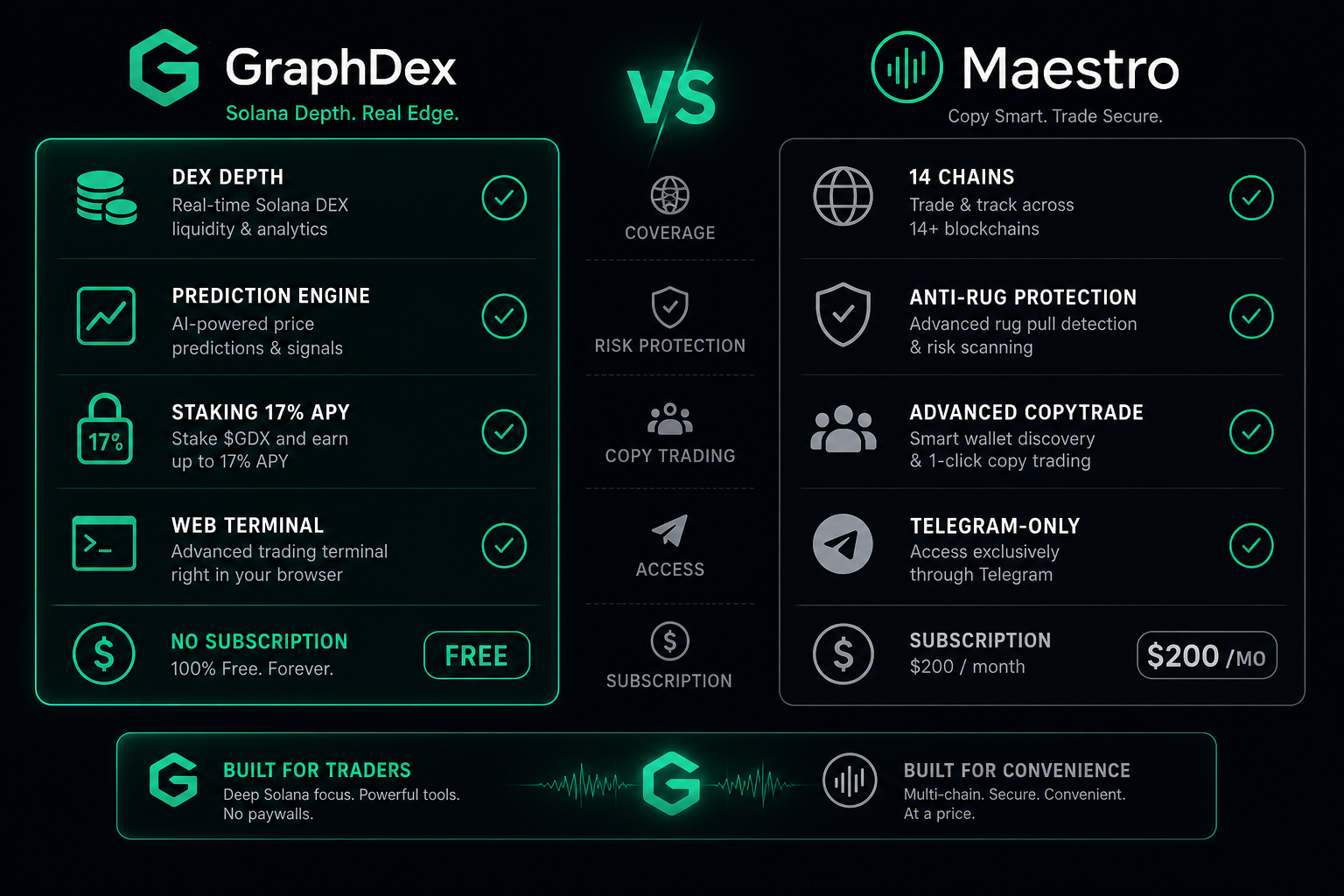
| Feature | GraphDex | Maestro |
|---|---|---|
| Type | Integrated terminal | Multi-chain Telegram bot |
| Interface | Web terminal | Telegram only |
| Chains | Solana focus | 14 chains |
| Anti-rug protection | Bubble Maps | Patented anti-rug |
| Copytrading | Yes | Yes (advanced) |
| Prediction markets | Yes | No |
| Staking | Yes (up to 17%) | No |
| Web terminal | Yes | No |
| Fees | Standard | 1% + monthly subscription |
| Best for | Integrated Solana workflow | Broad chain coverage |
What Is Maestro?
Maestro is one of the longest-running and most multi-chain trading bots in crypto. It covers more chains than any other major trading bot — 14 in total, including ETH, BNB, SOL, Base, ARB, AVAX, TON, Hyperliquid, Plasma, Monad, Sonic, TRON, Metis, and Linea. For traders who need chain breadth, nothing else matches it.
Maestro's standout features are its patented anti-rug protection and advanced copytrading setup. The anti-rug system aims to protect traders from malicious tokens, while its copytrading is among the more sophisticated available. At roughly $12.8 billion in lifetime volume and 573,000 users, Maestro is a well-established, widely-used platform.
Maestro has two notable constraints. First, it's Telegram-only — there's no web terminal, which limits the analytical depth available during live trading. Second, on cost: Maestro charges a monthly subscription on top of per-trade fees. Advanced copytrading (following up to 10 wallets rather than the free tier's three) requires a Premium subscription at roughly $200 per month — meaning it's the rare bot that bills you before you place a single order. For traders who don't generate high volume, this subscription changes the economics sharply.
What Is GraphDex?
GraphDex is the infrastructure for digital asset trading — a Solana-focused terminal combining DEX trading, prediction markets, and earning in one place. Where Maestro spreads across 14 chains via Telegram, GraphDex goes deep on Solana with a full web terminal.
GraphDex offers Solana DEX trading with MEV protection, the Pulse feed for token discovery, wallet tracking, AI signals, Bubble Maps (for spotting rug risk), copytrading, and — unlike Maestro — prediction market copytrading (follow top Polymarket forecasters) and staking up to 17% APY. Its ambassador program pays up to 65% revenue share, and there's no subscription fee.
GraphDex uses non-custodial Privy architecture with no seed phrase. Rather than maximizing chain coverage, it offers Solana depth plus prediction markets and earning in one web terminal, with no upfront subscription.
The Core Difference: Chain Breadth vs Solana Depth
This comparison centers on a clear strategic choice: maximum chain coverage versus deep Solana integration.
Maestro maximizes chain breadth. Its 14-chain coverage is unmatched — if you trade across Ethereum, BNB, Arbitrum, TON, and obscure chains others don't support, Maestro lets you do it all from one Telegram bot. For genuinely multi-chain traders, this breadth is its core value.
GraphDex maximizes Solana depth. Rather than spreading across many chains, GraphDex goes deep on Solana — the chain with near-zero fees and sub-second finality ideal for active trading — and adds prediction markets and staking. For Solana-focused traders, this depth and integration outweigh chain breadth.
The question is where your trading happens. If you genuinely trade across many chains, Maestro's breadth serves that. But many traders concentrate on Solana, where the speed and low fees make it the premier chain for active trading. For them, 14-chain coverage adds little, while GraphDex's Solana depth plus prediction markets, staking, and a web terminal (without a subscription) adds real value.
Where Maestro Wins
Maestro has genuine strengths worth acknowledging:
Unmatched chain coverage. Maestro's 14 chains are the broadest of any major trading bot. For traders active across Ethereum, BNB, Arbitrum, TON, and chains others don't support, nothing matches its reach.
Patented anti-rug protection. Maestro's anti-rug system is a notable, distinctive safety feature designed to protect traders from malicious tokens.
Advanced copytrading. Maestro's copytrading setup is among the more sophisticated available, with the ability to follow multiple wallets (on Premium).
Established track record. With $12.8B in volume and 573,000 users over a long history, Maestro is proven and widely trusted.
For traders who need broad chain coverage and advanced anti-rug protection across many ecosystems, Maestro's breadth is a real strength.
Where GraphDex Wins
GraphDex's advantages show for Solana-focused traders who want more than a multi-chain bot:
Prediction markets integrated. Maestro offers no prediction market features. GraphDex lets you trade Solana tokens and copytrade Polymarket forecasters in one place.
Staking on idle capital. GraphDex's up to 17% APY means capital earns between trades. Maestro offers nothing here.
No subscription. Maestro charges a monthly subscription (up to ~$200 for advanced copytrading) on top of per-trade fees. GraphDex has no subscription — you pay standard fees and earn up to 65% revenue share.
Full web terminal. Maestro is Telegram-only with limited analytical depth. GraphDex offers a complete web terminal with charting, AI signals, and Bubble Maps.
Complete Solana workflow. Instead of a multi-chain bot plus separate prediction market and staking tools, GraphDex consolidates everything Solana-focused in one interface.
For Solana-focused traders who want prediction markets, staking, and a web terminal without a subscription, GraphDex's depth is the advantage.
See GraphDex's integrated approach
Which Should You Choose?
Choose Maestro if:
- You trade across many chains (14 supported)
- You need chains other bots don't support (TON, Hyperliquid, Metis, etc.)
- You value patented anti-rug protection across ecosystems
- You're comfortable with Telegram-only and a monthly subscription
Choose GraphDex if:
- You're Solana-focused and want depth over chain breadth
- You want prediction market copytrading alongside token trading
- You want idle capital earning up to 17% APY
- You prefer no subscription and a full web terminal
- You want an integrated terminal over a multi-chain Telegram bot
The deciding question: Do you need maximum chain coverage, or deep Solana integration with prediction markets and staking? Maestro optimizes for 14-chain breadth via Telegram; GraphDex optimizes for a complete Solana workflow with a web terminal and no subscription.
Some traders use both — Maestro for multi-chain trading on obscure chains, GraphDex for Solana trading, prediction markets, and staking.
The Subscription Question
One notable difference deserves attention: Maestro's subscription model versus GraphDex's no-subscription approach.
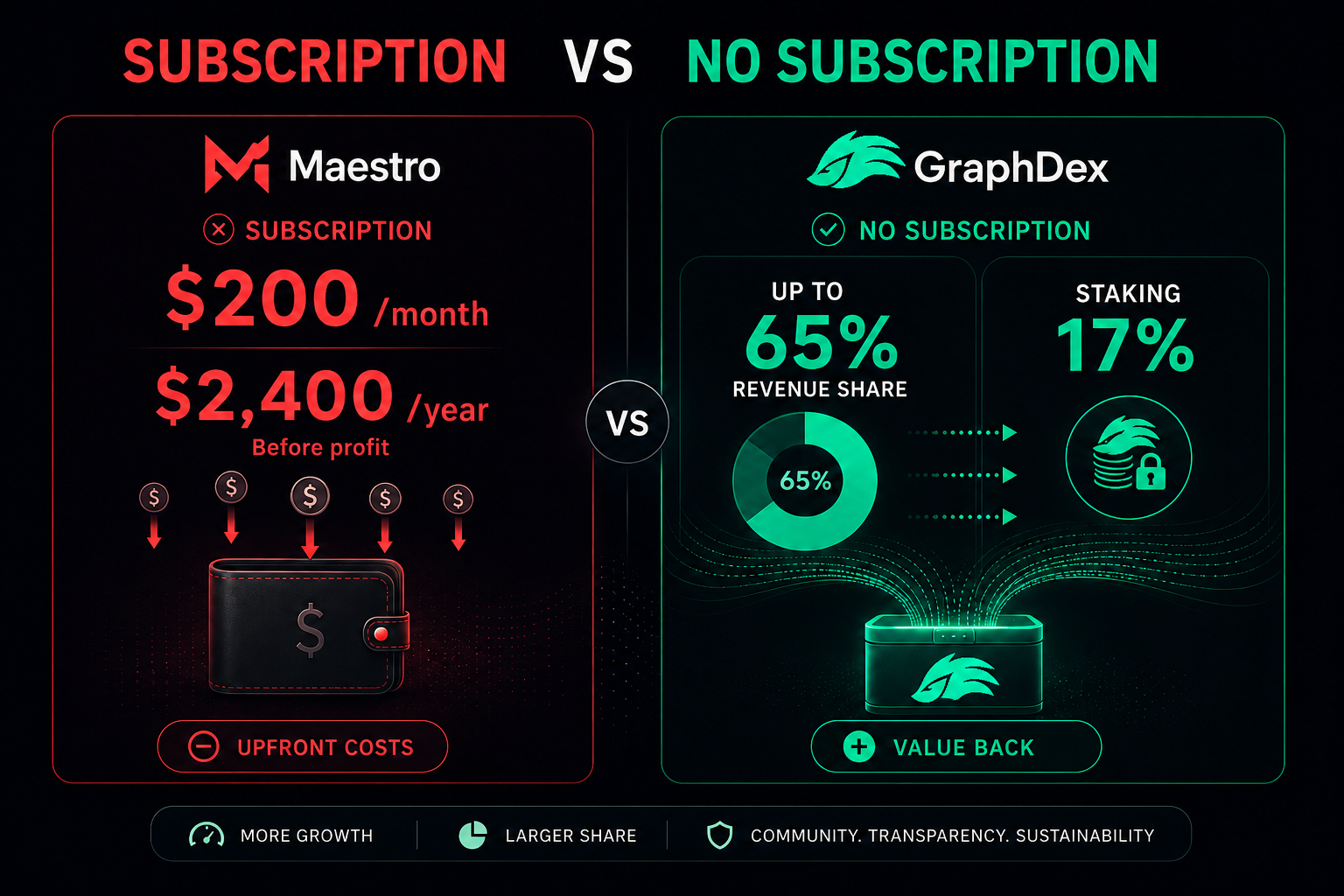
Maestro is the rare trading bot that bills you before you place a single order. Its advanced copytrading — following up to 10 wallets instead of the free tier's three — requires a Premium subscription at roughly $200 per month. For high-volume traders generating significant fees, this cost may be justified by the chain breadth and features. But for traders who don't generate high volume, a $200 monthly subscription changes the economics sharply: you're paying $2,400 a year before any trading profit.
GraphDex takes a different approach with no subscription. You pay standard per-trade platform fees, and active users can earn back value through up to 65% revenue share. Combined with staking (up to 17% APY) on idle capital, the model returns value to users rather than charging upfront.
For traders weighing the two, the subscription question matters most if you're not high-volume. Maestro's subscription suits traders who need its specific chain breadth and trade enough to justify the cost. GraphDex's no-subscription model suits traders who want to avoid upfront costs and prefer earning revenue share — particularly Solana-focused traders who don't need 14-chain coverage.
Trade with no subscription on GraphDex
Frequently Asked Questions
Is GraphDex or Maestro better for trading? Maestro is better for multi-chain trading across 14 chains with patented anti-rug protection. GraphDex is better for Solana-focused trading with prediction markets, copytrading, and staking up to 17%, plus a web terminal and no subscription. The choice depends on whether you need chain breadth or Solana depth.
Does Maestro offer prediction markets or staking? No. Maestro is a multi-chain trading bot focused on token trading, anti-rug protection, and copytrading, with no prediction markets or staking. GraphDex integrates both — Polymarket prediction market copytrading and staking up to 17% APY — alongside Solana DEX trading.
How many chains does Maestro support versus GraphDex? Maestro supports 14 chains (ETH, BNB, SOL, Base, ARB, AVAX, TON, and more) — the broadest of any major bot. GraphDex focuses on Solana plus Polymarket (on Polygon) for prediction markets. If you need many chains, Maestro leads; for Solana depth with prediction markets, GraphDex fits.
Does Maestro charge a subscription? Yes. Maestro charges a monthly subscription on top of per-trade fees. Advanced copytrading (up to 10 wallets vs the free tier's three) requires Premium at roughly $200 per month — making it the rare bot that bills you before you trade. GraphDex has no subscription, charging standard fees with up to 65% revenue share.
Does Maestro have a web terminal? No. Maestro is Telegram-only, which limits analytical depth during live trading. GraphDex offers a full web terminal with charting, wallet tracking, AI signals, and Bubble Maps. For analysis-driven trading, GraphDex provides far more depth.
Is Maestro's anti-rug protection better than GraphDex's? Maestro has a patented anti-rug protection system across its 14 chains. GraphDex offers Bubble Maps for spotting rug risk through holder distribution analysis on Solana. Both help protect against malicious tokens; Maestro's is a dedicated patented system, GraphDex's is integrated visual analysis.
Is GraphDex a good Maestro alternative? Yes, especially for Solana-focused traders who want prediction markets, staking, and no subscription. GraphDex provides Solana DEX trading, copytrading, and rug protection, plus prediction markets and staking up to 17%, without Maestro's monthly subscription. Maestro remains strong for broad multi-chain coverage.
About This Guide
This guide is published by the GraphDex Research team — analysts and traders building the infrastructure for digital asset trading on Solana. Our content is based on live platform data, current market figures, and hands-on experience with the platforms covered.
Sources & data: Platform features, fees, and details reflect publicly available information as of 2026 and may change as platforms update. Trading carries risk. This guide is educational and not financial advice.
GraphDex is the infrastructure for digital asset trading — trade, predict, and earn in one place. Learn more at graphdex.io.
Last reviewed: May 2026 · GraphDex Research
The infrastructure for digital asset trading. Trade, predict, stake, repeat. graphdex.io