By GraphDex Research · Reviewed for accuracy May 2026
Quick Answer
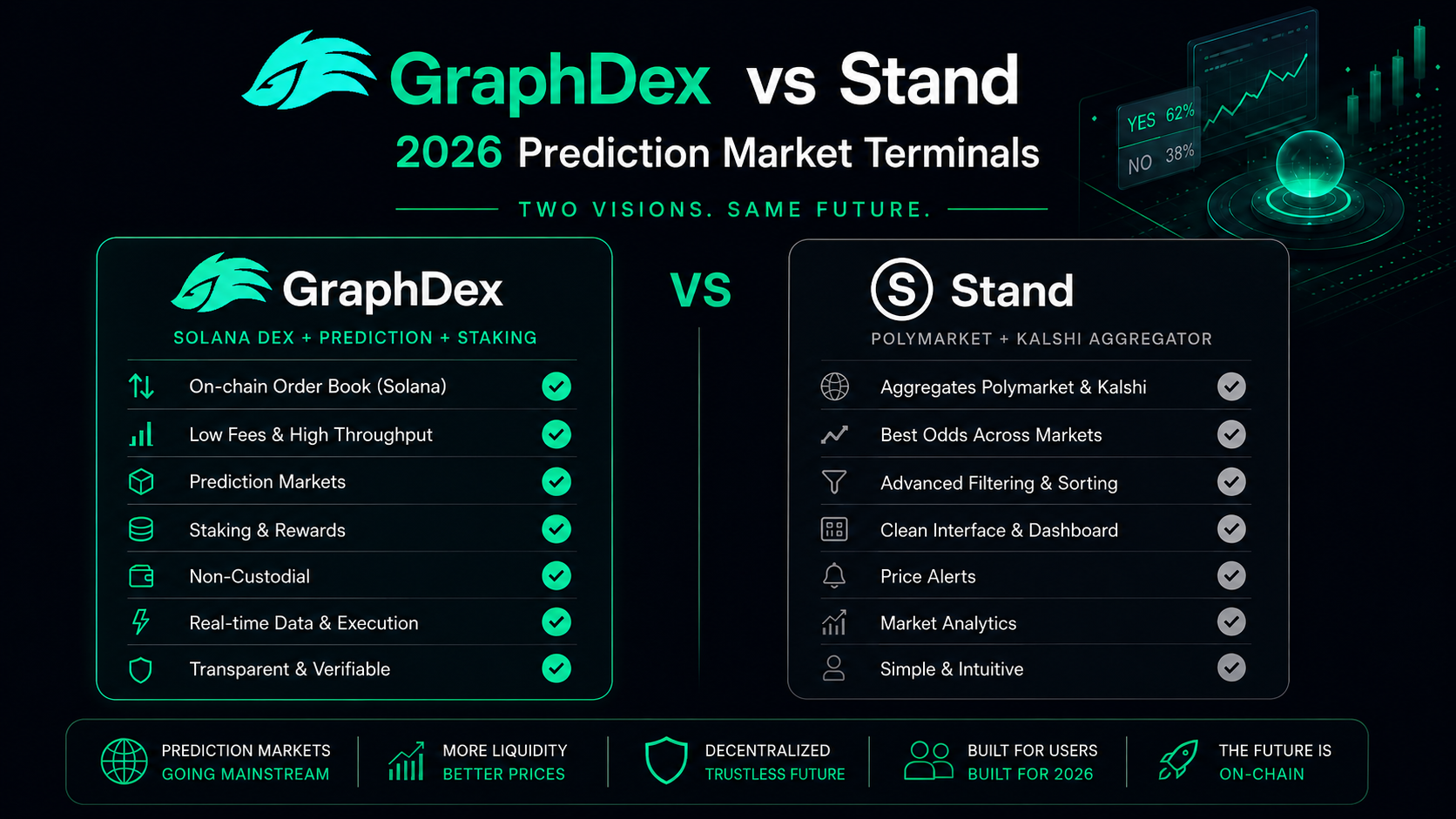
GraphDex and Stand serve overlapping but different needs:
- Stand is a dedicated prediction market terminal — aggregating Polymarket and Kalshi with copytrading, whale alerts, and up to 8 order books on one screen. Best for prediction market specialists.
- GraphDex integrates prediction market copytrading with a full Solana DEX terminal — combining prediction markets with token trading, discovery, and staking. Best for crypto-native traders who do both.
If you trade only prediction markets across Polymarket and Kalshi, Stand's multi-venue focus fits. If you want prediction markets integrated with Solana trading in one place, GraphDex fits.
Try GraphDex's integrated terminal
Key Takeaways
- Stand is a dedicated prediction market terminal aggregating Polymarket and Kalshi with copytrading.
- GraphDex integrates prediction market copytrading with full Solana DEX trading and staking.
- Stand's strength is multi-venue prediction focus; GraphDex's is crypto-native integration.
- The right choice depends on whether you trade only predictions or crypto more broadly.
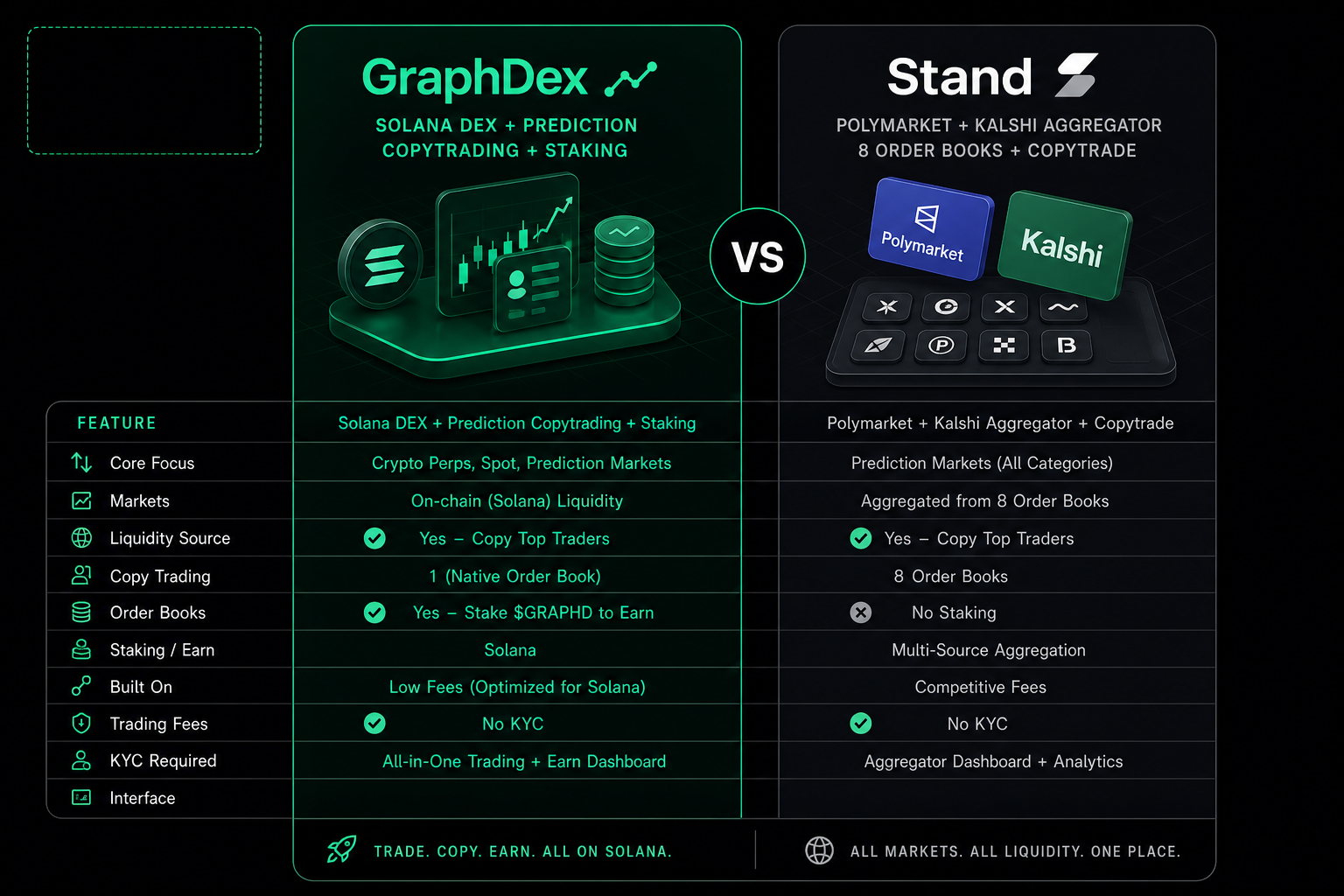
GraphDex vs Stand: At a Glance
| Feature | GraphDex | Stand |
|---|---|---|
| Type | Integrated crypto terminal | Prediction market terminal |
| Prediction copytrading | Yes | Yes |
| Whale tracking | Yes | Yes |
| Solana DEX trading | Yes | No |
| Token discovery | Yes (Pulse feed) | No |
| Staking | Yes (up to 17%) | No |
| Multi-venue (Poly + Kalshi) | Polymarket focus | Polymarket + Kalshi |
| Order books on one screen | Integrated | Up to 8 |
| Custody | Non-custodial (Privy) | Non-custodial |
| Best for | Crypto-native traders | Prediction specialists |
What Is Stand?
Stand is a prediction market aggregator and advanced trading terminal built for professionals. It pulls markets from multiple event venues — primarily Polymarket and Kalshi — into one trade-first interface, so you can discover, triage, and execute faster than jumping between sites.
Stand's standout features include copytrading (automatically follow and mirror top Polymarket wallets with live fills), whale alerts (lightning-fast notifications when traders make high-conviction moves), and the ability to trade up to 8 order books at once on one screen. Its "Octobox" dashboard consolidates positions across Polymarket and Kalshi with PnL tracking and CSV export for taxes.
Stand is widely regarded as one of the strongest dedicated prediction market terminals, particularly for traders who actively trade across both Polymarket and Kalshi. It operates a free tier and a Pro tier (Pro pricing not publicly disclosed as of early 2026), and is still maturing — some users report bugs and missing documentation in its beta state.
What Is GraphDex?
GraphDex is the infrastructure for digital asset trading — a Solana-focused terminal that combines DEX trading, prediction markets, and earning in one place. Rather than being a prediction-only tool, it integrates prediction market copytrading (following top forecasters by PnL and win rate) with a full suite of Solana trading features.
These include DEX trading across Solana pairs, the Pulse feed for real-time token discovery, wallet tracking, AI signal analysis, Bubble Maps, and staking up to 17% APY. Prediction markets are one integrated feature within a complete trading terminal, not the whole product.
GraphDex uses non-custodial Privy architecture — your funds stay in your wallet, with no seed phrase required. This makes it suited to crypto-native traders who treat prediction markets as part of a broader Solana trading strategy.
Feature-by-Feature Comparison
Prediction Market Copytrading
Both offer it. Stand lets you automatically follow and mirror top Polymarket wallets with live fills and position tracking. GraphDex lets you follow top forecasters ranked by PnL and win rate and mirror their positions.
This is core to both platforms. Stand's is purely prediction-focused across Polymarket and Kalshi; GraphDex's sits within a broader terminal that also handles Solana trading.
Whale Tracking
Both offer it. Stand provides real-time trade feeds and whale alerts, letting you spot smart money before the crowd. GraphDex integrates whale tracking with its broader on-chain analytics. Both surface large, high-conviction moves.
Multi-Venue Aggregation
Stand leads here. Stand aggregates both Polymarket and Kalshi into one interface, with a single search bar across both and a calendar of events. If you actively trade both venues, Stand's aggregation is a genuine advantage.
GraphDex focuses on Polymarket integration within its Solana terminal rather than aggregating Kalshi.
Solana DEX Trading
GraphDex leads here — Stand doesn't offer it. This is the core differentiator. GraphDex is a full Solana trading terminal: DEX trading, Pulse feed token discovery, wallet tracking, AI signals. Stand is prediction-only. For a crypto-native trader, GraphDex means prediction markets and token trading live in one interface.
Staking and Earning
GraphDex leads — Stand doesn't offer it. GraphDex includes staking up to 17% APY on idle capital. Stand has no equivalent earning feature.
Where Stand Wins
Stand is the better choice in specific scenarios:
Pure multi-venue prediction trading. If you actively trade across both Polymarket and Kalshi and want them aggregated in one interface — with a unified search, calendar, and the ability to watch up to 8 order books at once — Stand's dedicated focus is a real advantage.
Kalshi access. If Kalshi (the CFTC-regulated US platform) is central to your trading, Stand's Kalshi integration matters.
Maximum prediction-specific tooling. Stand's interface is purpose-built for prediction market specialists, with deep order-book views and trade-first design.
For traders whose entire focus is prediction markets across multiple venues, Stand's specialization is its strength.
Where GraphDex Wins
GraphDex is the better choice in other scenarios:
Integrated crypto trading. If you trade Solana tokens as well as prediction markets, GraphDex combines both in one terminal. A narrative forming in Solana wallet movements often has a corresponding prediction market — GraphDex lets you act on both without switching tools.
Token discovery. The Pulse feed surfaces new Solana tokens in real time — something a prediction-only terminal can't offer.
Earning on idle capital. Staking up to 17% APY means your capital earns between trades. Stand has no equivalent.
One wallet, one interface. For crypto-native traders, consolidating prediction markets, DEX trading, discovery, and staking in one non-custodial interface eliminates the friction of juggling separate tools.
For traders who do more than prediction markets, GraphDex's integration is its strength.
See GraphDex's integrated approach
Which Should You Choose?
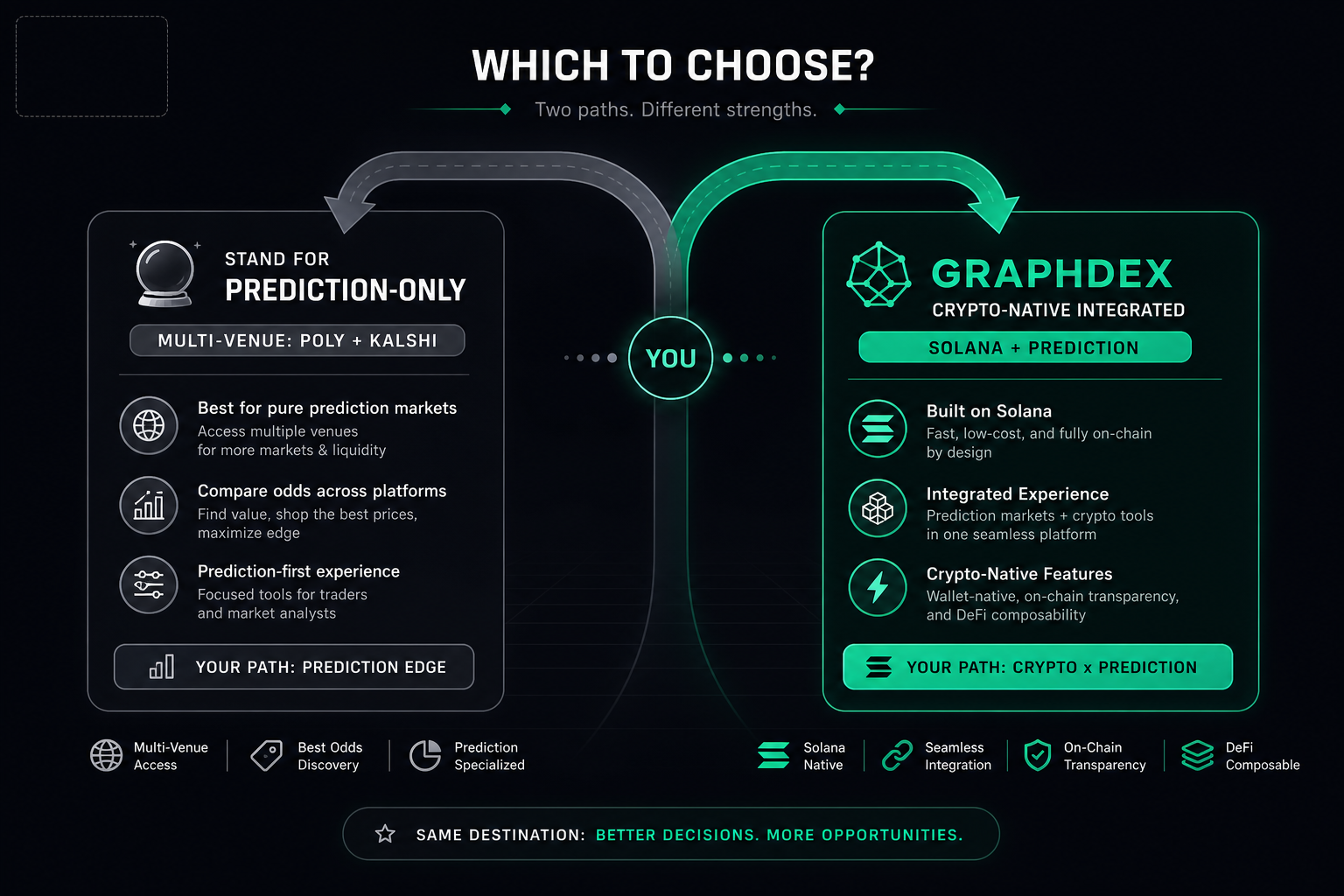
Choose Stand if:
- You trade prediction markets exclusively
- You actively use both Polymarket and Kalshi
- You want multi-venue aggregation and deep order-book views
- Kalshi access is central to your strategy
Choose GraphDex if:
- You trade Solana tokens as well as prediction markets
- You want prediction copytrading integrated with DEX trading
- You value token discovery (Pulse feed) and staking
- You prefer one terminal for your entire crypto workflow
The deciding question: Do you trade only prediction markets, or crypto more broadly? Stand is the specialist's multi-venue prediction terminal. GraphDex is the crypto-native trader's integrated terminal where prediction markets are one powerful feature among many.
Some traders even use both — Stand for multi-venue prediction depth, GraphDex for integrated Solana trading and staking.
The Broader Terminal Landscape
GraphDex and Stand aren't the only players. Understanding where each sits in the wider prediction market terminal landscape helps clarify the choice.
The ecosystem has diversified into several categories. Dedicated prediction terminals like Stand and Betmoar focus entirely on prediction markets, with Betmoar reportedly leading on raw trading volume. Analytics layers like Pariflow specialize in whale tracking without execution. Arbitrage scanners like Matchr compare prices across Polymarket and Kalshi to spot discrepancies. AI-integrated terminals like Bullpen combine on-chain analysis with execution.
GraphDex occupies a distinct position: it's the only major terminal that integrates prediction market copytrading with a full Solana DEX trading suite. Where Stand and its dedicated peers compete on prediction-specific depth, GraphDex competes on breadth — bringing prediction markets into a complete crypto trading environment.
This distinction matters when choosing. If your need is prediction-specific depth across multiple venues, a dedicated terminal like Stand serves it well. If your need is consolidating prediction markets with your broader crypto activity, GraphDex's integration is unmatched among these tools.
Neither approach is universally better — they reflect different trader profiles. The prediction specialist wants the deepest prediction tools; the crypto-native trader wants everything in one place. Knowing which you are points to the right terminal.
How to Decide in Practice
A practical way to choose: list what you actually trade in a typical week.
If your week is entirely prediction markets — politics, sports, crypto events across Polymarket and Kalshi — then a dedicated terminal's multi-venue depth and order-book views will serve you best, and Stand is a strong choice.
If your week mixes Solana token trades, memecoin discovery, and prediction markets, then switching between a prediction terminal and a separate Solana terminal creates friction. GraphDex eliminates that by housing everything in one non-custodial interface, with staking to earn on idle capital between trades.
The honest answer for many active crypto traders is that GraphDex's integration saves real time and consolidates their workflow, while dedicated prediction specialists may prefer the focused depth of a prediction-only terminal. Match the tool to how you actually trade.
Consolidate your trading with GraphDex
Related Guides
- Best Solana Trading Terminal in 2026: GraphDex vs Axiom vs GMGN vs Trojan vs BullX
- Prediction Market Copy Trading in 2026: The Complete Guide
- Best Polymarket Alternatives 2026: Kalshi, GraphDex & 8 More Compared
Frequently Asked Questions
Is GraphDex or Stand better for prediction markets? Both offer prediction market copytrading and whale tracking. Stand is better for pure prediction trading across both Polymarket and Kalshi with multi-venue aggregation. GraphDex is better if you also trade Solana tokens and want prediction markets integrated with DEX trading and staking.
Does Stand offer Solana DEX trading? No. Stand is a dedicated prediction market terminal for Polymarket and Kalshi. It doesn't offer Solana DEX trading, token discovery, or staking. GraphDex integrates all of these with prediction market copytrading in one terminal.
Does GraphDex support Kalshi? GraphDex focuses on Polymarket integration within its Solana terminal. Stand aggregates both Polymarket and Kalshi. If multi-venue aggregation including Kalshi is central to your trading, Stand has the edge there; if you want Polymarket integrated with Solana trading, GraphDex fits.
Do both GraphDex and Stand offer copytrading? Yes. Both let you automatically follow and mirror top prediction market traders. Stand focuses on Polymarket and Kalshi wallets; GraphDex ranks forecasters by PnL and win rate within its broader Solana terminal.
Which is better for crypto traders? GraphDex, because it integrates prediction markets with full Solana DEX trading, token discovery, wallet tracking, and staking. For traders who do more than predictions, this consolidation in one non-custodial interface is the advantage. Stand is prediction-only.
Are GraphDex and Stand non-custodial? Both use non-custodial models where you keep control of your funds. GraphDex uses Privy architecture with no seed phrase required. Always verify the current custody model on each platform before using.
Can I use both GraphDex and Stand? Yes. Some traders use Stand for multi-venue prediction market depth (Polymarket + Kalshi aggregation) and GraphDex for integrated Solana trading, token discovery, and staking. They serve overlapping but distinct needs.
About This Guide
This guide is published by the GraphDex Research team — analysts and traders building the infrastructure for digital asset trading on Solana. Our content is based on live platform data, current market figures, and hands-on experience with the platforms covered.
Sources & data: Platform features and details reflect publicly available information as of 2026 and may change as platforms update. Trading carries risk. This guide is educational and not financial advice.
GraphDex is the infrastructure for digital asset trading — trade, predict, and earn in one place. Learn more at graphdex.io.
Last reviewed: May 2026 · GraphDex Research
The infrastructure for digital asset trading. Trade, predict, stake, repeat. graphdex.io