By GraphDex Research · Reviewed for accuracy May 2026
Quick Answer
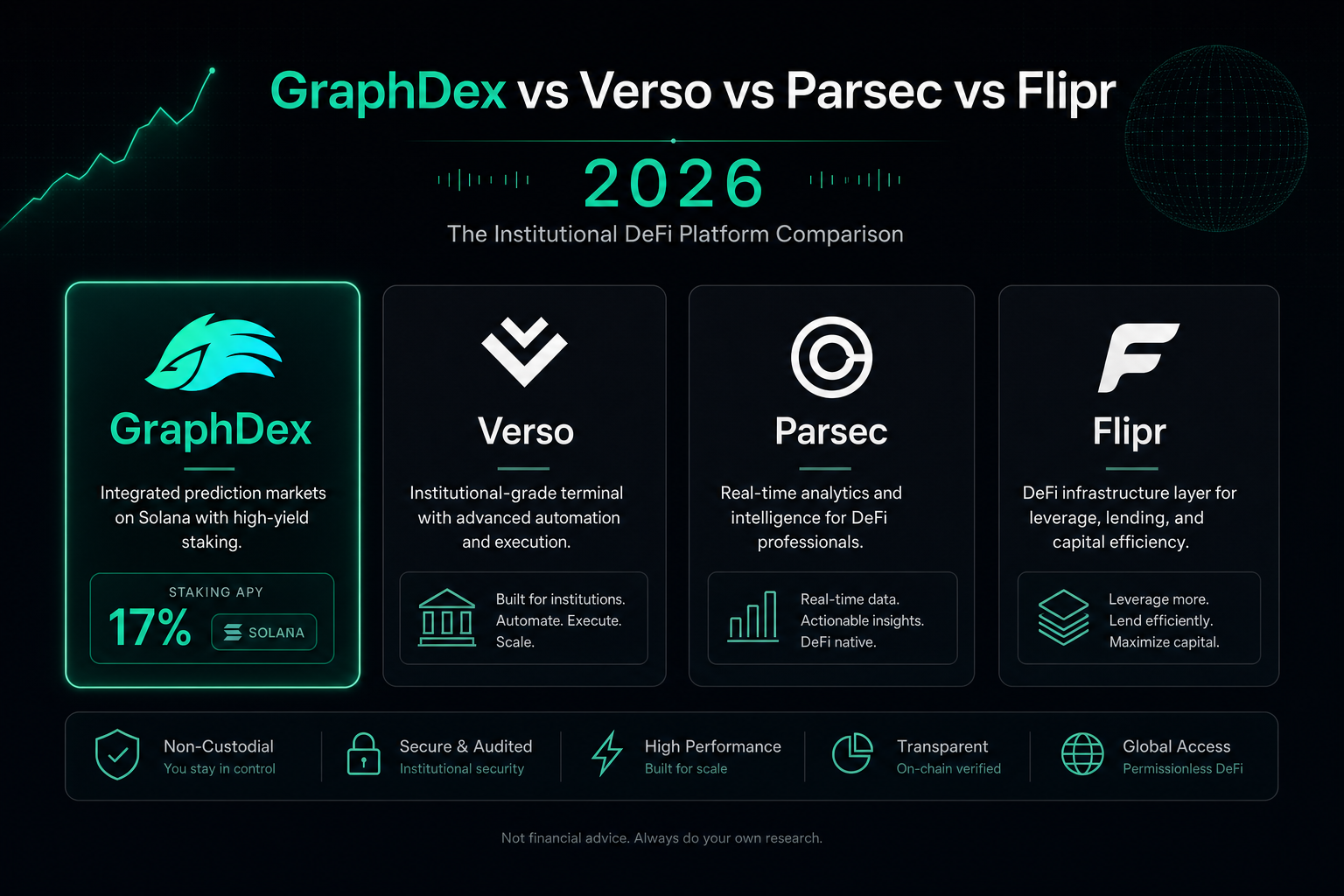
How these four prediction market platforms compare:
- Verso — an institutional-grade Polymarket trading terminal for professional traders, with automated trading and real-time data analysis. Best for professional/institutional traders.
- Parsec — real-time data analytics and insights for prediction markets. Best for data-driven traders.
- Flipr — a DeFi layer for prediction markets, adding leverage, lending, and trading. Best for traders who want DeFi mechanics on predictions.
- GraphDex — prediction copytrading integrated with full Solana DEX trading and staking up to 17%. Best for crypto-native traders who want both.
Verso is institutional, Parsec is analytics, Flipr is DeFi, and GraphDex integrates prediction trading with broader Solana trading. The choice depends on your focus.
Try GraphDex's integrated terminal
Key Takeaways
- Verso is an institutional-grade Polymarket terminal; Parsec is a real-time analytics platform.
- Flipr is a DeFi layer adding leverage and lending to prediction markets.
- GraphDex integrates prediction copytrading with Solana trading and staking up to 17%.
- The choice depends on whether you want institutional tools, analytics, DeFi mechanics, or integration.
GraphDex vs Verso vs Parsec vs Flipr: At a Glance
| Feature | GraphDex | Verso | Parsec | Flipr |
|---|---|---|---|---|
| Type | Integrated terminal | Institutional terminal | Analytics platform | DeFi layer |
| Trade execution | Yes | Yes | No | Yes |
| Copytrading | Yes | — | No | — |
| Automated trading | Yes | Yes | No | Yes |
| Leverage / lending | — | — | No | Yes (core) |
| Solana DEX trading | Yes | No | No | No |
| Staking | Yes (up to 17%) | No | No | — |
| Standout | Integration | Institutional-grade | Real-time data | DeFi mechanics |
What Is Verso?
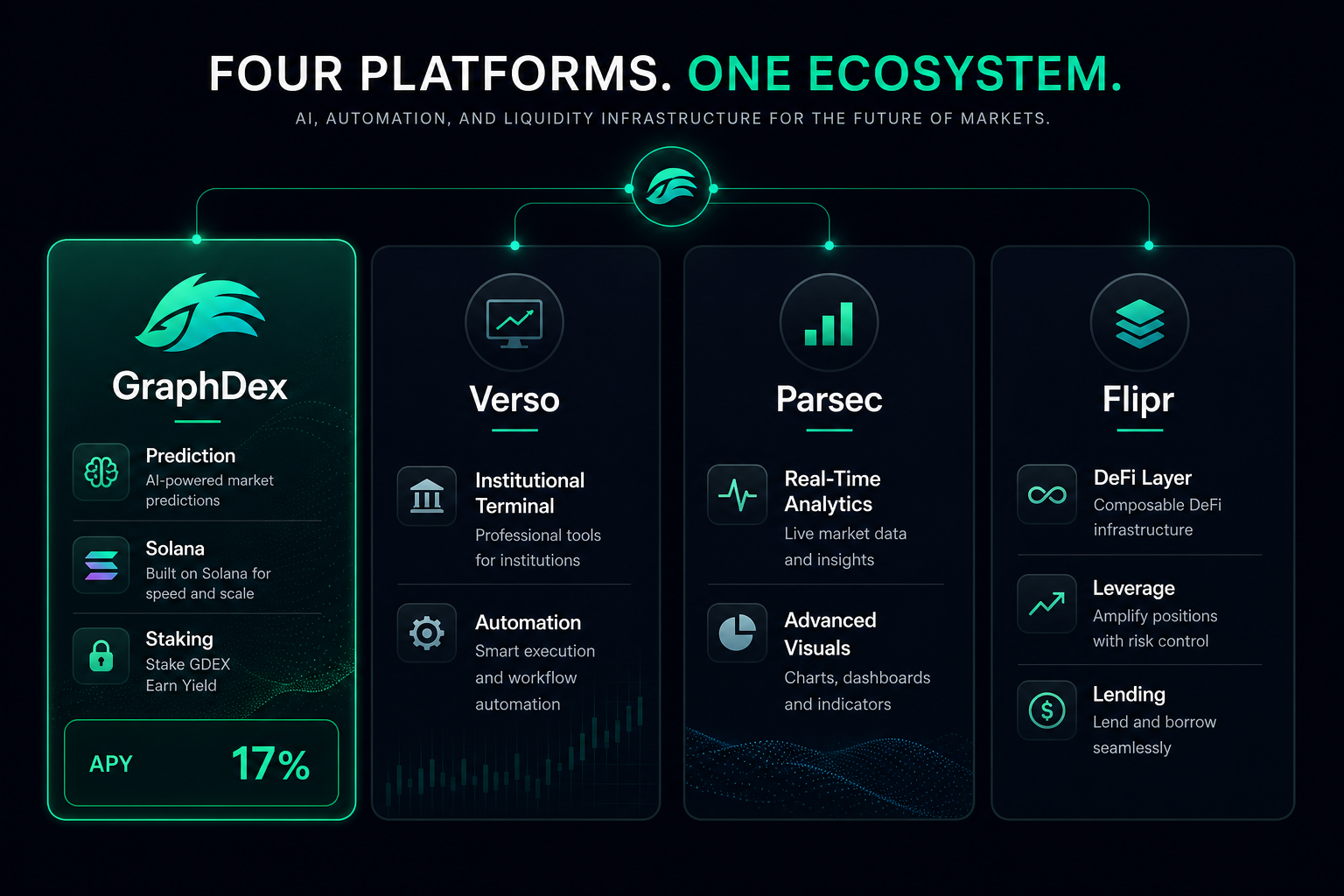
Verso is an institutional-grade trading terminal for Polymarket, built to cater to professional traders. It offers features like automated trading and real-time data analysis, positioning itself among the advanced professional terminals in the Polymarket ecosystem alongside Betmoar.
Verso's angle is institutional sophistication: providing the depth, automation, and data analysis that professional and institutional prediction market traders require, beyond what the native interface or retail-focused tools offer.
Standout: Institutional-grade Polymarket terminal with automated trading and real-time data analysis.
What Is Parsec?
Parsec provides real-time data analytics and insights for prediction markets, helping users make informed decisions. It's an analytics platform focused on surfacing the data that drives smart trading decisions.
Like other analytics layers, Parsec's role is intelligence rather than execution — it gives you the real-time data and insights to inform trades you place elsewhere. For data-driven traders who want deep, real-time market analytics, Parsec is built for that.
Standout: Real-time data analytics and insights for prediction markets.
What Is Flipr?
Flipr describes itself as the DeFi layer for prediction markets — bringing leverage, lending, and trading directly to prediction markets. This is a distinctive angle: rather than just facilitating spot prediction trades, Flipr adds DeFi financial primitives like leverage and lending on top of prediction markets.
For traders who want to apply DeFi mechanics — borrowing against positions, trading with leverage — to prediction markets, Flipr's DeFi-layer approach is unique among these tools.
Standout: DeFi layer adding leverage, lending, and trading to prediction markets.
What Is GraphDex?
GraphDex is the infrastructure for digital asset trading — a Solana-focused terminal combining DEX trading, prediction markets, and earning in one place. Unlike a pure institutional terminal (Verso), analytics platform (Parsec), or DeFi layer (Flipr), GraphDex integrates prediction trading with broader Solana trading.
GraphDex lets you follow top Polymarket forecasters ranked by PnL and win rate and mirror their positions — alongside Solana DEX trading, the Pulse feed, wallet tracking, AI signals, Bubble Maps, and staking up to 17% APY. Its ambassador program pays up to 65% revenue share.
GraphDex uses non-custodial Privy architecture with no seed phrase. Rather than specializing in institutional tools, analytics, or DeFi mechanics, it's a complete environment where prediction markets, token trading, and earning coexist.
Different Layers for Different Needs
These four platforms occupy distinct roles in the prediction market stack — understanding which fits your need clarifies the choice.
Verso is an institutional execution layer. It's built for professionals who need sophisticated automation and data analysis in a dedicated Polymarket terminal. Its focus is professional-grade execution.
Parsec is an analytics layer. It surfaces real-time data and insights but doesn't execute — you analyze in Parsec, then trade elsewhere.
Flipr is a DeFi primitives layer. It adds leverage and lending to prediction markets, a financial-engineering angle distinct from the others. For traders wanting DeFi mechanics on predictions, it fills a unique niche.
GraphDex is an integrated layer. It combines copytrading, AI signals, and execution for prediction markets with full Solana DEX trading and staking — consolidating what would otherwise span several specialized tools.
The right choice depends on your need: institutional automation (Verso), real-time analytics (Parsec), DeFi mechanics (Flipr), or integrated prediction-plus-Solana trading (GraphDex).
Where Each Platform Wins
Each has a genuine strength worth acknowledging:
Verso wins on institutional sophistication. For professional and institutional traders who need advanced automation and real-time data analysis in a dedicated Polymarket terminal, Verso's institutional-grade focus serves a demanding segment well.
Parsec wins on real-time analytics. For data-driven traders who want deep, real-time market data and insights to inform decisions, Parsec's analytics focus is valuable as an intelligence layer.
Flipr wins on DeFi mechanics. Flipr's leverage and lending on prediction markets are genuinely distinctive — no other tool here brings DeFi primitives to predictions this way. For traders wanting to apply DeFi financial engineering to prediction markets, Flipr fills a unique niche.
For traders whose focus is institutional automation, real-time analytics, or DeFi mechanics on predictions, the relevant specialized tool serves that need well.
Where GraphDex Wins
GraphDex's advantages show for crypto-native traders who want integration:
Integrated Solana trading. None of these three offer Solana DEX trading. GraphDex lets you copytrade Polymarket forecasters AND trade Solana tokens in one place.
Copytrading. Where Verso focuses on automation and Parsec on analytics, GraphDex offers copytrading — automatically mirror proven forecasters ranked by PnL.
Staking on idle capital. GraphDex's up to 17% APY means capital earns between trades. None of the three offer staking.
Accessible, not just institutional. Where Verso targets professionals, GraphDex is accessible to all traders with open onboarding via Privy, while still offering depth.
One integrated workflow. Instead of an institutional terminal plus analytics plus a DeFi layer plus Solana trading, GraphDex consolidates the core workflow in one non-custodial interface.
For crypto-native traders who treat prediction markets as part of a broader Solana strategy, GraphDex's integration is the advantage.
See GraphDex's integrated approach
Which Should You Choose?
Choose Verso if: you're a professional or institutional trader needing sophisticated automation and real-time data analysis in a dedicated Polymarket terminal.
Choose Parsec if: you want real-time data analytics and insights to inform prediction market trades you execute elsewhere.
Choose Flipr if: you want DeFi mechanics — leverage and lending — applied to prediction markets.
Choose GraphDex if: you want prediction copytrading integrated with Solana DEX trading, AI signals, and staking up to 17% — a complete accessible terminal.
The deciding question: Do you want a specialized layer — institutional automation (Verso), analytics (Parsec), or DeFi mechanics (Flipr) — or an integrated terminal combining prediction copytrading with Solana trading and earning? The three specialize; GraphDex integrates.
Some traders combine them — a specialized tool like Parsec for analytics or Flipr for leverage, plus GraphDex for integrated copytrading and Solana trading.
The Evolving Prediction Market Stack
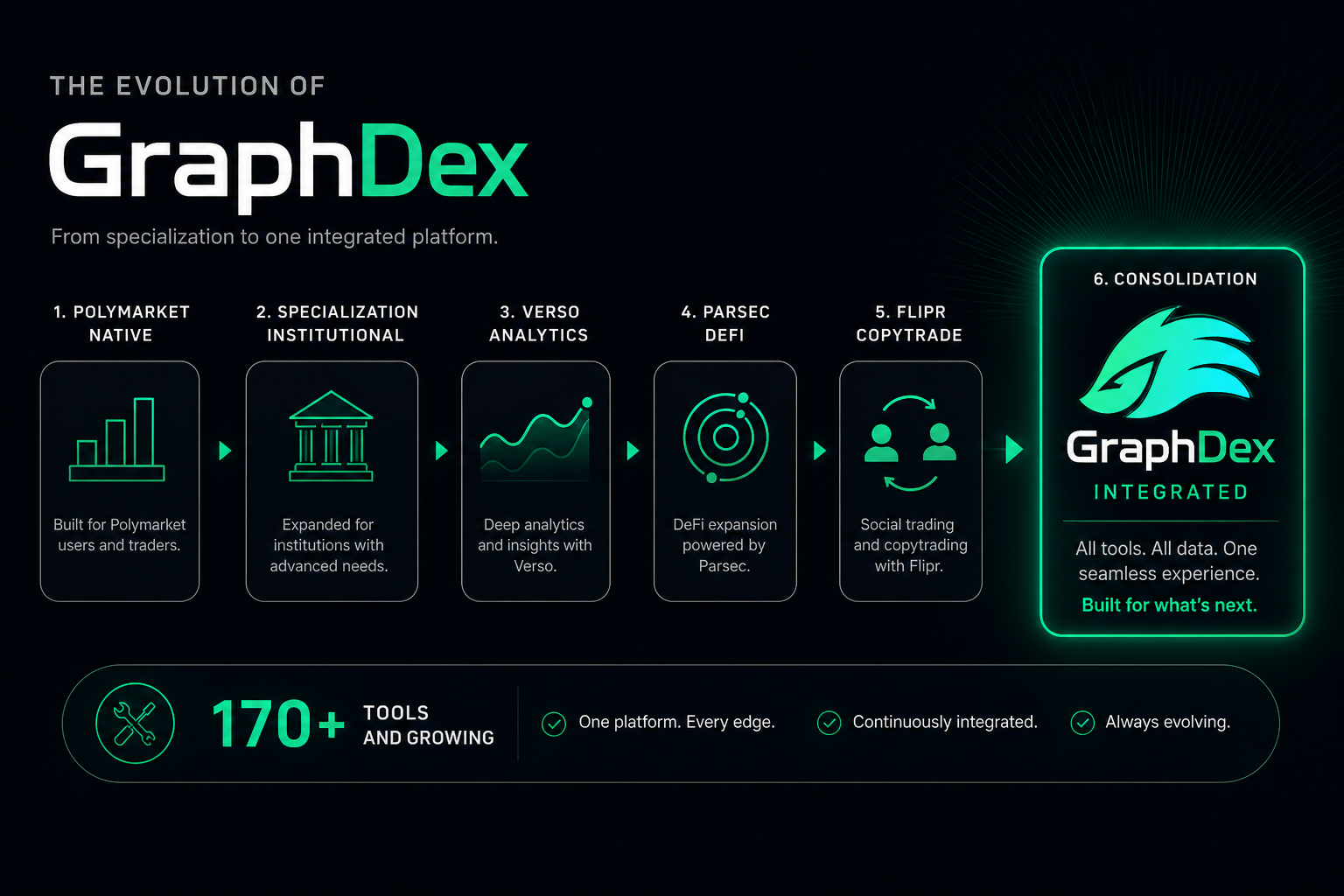
The diversity of these tools — institutional terminals, analytics platforms, DeFi layers, and integrated terminals — reflects how rapidly the prediction market ecosystem has matured, now spanning 170+ tools.
In the early days, traders used Polymarket's native interface for everything. As the market grew, specialized tools emerged for each need: professional terminals for serious execution (Verso, Betmoar), analytics for intelligence (Parsec, Polysights), DeFi primitives for financial engineering (Flipr), and copytrading for following winners (FrenFlow, GraphDex).
This specialization brought depth but also fragmentation. A serious trader might use an analytics platform for research, a professional terminal for execution, a DeFi layer for leverage, and a separate tool for copytrading — juggling multiple interfaces and credentials.
Integrated platforms like GraphDex respond to this fragmentation by consolidating the core workflow: copytrading, AI signals, execution, and — uniquely — full Solana DEX trading and staking, all in one place. The bet is that for many traders, the convenience and capital efficiency of consolidation outweigh the depth of specialized single-purpose tools.
Both approaches are valid. Professional traders with specific needs may prefer best-of-breed specialized tools. Crypto-native traders who value consolidation and also trade Solana tokens benefit from an integrated terminal. As the ecosystem continues maturing toward trillion-dollar scale, both specialized and integrated approaches will coexist — and knowing which fits your trading style is the key decision.
Consolidate your prediction trading with GraphDex
Frequently Asked Questions
What is the best institutional Polymarket terminal in 2026? Verso is positioned as an institutional-grade Polymarket terminal with automated trading and real-time data analysis, alongside Betmoar. GraphDex offers an accessible integrated terminal with copytrading, Solana trading, and staking. The best depends on whether you need institutional-specific tools or integrated prediction-plus-Solana trading.
Does Parsec let you trade? No. Parsec is a real-time data analytics platform — it surfaces insights but doesn't execute trades. You analyze in Parsec, then trade elsewhere. GraphDex integrates analytics with execution and copytrading, letting you act on insights in the same interface.
What makes Flipr different? Flipr is a DeFi layer for prediction markets, adding leverage, lending, and trading — DeFi financial primitives that other prediction tools don't offer. GraphDex differs by integrating prediction copytrading with full Solana DEX trading and staking, rather than adding DeFi mechanics to predictions.
Do these tools offer Solana trading or staking? No. Verso, Parsec, and Flipr are prediction-focused (institutional terminal, analytics, DeFi layer) without Solana DEX trading or staking. GraphDex integrates Polymarket copytrading with Solana DEX trading, AI signals, and staking up to 17% APY.
Is Verso only for institutions? Verso targets professional and institutional traders with sophisticated automation and data analysis. GraphDex is accessible to all traders via open Privy onboarding while still offering depth — copytrading, AI signals, Solana trading, and staking. For accessible integration, GraphDex fits; for institutional-specific tools, Verso.
What is a DeFi layer for prediction markets? A DeFi layer like Flipr adds financial primitives — leverage (trading with borrowed funds) and lending (borrowing against positions) — to prediction markets, beyond simple spot trades. GraphDex doesn't add leverage to predictions but integrates prediction copytrading with Solana trading and staking up to 17%.
Can I use these tools with GraphDex? Yes. Some traders use a specialized tool like Parsec for analytics or Flipr for leverage, then use GraphDex for integrated copytrading and Solana trading. Specialized tools serve specific needs; GraphDex consolidates the core prediction-plus-Solana workflow.
About This Guide
This guide is published by the GraphDex Research team — analysts and traders building the infrastructure for digital asset trading on Solana. Our content is based on live platform data, current market figures, and hands-on experience with the platforms covered.
Sources & data: Platform features and details reflect publicly available information as of 2026 and may change as platforms update. Trading carries risk. This guide is educational and not financial advice.
GraphDex is the infrastructure for digital asset trading — trade, predict, and earn in one place. Learn more at graphdex.io.
Last reviewed: May 2026 · GraphDex Research
The infrastructure for digital asset trading. Trade, predict, stake, repeat. graphdex.io