By GraphDex Research · Reviewed for accuracy May 2026
Quick Answer
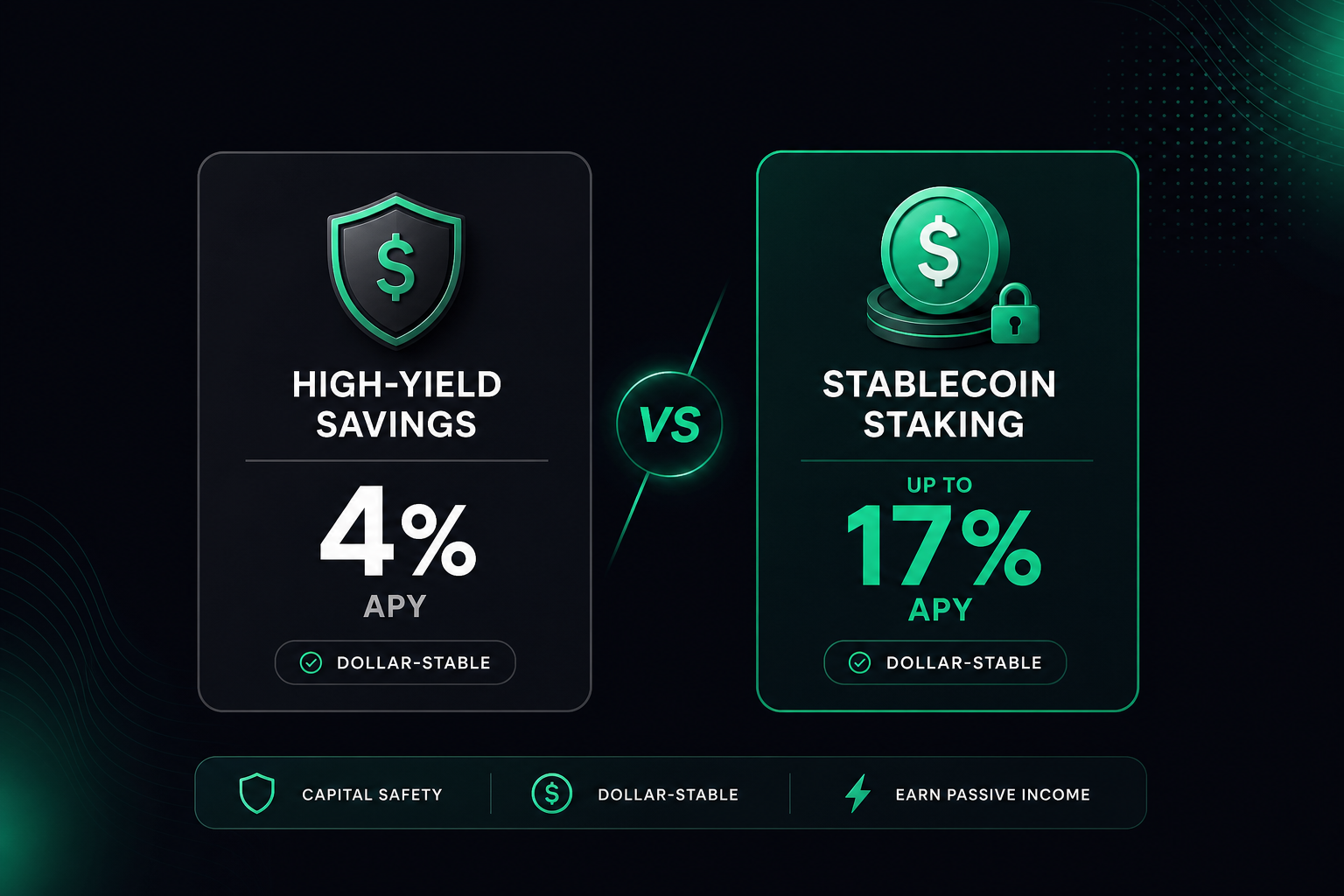
High-yield savings and stablecoin staking both earn yield on dollar-denominated money, but differ sharply:
- High-yield savings: ~4% APY, FDIC-insured, fully regulated, bank-backed
- Stablecoin staking: up to 17% APY, not insured, platform risk, dollar-pegged
The core trade-off: high-yield savings offers government insurance at a modest 4%; stablecoin staking offers up to 17% but trades that insurance for platform risk. Both keep your principal at dollar value (no price volatility). Many people use both — savings for insured reserves, staking for higher yield on the rest.
Earn up to 17% with stablecoin staking on GraphDex
Key Takeaways
- Both keep your money dollar-stable, but high-yield savings pays ~4% vs up to 17% for stablecoin staking.
- High-yield savings is FDIC-insured; stablecoin staking trades insurance for higher yield and platform risk.
- On $10,000: ~$400/year in savings vs up to $1,700/year staking — a 4x+ difference.
- A common approach: insured savings for emergency funds, stablecoin staking for higher-yield capital.
High-Yield Savings vs Stablecoin Staking: Head to Head
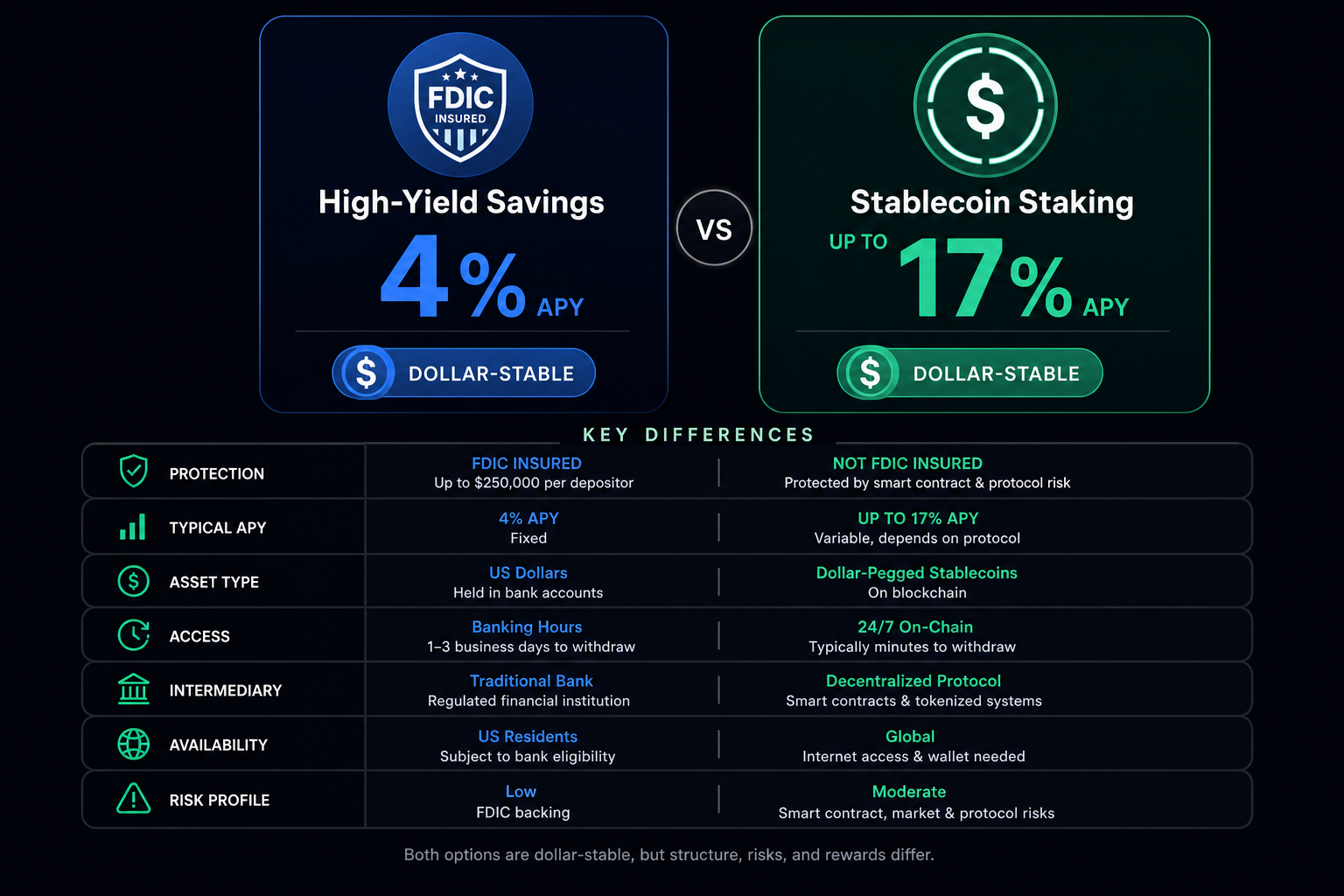
| Factor | High-Yield Savings | Stablecoin Staking |
|---|---|---|
| Typical yield | ~4% | Up to 17% |
| Principal stability | Yes (USD) | Yes (USD-pegged) |
| Insurance | FDIC (to $250k) | None |
| Regulation | Fully regulated | Varies |
| Access | Instant | Flexible terms |
| Who holds funds | The bank | You (non-custodial) or platform |
| Yield source | Bank lending margin | Platform fees / lending |
| Risk | Minimal (insured) | Platform, smart contract |
Both are ways to earn yield on dollar-denominated money without crypto price volatility. The decisive differences are yield (4% vs up to 17%) and insurance (FDIC vs none).
What They Have in Common
Before the differences, it's worth noting what high-yield savings and stablecoin staking share — because it's more than people expect.
Dollar-stable principal. Both keep your money at dollar value. A high-yield savings balance doesn't fluctuate, and neither does a stablecoin balance (USDC and USDT are pegged 1:1 to the dollar). Unlike stocks or volatile crypto, your principal in both stays stable.
Predictable yield. Both pay a knowable rate. You know your APY going in, and returns accrue steadily rather than swinging with markets.
Liquidity (with flexible terms). High-yield savings offers instant access; stablecoin staking offers flexible lock periods, including short ones. Both can be structured for relatively quick access.
This is why stablecoin staking is often compared directly to high-yield savings: both are "park your dollars and earn" products, not volatile investments. The comparison is apples to apples in a way that comparing savings to stocks is not.
The Key Differences
Yield: 4% vs Up to 17%
The headline difference. High-yield savings accounts pay around 4% in 2026. Stablecoin staking on GraphDex pays up to 17% — more than four times higher.
Why the gap? Banks earn from lending your deposits and pass through only a small fraction, keeping the rest as margin. Stablecoin staking platforms pass through more — GraphDex's yield comes from platform trading fees, returning a larger share to stakers.
Insurance: FDIC vs None
High-yield savings is FDIC-insured up to $250,000 per depositor — if the bank fails, the government makes you whole. Stablecoin staking has no equivalent. This is the single biggest difference in safety, and the main reason savings pays less: you're paying for insurance with lower yield.
Custody: Bank vs You
In a savings account, the bank holds your money. In non-custodial stablecoin staking (like GraphDex via Privy), you hold your own funds — the platform can't access them. This eliminates the custodial failure risk (FTX, Celsius), though smart contract risk remains.
The Numbers: What You Actually Earn
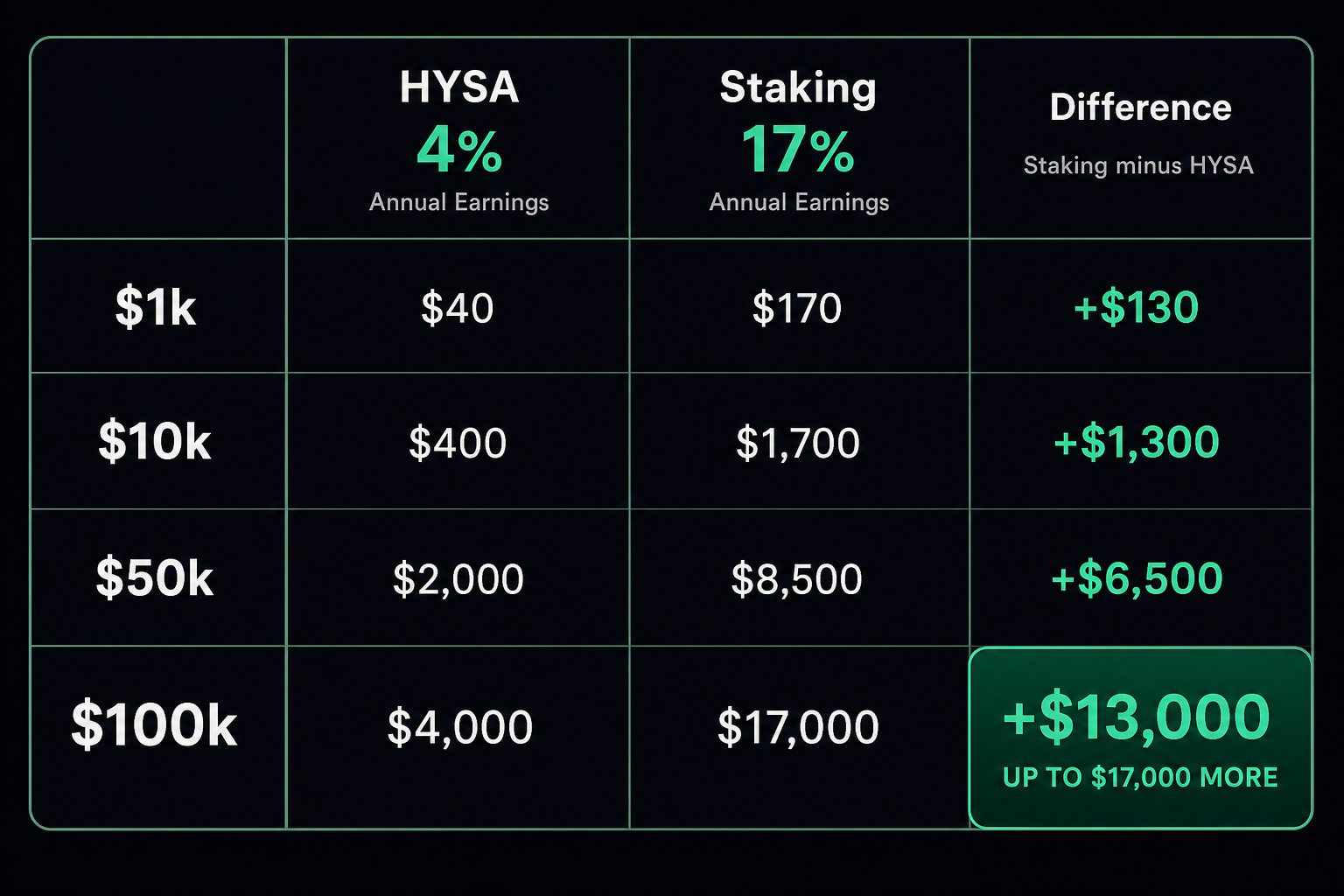
The yield difference becomes concrete with real amounts:
| Deposit | High-Yield Savings (4%) | Stablecoin Staking (up to 17%) |
|---|---|---|
| $1,000 | $40 | Up to $170 |
| $10,000 | $400 | Up to $1,700 |
| $50,000 | $2,000 | Up to $8,500 |
| $100,000 | $4,000 | Up to $17,000 |
On every amount, stablecoin staking earns over four times more. On $100,000, that's a difference of up to $13,000 a year. The question is whether the higher yield justifies giving up FDIC insurance and accepting platform risk — a decision that depends on the amount and your risk tolerance.
Which Should You Choose?
Choose high-yield savings for:
- Your emergency fund (3-6 months expenses)
- Money you absolutely cannot risk
- Cash needing FDIC insurance and instant access
- If you're uncomfortable with any platform risk
Choose stablecoin staking for:
- Capital you want earning significantly more
- Money you can commit for flexible terms
- The portion of your dollars where up to 17% beats 4%
- If you're comfortable with non-custodial platforms and accept platform risk
Use both (the common approach):
- Emergency fund and untouchable cash in FDIC-insured high-yield savings
- Higher-yield capital in stablecoin staking
- This captures insurance for what you can't risk and superior yield for what you can
The decision isn't either/or for most people. It's about splitting your dollars between the insured safety of savings for essentials and the higher yield of staking for capital that can tolerate the trade-off.
Add a higher-yield option with GraphDex
How to Reduce the Risk of Stablecoin Staking
If the higher yield appeals but the risk concerns you, several choices narrow the gap with insured savings:
Use non-custodial platforms. GraphDex keeps funds in your own wallet via Privy — the platform can't access them, eliminating the custodial risk behind FTX and Celsius. This is the closest structural equivalent to not trusting a single institution.
Choose transparent, audited platforms. Favor platforms with security audits and a clear yield source over unknown ones with suspicious rates.
Use established stablecoins. USDC (Circle, monthly-audited 1:1 reserves) and USDT (deepest liquidity) have the lowest peg risk.
Start small and diversify. Test with a smaller amount, and don't put all your dollars in one platform.
Match terms to needs. Use flexible or shorter lock periods for money you might need.
With these choices — non-custodial, audited, established stablecoins — stablecoin staking's risk profile moves meaningfully closer to insured savings, while still paying multiples of the yield. It won't ever match FDIC insurance, but the gap narrows substantially.
Stake safely and non-custodially on GraphDex
Why Stablecoin Staking Emerged as a Savings Alternative
Stablecoin staking didn't exist as a mainstream option a few years ago. Understanding why it emerged explains why it's now compared directly to high-yield savings.
The story starts with the yield gap. For years, traditional savings paid near-zero rates while inflation eroded purchasing power. Even today's improved 4% high-yield savings barely keeps pace with inflation. Savers wanted more, but stocks and crypto carried price volatility they didn't want for their cash reserves.
Stablecoins solved the volatility problem. By pegging 1:1 to the dollar, they let people hold dollar-denominated value on-chain. Once stablecoins existed, platforms could offer yield on them — from lending demand or, in GraphDex's case, platform trading fees — at rates far above banks.
The result is a product that behaves like a high-yield savings account (dollar-stable, predictable yield) but pays multiples more. This is why it's increasingly mentioned alongside traditional savings in personal finance discussions, not just crypto circles.
The remaining gap is insurance and regulation. Banks have FDIC backing and decades of regulatory infrastructure; stablecoin staking has neither, relying instead on non-custodial architecture and platform transparency for safety. As this infrastructure matures — audited platforms, established stablecoins, non-custodial wallets — the practical risk gap narrows, even as the formal insurance gap remains.
For savers frustrated by banks barely beating inflation, stablecoin staking represents a higher-yield alternative for the portion of their dollars that can tolerate the trade-offs. It doesn't replace insured savings for essentials — it complements it for capital seeking better returns. The most balanced approach uses each for what it does best: the bank's insured safety for money you cannot afford to lose, and stablecoin staking's higher yield for the working capital that can tolerate platform risk in exchange for several times the return.
Explore the savings alternative on GraphDex
Frequently Asked Questions
Is stablecoin staking better than a high-yield savings account? It pays much more (up to 17% vs ~4%) but isn't FDIC-insured and carries platform risk. High-yield savings is better for insured, essential funds; stablecoin staking is better for higher yield on capital you can tolerate more risk on. Both keep principal dollar-stable. Many people use both.
How much more does stablecoin staking pay than high-yield savings? Stablecoin staking on GraphDex pays up to 17% versus ~4% for high-yield savings — over four times more. On $10,000, that's up to $1,700 a year versus $400. On $100,000, up to $17,000 versus $4,000.
Is stablecoin staking safe like a savings account? Not in the same way. Savings accounts are FDIC-insured; stablecoin staking is not. However, stablecoin staking keeps principal dollar-stable (no volatility), and non-custodial platforms like GraphDex keep funds in your wallet. It trades insurance for higher yield — a different risk profile, not necessarily catastrophic.
Why does stablecoin staking pay so much more than a bank? Banks pass through only a small fraction of what they earn lending your deposits, keeping the rest as margin. Stablecoin staking platforms pass through more — GraphDex's yield comes from platform trading fees. The higher yield also compensates for the absence of FDIC insurance.
Can I lose money in stablecoin staking but not in savings? Yes. FDIC-insured savings protects your principal even if the bank fails. Stablecoin staking carries platform and smart contract risk with no insurance, so loss is possible (though non-custodial, audited platforms minimize it). This is the core trade-off for the higher yield.
Should I move my savings into stablecoin staking? Not all of it. Keep your emergency fund and untouchable cash in FDIC-insured savings. For capital that can tolerate platform risk in exchange for much higher yield, stablecoin staking is worth considering for a portion. A balanced split captures both insurance and higher yield.
What's the safest way to earn high yield on dollars? Stake established stablecoins (USDC, USDT) on a non-custodial, audited platform like GraphDex. This keeps principal dollar-stable, eliminates custodial risk, and pays up to 17%. It's the closest you can get to high yield on dollars, though it still lacks the FDIC insurance of a savings account.
About This Guide
This guide is published by the GraphDex Research team — analysts building the infrastructure for digital asset trading on Solana. Our content is based on live platform data and current market figures.
Sources & data: Rates and figures reflect publicly available information as of 2026 and are estimates. All investments carry risk; returns are not guaranteed. Stablecoin staking is not FDIC-insured. This guide is educational and not financial advice — consult a financial advisor for your situation.
GraphDex is the infrastructure for digital asset trading — trade, predict, and earn in one place. Learn more at graphdex.io.
Last reviewed: May 2026 · GraphDex Research
The infrastructure for digital asset trading. Trade, predict, stake, repeat. graphdex.io