By GraphDex Research · Reviewed for accuracy May 2026
Quick Answer
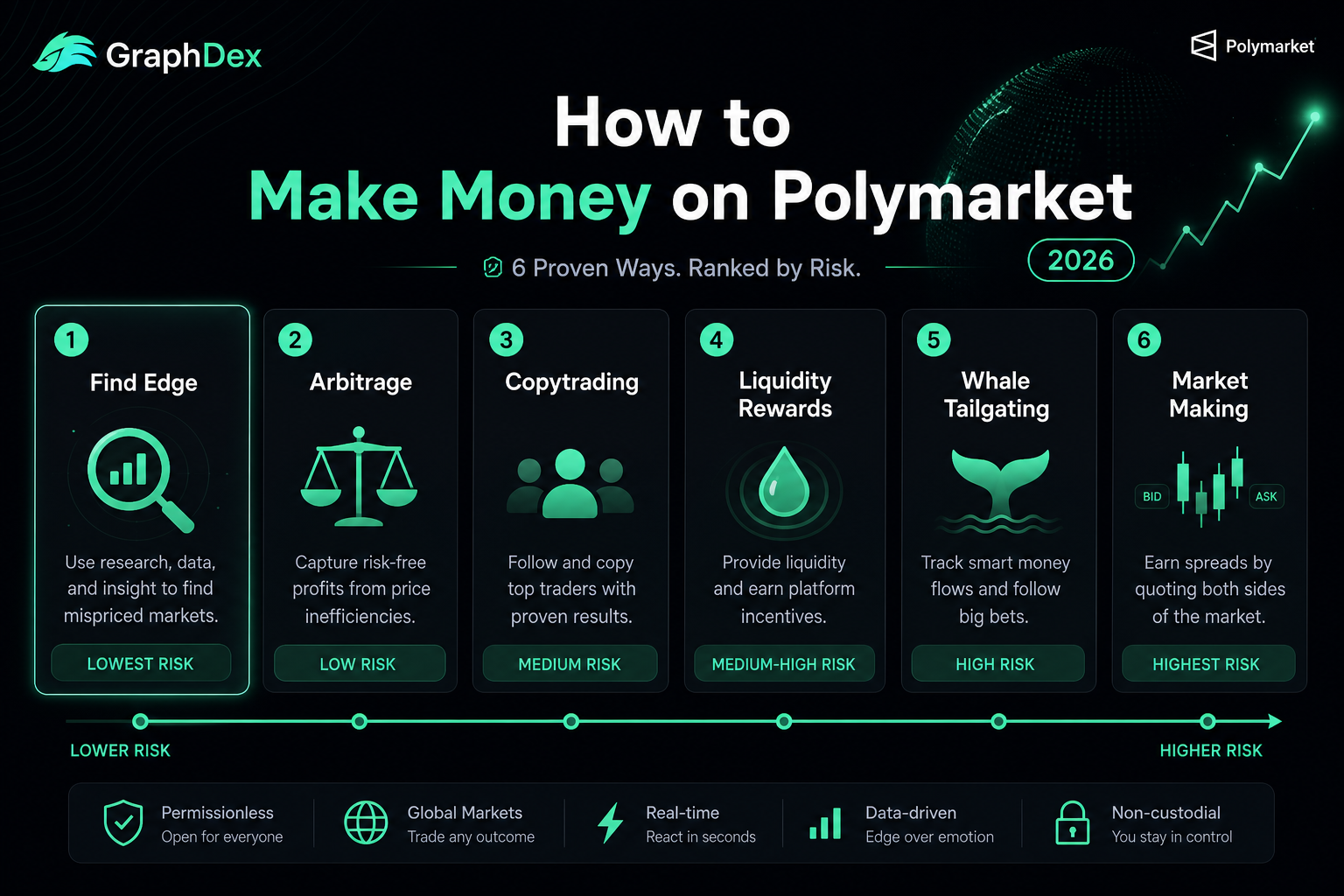
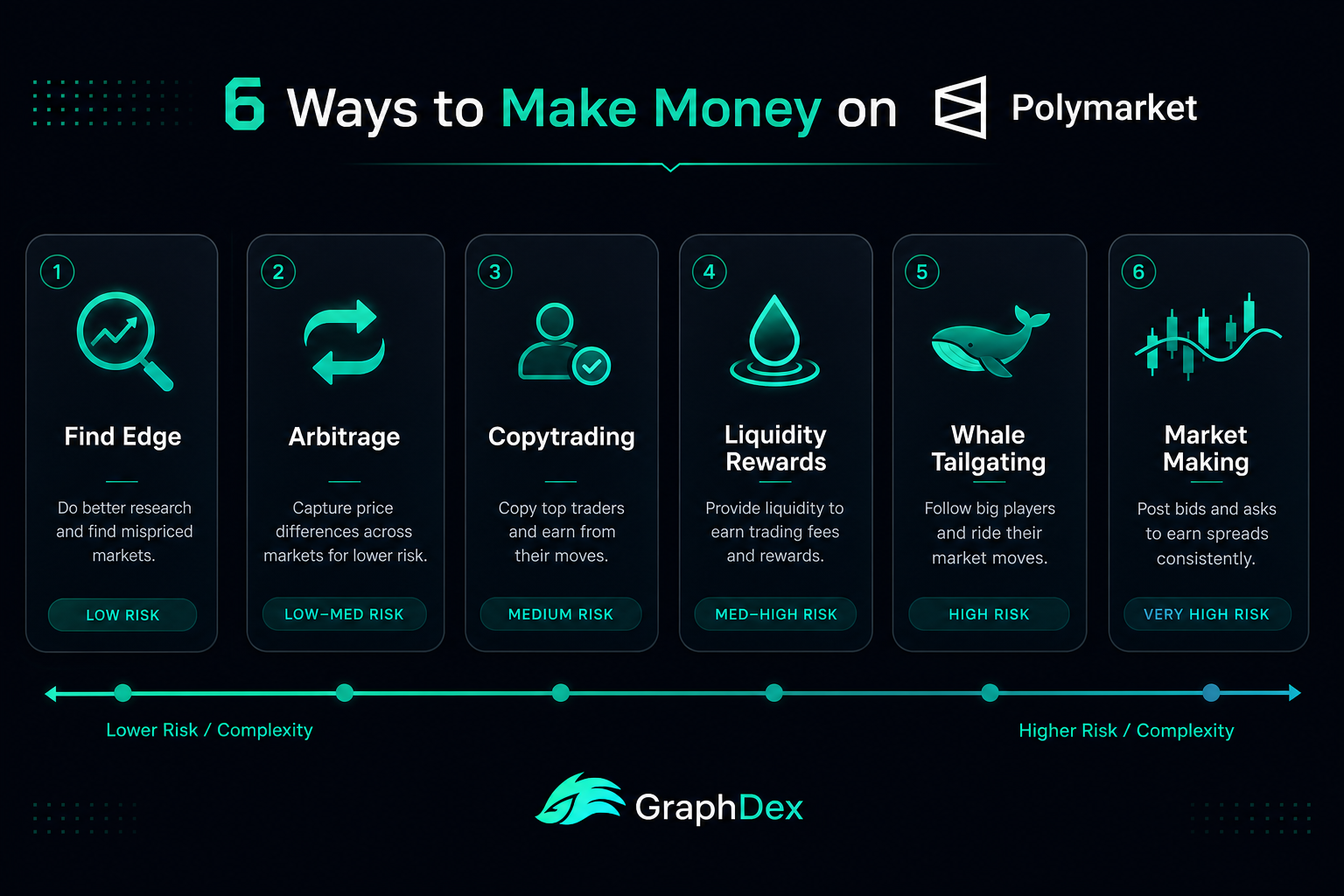
You make money on Polymarket by buying YES or NO shares at prices you believe are mispriced, then selling higher or holding to resolution. The main methods:
- Finding edge — trade where your probability estimate beats the market price
- Arbitrage — capture price gaps across Polymarket and Kalshi, or YES+NO under $1.00
- Copytrading — mirror proven winning traders automatically
- Liquidity rewards — earn from providing liquidity
- Whale tailgating — follow large informed trades
- Market making — profit from spreads
Realistic earnings: $50-300/month casual, $500-2,000+/month for consistent strategic traders. Most casual bettors lose; disciplined traders profit. It takes 6-12 months to reach consistent profitability.
Trade and copytrade Polymarket on GraphDex
Key Takeaways
- Polymarket is a liquidity market like a stock exchange, not a casino — prices move on order flow and information.
- Profitable traders make hundreds of small, mathematically sound bets, not a few big lucky calls.
- Strategies: finding edge, arbitrage, copytrading, liquidity rewards, whale tailgating, market making.
- Realistic earnings are $50-300/month casual to $500-2,000+/month strategic; most casual bettors lose.
Why Most People Lose (and How Winners Differ)
The biggest mistake is treating Polymarket like a casino — bet YES on an election, wait three months, collect or lose. That mental model is wrong, and it's why most people lose.
Polymarket is a liquidity market, closer to a stock exchange than a casino. Prices move based on order flow, sentiment shifts, and information asymmetry. Like any market, it consistently transfers money from the uninformed to the informed. Casual bettors who treat it like a lottery ticket tend to lose; traders who understand the mechanics, find genuine edges, and manage risk consistently extract documented profit.
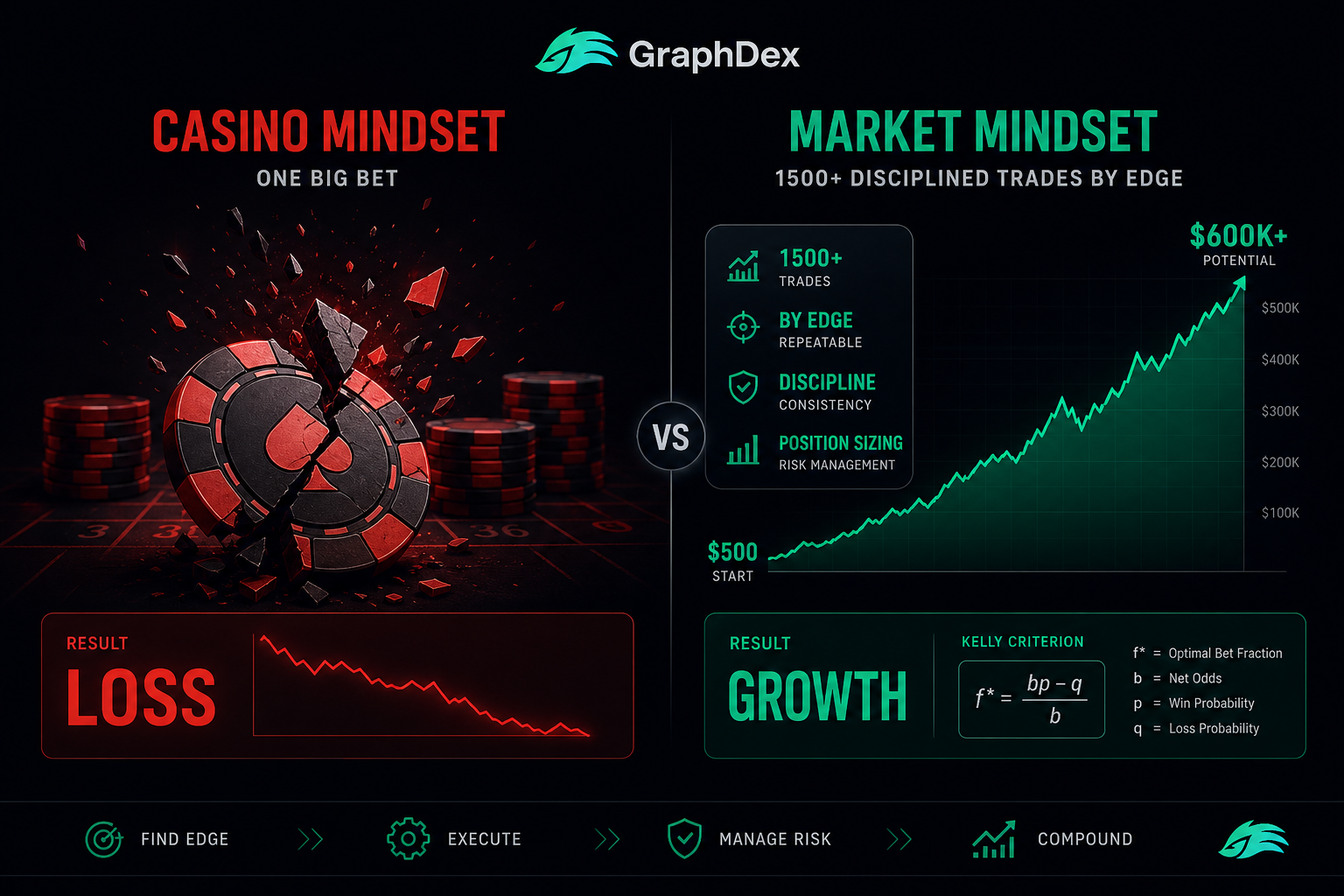
The data confirms this. The wallets generating the largest returns aren't making a few big bets — one verified wallet turned roughly $500 into $600,000 by executing over 1,500 disciplined trades, not three lucky calls. High frequency plus positive expected value compounds extraordinarily fast. Winners bet according to mathematical edge — the gap between market price and true probability — regardless of emotional conviction.
This is the core lesson: making money on Polymarket is about edge, discipline, and risk management, not prediction luck.
How Much Can You Realistically Make?
Honest expectations matter. Here's what different participants actually earn:
| Trader Type | Realistic Earnings | Requirements |
|---|---|---|
| Casual trader | $50-300/month | Basic strategy, some research |
| Strategic trader | $500-2,000+/month | Consistent edge, 60-90 days to build |
| Liquidity provider | $200-800/day (peak) | Capital + often automation |
| Full-time pro | Six figures+ | $50,000+ capital, proven edge |
These figures come from on-chain data and trader reports. The extreme cases — turning $1,000 into $50,000+ — exist but reflect deep expertise, hundreds of trades, and significant time, not luck. Expect to lose money on your first 10-20 trades while learning; positive expectancy typically comes after 50-100 trades, and consistent monthly profit after 6-12 months.
A note on access: US users are officially restricted from trading on Polymarket due to CFTC regulations on event contracts. Kalshi is the CFTC-regulated US alternative.
Strategy 1: Find Your Edge (Mispricing)
The foundation of all profit on Polymarket is edge — knowing something the market hasn't fully priced. The market price reflects collective opinion; profit comes from the gap between that price and the true probability.
How to find edge:
- Specialize in markets you understand deeply (a specific sport, region, or topic)
- Identify mispricing where the market over- or under-reacts to news
- Be faster than the market's information processing — connect news to markets before others
Election markets and economic data releases are good starting points: highly liquid, with straightforward fundamental analysis where edge is easier to identify than in low-liquidity markets. The key is to only trade when you have a genuine edge, not on every market.
Strategy 2: Arbitrage (Lower Risk)
Arbitrage captures guaranteed or near-guaranteed profit from price discrepancies — one of the lower-risk approaches.
Cross-platform arbitrage: When the same event trades at different prices on Polymarket and Kalshi, you buy the cheaper side and sell the more expensive. For example, if "Will the Senate pass the Act?" is YES at $0.61 on Polymarket but $0.54 on Kalshi, you can construct a position with a guaranteed payout exceeding cost — roughly 7.5% profit before fees.
Single-market arbitrage: Sometimes YES + NO prices within one market sum to less than $1.00, creating guaranteed profit with no cross-platform risk. If YES is $0.58 and NO is $0.38 (total $0.96), the $0.04 gap is capturable.
Arbitrage margins are thin and competition is fierce — over $40 million in such profits were documented across prediction markets from 2024-2025, but speed (often automation) is essential to capture them before they close.
Track cross-venue opportunities on GraphDex
Strategy 3: Copytrading (Borrow Others' Edge)
If developing your own edge takes too long, copytrading lets you mirror proven winners automatically. Since every Polymarket trade is public on-chain, the best traders' track records are verifiable.
How it works: Choose traders ranked by consistent PnL over large samples (hundreds of resolved markets, not a few lucky wins), then automatically mirror their positions within your risk parameters. When they open a position, you open a proportional one; when they close, you close.
Polymarket's native interface has no copytrading — you need a terminal like GraphDex, which ranks forecasters by PnL and win rate and lets you copytrade them. For a full walkthrough, see our prediction market copy trading guide. This is one of the most accessible ways for newer traders to profit: borrow the edge of proven performers rather than building your own from scratch.
Copytrade proven Polymarket forecasters on GraphDex
Strategy 4: Liquidity Rewards (Lower Effort)
Polymarket offers rewards for providing liquidity — placing competitive buy and sell orders that keep markets functioning. Liquidity providers running competitive orders across many markets report $200-800 per day during high-activity periods, though this often requires automation to sustain.
In February 2026, Polymarket launched a sports market fee pilot where takers pay fees but makers earn rebates — rewarding liquidity provision. This is one of the more passive income streams: you earn from market mechanics rather than directional bets, though it requires capital and ideally automation.
Strategy 5: Whale Tailgating
Whales — wallets dropping $10,000+ in single transactions — usually possess asymmetric information or heavy quantitative research. Whale tailgating means following their large trades.
One specific tactic: when a whale aggressively buys a YES contract pushing odds to 99.5%, a tiny 0.5% margin remains. Since the whale essentially validated the outcome, traders "sweep" the remaining fractions for a high-win-rate (but low-yield) scalp. The risk: in rare cases (oracle disputes, black swans, cancelled events), you can lose 100% of capital to make 0.5%, so only allocate a small portion to sweeping.
Executing these sweeps manually before probabilities adjust is nearly impossible, so traders rely on automation or integrated tools that track whales and let you act fast.
Strategy 6: Market Making
Market making means placing buy and sell orders around the current price, profiting from the spread rather than directional bets. It suits traders wanting steadier, lower-variance returns.
This is more advanced and typically requires capital and automation, but it generates returns from market activity regardless of which way prices move — making it attractive in choppy or uncertain markets where directional bets are hard.
The Key to All Strategies: Risk Management
No strategy works without disciplined risk management. This is what separates winners from losers.
Bet according to edge, not emotion. Most losing traders bet large when confident and small when uncertain. Profitable traders bet according to mathematical edge — the gap between price and true probability — regardless of feeling.
Use the Kelly Criterion. This framework sizes bets proportional to your edge: bet a percentage of your bankroll matching your advantage. Applying it consistently is more valuable than any single prediction.
Make many small, sound bets. The winners make hundreds of disciplined entries, not a few big ones. High frequency plus positive expected value compounds fast. The $500-to-$600K wallet executed 1,500+ trades.
Diversify and cap exposure. Don't concentrate in one market. Limit any single position so one loss can't devastate you.
Take the early-exit option. Unlike fixed-odds betting, you can sell before resolution to lock in gains or cut losses as new information arrives.
Apply these strategies with GraphDex tools
How GraphDex Helps You Profit on Polymarket
Several of these strategies are far easier with the right tools. GraphDex is a terminal that integrates Polymarket trading with features built for these strategies:
- Copytrading — mirror proven forecasters ranked by PnL and win rate (Strategy 3)
- Whale tracking — follow large informed trades and act fast (Strategy 5)
- AI signals and Bubble Maps — find mispricing and edge (Strategy 1)
- Integrated execution — act on opportunities immediately without switching tools
Because GraphDex combines these with Solana DEX trading and staking up to 17% APY, you can pursue Polymarket strategies while your idle capital earns and you trade tokens — all in one non-custodial interface. For traders serious about profiting on Polymarket, having tracking, copytrading, and execution unified preserves the edge that switching between tools erodes.
Start trading Polymarket smarter on GraphDex
Related Guides
- Prediction Market Copy Trading in 2026: The Complete Guide
- Passive Income with Prediction Markets in 2026: Realistic Strategies
- How to Find Profitable Polymarket Traders to Copy in 2026
- Best Solana Trading Terminal in 2026: GraphDex vs Axiom vs GMGN vs Trojan vs BullX
Frequently Asked Questions
Can you really make money on Polymarket? Yes, but it depends on your approach. Casual bettors treating it like a casino tend to lose. Strategic traders finding edge and managing risk earn $50-300/month casually to $500-2,000+/month consistently. Studies of top traders show 50-300%+ annual returns, but most casual traders lose — skill and discipline are required.
How much money do I need to start on Polymarket? You can start with $100-500 to learn the mechanics. Full-time profitability typically requires $50,000+ capital and a proven edge. Start small, prove your system over 50-100 trades, then scale. Expect to lose on your first 10-20 trades while learning.
What is the easiest way to make money on Polymarket? The lowest-effort methods are liquidity rewards (earning from providing liquidity) and copytrading (mirroring proven winners). Arbitrage offers lower-risk profit but requires speed. Finding your own edge takes longer to develop but is the foundation of consistent profit.
Is Polymarket gambling? No — Polymarket is a liquidity market closer to a stock exchange than a casino. You trade peer-to-peer against other traders, not against a house, and prices reflect real probabilities. Unlike gambling, skill genuinely beats luck over time because you can find and exploit mispricing.
How long until I'm profitable on Polymarket? Expect to lose on your first 10-20 trades while learning. Positive expectancy typically comes after 50-100 trades, and consistent monthly profit after 6-12 months of active, disciplined trading. It's a skill that develops with experience, not instant.
Can US residents trade on Polymarket? US users are officially restricted from Polymarket due to CFTC regulations on event contracts. Kalshi is the CFTC-regulated US alternative for real-money prediction trading. Always check current regulations for your jurisdiction.
What's the best strategy for beginners? Start by specializing in markets you understand deeply, use small position sizes, and consider copytrading proven forecasters to learn from their moves. Focus on risk management — bet according to edge, not emotion — and treat your first months as learning rather than expecting immediate profit.
About This Guide
This guide is published by the GraphDex Research team — analysts and traders building the infrastructure for digital asset trading on Solana. Our content is based on live platform data, current market figures, and hands-on experience with the platforms covered.
Sources & data: Earnings figures, strategies, and data reflect publicly available information as of 2026 and are not guarantees. Prediction market trading involves significant risk of loss. This guide is educational and not financial advice — always do your own research.
GraphDex is the infrastructure for digital asset trading — trade, predict, and earn in one place. Learn more at graphdex.io.
Last reviewed: May 2026 · GraphDex Research
The infrastructure for digital asset trading. Trade, predict, stake, repeat. graphdex.io