By GraphDex Research · Reviewed for accuracy May 2026
Quick Answer
Gas fees are transaction costs paid to blockchain validators to process and record your transactions. Key facts in 2026:
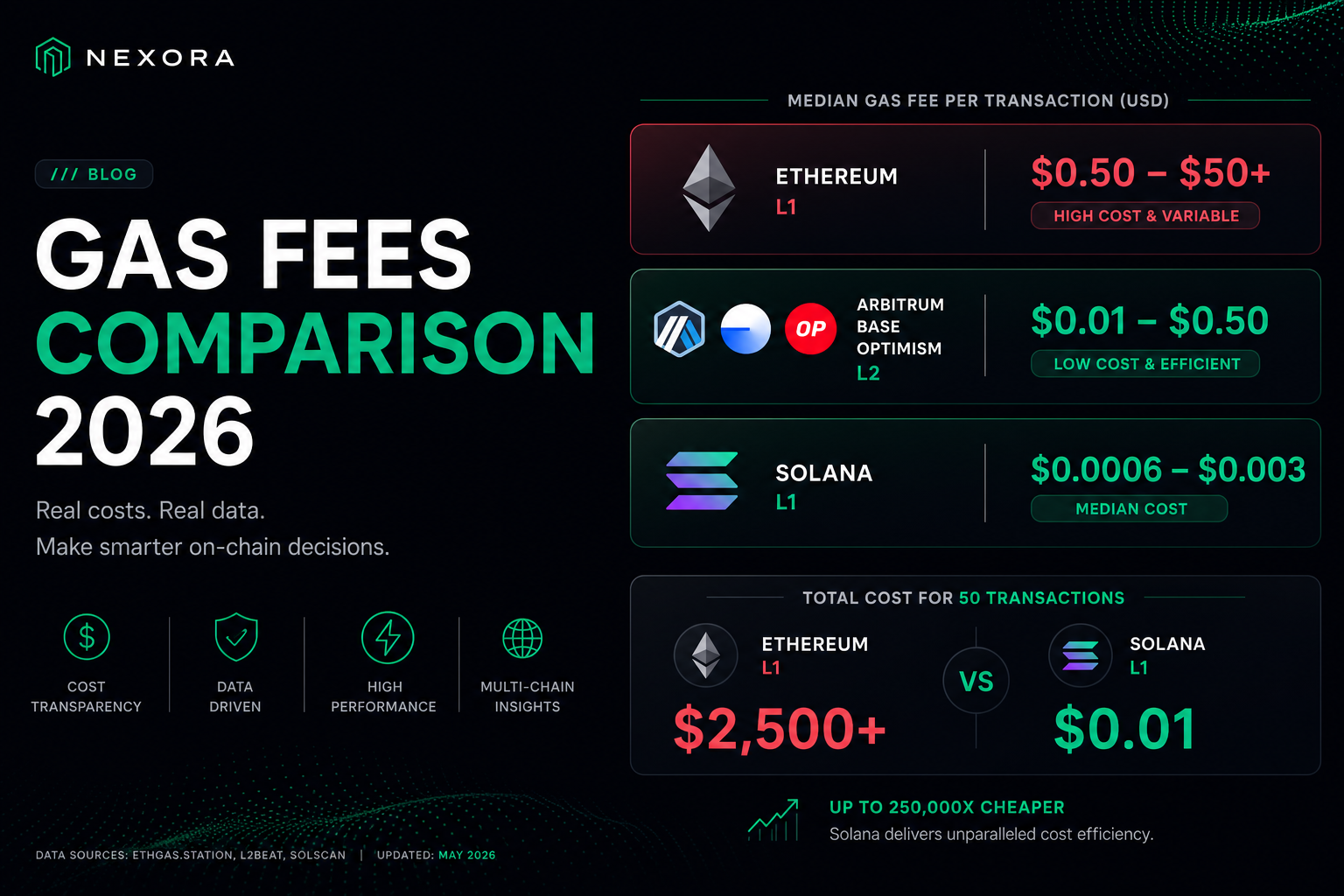
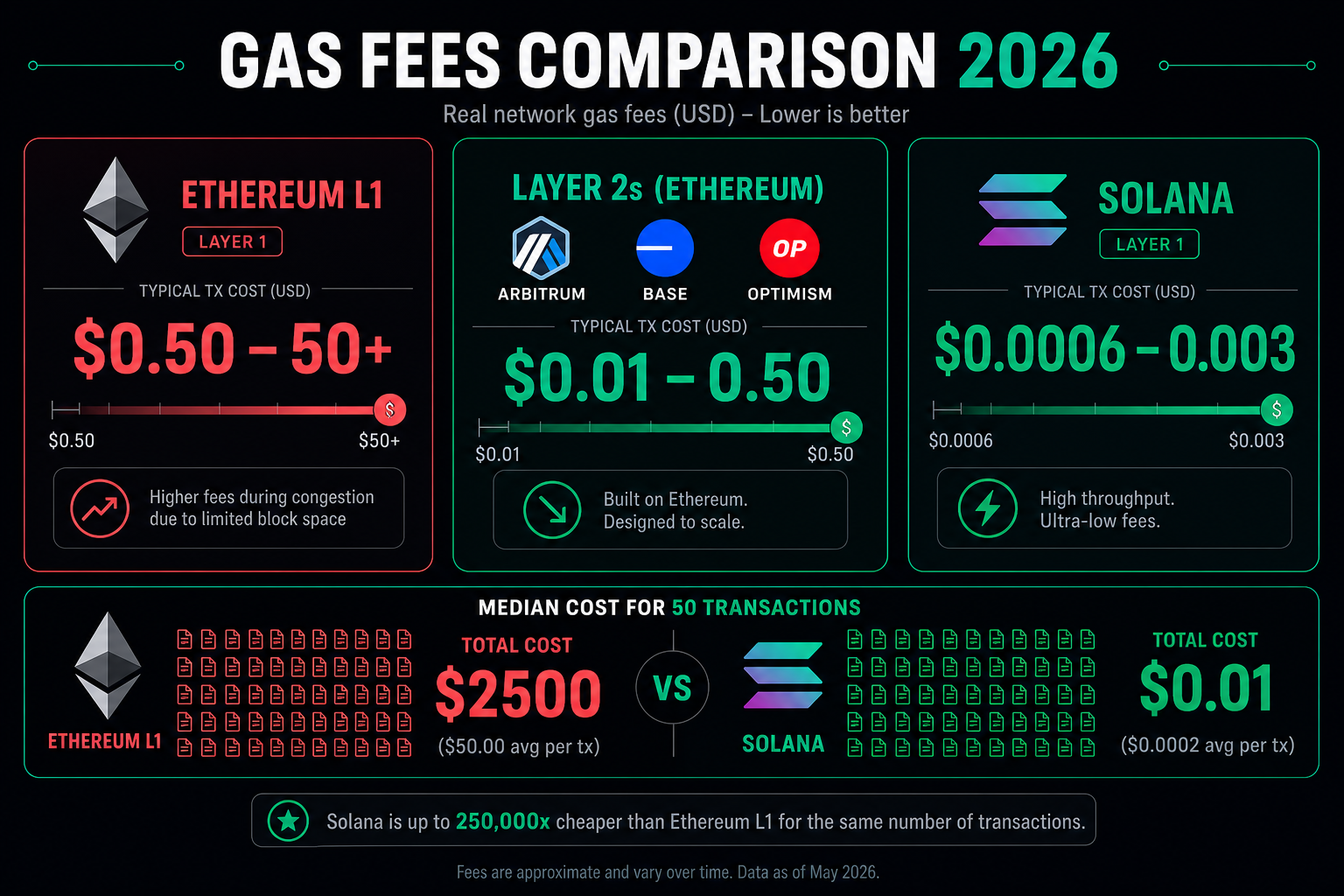
- Ethereum L1: $0.50-50+ per transaction (depending on demand), measured in "gwei"
- Ethereum L2s (Arbitrum, Base, Optimism): $0.01-0.50 — 10-100x cheaper than mainnet
- Solana: Median $0.0038 — under a penny, including base + priority fees
- Why Solana is so cheap: Proof of History + parallel processing + local fee markets
- Failed transactions: You still pay gas on Ethereum even if a transaction fails
- Hidden cost: Solana also charges "rent" (a refundable deposit) for new accounts
Gas fees compensate the network for processing your transaction and prevent spam. Smart timing and chain selection can save you significantly.
Trade on Solana with near-zero fees on GraphDex
Key Takeaways
- Gas fees are paid to validators to process and record blockchain transactions.
- Ethereum L1 fees fluctuate by demand ($0.50-50+); Solana stays under a penny ($0.0038 median).
- Solana's Proof of History and parallel processing keep fees low even during high activity.
- Strategies to save: use L2s, time transactions, batch actions, or use Solana for active trading.
What Are Gas Fees?
Gas fees are the transaction costs you pay to use blockchain networks. Every time you send crypto, swap tokens, interact with a smart contract, or mint an NFT, you pay a small amount to compensate the network's validators who process and record your transaction.
The term "gas" comes from Ethereum, where computation is measured in units of "gas" — like fuel for an engine. Each operation a smart contract performs consumes gas; the more complex the operation, the more gas it requires. You pay for the total gas used multiplied by a per-unit price. Solana borrowed the term but uses a different fee model.
Gas fees serve two purposes:
- Compensate validators for the computational and storage resources to process your transaction
- Prevent spam — without fees, malicious actors could flood the network with junk transactions
Understanding gas matters because the difference between paying $0.01 and $50 for the same operation often comes down to which chain you use, when you transact, and whether you optimize settings. A DeFi trader running 50 transactions a day on Ethereum mainnet during congested sessions can spend more than $2,500 in gas. The same 50 transactions on Solana cost roughly $0.01. That gap shapes user behavior, developer decisions, and entire ecosystem trajectories.
How Ethereum Gas Works
Ethereum's gas system is the original and most influential — and the source of most "high gas fees" complaints in crypto.
The mechanics. Every Ethereum transaction requires a certain amount of gas (units of computation). Simple ETH transfers use about 21,000 gas units; complex DeFi interactions can use 200,000+. You pay this gas at a "gas price" measured in gwei (1 gwei = 0.000000001 ETH). Your total fee = gas units × gas price.
Why fees fluctuate. Ethereum processes only about 15-20 transactions per second on its base layer. When demand exceeds capacity, users bid higher gas prices to get priority — like an auction for limited block space. During NFT mints, major DeFi events, or market volatility, gas prices can spike from $1 to $50+ for the same transaction.
Three components of an Ethereum fee:
- Base fee: Burned (removed from supply) — set algorithmically based on network demand
- Priority fee (tip): Goes to validators to incentivize inclusion in the next block
- Max fee: The maximum total you're willing to pay; you typically pay less
A critical pitfall: failed transactions still cost gas. If your Ethereum transaction fails (insufficient slippage tolerance, contract reverts, etc.), you still pay the gas — the network already used resources to process it.
Timing matters. Ethereum gas is typically lowest on weekends and during early morning UTC (2-8 AM), when global demand is lower. Tools like etherscan.io/gastracker show current prices in real time.
How Solana Fees Work (Why They're So Cheap)
Solana's fee structure is fundamentally different — and far cheaper.
Two components:
- Base fee: 5,000 lamports per signature (1 lamport = 0.000000001 SOL). Most transactions have one signature, so the base fee is under $0.001 — about a tenth of a cent.
- Priority fee (optional): Additional small payment for higher priority during congestion. Usually pennies even when included.
Typical costs:
- Median Solana transaction: $0.0038 (per multi-year Token Terminal data)
- Most transactions: $0.0006-0.001
- Swaps: $0.001-0.003
- NFT mints: under $0.01
Why Solana fees stay low — three architectural reasons:
-
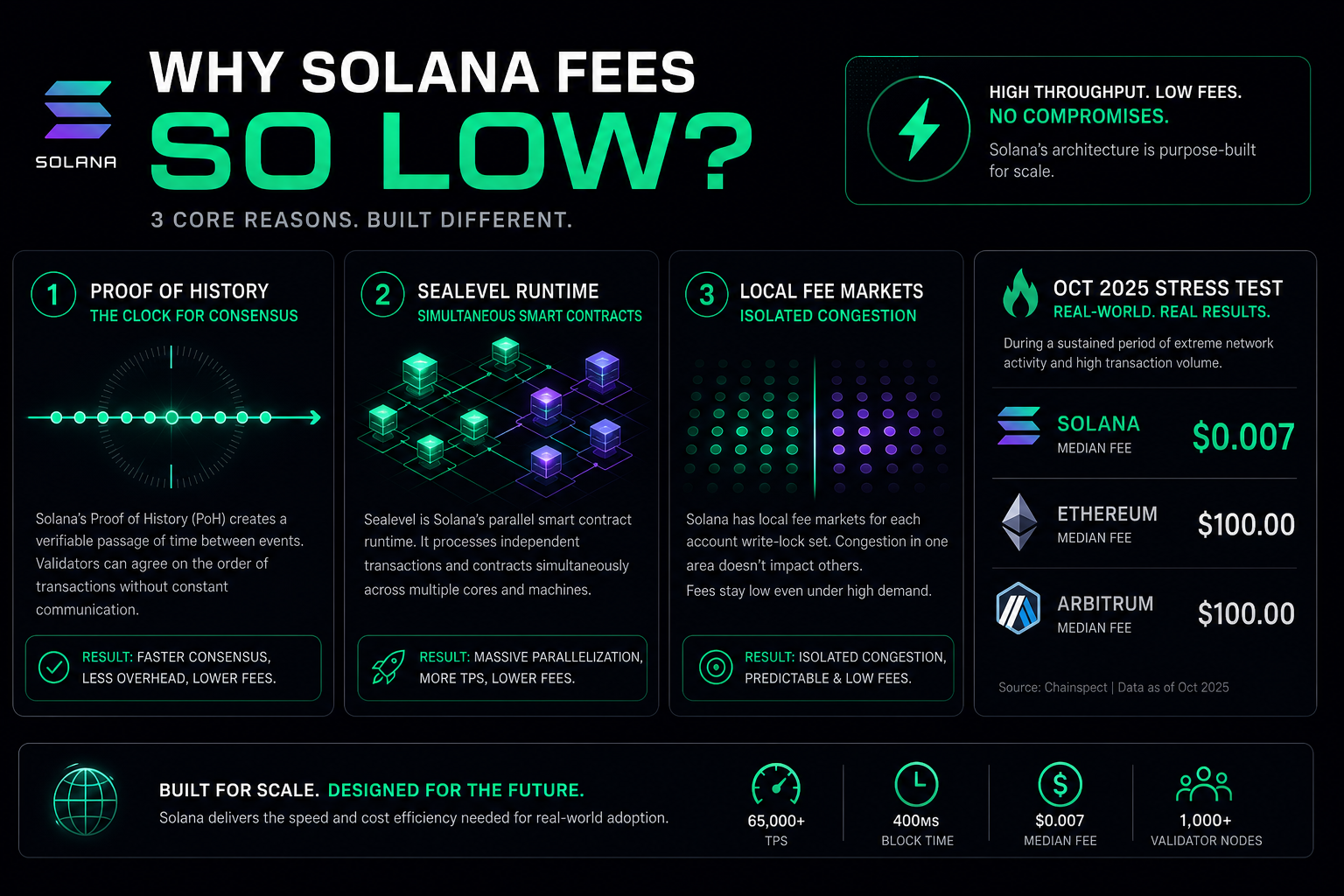
Proof of History. Solana's cryptographic clock lets validators process transactions in parallel without extensive coordination. More throughput per validator = lower cost per transaction.
-
Parallel processing (Sealevel runtime). Solana executes multiple smart contracts simultaneously, unlike Ethereum's sequential model. Transactions that don't touch the same accounts run in parallel.
-
Local fee markets. This is critical and often misunderstood. On Ethereum, a popular NFT mint raises gas for everyone on the network. On Solana, congestion is isolated to specific accounts/programs — if an NFT mint is popular, it only raises costs for that mint, while unrelated transactions stay cheap. Most users never feel "Solana network congestion" because it's localized.
The stress test that proved the design. On October 10, 2025 — the largest crypto liquidation event on record at the time — Solana performed seamlessly, processing approximately 100,000 transaction packets per second with median fees rising only to $0.007. In contrast, several Ethereum Layer 2 solutions reported latency issues, and median fees on Ethereum and Arbitrum spiked to $100. This wasn't a stable market test — it was the worst-case scenario, and Solana handled it.
The 2026 upgrades. SIMD-0096 and SIMD-0123 have changed how Solana fees are collected and distributed. Firedancer, Jump Crypto's independent validator client live since December 2025, has measurably smoothed fee spikes during congestion.
Ethereum L2s: The Compromise
For users who want Ethereum compatibility with lower fees, Layer 2 networks are the answer.
What L2s are. Networks that process transactions off the main Ethereum chain, then settle batches back to mainnet. They inherit Ethereum's security while dramatically improving throughput and reducing costs.
Major L2s and typical fees:
- Arbitrum: $0.01-0.20 per transaction
- Base (Coinbase's L2): $0.01-0.10
- Optimism: $0.01-0.20
- zkSync: $0.05-0.50
That's roughly 10-100x cheaper than Ethereum mainnet for the same operations.
The trade-off. L2s require bridging assets between Ethereum and the L2 (which has its own gas cost and time delay), and they fragment liquidity across multiple chains. They're a solid middle ground — Ethereum-compatible smart contracts, much cheaper fees — but they're more complex than a single-chain solution like Solana.
When L2s make sense. If your assets and the protocols you use are concentrated on Ethereum/EVM, L2s are the natural cost-reduction path. If you're starting fresh and want pure low-fee active trading, Solana avoids the bridging complexity entirely.
A Hidden Cost: Solana Rent
Solana has a fee concept Ethereum doesn't — and it confuses new users.
Rent is a refundable deposit you pay to keep accounts active on the Solana network. When you create a new token account (like the first time you hold a specific token), you pay approximately 0.002 SOL (~$0.25) as rent. This isn't a transaction fee — it's a deposit that keeps your account in the network's active state.
Key points:
- Rent is refundable when you close the account
- Most wallets handle this automatically when you receive a new token
- You only pay rent once per unique token account, not per transaction
- The fee structure is designed to prevent abandoned accounts from cluttering the network indefinitely
For most users, rent is invisible — your wallet handles it during normal use. But it's worth knowing: a "$0.25 fee" you might see receiving a new token isn't a gas fee, it's a refundable deposit you can recover later.
Why Validators Make Money With Low Fees
A reasonable question: if Solana fees are so low, how do validators make a living?
The answer is volume plus inflation rewards.
High volume. Solana processes daily transaction counts in the tens of millions. Even at $0.001 per transaction, this adds up to meaningful validator revenue at scale.
Inflation rewards. Validators receive newly minted SOL for participating in consensus. This is currently the primary income source — staking yield around 7-8% APY paid in SOL. Stakers (who delegate to validators) earn most of this, with validators taking a small commission.
Priority fees and MEV. During congestion, validators earn additional revenue from priority fees and MEV opportunities.
For Ethereum, the model is similar but inverted: base fees are burned (reducing ETH supply), while priority fees and MEV go to validators. The high cost per transaction means smaller volumes per validator are sufficient.
Both models work — they just price differently. Ethereum optimizes for "expensive but valuable" transactions; Solana optimizes for "cheap and frequent."
How to Save on Gas Fees
Practical strategies to minimize what you pay:
Time your transactions on Ethereum. Weekends and early morning UTC (2-8 AM) typically have lower demand. Check etherscan.io/gastracker before transacting.
Use Layer 2s. Arbitrum, Base, Optimism, and zkSync offer Ethereum-compatible smart contracts at 10-100x lower fees. Worth bridging if you're active.
Switch to Solana for active trading. For high-frequency activity (DeFi trading, memecoins, NFT mints), Solana's economics are transformative. Median $0.0038 versus Ethereum's $5-50.
Batch transactions. Some protocols let you bundle multiple actions into one transaction, saving on per-transaction overhead.
Set custom gas (Ethereum). In MetaMask, manually setting a lower gas price (and waiting longer for confirmation) avoids overpaying during competitive moments.
Avoid unnecessary approvals. Each token approval is a separate transaction with its own gas. Use "max approval" sparingly and revoke unneeded ones periodically with tools like revoke.cash.
Check fee tools. Etherscan gas tracker for Ethereum; Solana's fees are stable enough that real-time tracking is rarely needed.
Use a terminal with smart routing. Quality trading terminals route through efficient liquidity paths and bundle operations where possible, reducing per-trade fee impact.
For most active traders in 2026, the dominant strategy is "use Solana or L2s for high-frequency activity, Ethereum mainnet only for large, infrequent moves where deep liquidity matters." This is why Solana has captured most active DEX volume.
Trade frequently with near-zero fees on GraphDex
Trade with smart routing and low fees on GraphDex
Frequently Asked Questions
What are gas fees in crypto? Gas fees are transaction costs paid to blockchain validators to process and record transactions. They compensate validators for computational resources and prevent spam. The term "gas" comes from Ethereum where computation is measured in gas units; Solana uses a different fee model but the concept is similar — every transaction has a small fee.
Why are Solana gas fees so much cheaper than Ethereum? Solana's architecture: Proof of History (cryptographic clock enables parallel processing), Sealevel runtime (executes multiple smart contracts simultaneously), and local fee markets (congestion isolated to specific apps, not the whole network). The result: median $0.0038 versus Ethereum's $0.50-50+. Solana handles 1,000-4,000 TPS sustained vs Ethereum L1's 15-20.
Do I pay gas fees for failed transactions? On Ethereum, yes — you pay the gas even if your transaction fails (the network used resources processing it). On Solana, base fees are charged for processing but failed transactions cost very little ($0.0006+). This is one of Ethereum's most common frustrations and another reason active traders prefer Solana.
What's the difference between gas fees and Solana rent? Gas fees are transaction costs paid to validators (non-refundable). Solana rent is a refundable deposit (~$0.25) to keep new accounts active on the network — you can recover it when closing the account. Most wallets handle rent automatically; it's not really a "fee" in the traditional sense.
How much does it cost to swap tokens on Solana vs Ethereum? On Solana, a swap typically costs $0.001-0.003 in fees. On Ethereum mainnet, the same swap can cost $5-50+ depending on demand. On Ethereum L2s (Arbitrum, Base), expect $0.05-0.50. Solana is dramatically cheaper for active trading; Ethereum mainnet is reserved for large, infrequent operations.
What is gwei? Gwei is the unit Ethereum uses to measure gas prices. 1 gwei = 0.000000001 ETH (one billionth of an ETH). Gas prices are typically quoted as "20 gwei" or "50 gwei." Your total fee is gas units used × gas price in gwei × ETH price. Higher gwei = higher fee = faster transaction priority.
How can I reduce my crypto gas fees? Use Layer 2s (Arbitrum, Base) for 10-100x savings on Ethereum activity. Use Solana for high-frequency trading (sub-cent fees). Time Ethereum transactions for low-demand windows (weekends, 2-8 AM UTC). Batch operations where possible. Avoid unnecessary token approvals. For active traders, switching primary activity to Solana or L2s is the single biggest fee reduction.
About This Guide
This guide is published by the GraphDex Research team — analysts and traders building the infrastructure for digital asset trading on Solana. Our content is based on live network data, current fee figures, and hands-on experience.
Sources & data: Fee figures, network metrics, and platform details reflect publicly available information as of 2026 and change with network conditions. Gas fees vary based on demand. This guide is educational and not financial advice — always do your own research.
GraphDex is the infrastructure for digital asset trading — trade, predict, and earn in one place. Learn more at graphdex.io.
Last reviewed: May 2026 · GraphDex Research
The infrastructure for digital asset trading. Trade, predict, stake, repeat. graphdex.io