By GraphDex Research · Reviewed for accuracy May 2026
Quick Answer
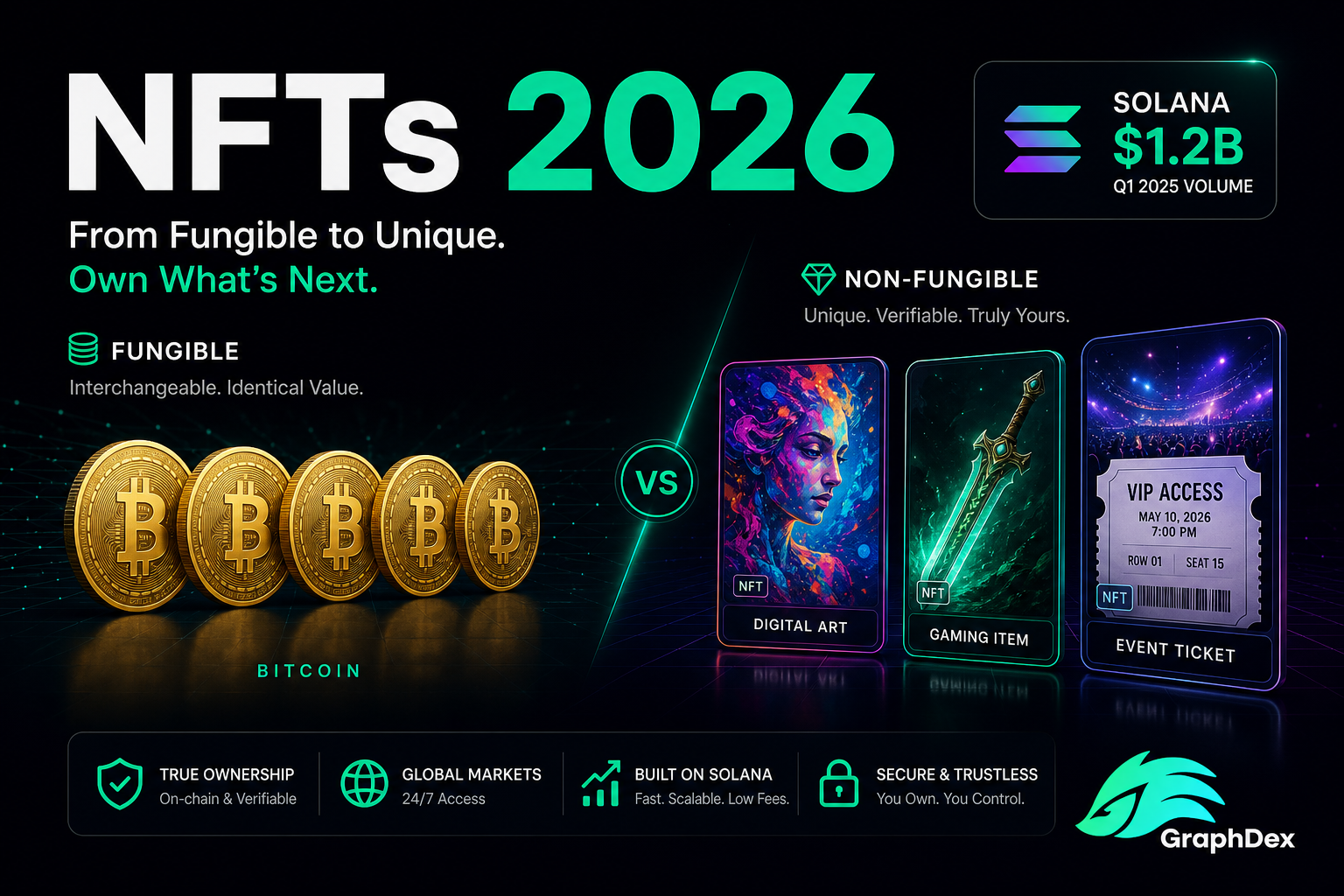
An NFT (Non-Fungible Token) is a unique digital token on a blockchain that represents ownership of a specific item — digital art, gaming asset, identity, ticket, or in-game collectible. Key facts in 2026:
- "Non-fungible" means unique: Unlike Bitcoin or USDC (where each unit is interchangeable), each NFT is one-of-a-kind
- Standards: ERC-721/ERC-1155 (Ethereum), Metaplex Core (Solana, 80%+ cheaper to mint)
- Solana NFTs: $1.2B+ in Q1 2025 trading volume, compressed NFTs (cNFTs) enable near-zero-cost minting
- Top marketplaces: Magic Eden (multi-chain leader), OpenSea (Ethereum standard), Blur (Ethereum pro trading)
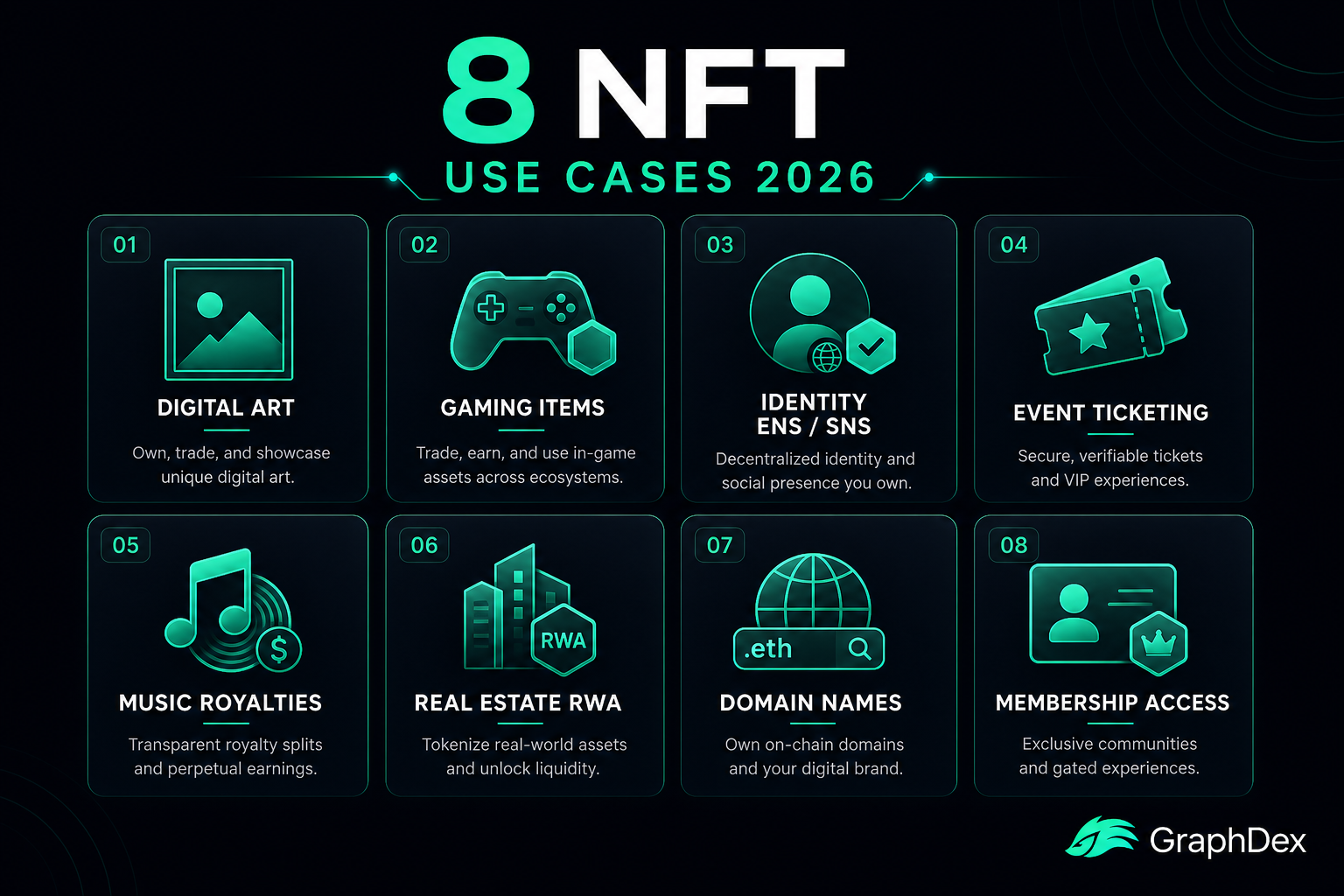
- Real use cases beyond art: Gaming items, identity, event ticketing, music royalties, real estate
- Environmental shift: Ethereum's 2022 Merge cut energy use 99.95%; Solana and most NFT chains are PoS-efficient
NFTs are about provable digital ownership — and that's increasingly useful in gaming, identity, and digital culture.
Trade on Solana with low fees on GraphDex
Key Takeaways
- NFTs are unique blockchain tokens representing ownership of specific digital or physical items.
- Solana leads on accessible NFT infrastructure: $1.2B+ Q1 2025 volume, cNFTs cut costs 80%+.
- Major use cases beyond art: gaming, ticketing, identity, music, real estate, on-chain provenance.
- Top marketplaces: Magic Eden (multi-chain), OpenSea (Ethereum), Blur (Ethereum pro), Tensor (Solana).
What Is an NFT?
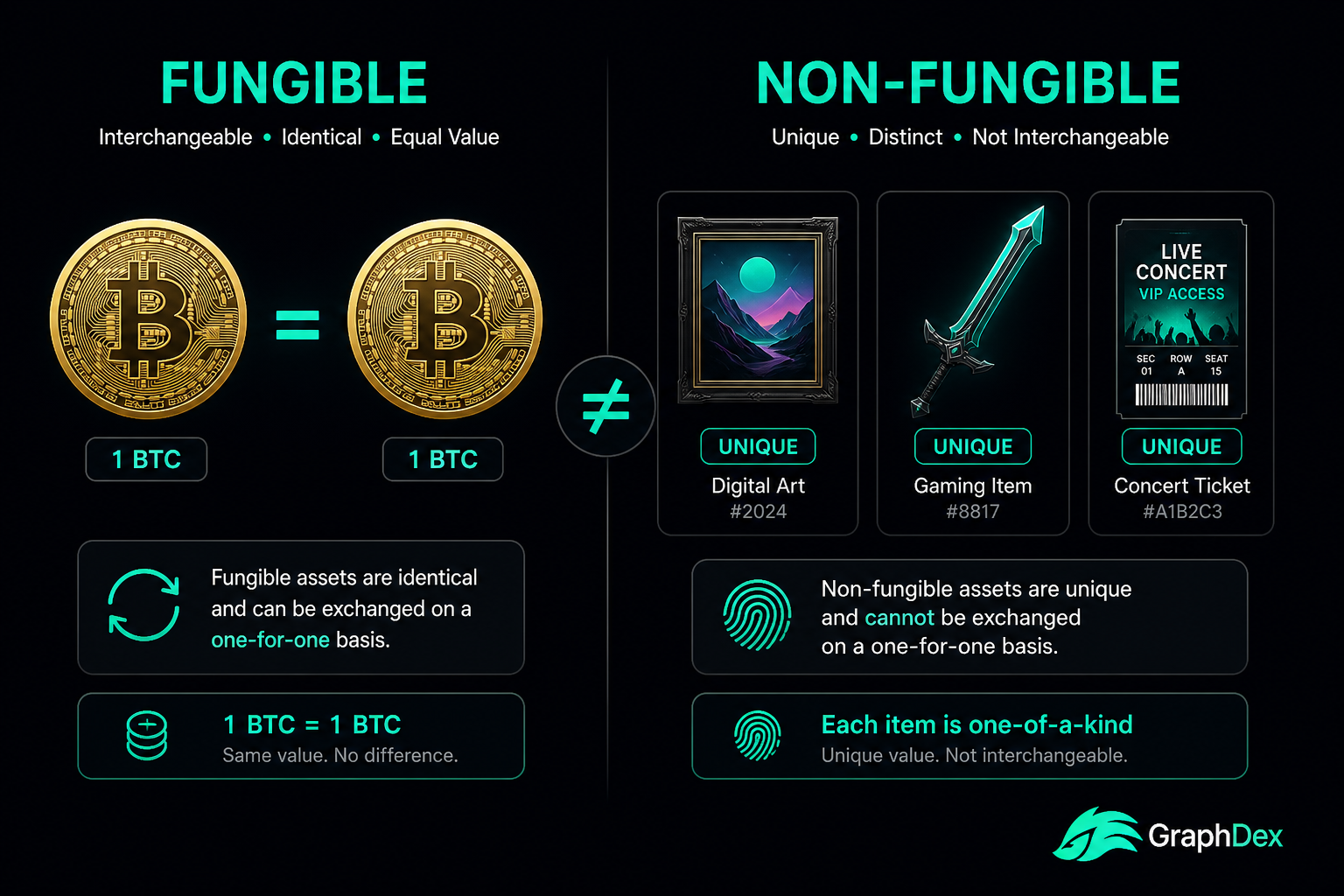
An NFT (Non-Fungible Token) is a unique digital token recorded on a blockchain. Unlike fungible cryptocurrencies — where each Bitcoin, USDC, or SOL is interchangeable with any other — each NFT is one-of-a-kind. That uniqueness is what enables NFTs to represent ownership of specific items.
The "non-fungible" insight. Money is fungible: any dollar equals any other dollar. A plane ticket is non-fungible: your specific ticket on a specific flight is unique. NFTs apply this to blockchain — making them suitable for representing things where uniqueness matters: a specific digital artwork, a particular gaming sword, a specific event ticket, a unique identity credential.
What's actually on the blockchain. When you "own" an NFT, the blockchain records that your wallet address controls a token with a unique identifier. The actual image, video, or asset is typically stored off-chain (on IPFS, Arweave, or traditional servers), with the on-chain token containing a link and metadata. You own the token; the token points to the asset.
Why this matters. Before NFTs, digital items couldn't be "owned" the way physical items can — they could only be copied infinitely. NFTs introduced verifiable digital ownership: a way to prove you specifically own a digital item, that it's distinct from copies, and that ownership can be transferred peer-to-peer without intermediaries. This is foundational for digital culture, gaming, identity, and many emerging use cases.
By 2026, NFTs have moved well past the 2021-2022 speculation peak into more mature use cases. The category is smaller in dollar terms than its peak but more functional and grounded.
How NFTs Actually Work
The technical foundation involves token standards, marketplaces, and storage.
Token standards. NFTs are issued using standardized smart contract templates that ensure marketplaces and wallets can read them consistently.
- Ethereum: ERC-721 (one-of-one NFTs) and ERC-1155 (semi-fungible, like 100 copies of the same item) are the dominant standards.
- Solana: Metaplex's Core standard has become the standard, cutting minting costs by 80%+ vs older approaches. Compressed NFTs (cNFTs) enable mass minting at near-zero cost.
- Other chains: Polygon, Base, Aptos, and others use their own standards (often EVM-compatible).
Minting. Creating an NFT is called "minting." You deploy a smart contract that issues unique tokens to wallet addresses. On Ethereum, minting can cost $5-100+ in gas; on Solana, it's typically fractions of a cent — making large collections economically viable.
Marketplaces. NFT marketplaces are where buying and selling happens:
- Magic Eden — multi-chain leader, started on Solana, now supports Ethereum, Bitcoin Ordinals, Polygon, Base
- OpenSea — the original Ethereum marketplace with broad reach
- Blur — Ethereum pro-trader-focused, zero trading fees, BLUR airdrop incentives
- Tensor — Solana professional trading platform
- Solanart — Solana-focused, curated drops
Storage. The actual NFT asset (image, video, audio) typically lives off-chain on decentralized storage (IPFS, Arweave) or traditional servers. Best practice uses decentralized storage so the asset persists even if a marketplace disappears.
Wallets. Standard crypto wallets (Phantom for Solana, MetaMask for Ethereum) hold NFTs the same way they hold tokens. Your wallet address is your NFT inventory.
What NFTs Are Used For in 2026
The 2021 hype focused almost entirely on profile pictures and digital art. By 2026, the use cases have matured significantly.
Digital Art and Collectibles
The original use case remains significant. Major collections (CryptoPunks, Bored Ape Yacht Club) retain cultural and economic relevance. New artists launch through platforms like SuperRare, Foundation, and Solana's Tensor/Magic Eden.
Gaming Items and Game Economies
Probably the highest-impact use case. Game items as NFTs mean players own their assets — and can trade, sell, or carry them across games. If a game shuts down, your items persist (provided they're stored on decentralized infrastructure). Solana's speed and low fees make NFT-based gaming economically viable; major Solana games rely heavily on NFTs.
Identity and Credentials
Wallet-bound credentials (ENS domain names, Solana's SNS, Lens Protocol profiles, soulbound tokens) represent identity, achievements, and credentials. ENS gave wallets human-readable names (yourname.eth); similar Solana naming services exist. These are foundational for Web3 identity.
Event Ticketing
NFTs as event tickets prevent counterfeiting and enable smart royalties on resale. Major sports leagues, music festivals, and conferences have piloted NFT ticketing. The model addresses real ticketing problems (scalping, fraud) better than legacy systems.
Music and Media Royalties
Musicians issue NFTs that represent royalty rights — fans can own a percentage of streaming revenue. Platforms like Sound.xyz and Royal pioneered this. Cuts out traditional music industry intermediaries for some artists.
Real Estate and RWAs
Tokenized real estate uses NFT-like (or sometimes fungible token) structures to represent fractional property ownership. Overlaps significantly with the RWA category.
Domain Names
ENS (.eth) on Ethereum, Solana Name Service (.sol), and similar protocols on other chains use NFTs to represent domain ownership. Major Web3 infrastructure.
Membership and Access
NFTs as membership tokens — owning the NFT grants access to a community, content, or service. Used by DAOs, content platforms, exclusive groups.
The pattern: NFTs work best where verifiable, transferable, and unique ownership creates value. Pure profile-picture speculation has receded; substantive use cases have grown.
NFTs on Solana vs Ethereum
The two main NFT chains have diverged into different specialties.
Ethereum's NFT scene:
- Highest dollar volume historically — blue chips (CryptoPunks, BAYC, Art Blocks) live here
- Strongest collector base for fine art and high-value collectibles
- Deeper liquidity for premium collections
- Pro-trader infrastructure (Blur) for active trading
- Higher minting costs limit accessibility
Solana's NFT scene:
- $1.2 billion+ in Q1 2025 trading volume — major player
- Mass-minting collections economically viable due to low fees
- Compressed NFTs (cNFTs) make minting "millions of assets at near-zero cost" possible — useful for gaming and consumer apps
- Magic Eden originated here before going multi-chain
- Strong gaming and consumer-app NFT focus
Metaplex is the foundational NFT infrastructure on Solana. Its Core standard (released 2024-2025) cuts minting costs by more than 80% compared with older Metaplex methods, dramatically improving the economics of large drops.
The practical takeaway: Ethereum for premium fine art and established blue chips; Solana for accessible drops, gaming, and consumer applications. Many serious collectors hold NFTs across both.
How to Buy Your First NFT
For beginners wanting to start with NFTs:
Step 1: Choose a chain. Solana (low fees, accessible) or Ethereum (established collections, higher costs). For first NFT purchases, Solana is often the better learning ground due to fees.
Step 2: Get a wallet. Phantom for Solana; MetaMask for Ethereum. Both are non-custodial and free.
Step 3: Fund your wallet. Buy crypto (SOL for Solana, ETH for Ethereum) on an exchange and transfer to your wallet.
Step 4: Choose a marketplace. Magic Eden (Solana, multi-chain), OpenSea (Ethereum), Blur (Ethereum pro), Tensor (Solana pro). Each has slightly different UX and fees.
Step 5: Browse and verify. Use only verified collections on marketplace front pages — most marketplaces show verification checkmarks. Beware fake/copy collections.
Step 6: Check the floor price and rarity. Floor price is the cheapest listing in a collection — your minimum entry. Rarity tools (in marketplaces) show which traits make specific NFTs more valuable.
Step 7: Buy. Connect wallet, approve transaction (you'll pay the NFT price + gas), receive the NFT.
Step 8: Store securely. Your NFT is now in your wallet. For valuable NFTs, consider transferring to a hardware wallet for cold storage.
NFT Risks and Realities
For balance, NFTs carry specific risks worth understanding.
Market volatility. NFT prices can swing wildly. Many 2021-2022 collections lost 80-95% of their peak value. NFT investing is high-risk speculation, not stable asset acquisition.
Theft and phishing. NFTs can be stolen via wallet exploits, malicious smart contract approvals, or seed phrase theft. Once transferred, transactions are irreversible. Use hardware wallets for valuable NFTs and never sign suspicious transactions.
Wash trading and fake volume. Some NFT markets are manipulated by wash trading (trading with yourself to fake volume). Established marketplaces have anti-wash measures, but vigilance matters.
Storage permanence. NFTs point to assets stored off-chain. If storage fails (a private server goes down, IPFS pin lapses), the asset can be lost while the token persists. Reputable collections use Arweave or pinned IPFS for permanence.
Royalty erosion. Marketplaces have warred over royalty enforcement. Some no longer enforce creator royalties, reducing creator income. This is an evolving issue.
Regulatory uncertainty. Whether specific NFTs are securities depends on jurisdiction and use case. Most pure collectibles are not, but utility tokens with profit promises may be.
Pure speculation risk. Many NFT collections have no underlying value beyond community attention. Like memecoins, most go to zero. Treat NFT purchases as collecting/speculation, not investment.
The environmental argument is outdated. Ethereum's September 2022 Merge cut energy use by 99.95%. Solana and most NFT chains use efficient Proof-of-Stake. The "NFTs destroy the planet" argument was real in 2021 but is largely outdated in 2026.
For beginners: start small, stick to established collections, never invest more than you can afford to lose, and treat NFTs as cultural artifacts or speculation rather than reliable investments.
Explore Solana via GraphDex's integrated terminal
How GraphDex Fits Into the Solana Ecosystem
GraphDex isn't an NFT marketplace, but it's part of the broader Solana ecosystem where NFTs live and thrive. The same Solana strengths that enable accessible NFT minting (low fees, fast finality) make GraphDex's active trading economics viable.
For Solana users, the workflow connects: you might trade tokens on GraphDex, earn yield on stablecoins (up to 17% APY), participate in Polymarket prediction markets via GraphDex, AND hold NFTs in the same Phantom or Privy-backed wallet. The non-custodial wallet architecture is identical — your assets, including NFTs, stay in your control.
As Solana NFTs continue evolving toward gaming, consumer apps, and utility-driven use cases, terminals like GraphDex represent the trading and earning infrastructure for the broader Solana ecosystem they live alongside.
Trade on Solana with one terminal on GraphDex
Frequently Asked Questions
What is an NFT in simple terms? An NFT (Non-Fungible Token) is a unique digital token recorded on a blockchain that represents ownership of a specific item — like digital art, a gaming asset, an event ticket, or an identity credential. Unlike Bitcoin or USDC where each unit is interchangeable, each NFT is one-of-a-kind, enabling provable digital ownership.
Are NFTs still valuable in 2026? The category has shifted significantly. Pure profile-picture speculation has receded from 2021 peaks (many collections lost 80-95% of value). But substantive use cases — gaming, identity, ticketing, music royalties, real estate — have grown. Solana alone had $1.2 billion+ NFT trading volume in Q1 2025. Value depends on the use case and specific NFT, not the category as a whole.
Where do I buy NFTs? Top marketplaces: Magic Eden (Solana plus multi-chain), OpenSea (Ethereum), Blur (Ethereum pro trading with zero fees), Tensor (Solana pro). Choose based on your chain and the collection you want. Always verify collections via marketplace verification badges to avoid fakes.
How are Solana NFTs different from Ethereum NFTs? Solana NFTs use the Metaplex standard with much lower minting costs (Metaplex Core cut costs 80%+ vs older methods). Compressed NFTs (cNFTs) enable minting millions at near-zero cost. Ethereum NFTs use ERC-721/ERC-1155 standards with higher minting costs but the most established blue-chip collections. Different chains for different use cases — Ethereum for premium art, Solana for accessible drops and gaming.
What's the cheapest way to mint NFTs? Solana with the Metaplex Core standard is among the cheapest — typically fractions of a cent per NFT. Compressed NFTs (cNFTs) can be even cheaper for large collections. Polygon offers EVM-compatible low-cost minting. Ethereum mainnet is the most expensive ($5-100+ in gas). Choose based on your audience and project economics.
Can NFTs be stolen? Yes. NFTs can be stolen via wallet exploits, phishing, malicious smart contract approvals, or seed phrase theft. Once transferred on the blockchain, transactions are irreversible. Security practices: use hardware wallets for valuable NFTs, never share seed phrases, carefully review every transaction you sign, avoid suspicious sites, and revoke unused contract approvals.
Are NFTs bad for the environment? This concern was valid in 2021 under Ethereum's Proof-of-Work. After Ethereum's September 2022 Merge to Proof-of-Stake, energy consumption dropped by ~99.95%. Solana, Polygon, and most other NFT chains use energy-efficient consensus. The environmental argument against NFTs is largely outdated in 2026.
About This Guide
This guide is published by the GraphDex Research team — analysts and traders building the infrastructure for digital asset trading on Solana. Our content is based on live market data, current platform information, and hands-on experience.
Sources & data: NFT volume figures, platform details, and market dynamics reflect publicly available information as of 2026 and may change. NFTs carry significant risk of loss including total loss. This guide is educational and not financial advice — always do your own research.
GraphDex is the infrastructure for digital asset trading — trade, predict, and earn in one place. Learn more at graphdex.io.
Last reviewed: May 2026 · GraphDex Research
The infrastructure for digital asset trading. Trade, predict, stake, repeat. graphdex.io