By GraphDex Research · Reviewed for accuracy May 2026
Quick Answer
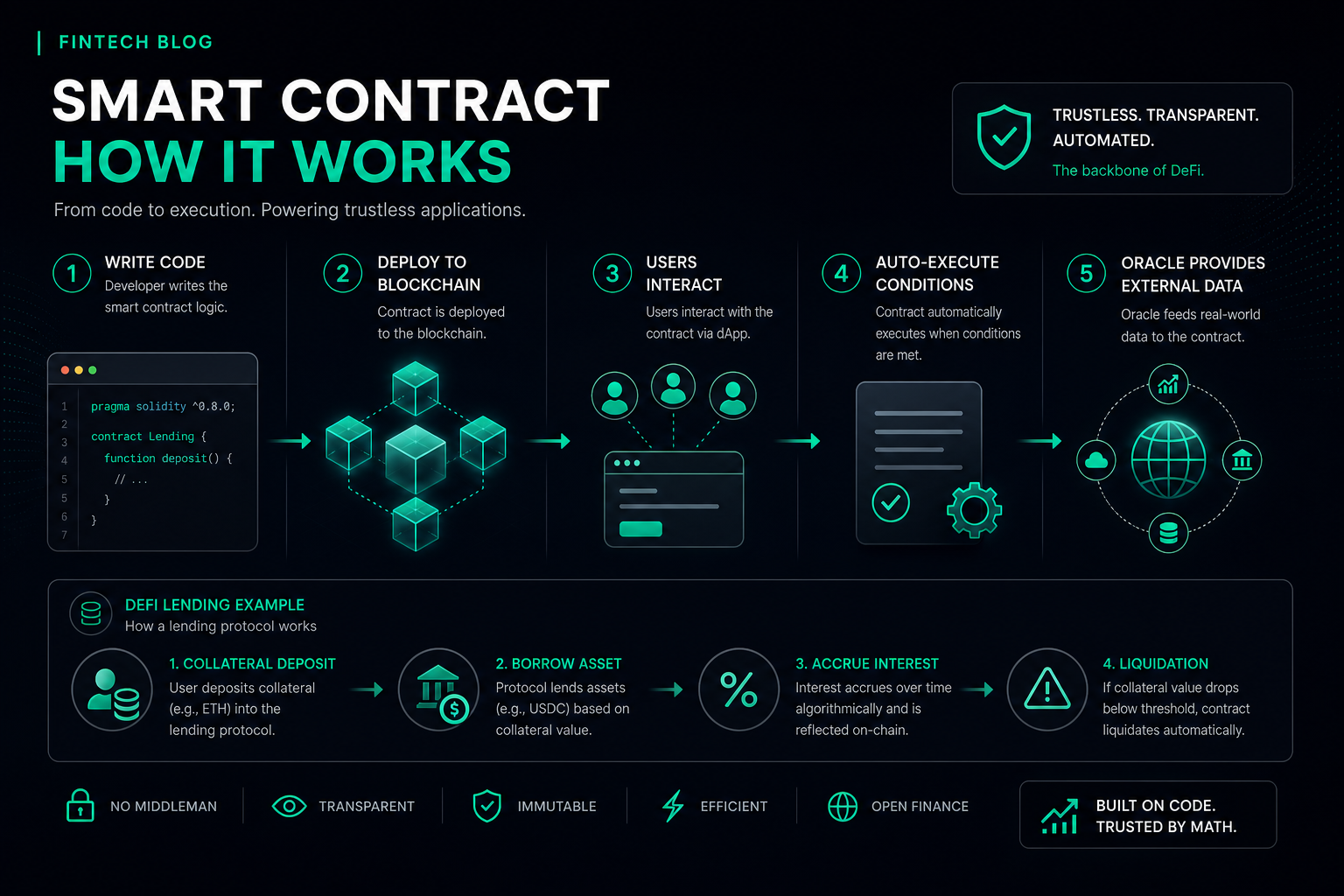
A smart contract is a self-executing program stored on a blockchain that automatically performs actions when predefined conditions are met. Key facts:
- Concept: First proposed by cryptographer Nick Szabo in 1994 (vending machine analogy)
- Real implementation: Ethereum (2015) brought programmable smart contracts at scale
- How they work: Code deployed to a blockchain; once live, it's immutable and executes automatically
- Languages: Solidity (Ethereum), Rust (Solana), Move (Aptos/Sui), and others
- Use cases: DeFi lending, DEXs, NFTs, prediction markets, DAOs, automated insurance
- Solana difference: Smart contracts are called "programs" and separate code from state (data) for better scalability
Smart contracts power most of DeFi, but bugs in code can cause major losses. Use audited protocols.
Trade smart-contract DeFi on Solana via GraphDex
Key Takeaways
- A smart contract is self-executing code on a blockchain that runs when conditions are met.
- Ethereum pioneered them; Solana evolved the design with "programs" that separate code from state.
- They power DeFi, DEXs, NFTs, prediction markets, DAOs, and many other crypto applications.
- Smart contract bugs are real — use audited protocols and verify before approving transactions.
What Is a Smart Contract?
A smart contract is a self-executing program stored on a blockchain that automatically performs actions when specific, predetermined conditions are met. The key word is automatic: there's no human intervention needed to enforce the agreement — the code does it.
Cryptographer Nick Szabo proposed the concept in 1994, using the vending machine analogy: you insert the right input (money), and the machine delivers the output (a soda), with no negotiation, no human cashier, no recourse if the conditions are met. The agreement is self-enforcing through the machine's mechanism. Smart contracts apply this idea to financial agreements at internet scale.
Early blockchains like Bitcoin had limited scripting, but real programmable smart contracts arrived with Ethereum in 2015. Ethereum introduced a virtual machine (the EVM) that could execute arbitrary code on-chain, opening up entire categories of applications that didn't exist before: decentralized exchanges, lending protocols, NFTs, DAOs.
Today, smart contracts run across dozens of blockchain networks supporting DeFi activity. They underpin over $100 billion in TVL (Total Value Locked) in DeFi protocols, billions in NFT marketplaces, and the entire infrastructure of decentralized finance.
How Smart Contracts Work
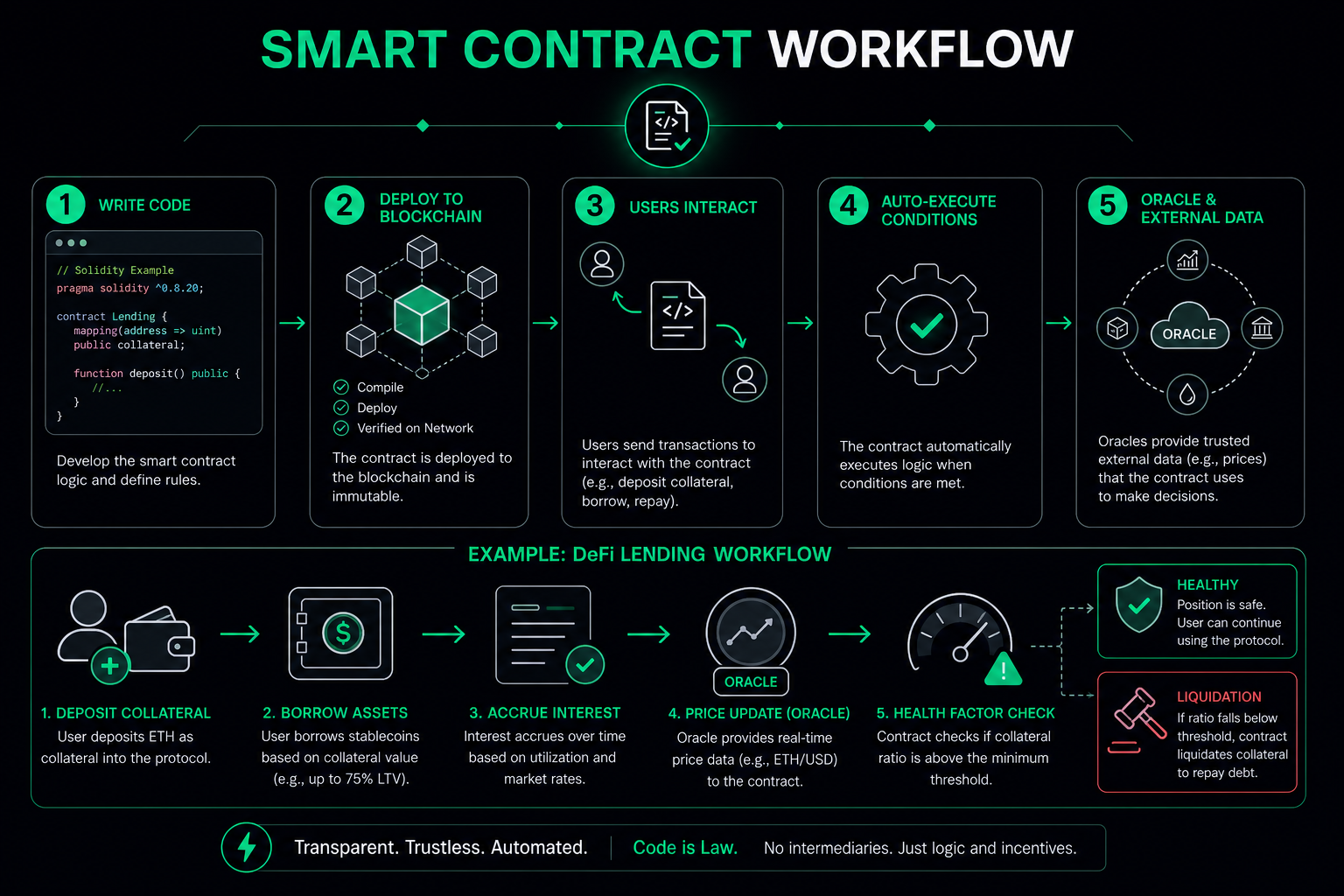
The mechanics of a smart contract follow a clear sequence:
1. Write the code. Developers define the contract's terms, conditions, and execution logic in a programming language (Solidity for Ethereum, Rust for Solana, others for other chains).
2. Deploy to the blockchain. The compiled code is broadcast to the network via a wallet transaction. Once confirmed in a block, the contract is live, has a unique address, and is immutable — it cannot be changed (with some exceptions discussed below).
3. Users interact with it. Anyone can call the contract's functions by sending a transaction to its address. This might involve sending tokens, querying state, or triggering specific functions.
4. Automatic execution. When the predefined conditions are met, the blockchain executes the contract's logic and records the result permanently on the ledger. No human can override or stop the execution mid-way (within the rules of the contract).
5. Oracle integration (if needed). Smart contracts run in a deterministic environment — they can't natively access real-world data (asset prices, weather, sports results). Oracle networks like Chainlink feed verified external information into the blockchain so contracts can act on it.
A concrete example: A DeFi lending protocol. You deposit crypto as collateral, the contract calculates your borrowing limit based on the collateral value, disburses a loan instantly when you request it, charges interest over time, and automatically liquidates your collateral if its value drops below a set threshold. All without a loan officer, paperwork, or approval delay — pure code execution against deposited assets.
What Makes Smart Contracts Special
Smart contracts have several properties that make them genuinely different from traditional code:
Trustless execution. You don't need to trust a counterparty — the code's behavior is the agreement, and it's executed by the network rather than a single party. As long as you trust the code (and the underlying blockchain), the agreement holds.
Transparency. Because contracts are deployed on public blockchains, anyone can read the code, verify what it does, and audit it. There are no hidden terms.
Immutability. Once deployed, a standard smart contract cannot be changed. This guarantees the rules won't shift after you've engaged — but it also means bugs become permanent without special design. (Some contracts use "upgradeable proxy patterns" to allow updates, though this introduces trust assumptions about who controls upgrades.)
Composability. Smart contracts can call each other. A new protocol can build on top of an existing one without permission, leading to the "money lego" effect where DeFi protocols stack to create complex new products.
Permissionless deployment. Anyone can deploy a smart contract — no approval, no gatekeeper. This is both a strength (innovation flourishes) and a risk (scams flourish too).
Global reach, 24/7. Smart contracts execute regardless of geography, holidays, or business hours. They're always on.
These properties together enable use cases that traditional contracts can't match — automated, transparent, programmable financial logic at internet scale.
Ethereum vs Solana Smart Contracts
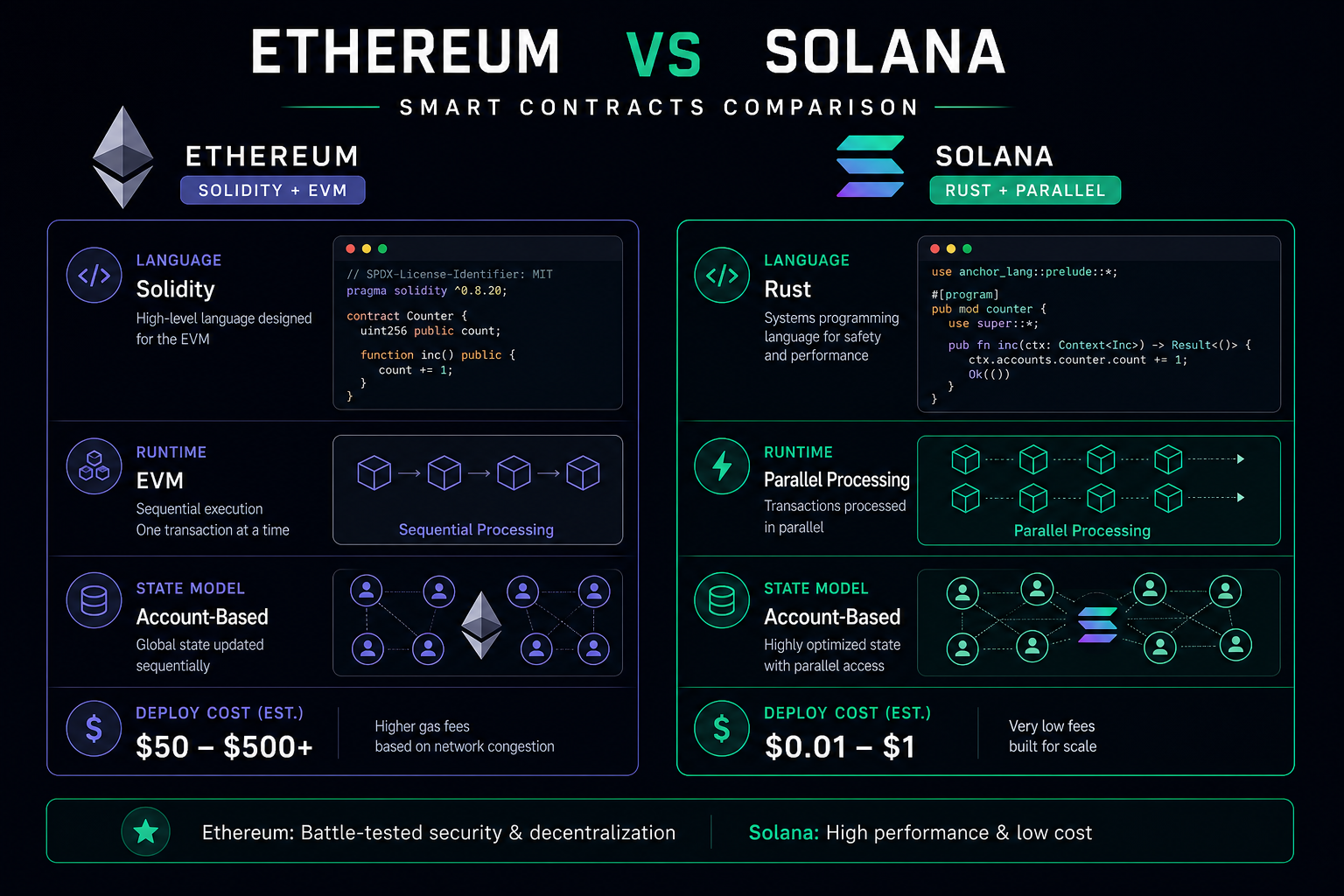
The two major smart contract platforms take different architectural approaches that matter for performance and development.
Ethereum Smart Contracts
Ethereum has the largest smart contract ecosystem by TVL, the most mature tooling, and the strongest network effects. Contracts are written in Solidity (primarily) or Vyper, and deployed to the Ethereum Virtual Machine (EVM). EVM compatibility means Ethereum-style contracts also run on Arbitrum, Base, Polygon, BNB Chain, and many other "EVM-compatible" chains, sharing the same development ecosystem.
Ethereum's model: Code and state (data) are bundled together in each contract. A contract's address holds both its logic and its current data. This unified model is intuitive but limits parallel processing.
Deployment cost: $50-500+ on Ethereum mainnet depending on gas prices and contract complexity. L2s are dramatically cheaper.
Solana Smart Contracts ("Programs")
Solana evolved the design for performance. On Solana, smart contracts are called programs, and they operate differently than Ethereum.
The key architectural difference: Solana separates state from logic. Programs contain only code; data is stored in separate accounts. This separation allows Solana to process many transactions in parallel — multiple transactions that don't access the same data can run simultaneously, dramatically improving throughput.
Solana programs are primarily written in Rust (for performance and memory safety), with some in C or C++. The Anchor framework simplifies development.
Deployment cost: Dramatically cheaper than Ethereum, often a few dollars to a few hundred for the on-chain rent — making Solana attractive for high-volume and consumer applications.
The architectural difference means Solana smart contracts excel at scenarios requiring high transaction volumes, low latency, or minimal fees — exactly the conditions that suit active trading, memecoins, and prediction markets.
Real-World Use Cases
Smart contracts power most of what's exciting in crypto. Major categories:
Decentralized Exchanges (DEXs). Smart contracts hold liquidity pools and execute trades algorithmically. Uniswap on Ethereum, Raydium and Orca on Solana — all are smart-contract-powered DEXs.
Lending and borrowing. Aave, Compound (Ethereum), Kamino (Solana) — protocols where smart contracts hold collateral, calculate interest, and execute liquidations automatically.
Stablecoins. USDC and USDT are smart contracts that mint dollar-pegged tokens; DAI is a smart contract that mints stablecoin against collateral.
Liquid staking. Lido (ETH), Jito and Marinade (SOL) use smart contracts to stake tokens and issue derivative tokens representing your stake.
NFTs and marketplaces. OpenSea, Magic Eden — smart contracts that govern NFT minting, ownership, transfers, and royalties.
Prediction markets. Polymarket runs on smart contracts that hold collateral, settle outcomes based on oracles, and pay winners — all without a centralized operator.
DAOs (Decentralized Autonomous Organizations). Smart contracts manage treasuries, voting, and execution of organizational decisions.
Gaming. On-chain games use smart contracts for in-game economies, asset ownership, and transparent rules.
Insurance and derivatives. Decentralized insurance protocols, options, futures — programmatically enforced.
Each of these replaces a traditional intermediary (exchange, lender, escrow, marketplace) with code that executes automatically. The total economic activity running on smart contracts now exceeds many traditional financial markets.
The Risks of Smart Contracts
For balance, smart contracts have genuine risks worth understanding.
Bugs and exploits. Smart contract code is software, and software has bugs. When a financial smart contract has a bug, attackers can drain it. Major DeFi hacks have lost hundreds of millions: the $285M Drift exploit on Solana in 2025 is a recent example. Using only audited, established protocols reduces but doesn't eliminate this risk.
Immutability cuts both ways. Once deployed, a contract can't be changed. If a bug exists, it stays unless the contract uses an upgradeable pattern (which itself introduces trust assumptions about who controls upgrades). Standard contracts can be paused or deprecated, but the code itself is permanent.
Oracle risk. Contracts that depend on external data (prices, outcomes) inherit the security of their oracle. Manipulated oracles have caused major exploits.
Approval risk. Many smart contract interactions require approving the contract to spend tokens on your behalf. A malicious or compromised contract with broad approvals can drain your wallet. Always review approvals carefully.
Composability risk. Because protocols stack, a vulnerability in one can cascade through many that depend on it.
No customer service. If you send tokens to the wrong contract address, mistakenly approve a malicious contract, or get exploited, there's no support to call. The code executes; what's done is done.
Audit costs. Professional audits help — they typically cost $15,000-60,000 depending on complexity — but they're not foolproof. Even audited contracts have been exploited. Multiple audits and bug bounties are best practice but never guarantee safety.
The takeaway: smart contracts power genuinely transformative applications, but they require careful evaluation. Use established protocols with audit history. Review what you're signing. Never invest more than you can afford to lose.
How to Read a Smart Contract
For users wanting to verify what they're interacting with, basic smart contract literacy helps.
Block explorers (Etherscan for Ethereum, Solscan for Solana) display the contract's address, transaction history, deployed bytecode, and (if the developer verified it) the original source code. Verified contracts let you read the actual logic.
Read for red flags: Functions that let the owner mint unlimited tokens (mint authority), pause withdrawals, freeze accounts, or change critical parameters at will. These aren't always malicious but represent trust assumptions.
Check token approvals. Tools like revoke.cash let you see and revoke contract approvals on your wallet — important hygiene after using new dApps.
Look for audit reports. Reputable protocols publicize audits from established firms (Trail of Bits, OpenZeppelin, CertiK, Halborn, others). Multiple audits and active bug bounties are positive signals.
Use community signals. Established protocols with millions in TVL and years of operation have an implicit safety record over new untested contracts.
For most users, the practical version is simpler: stick to well-known, audited protocols. Check approvals. Be skeptical of new contracts especially those promising outsized returns.
Interact with audited Solana protocols via GraphDex
How GraphDex Uses Smart Contracts
GraphDex builds on Solana's smart contract infrastructure. When you trade through GraphDex, you're interacting with Solana programs — the DEX programs of Raydium, Orca, Meteora, plus Polymarket's smart contracts (on Polygon) for prediction markets.
GraphDex itself uses Privy's non-custodial wallet infrastructure (smart contract-backed wallets via MPC) to provide a seedless trading experience. Your transactions sign against established, audited Solana programs through a familiar terminal interface.
What this means in practice: you get smart contract-powered DeFi (DEX trading, prediction markets, staking up to 17% APY) without the complexity of managing multiple wallets, evaluating contracts directly, or learning the technical details. GraphDex routes through established programs while you focus on trading.
The integrated approach — smart contract execution plus user-friendly terminal plus safety tools like Bubble Maps and MEV protection — is how DeFi becomes accessible without surrendering its core advantages: self-custody, transparency, and the trustless execution that smart contracts enable.
Trade smart-contract DeFi without complexity on GraphDex
Frequently Asked Questions
What is a smart contract in simple terms? A smart contract is computer code stored on a blockchain that automatically executes when specific conditions are met — like a vending machine that delivers a soda when you insert the right money. It eliminates the need for human intermediaries to enforce the agreement. Smart contracts power DEXs, lending, NFTs, prediction markets, and most of DeFi.
Who invented smart contracts? The concept was proposed by cryptographer Nick Szabo in 1994, using the vending machine analogy. The first practical implementation at scale came with Ethereum's launch in 2015, which introduced a virtual machine (the EVM) capable of executing arbitrary programmable code on a blockchain.
What's the difference between Ethereum and Solana smart contracts? Ethereum bundles code and state (data) together in each contract, using Solidity/Vyper languages. Solana calls them "programs" and separates code from state, using Rust/C/C++ — enabling parallel transaction processing. Ethereum has the largest ecosystem and most mature tooling; Solana is dramatically faster and cheaper to deploy on.
Can smart contracts be changed after deployment? Standard smart contracts are immutable once deployed — they cannot be changed. This guarantees the rules don't shift, but means bugs become permanent. Developers can use "upgradeable proxy patterns" that allow updating the underlying logic while keeping the same contract address, common in major DeFi protocols, though this introduces trust assumptions about who controls upgrades.
Are smart contracts safe? Smart contracts can be exploited if they have bugs. The $285M Drift exploit on Solana in 2025 is one example among many. Using audited, established protocols reduces risk significantly, but no smart contract is provably safe — even audited contracts have been exploited. Review approvals, use established protocols, and never invest more than you can afford to lose.
Who pays for smart contract execution? The user calling the contract pays a "gas fee" (transaction fee) to the network's validators. On Ethereum mainnet, this can be $1-50+ depending on demand and contract complexity. On Solana, fees are under $0.001 for most transactions. The fee covers the computational cost of executing the contract.
What languages are smart contracts written in? Ethereum and EVM-compatible chains primarily use Solidity (most popular) or Vyper. Solana uses Rust (most common), C, or C++. Other chains use different languages: Move (Aptos/Sui), Cairo (Starknet), Michelson (Tezos), Plutus (Cardano). Solidity has the most learning resources and developer mindshare; Rust is favored for high-performance Solana programs.
About This Guide
This guide is published by the GraphDex Research team — analysts and traders building the infrastructure for digital asset trading on Solana. Our content is based on current technical understanding, live platform data, and hands-on experience.
Sources & data: Smart contract mechanics and platform details reflect publicly available information as of 2026 and may change. Interacting with smart contracts carries risk including total loss from bugs or exploits. This guide is educational and not financial advice — always do your own research.
GraphDex is the infrastructure for digital asset trading — trade, predict, and earn in one place. Learn more at graphdex.io.
Last reviewed: May 2026 · GraphDex Research
The infrastructure for digital asset trading. Trade, predict, stake, repeat. graphdex.io