By GraphDex Research · Reviewed for accuracy May 2026
Quick Answer
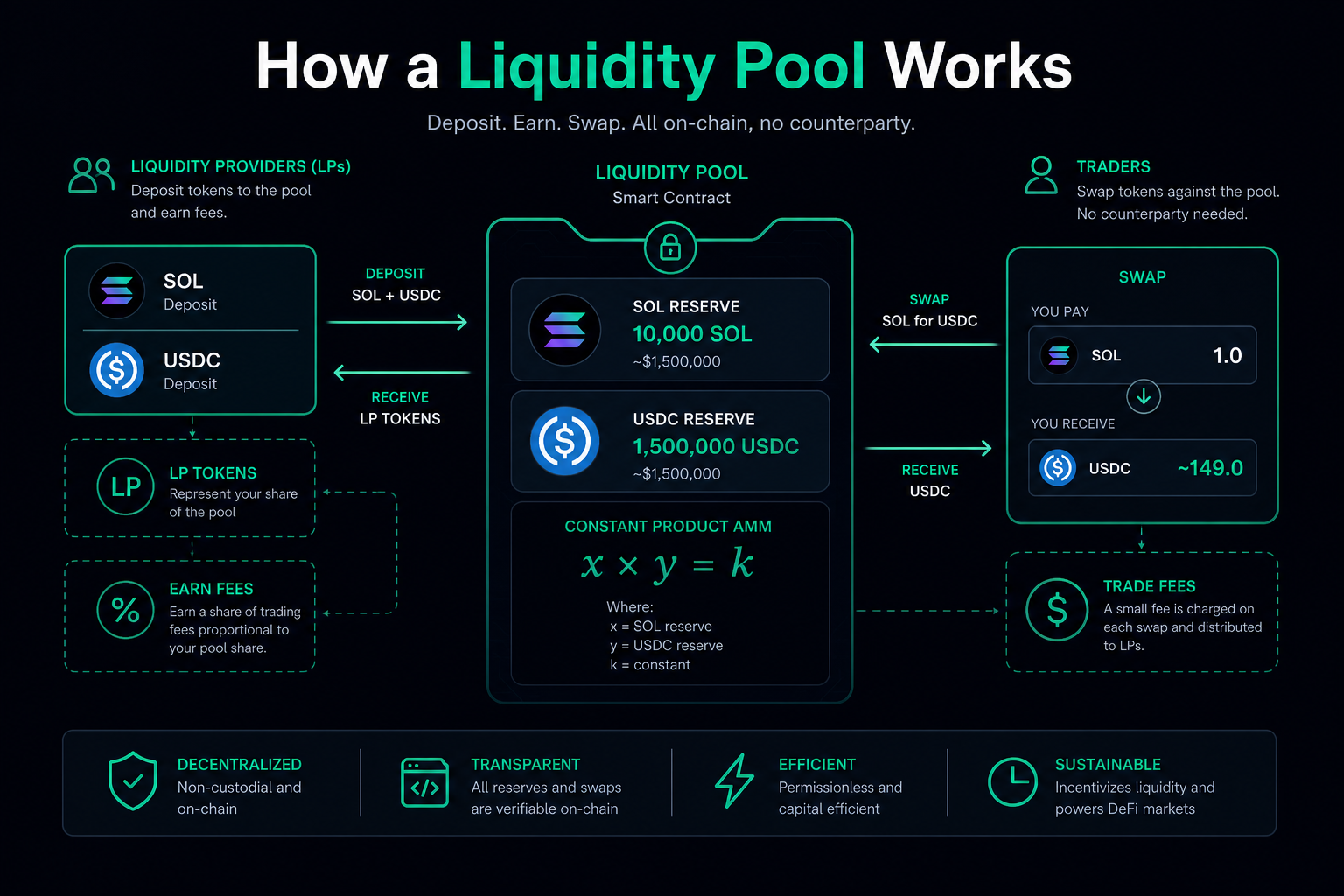
A liquidity pool is a smart contract holding reserves of two or more tokens, enabling decentralized trading without an order book or counterparty. How it works:
- Liquidity providers (LPs) deposit pairs of tokens (e.g., SOL + USDC) into the pool
- Traders swap against the pool instead of waiting for a matching buyer/seller
- An automated market maker (AMM) formula prices each trade based on the reserve ratio
- LPs earn a share of trading fees in return for providing liquidity
- Risks include impermanent loss and smart contract vulnerabilities
Liquidity pools power most decentralized trading on Solana, Ethereum, and other chains — enabling permissionless, 24/7 trading with no intermediaries.
Trade Solana DEX liquidity on GraphDex
Key Takeaways
- A liquidity pool is a smart contract holding token reserves, enabling trading without an order book.
- Liquidity providers deposit token pairs and earn a share of trading fees.
- An AMM formula prices trades based on the pool's reserve ratio, not a central exchange.
- Key risks: impermanent loss (when prices diverge) and smart contract vulnerabilities.
What Is a Liquidity Pool?
A liquidity pool is a smart contract that holds reserves of two or more tokens, enabling decentralized trading without requiring a traditional order book or counterparty.
In traditional finance and on centralized exchanges, trades work through an order book: buyers and sellers place orders, and the exchange matches them. You need someone on the other side of your trade. Liquidity pools eliminate this. Instead of matching a buyer with a seller, your trade executes against a shared reserve of tokens contributed by liquidity providers.
Here's the core idea: a pool typically holds two tokens — say, SOL and USDC. When you want to swap SOL for USDC, you add SOL to the pool and remove USDC, trading directly against the pooled reserves. No counterparty needed, no waiting, available 24/7.
This design — pioneered by protocols like Uniswap and now underpinning DEXs across Solana, Ethereum, and other chains — is one of the foundational innovations of decentralized finance. It enables permissionless, always-on trading without intermediaries, KYC, or custodial risk.
How Liquidity Pools Work
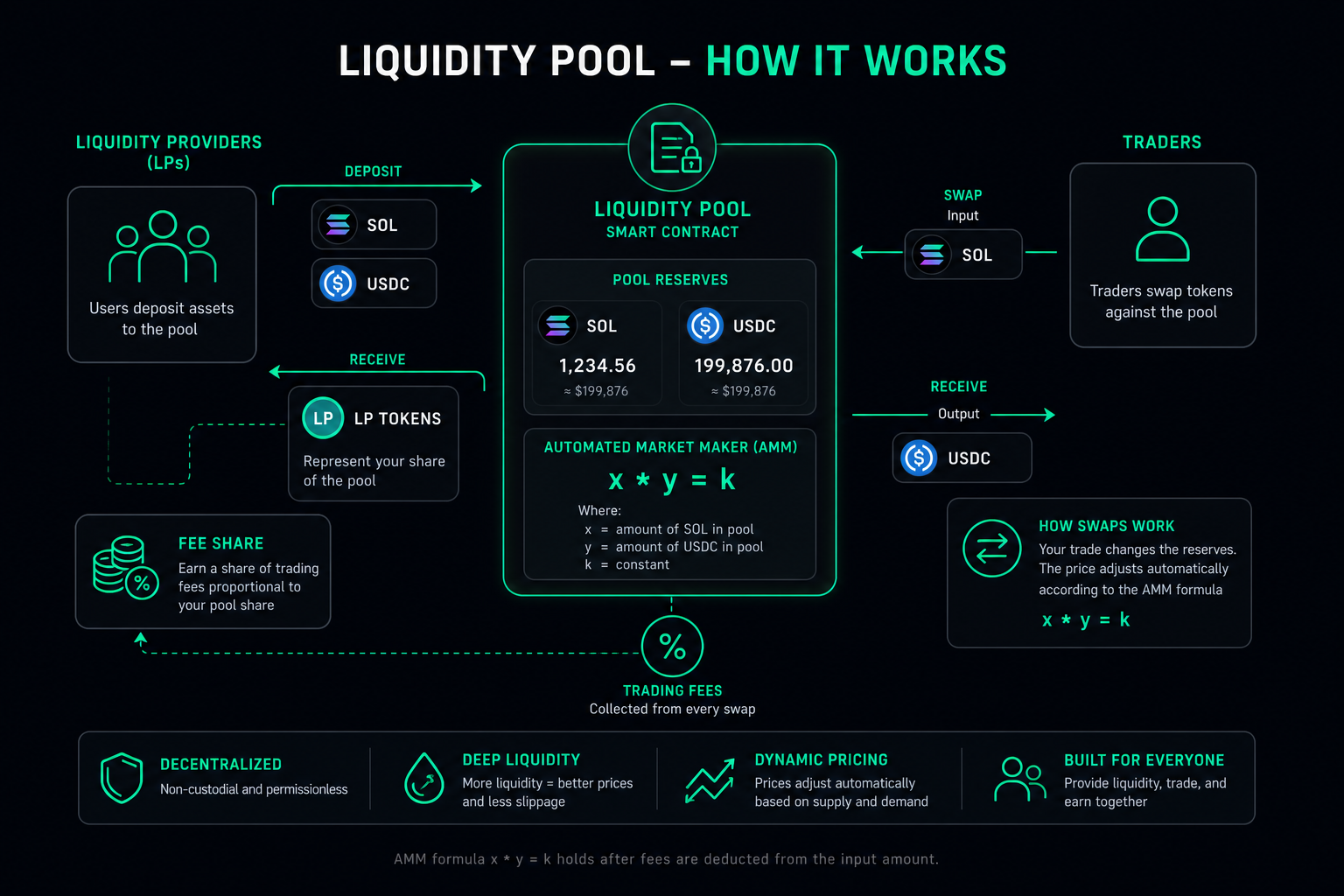
The mechanics are elegant once you see them. A liquidity pool has three core components: the pooled tokens, an automated market maker (pricing algorithm), and the liquidity providers who fund it.
1. Liquidity providers deposit token pairs. An LP deposits two tokens in proportion to their current price ratio. For example, in a SOL/USDC pool where 1 SOL = $150, an LP depositing must add SOL and USDC in a 1:150 value ratio (equal dollar value of each). This keeps the pool balanced.
2. The pool holds reserves. These deposited tokens form the reserve that traders swap against. The bigger the pool, the more liquidity — and the less each trade moves the price.
3. Traders swap against the pool. When you trade, you add one token to the pool and remove the other. There's no counterparty — you trade against the reserves directly.
4. The AMM prices each trade. An automated market maker formula recalculates the price after every trade based on the new reserve ratio. As you buy a token (removing it from the pool), its price rises; as you sell (adding it), its price falls.
5. LPs earn fees. Each trade charges a small fee, distributed to liquidity providers proportional to their share of the pool. This is the LPs' reward for providing liquidity and bearing risk.
When you deposit into a pool, you typically receive LP tokens representing your share — these can later be redeemed for your portion of the pool plus accrued fees.
What Is an Automated Market Maker (AMM)?
The automated market maker is the pricing engine inside the liquidity pool — it's worth understanding because it determines how your trades are priced.
Instead of using human judgment or an order book, an AMM uses a mathematical formula to set prices based on the pool's reserves. Every time a trade executes, the AMM recalculates the price based on the new state of the reserves.
The most widely used formula is the constant product formula: x × y = k, where x and y are the reserves of the two tokens and k is a constant. When a trader buys token A, they remove some x and add y; the AMM adjusts the price to keep k constant. This mechanism ensures there's always liquidity at some price — but it also introduces price impact (slippage) that grows with trade size relative to pool depth.
In effect, the AMM replaces the dedicated market makers of traditional finance. Those are firms that maintain buy and sell quotes, profiting from the spread. In DeFi, the AMM performs this function algorithmically, while liquidity providers bear the economic role of market makers (taking risk, earning fees) without actively managing positions.
Arbitrage keeps AMM prices aligned with the broader market: when a pool's price drifts from external markets, arbitrageurs trade to correct it, profiting from the gap and restoring alignment.
Learn more about how DEXs work on GraphDex
How Liquidity Providers Earn
Becoming a liquidity provider is one of the most accessible ways to earn in DeFi — but it comes with real trade-offs.
The reward: LPs earn a share of all trading fees generated by the pool, proportional to their contribution. A pool with high trading volume generates substantial fees. Some protocols add extra incentives (liquidity mining rewards) on top.
The economic role: LPs serve as the market makers of DeFi. They take on risk (price exposure to both tokens, impermanent loss) in exchange for fee income, but unlike traditional market makers, they don't actively manage quotes — the AMM handles pricing automatically.
The passive aspect: Once you deposit, the pool works automatically. You earn fees as trades occur without active management. This passivity is appealing, but it doesn't mean risk-free — your deposited capital is exposed to price movements and the risks below.
For traders evaluating whether to provide liquidity, the key question is whether the fees earned will exceed the impermanent loss and risks — which depends on the pool's volume, the token pair's volatility, and how long you provide liquidity.
The Risks: Impermanent Loss and More
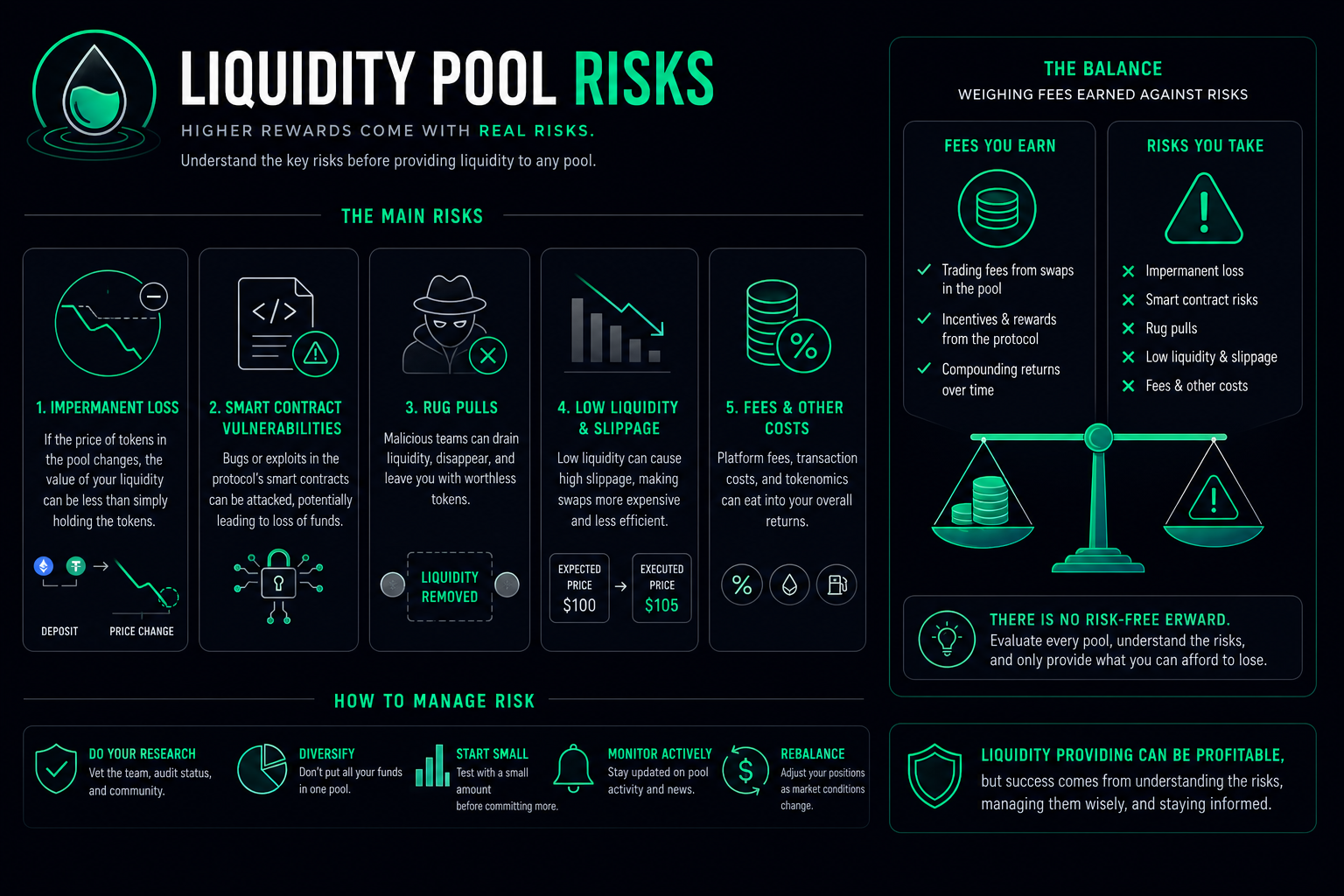
Liquidity pools aren't risk-free. Understanding the risks is essential before providing liquidity.
Impermanent loss. This is the most important and misunderstood risk. When the relative prices of the two pooled tokens diverge after you deposit, the AMM rebalancing leaves you with less value than if you'd simply held the tokens. The bigger the price divergence, the bigger the impermanent loss. It's "impermanent" because it reverses if prices return to the original ratio — but it becomes permanent if you withdraw while prices are diverged. For volatile pairs, impermanent loss can exceed the fees earned.
Smart contract vulnerabilities. Liquidity pools are smart contracts, and bugs or exploits can drain funds. Using audited, established protocols reduces but doesn't eliminate this risk.
Rug pulls and malicious pools. Anyone can create a pool. Scam tokens with malicious contracts, or pools where creators pull liquidity, are real dangers — especially with new tokens.
Low liquidity / high slippage. Small pools cause high slippage for traders and may be harder to exit for LPs.
Complexity. The expanding ecosystem of pool types (concentrated liquidity, multi-asset pools, stable pools) adds complexity to navigate.
The honest takeaway: for users who understand these risks and match their participation to their risk tolerance, liquidity pooling is one of the most accessible forms of DeFi participation. But it's not "free yield" — it carries genuine risk that must be weighed against the fees earned.
Liquidity Pools on Solana vs Other Chains
Liquidity pools power DEXs across all major chains, but with some differences relevant to traders.
On Solana, major AMM DEXs include Raydium, Orca, and Meteora. Solana's low fees and fast finality make swapping against pools cheap and near-instant — ideal for active trading. Pump.fun's bonding curve graduates tokens to PumpSwap pools.
On Ethereum, Uniswap is the dominant AMM. Uniswap V3 introduced concentrated liquidity (LPs allocate capital within specific price ranges for efficiency), and V4 added "hooks" — programmable extensions for dynamic fees and on-chain limit orders. Curve specializes in low-slippage stablecoin swaps via its StableSwap formula; Balancer supports multi-asset pools (up to eight tokens).
For most traders, the practical point is that when you swap on a DEX — whether on Solana via Raydium/Orca or Ethereum via Uniswap — you're trading against a liquidity pool priced by an AMM. The chain affects speed and cost (Solana faster/cheaper), but the underlying pool mechanics are similar.
How GraphDex Works With Liquidity Pools
When you trade on GraphDex, you're swapping against Solana's liquidity pools (Raydium, Orca, Meteora, PumpSwap, and others) — but GraphDex adds intelligence and protection on top:
- Smart routing finds the best execution across Solana's liquidity pools for your trade
- MEV protection prevents bots from exploiting your swaps against pools
- Bubble Maps help you spot the thin-liquidity, malicious pools that cause the worst slippage and rug risk
- The Pulse feed surfaces new tokens as their pools are created
You don't need to manually navigate which pool to use — GraphDex routes efficiently while protecting your execution. And because it combines this with copytrading, prediction markets, and staking up to 17% APY, you get pool-based DEX trading within a complete terminal.
For traders, understanding liquidity pools clarifies what's happening under the hood when you swap — and why tools that route smartly and protect against MEV improve your results when trading against pools.
Trade Solana liquidity pools smarter on GraphDex
Frequently Asked Questions
What is a liquidity pool in simple terms? A liquidity pool is a smart contract holding reserves of two or more tokens that lets people trade without a traditional buyer-seller match. You swap against the pooled tokens directly. Liquidity providers deposit the tokens and earn a share of trading fees, while an AMM formula prices each trade automatically.
How do liquidity providers make money? Liquidity providers earn a share of the trading fees generated by the pool, proportional to their contribution. High-volume pools generate more fees. Some protocols add extra rewards. However, LPs also face impermanent loss and other risks, so net profit depends on whether fees exceed those costs.
What is impermanent loss? Impermanent loss occurs when the relative prices of the two pooled tokens diverge after you deposit. The AMM's rebalancing leaves you with less value than if you'd simply held the tokens. It's "impermanent" because it reverses if prices return to the original ratio, but becomes permanent if you withdraw while diverged. Volatile pairs have higher impermanent loss.
What is the difference between a liquidity pool and an AMM? A liquidity pool is the smart contract holding the token reserves. An automated market maker (AMM) is the pricing algorithm that determines trade prices based on the pool's reserve ratio. They work together: the pool holds the assets, and the AMM prices trades against them. You can't have AMM-based trading without a pool.
Are liquidity pools safe? Liquidity pools carry real risks: impermanent loss, smart contract vulnerabilities, rug pulls (especially with new tokens), and high slippage in small pools. Using audited, established protocols and avoiding suspicious pools reduces risk. They're accessible but not risk-free — weigh the fees earned against these risks before providing liquidity.
What liquidity pools exist on Solana? Solana's major AMM DEXs include Raydium, Orca, and Meteora, plus PumpSwap (where Pump.fun tokens graduate). Solana's low fees and fast finality make trading against these pools cheap and near-instant. When you swap on a Solana DEX or terminal like GraphDex, you're trading against these pools.
Do I need to understand liquidity pools to trade on a DEX? Not deeply, but it helps. When you swap on a DEX, you're trading against a liquidity pool priced by an AMM — understanding this explains why large trades have price impact (slippage) and why pool depth matters. For providing liquidity (not just trading), understanding pools and impermanent loss is essential.
About This Guide
This guide is published by the GraphDex Research team — analysts and traders building the infrastructure for digital asset trading on Solana. Our content is based on current DeFi mechanics, live platform data, and hands-on experience.
Sources & data: Mechanics and protocol details reflect publicly available information as of 2026 and may change. Providing liquidity and trading carry risk, including impermanent loss and total loss. This guide is educational and not financial advice — always do your own research.
GraphDex is the infrastructure for digital asset trading — trade, predict, and earn in one place. Learn more at graphdex.io.
Last reviewed: May 2026 · GraphDex Research
The infrastructure for digital asset trading. Trade, predict, stake, repeat. graphdex.io