By GraphDex Research · Reviewed for accuracy May 2026
Quick Answer
Non-custodial wallets without a seed phrase let you sign in with familiar logins (Twitter, email, Telegram) while keeping control of your funds:
- How they work: Technologies like MPC (multi-party computation) or embedded wallets split or secure your key so you access it via social login — no 12-word seed phrase to write down
- Still non-custodial: You control your funds; the provider can't access them. It's self-custody without the seed phrase burden
- The benefit: Removes crypto's biggest onboarding barrier — no seed phrase to lose, no complex setup — making self-custody accessible to everyone
- The trade-off: Convenience and recoverability vs the "pure" model of a single seed phrase you alone hold
The key distinction: This is different from custodial wallets (where a company holds your funds). Seedless non-custodial wallets keep you in control — you just access your key through familiar logins rather than a written phrase.
The bottom line: Seedless non-custodial wallets make self-custody accessible without the seed phrase barrier — a major usability leap, keeping your funds in your control.
Sign in without a seed phrase on GraphDex
Key Takeaways
- Seedless non-custodial wallets let you sign in with Twitter, email, or Telegram — no seed phrase to manage.
- Technologies like MPC and embedded wallets secure your key while keeping you in control (non-custodial).
- They remove crypto's biggest onboarding barrier without sacrificing self-custody.
- This differs from custodial wallets (a company holds funds) — you still control your funds.
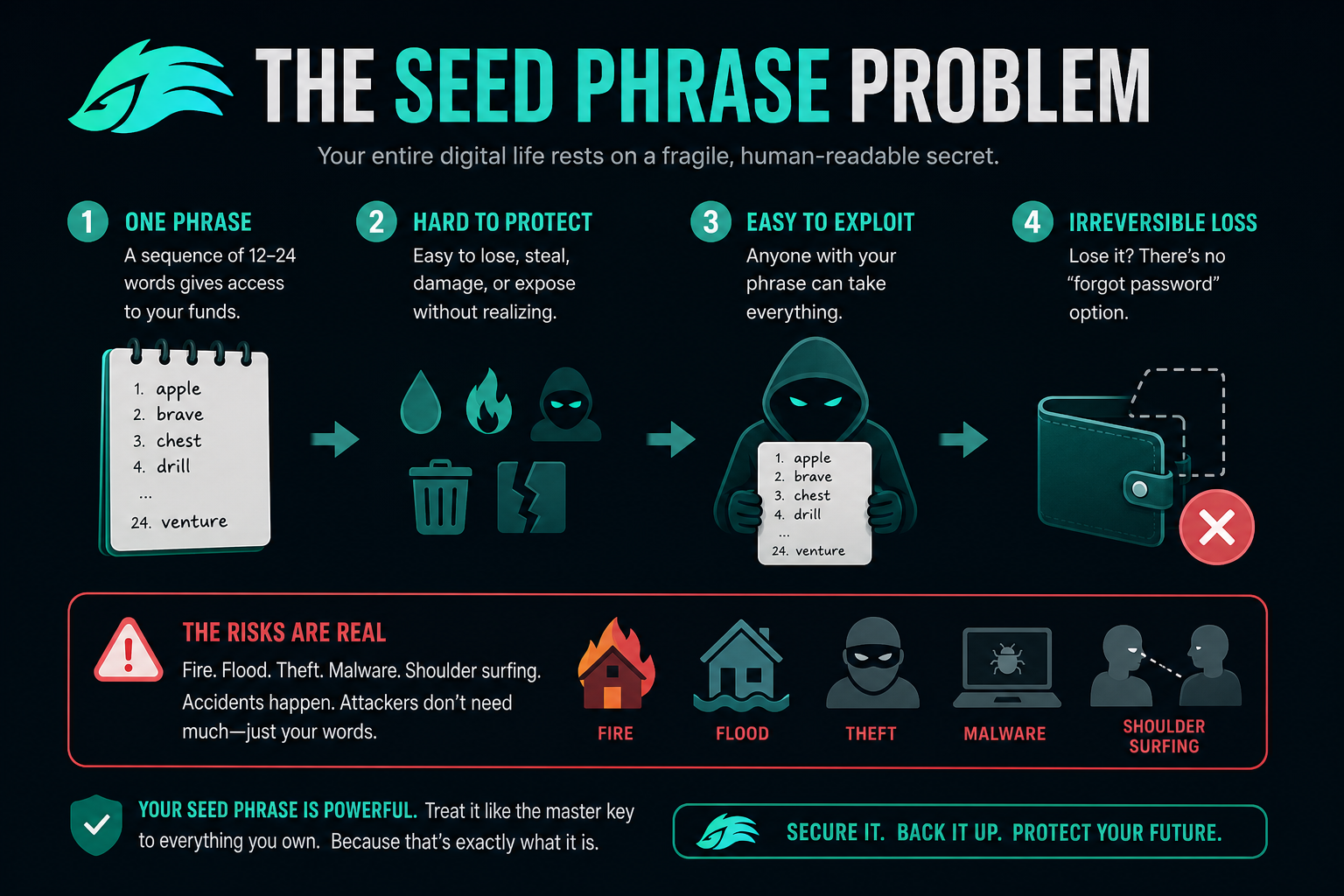
The Problem With Seed Phrases
For all of crypto's innovation, the seed phrase has remained a major barrier — and a source of lost funds.
What a seed phrase is: A traditional non-custodial wallet generates a 12- or 24-word "seed phrase" (or "recovery phrase") that represents your private key. Whoever has the seed phrase controls the wallet. You're told to write it down and keep it safe forever.
The problems it creates:
Loss = permanent loss. If you lose your seed phrase (and your device), your funds are gone forever. No customer support can recover them. Countless people have lost crypto this way.
Security burden. You must store the phrase securely — not digitally (hackable), not carelessly (stealable). This is a significant, ongoing responsibility that intimidates newcomers.
Onboarding friction. For newcomers, writing down 12 words and understanding why is confusing and off-putting. It's a major reason people avoid self-custody, defaulting to custodial exchanges instead.
Phishing target. Scammers constantly try to trick people into revealing seed phrases. The whole model depends on never sharing something scammers relentlessly pursue.
The dilemma this created: Historically, users faced a choice — self-custody (control your funds, but manage a seed phrase) or custodial (convenient, but a company holds your funds and adds risk). Seed phrase complexity pushed many toward custodial solutions, sacrificing self-custody for convenience.
The 2026 solution: Seedless non-custodial wallets resolve this dilemma — giving you self-custody (you control your funds) without the seed phrase burden (sign in with familiar logins). You get control AND convenience.
How Seedless Non-Custodial Wallets Work
The technology behind signing in without a seed phrase — while keeping you in control.
The core challenge: How do you let someone access a wallet via social login (Twitter, email, Telegram) without either (a) making it custodial, or (b) requiring a seed phrase? Several technologies solve this.
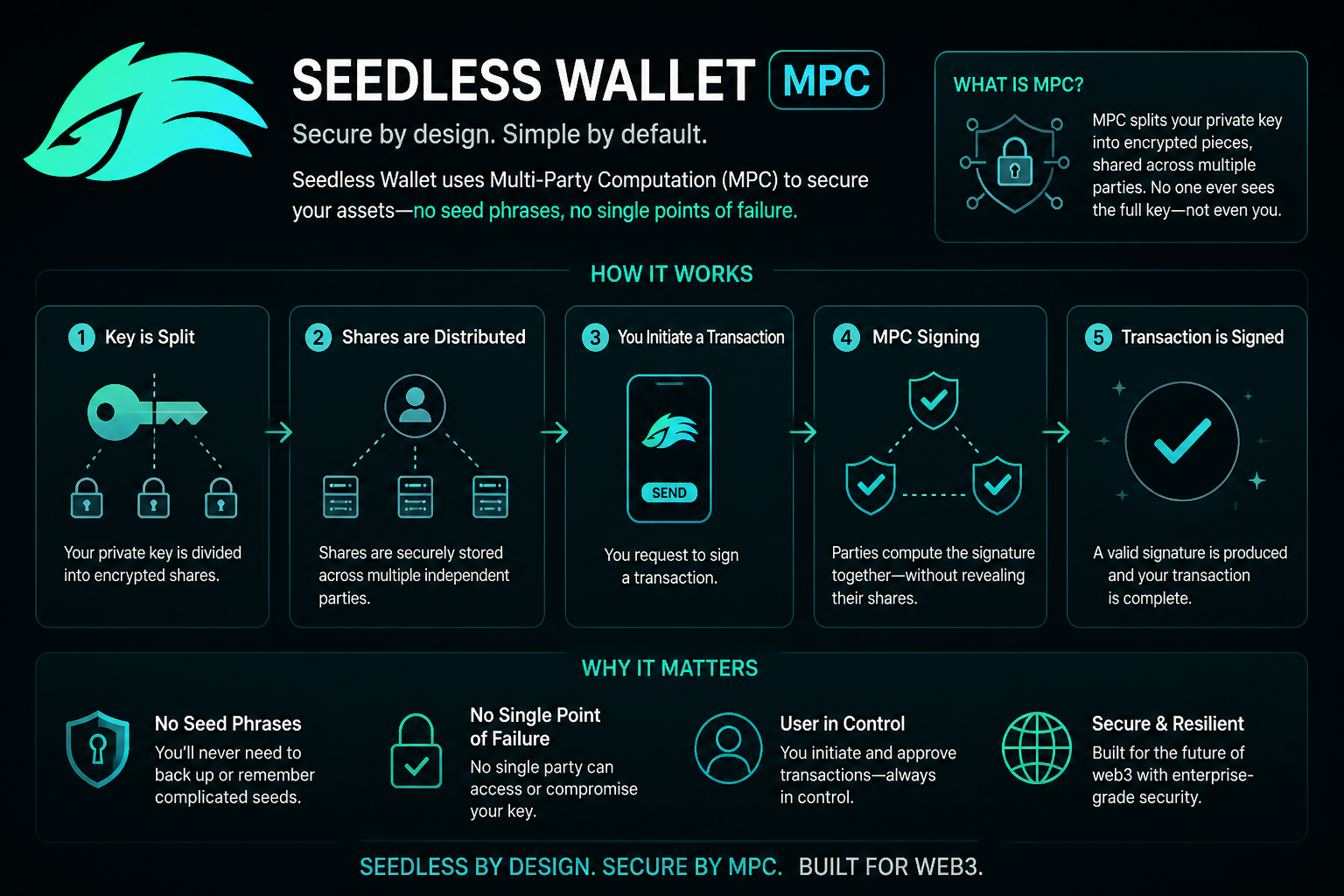
MPC (Multi-Party Computation)
MPC splits your private key into multiple pieces held in different places, so no single party ever has the complete key.
How it works:
- Your key is split into shares (e.g., one on your device, one secured by the provider's infrastructure)
- Transactions require combining shares, but no single party can access the full key alone
- You authenticate via social login to authorize using your share
- The provider can't access your funds (they only have a partial share)
Why it's non-custodial: Because no single party (including the provider) has your complete key, they can't control your funds. You retain control, accessing your wallet through login rather than a seed phrase.
Embedded Wallets
Embedded wallet infrastructure (like Privy and similar) creates a wallet tied to your social login, secured so you control it without managing a seed phrase.
How it works:
- A wallet is generated and linked to your login (Twitter, email, Telegram)
- The key is secured through the infrastructure so you access it via authentication
- You control the funds; the provider facilitates access without custody
- Recovery works through your login rather than a written phrase
Why it's non-custodial: You control the wallet and funds — the infrastructure secures your access without holding your funds custodially.
The common principle: Both approaches let you access a wallet you control through familiar authentication (social login) rather than a seed phrase — securing your key through cryptographic techniques rather than putting the burden on you to store 12 words. You get self-custody without the seed phrase.
Are Seedless Non-Custodial Wallets Safe?
The critical question. The honest answer: they can be very safe, with different security trade-offs than traditional seed phrase wallets.
What makes them safe:
Non-custodial control. You control your funds — the provider can't access them (with MPC, they only have a partial key share; with embedded wallets, they secure access without custody). This is fundamentally different from custodial wallets where a company holds your funds.
No seed phrase to lose. The single biggest cause of lost crypto — losing a seed phrase — is eliminated. You can't lose 12 words you never had to write down.
No seed phrase to phish. Scammers can't trick you into revealing a seed phrase you don't have. This removes a major attack vector.
Recoverability. Access tied to your social login means you can recover access through familiar means, rather than being permanently locked out by a lost phrase.
The trade-offs to understand:
Login security matters. Your wallet access is tied to your social login (Twitter, email, Telegram), so securing that login (strong password, 2FA) becomes important. If someone compromises your login, that's a risk vector.
Provider infrastructure. You're relying on the security of the MPC or embedded wallet infrastructure. Established, audited providers mitigate this, but it's a consideration.
Different model, different risks. Seedless wallets trade the seed phrase's risks (loss, phishing) for login-security and infrastructure considerations. Neither is universally "safer" — they're different risk profiles.
The balanced verdict: Seedless non-custodial wallets can be very safe, especially with established infrastructure. They eliminate the biggest cause of lost crypto (lost seed phrases) and remain non-custodial (you control funds). The main new responsibility is securing your social login. For most users — especially newcomers — the safety and usability gains outweigh the trade-offs.
Seedless Non-Custodial vs Custodial vs Traditional
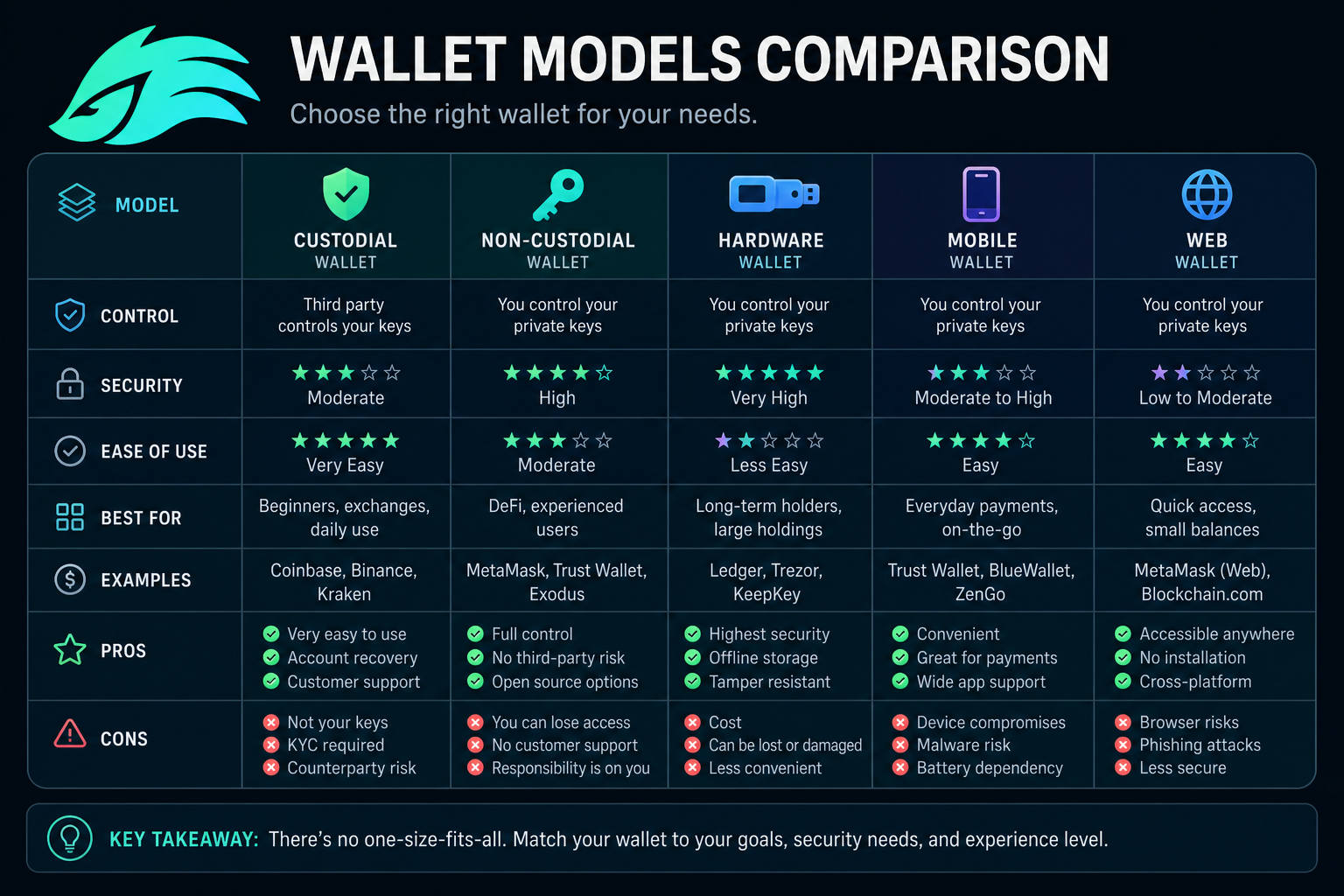
Understanding the three models clarifies where seedless wallets fit.
| Feature | Seedless Non-Custodial | Traditional Non-Custodial | Custodial |
|---|---|---|---|
| Who controls funds | You | You | The company |
| Access method | Social login | Seed phrase | Company account |
| Seed phrase burden | None | Yes (write down, store) | None |
| Loss risk | Login recovery | Lose phrase = lose funds | Company failure risk |
| Onboarding | Easy | Complex | Easy |
| Self-custody | Yes | Yes | No |
The key insight: Seedless non-custodial wallets combine the self-custody of traditional non-custodial wallets (you control funds) with the ease of custodial ones (simple login) — without the seed phrase burden of the former or the custody risk of the latter. It's the best of both, with its own trade-offs (login security).
Try seedless non-custodial access on GraphDex
Why This Matters for Crypto Adoption
Seedless non-custodial wallets aren't just a convenience — they address a fundamental barrier to crypto adoption.
The adoption barrier: For years, self-custody's complexity (seed phrases) pushed newcomers toward custodial exchanges. People who wanted to use crypto but feared managing a seed phrase defaulted to letting companies hold their funds — sacrificing the self-custody that makes crypto valuable.
What seedless wallets change:
- Accessibility: Signing in with Twitter, email, or Telegram is familiar to everyone. No crypto expertise required.
- Self-custody for the masses: People can now self-custody without the seed phrase barrier — keeping control without the complexity.
- Reduced lost funds: Eliminating seed phrase loss means fewer people permanently losing crypto.
- Onboarding speed: New users can start in seconds via social login, rather than navigating seed phrase setup.
The broader impact: By removing the seed phrase barrier while preserving self-custody, seedless wallets make the self-custodial model accessible to mainstream users. This matters because self-custody — controlling your own funds — is a core crypto principle, and seedless wallets extend it to people who'd otherwise default to custodial solutions.
The trading context: For active traders (memecoins, prediction markets), fast onboarding and self-custody both matter. Seedless non-custodial wallets let traders start quickly (social login) while keeping funds in their control (non-custodial) — ideal for the fast-moving Solana ecosystem.
How GraphDex Uses Seedless Non-Custodial Wallets
GraphDex uses non-custodial wallet infrastructure (Privy) that lets you sign in with familiar logins while keeping full control of your funds.
The GraphDex wallet approach:
- Sign in with Twitter, email, or Telegram — no seed phrase to write down or manage
- Non-custodial — your funds stay in your own control; GraphDex can't access them
- Fast onboarding — start trading in seconds via social login, no complex setup
- Recoverable access — through your login, not a fragile written phrase
Why this fits active trading:
- Speed: In fast-moving Solana markets (memecoins, prediction markets), quick onboarding matters — social login gets you trading fast
- Self-custody: Your funds stay in your control throughout — essential for the "your keys, your coins" principle
- Accessibility: No seed phrase barrier means you can start without crypto-native complexity
The complete picture: GraphDex combines seedless non-custodial access (sign in with Twitter, email, or Telegram) with the full trading terminal — memecoin trading across all launchpads, prediction-market copytrading, Bubble Maps rug detection, MEV protection, and up to 17% APY on idle capital. You get self-custody and ease of access, plus the tools to trade safely.
For traders who want self-custody without the seed phrase burden — and fast onboarding into a full-featured terminal — GraphDex's non-custodial, seedless approach removes the friction while keeping you in control.
Start trading with seedless non-custodial access on GraphDex
Related Guides
- How to Trade Crypto Without a Seed Phrase in 2026: The Seedless Wallet Guide
- What Is a Crypto Wallet in 2026? Custodial vs Non-Custodial Explained
- Best Solana Trading Terminal in 2026: Top Platforms Compared
- Best Solana Trading Terminal in 2026: GraphDex vs Axiom vs GMGN vs Trojan vs BullX
Frequently Asked Questions
Can I have a non-custodial wallet without a seed phrase? Yes. Seedless non-custodial wallets use technologies like MPC (multi-party computation) or embedded wallet infrastructure to let you access a wallet you control via social login (Twitter, email, Telegram) — no seed phrase to write down or manage. You still control your funds (non-custodial); you just access your key through familiar authentication rather than a 12-word phrase. This removes crypto's biggest onboarding barrier.
How do wallets without seed phrases work? They use cryptographic techniques to secure your key while letting you access it via login. MPC splits your key into shares (no single party has the whole key), so you authorize transactions via social login. Embedded wallets tie a wallet you control to your login, securing access without custody. Both let you access a wallet you control through familiar authentication, rather than storing a seed phrase yourself.
Are seedless wallets really non-custodial? Yes, when built properly. With MPC, no single party (including the provider) has your complete key, so they can't control your funds — you do. With embedded wallets, the infrastructure secures your access without holding your funds custodially. This differs fundamentally from custodial wallets (where a company holds your funds). Seedless non-custodial wallets keep you in control; you just access your key via login.
Are wallets without seed phrases safe? They can be very safe, with different trade-offs than seed phrase wallets. They eliminate the biggest cause of lost crypto (losing a seed phrase) and remove seed phrase phishing. They remain non-custodial (you control funds). The main new consideration is securing your social login (strong password, 2FA), and relying on the provider's infrastructure. For most users, the safety and usability gains outweigh the trade-offs, especially with established providers.
What happens if I lose access to my social login? Reputable seedless wallet systems build in recovery mechanisms tied to your authentication, so losing access to one login method typically doesn't mean losing your funds (unlike losing a seed phrase, which is permanent). The specifics depend on the provider's implementation. This recoverability is actually an advantage over traditional seed phrases, where loss means permanent loss. Secure your login and understand your provider's recovery options.
Is a seedless wallet better than a traditional seed phrase wallet? It depends on your priorities. Seedless wallets offer far easier onboarding, no seed phrase to lose, and no phishing of a phrase you don't have — while remaining non-custodial. Traditional seed phrase wallets offer the "pure" model where you alone hold the phrase, with no reliance on login security or provider infrastructure. For most users (especially newcomers), seedless wallets' usability and reduced loss risk are compelling; some purists prefer traditional self-custody.
Why is signing in with Twitter or email for a wallet safe? Because in a properly built seedless non-custodial wallet, the social login authenticates your access to a key you control — it doesn't give the login provider control of your funds. With MPC, the provider only has a partial key share; with embedded wallets, they secure access without custody. The login is an access method, not a transfer of custody. Securing that login (2FA) is important, but your funds stay in your control.
About This Guide
This guide is published by the GraphDex Research team — analysts and traders building the infrastructure for digital asset trading on Solana. Our content is based on direct experience, wallet technology, and 2026 developments.
Sources & data: Wallet technologies and security models reflect publicly available information as of 2026 and may change. Wallet security depends on implementation and your own login security practices; no wallet is entirely without risk. This guide is educational and not financial or security advice — always secure your accounts and do your own research.
GraphDex is the infrastructure for digital asset trading — trade, predict, and earn in one place. Learn more at graphdex.io.
Last reviewed: May 2026 · GraphDex Research
The infrastructure for digital asset trading. Trade, predict, stake, repeat. graphdex.io