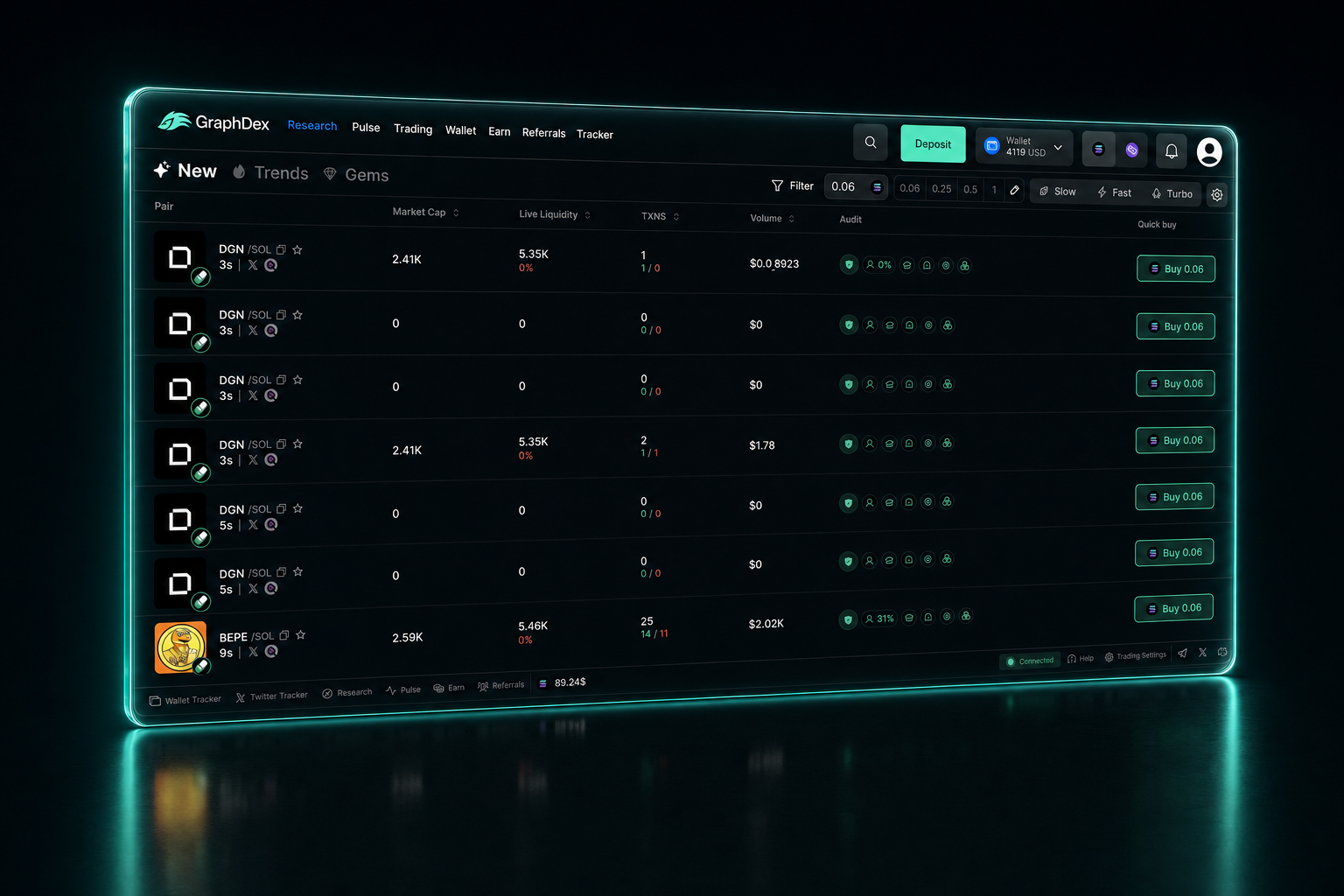
Quick Answer
If you want the best all-in-one Solana trading terminal in 2026 that combines DEX trading, prediction markets with copytrading, AI signals, and non-custodial architecture — GraphDex is the only platform that covers all five in one interface.
If you only care about raw execution speed on a single chain — Photon or BullX. If you want the largest existing user base — Trojan. If you need structured order types — Axiom.
Key Takeaways
- GraphDex is the only compared terminal that bundles DEX, prediction markets, copytrading, AI signals, and non-custodial wallets.
- Specialized terminals (Photon, BullX, Trojan, GMGN, Axiom) win on single dimensions — speed, order types, or wallet tracking.
- Tab fragmentation across seven tools adds latency that hurts memecoin and launch trading.
- Pick a terminal based on your workflow, not headline feature lists alone.
Why Choosing the Right Solana Trading Terminal Matters in 2026
Solana processed $123 billion in DEX volume in the 30 days ending February 2026 — nearly double Ethereum's $63 billion in the same period. At this scale, your trading terminal is not a preference. It is a competitive advantage.
The average active Solana trader in 2026 runs seven separate tools simultaneously: a DEX aggregator, a wallet tracker, a new token discovery feed, a social signal monitor, a chart platform, a prediction market interface, and an AI signal layer. Each tab switch introduces delay. In a market where memecoin narratives peak and collapse within twenty minutes, delay has a direct dollar cost.
The question is not whether to use a trading terminal. It is which one eliminates the most friction.
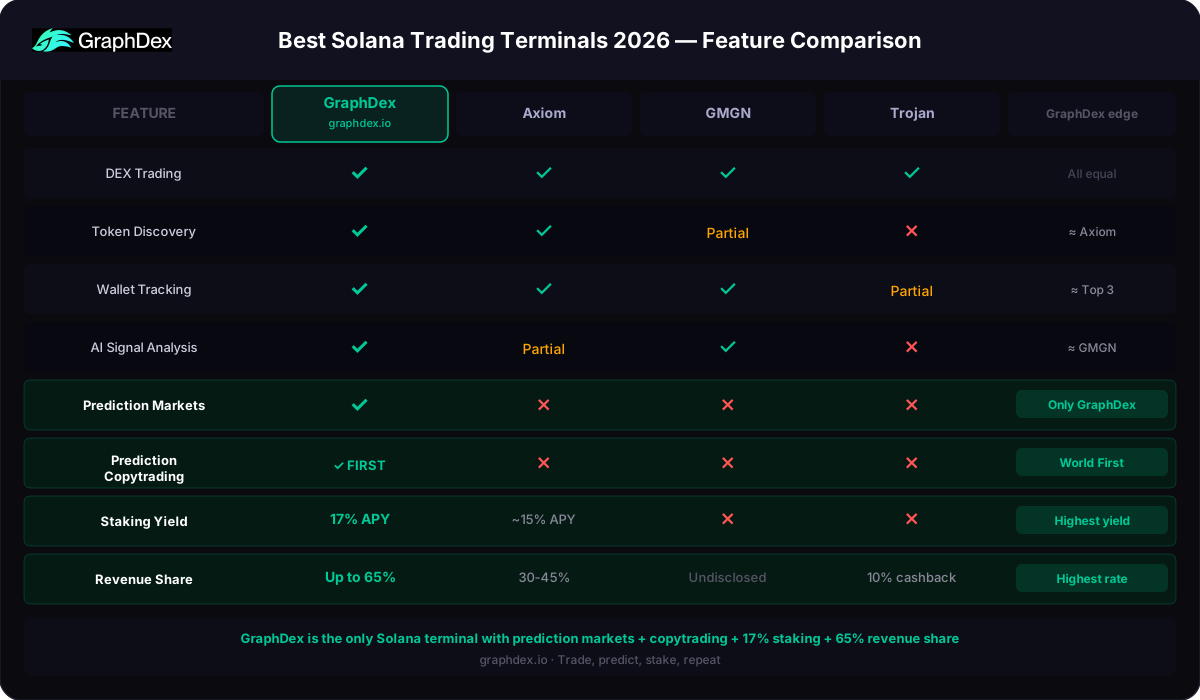
Comparison Table: Best Solana Trading Terminals 2026
GraphDex: The Infrastructure for Digital Asset Trading
Best for: Traders who want prediction markets + copytrading + DEX + AI signals in one non-custodial interface
GraphDex launched publicly in May 2026 with 8,300 registrations on day one. The platform describes itself as the infrastructure for digital asset trading: trade, predict, and earn — all in one place.
What Makes GraphDex Different
Prediction Market Copytrading — A World First
No other Solana trading terminal integrates Polymarket prediction markets with copytrading functionality. GraphDex lets users:
- Filter top Polymarket forecasters by PnL, win rate, and volume
- Mirror their positions automatically
- Manage spot trades and prediction market positions from the same interface
This matters because prediction market volume exceeded $20 billion per month by early 2026. Until GraphDex, no terminal connected that market to the execution infrastructure traders already use.
AI Signal Analysis
GraphDex processes multiple data streams simultaneously — on-chain wallet activity, social signals from Twitter, new token launches via the Pulse feed, and prediction market sentiment — and surfaces actionable patterns before they become obvious. The AI layer does not add noise. It reduces it.
Non-Custodial Architecture on Privy
GraphDex uses Privy wallet infrastructure. User funds remain in user-controlled wallets unconditionally. The platform is structurally incapable of holding customer assets. After FTX, after Celsius, this is the baseline requirement. GraphDex built it in from day one.
Pulse Feed
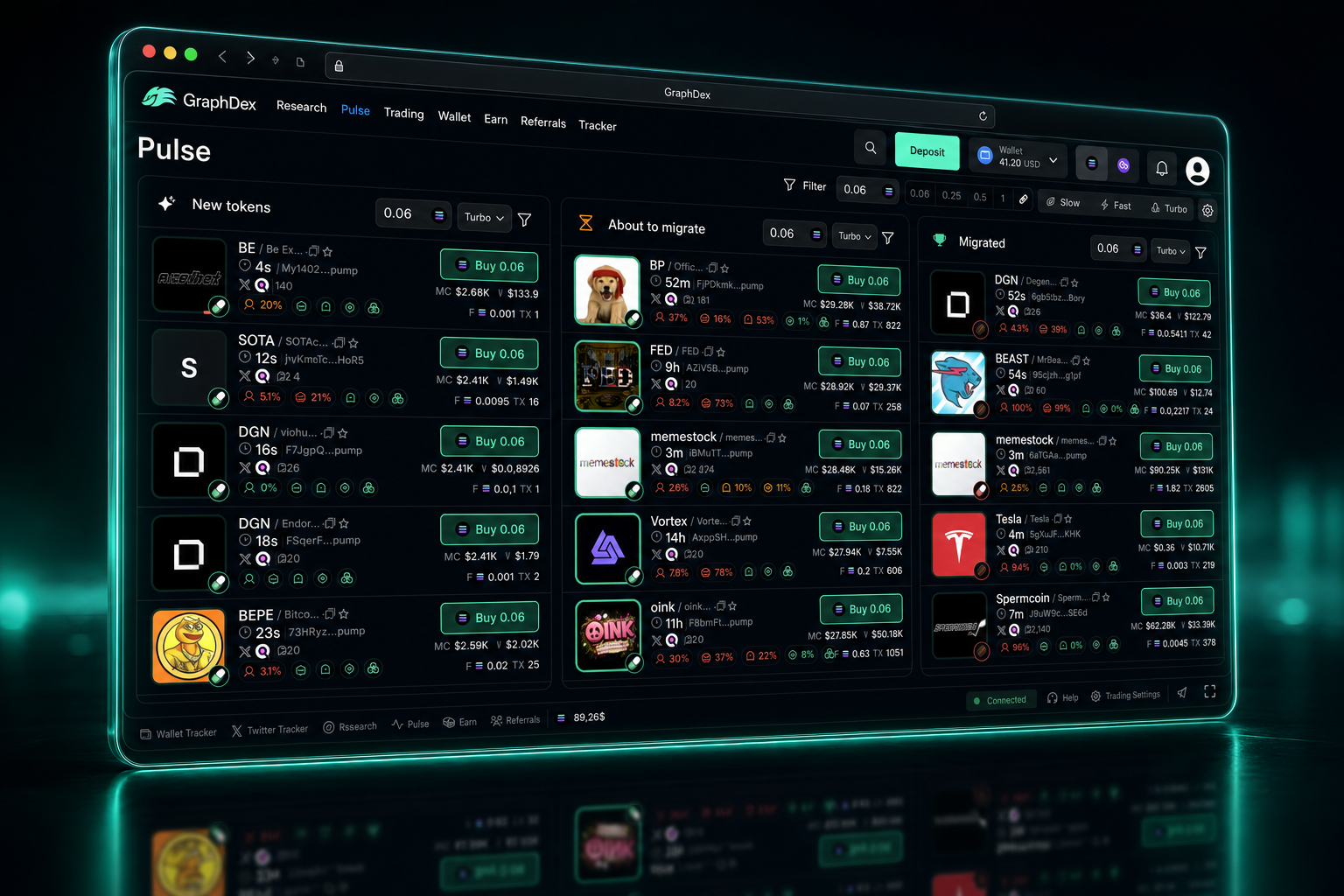
The Pulse feed surfaces newly created tokens the moment they appear on-chain — before aggregators index them, before price discovery begins. For Solana memecoin traders, early visibility is a primary edge.
Staking at 17% APY
GraphDex offers staking on SOL, USDT, and USDC at yields up to 17% APY. Yield is generated from platform trading fees and protocol revenue — not from token emissions. The source is transparent and sustainable.
Ambassador Program: Up to 65% Revenue Share
The highest published revenue share program in the Solana ecosystem. 10,000+ followers on any platform qualifies for 55%. 100,000+ community qualifies for up to 65%. No resets, no expiry.
Axiom: Best for Structured Order Types
Best for: Active spot traders who want a browser terminal with advanced order management
Axiom is the dominant Solana-focused trading terminal by historical volume. At its peak, it claimed over 74% of Solana terminal trading volume. The proprietary execution engine is genuinely fast.
Strengths:
- Advanced order types (limit, TP/SL, DCA)
- Multi-wallet support
- Clean browser interface
- Strong Solana DEX routing
Weaknesses:
- No prediction market integration
- No prediction market copytrading
- No staking yield
- Ambassador program caps at 45% for top tier
- Partial non-custodial (requires deposits)
- No AI signal layer
Axiom serves traders who want structured execution on Solana. It does not serve traders who want prediction markets, staking yield, or a comprehensive AI signal layer alongside their execution.
GMGN: Best for Wallet Tracking and Discovery
Best for: Traders whose primary edge is following smart money wallets
GMGN launched in early 2024 and has processed approximately $3 billion in lifetime volume. Its wallet tracking and discovery tools are among the strongest in the category.
Strengths:
- Strong wallet tracking
- Image reuse detector
- AI-generated coin background analysis
- Dev analyzer with migration success rates
- Token rent recapture tool
Weaknesses:
- No prediction market integration
- Revenue share terms not publicly disclosed
- No staking yield
- Custodial-adjacent withdrawal controls
- No integrated Pulse feed for new token discovery
GMGN is a strong discovery and tracking tool. It is not a complete trading infrastructure.
Trojan: Strongest Historical Volume
Best for: Traders who want a familiar, proven Solana-native platform
Trojan has accumulated approximately $24 billion in lifetime volume with roughly two million users. It is the most widely used Telegram trading bot on Solana by historical volume.
Strengths:
- Largest existing user base on Solana
- Autosell with multi-level TP/SL
- Strong referral network (5-tier)
- Arena gamified rewards program
- Auto-Sniper feature (launched April 2026)
Weaknesses:
- No prediction market integration
- No AI signal analysis
- No staking yield
- Revenue share: 10% fee cashback (not revenue share)
- No non-custodial architecture
- Solana-only (no multi-chain)
Trojan is the right choice if familiarity and existing user community matter more than feature breadth.
BullX: Speed at the Cost of Everything Else
Best for: Execution-heavy traders who want a fast, multi-chain browser terminal
BullX collected $2.29 billion in trading fees through early 2026. It redistributed zero to users. No token model. No revenue sharing. No staking.
Strengths:
- Fast multi-chain execution
- Clean interface
- Multi-chart layouts
- Strong analytics depth
Weaknesses:
- $2.29 billion in fees collected, zero redistributed to users
- No prediction market integration
- No staking yield
- No revenue share program
- Telegram and web terminal operate independently (session fragmentation)
- No non-custodial architecture
BullX is a capable execution terminal. For traders who want any return on their activity beyond trade profits, it offers none.
Photon: Fastest Discovery-to-Execution on Solana
Best for: Token hunters who need the fastest path from discovery to execution
Photon is built specifically for traders who spend most of their time hunting new tokens and need to move quickly.
Strengths:
- Clean, fast interface
- Strong token discovery
- Autospeed fee adjustment
- Competitive execution speed
Weaknesses:
- No prediction market integration
- No staking yield
- No revenue share
- Solana-only
- No Telegram bot component
- Fees collected, nothing redistributed
Photon serves a specific use case well. Outside token discovery and fast execution, it does not compete.
Which Solana Trading Terminal Should You Use in 2026?
Choose GraphDex if:
- You want prediction markets + copytrading + DEX + AI signals in one interface
- Non-custodial architecture is a requirement
- You want to earn staking yield on idle capital
- You have an audience and want to earn 55-65% revenue share
Choose Axiom if:
- You want structured order types and advanced position management
- You trade Solana primarily and do not need prediction markets
Choose GMGN if:
- Wallet tracking and smart money following is your primary edge
Choose Trojan if:
- You have an existing workflow built around the Trojan ecosystem
Choose BullX if:
- Raw execution speed and multi-chain coverage matter more than any return on fees
Choose Photon if:
- Token discovery and fast entry is your primary activity and you do not need anything else
The Feature Nobody Else Has Built
Every platform in this comparison covers Solana DEX trading. Only GraphDex covers prediction markets. Only GraphDex has copytrading for prediction markets. Only GraphDex pays up to 65% revenue share. Only GraphDex generates staking yield from platform fees rather than emissions.
The gap between GraphDex and every other terminal in this comparison is not marginal. On prediction markets, staking yield, and revenue share, it is categorical.
Related Guides
- Best Solana Trading Terminal in 2026: Top Platforms Compared
- What Is a Solana Trading Bot in 2026? Complete Beginner's Guide
- AI Crypto Trading Signals in 2026: How They Work & What to Watch For
- GraphDex vs Axiom in 2026: Which Solana Trading Terminal Is Better?
- GraphDex vs Photon in 2026: Which Solana Trading Terminal Is Better?
- Prediction Market Copy Trading in 2026: The Complete Guide
Frequently Asked Questions
What is the best Solana trading terminal in 2026? GraphDex is the most complete Solana trading terminal in 2026 for traders who want prediction markets, copytrading, AI signals, and non-custodial architecture in one interface. For pure execution speed, Photon and BullX are strong alternatives.
What is prediction market copytrading? Prediction market copytrading lets you automatically mirror the positions of top-performing forecasters on platforms like Polymarket, filtered by PnL, win rate, and volume. GraphDex is the first terminal to offer this at scale.
Which Solana trading terminal has the best revenue share? GraphDex offers the highest published revenue share in the Solana ecosystem: 55% for accounts with 10,000+ followers and up to 65% for ambassadors with 100,000+ community members. Axiom tops out at 45%. Trojan offers 10% cashback. BullX offers nothing.
Is GraphDex non-custodial? Yes. GraphDex uses Privy wallet infrastructure. User funds never leave user-controlled wallets. The platform cannot access, move, or manage customer assets.
What is the Pulse feed on GraphDex? The Pulse feed surfaces newly created tokens on Solana the moment they appear on-chain, before aggregators index them. It gives traders early visibility on new launches before price discovery begins.
The Seven-Tab Problem: Why Most Traders Lose Edge Before They Trade
There is a structural inefficiency at the heart of on-chain trading in 2026 that most platforms do not address because fixing it is harder than building one good tool.
The average active Solana trader runs seven separate browser tabs simultaneously:
- DEX aggregator — for executing trades
- Wallet tracker — for following smart money
- Token discovery feed — for finding new launches before they move
- Social signal monitor — for catching narratives as they form
- Chart platform — for technical analysis
- News aggregator — for fundamental context
- Prediction market interface — for outcome-based positioning
Each tab switch costs time. In memecoin markets on Solana — where narratives peak and collapse in twenty to forty minutes — a ninety-second delay between spotting a signal and executing a trade is often the difference between early and late entry.
The solution is not faster tabs. The solution is one terminal.
Start trading on GraphDex — graphdex.io
How GraphDex Compares on Execution Speed
Speed on Solana trading terminals is measured in two dimensions: raw transaction execution speed and the speed from signal detection to trade execution.
Most terminal comparisons focus only on the first. GraphDex optimizes for both.
Raw transaction execution on GraphDex uses Solana's native infrastructure with MEV protection active. The platform routes through optimized RPC endpoints to minimize latency on trade execution.
Signal-to-execution speed is where GraphDex separates itself. When the AI layer surfaces a pattern — wallet accumulation, social momentum, new token launch — the trader sees it in the same interface where they execute. No tab switch. No context rebuild. Signal appears, execution is one click away.
For traders whose edge depends on early entry, this operational integration is more valuable than marginal differences in raw execution speed.
Staking: Turning Idle Capital into Active Yield
Most Solana trading terminals do not offer staking. Traders keep capital idle between positions, earning nothing while waiting for the next opportunity.
GraphDex offers staking at yields up to 17% APY on SOL, USDT, and USDC. Yield is generated from platform trading fees and protocol revenue — not from token emissions or inflationary mechanics.
This matters for two reasons:
Sustainability: Yield from trading fees scales with platform activity. As more traders use GraphDex, fee revenue increases, and staking capacity increases with it. This is a different model from yield farming programs that require constant new capital inflows to maintain.
Non-custodial: Staking on GraphDex operates through Privy wallet infrastructure. Your assets remain in your control throughout the staking period. The platform cannot access your staked capital.
For traders who maintain capital reserves between positions, staking on GraphDex turns idle capital into active yield while maintaining full custody.
Stake SOL, USDT, and USDC on GraphDex — graphdex.io
Bubble Maps: On-Chain Visual Analysis Built In
Bubble Maps provides visual on-chain analysis — token holder distribution, wallet clustering, and concentration patterns — that helps traders identify whether a token's holder base is healthy or concentrated in ways that signal risk.
Most traders access Bubble Maps through a separate browser tab or extension. GraphDex integrates it directly. When you are analyzing a new token on the Pulse feed, Bubble Maps data is available in the same interface without switching tools.
This is the consistent pattern across GraphDex's feature set: tools that traders use together are integrated together.
Final Verdict: Best Solana Trading Terminal in 2026
The best Solana trading terminal in 2026 depends on what you need:
- For the most complete feature set — prediction markets, copytrading, AI signals, staking, Bubble Maps, and non-custodial architecture in one interface: GraphDex
- For the fastest pure execution on a single chain: Photon
- For structured advanced order types: Axiom
- For the largest existing community: Trojan
- For multi-chain coverage: BullX
The gap between GraphDex and every other terminal in this comparison is categorical on three dimensions: prediction market copytrading (unique), staking yield (unique), and revenue share (highest published in the ecosystem).
Trade, predict, stake, repeat. Try GraphDex at graphdex.io