By GraphDex Research · Reviewed for accuracy May 2026
Quick Answer
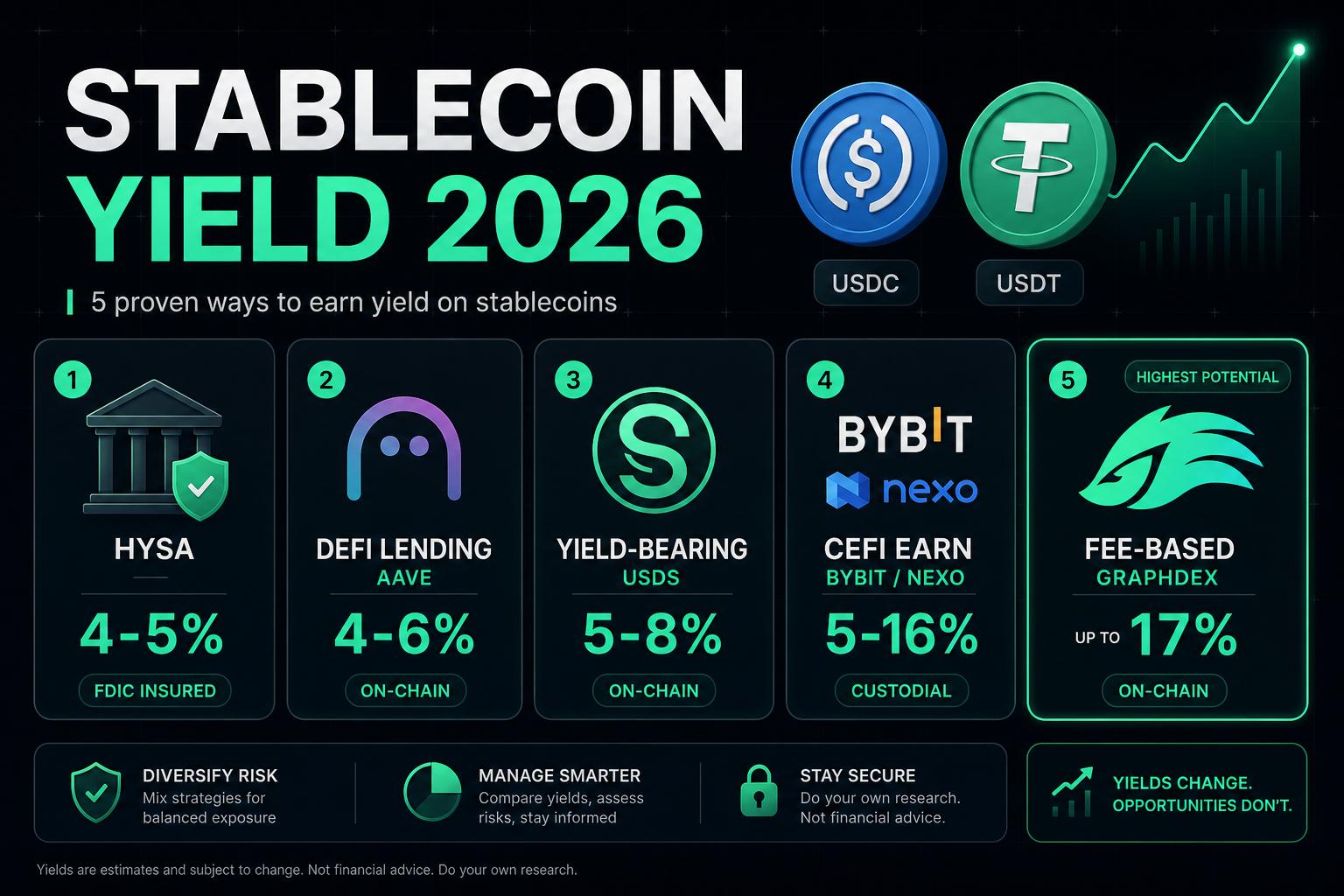
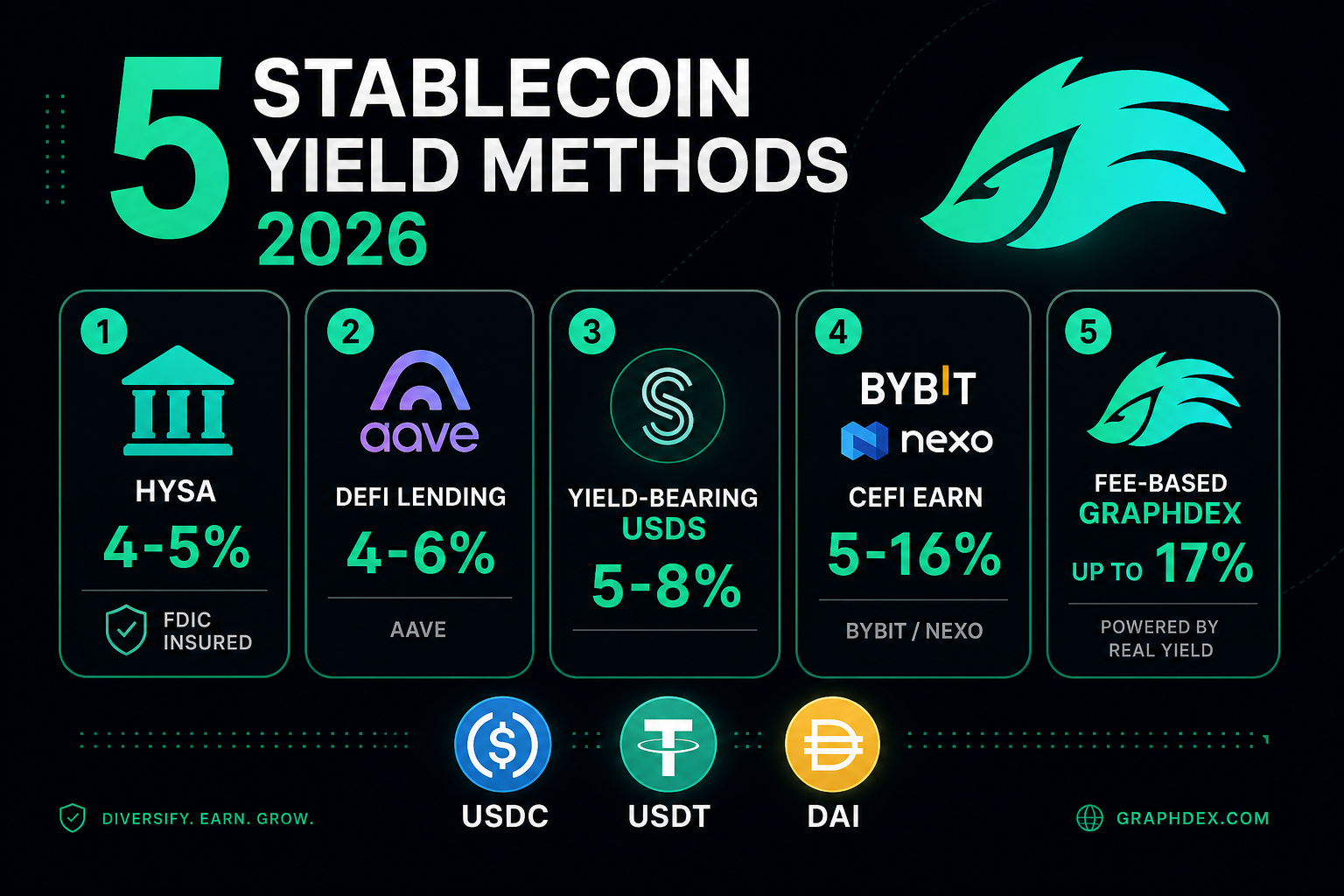
The best ways to earn yield on stablecoins in 2026 fall into five categories, each with different risk-reward profiles:
- DeFi lending (3-8% APY): Aave, Compound, Morpho, Kamino — yield from real borrower demand, sustainable, low-moderate risk
- Yield-bearing stablecoins (5-8%): USDS/DAI Savings Rate, sUSDe (Ethena), Ondo USDY — built-in yield
- CeFi platforms (5-16%): Binance, Bybit, Nexo, YouHodler — convenience, but exchange custody risk
- Fee-based platform yields (up to 17%): GraphDex's fee-based 17% APY — from real trading fees
- High-yield savings (FDIC, 4-5%): Traditional banks — government insurance but lower yields
The honest rule: "If you don't know where the yield comes from, you are the yield." Real yield comes from real activity. Always know the source.
Earn fee-based yield up to 17% APY on GraphDex
Key Takeaways
- Realistic stablecoin yields in 2026: 3-5% (low risk, lending), 5-8% (DeFi/yield-bearing), 15%+ (fee-based platforms).
- DeFi yields come from real borrower demand; CeFi from exchange operations; fee-based from platform revenue.
- Always understand the yield source before depositing — emission-based "yield" isn't sustainable.
- For most users: a stack of DeFi lending + yield-bearing stablecoins + fee-based platforms diversifies risk.
Why Earn Yield on Stablecoins?
Holding stablecoins (USDC, USDT, DAI) idle in a wallet earns nothing. But deploying them into yield products can generate meaningful returns without crypto volatility exposure.
The opportunity: Traditional bank savings accounts pay 0.5% on average; high-yield savings reach 4-5% APY with FDIC insurance. Stablecoin yield products pay 3-17%+ APY through various mechanisms, often without lock-ups, often available 24/7 globally, often with composability into broader DeFi strategies.
The trade-off: Higher yields generally reflect higher risks — smart contract exposure, platform solvency, regulatory uncertainty, or strategy complexity. There's no FDIC equivalent for most crypto yields. Understanding what you're trading off matters.
The 2026 reality: The stablecoin market exceeded $319 billion in April 2026. With this much capital seeking yield, productive deployments are mature and diverse — but the "100% APY" era of 2020 is over. Sustainable yields cluster in defensible ranges.
How Does DeFi Lending Earn Yield on Stablecoins? (3-8% APY)
The oldest stablecoin yield strategy and still one of the best risk-adjusted approaches.
How it works: You deposit stablecoins into a lending protocol's smart contract. Borrowers (typically traders wanting leverage) take loans against crypto collateral and pay interest. The protocol distributes most of that interest to lenders.
Top DeFi Lending Platforms
Aave — The largest decentralized lending protocol globally with ~$38.6 billion in TVL. Operates on 15+ blockchains including Ethereum, Avalanche, Polygon, and Base. Current USDC/USDT yields range 4-6% APY, fluctuating with demand. Strong audit history with no critical exploits on core lending contracts. The reference standard for DeFi lending.
Compound — Long-established lending protocol with V3 offering simplified single-asset markets. Comparable yields to Aave with slightly different mechanics. Solid track record on Ethereum and L2s.
Morpho Blue — Curated vault architecture where specialized curators deploy isolated markets with specific risk parameters. Premium of 50-150 basis points over Aave for equivalent risk. Trade-off: each vault is a distinct smart contract and curator trust surface. Sophisticated users prefer Morpho for risk-targeted yield.
Kamino (Solana) — The leading Solana lending protocol with strong stablecoin markets. Lower fees than Ethereum L1 make small positions economically viable. Yields competitive with Ethereum lending.
Spark Protocol — DAI/USDS lending with rates set by Sky (formerly MakerDAO) governance. Stable 5-6% yields from protocol revenue including RWA exposure.
When to Use DeFi Lending
- Multi-month horizon: Variable yields work well when you can ride fluctuations
- Conservative core position: The foundation of most stablecoin yield strategies
- Non-custodial preference: Your funds aren't on a centralized exchange
- Composability: Lending positions can be used as collateral elsewhere
Risks: Smart contract exposure (well-audited but not zero), utilization spikes (withdrawal delays when borrowing demand is high), governance risk, and underlying protocol risk.
What Are Yield-Bearing Stablecoins? (5-8% APY)
A newer category — stablecoins with yield mechanisms built in. You hold the token; the yield accrues automatically.
Top Yield-Bearing Stablecoins
USDS / DAI Savings Rate (DSR) — Sky's (formerly MakerDAO) stablecoin offers 5-8% on DAI/USDS, backed by protocol revenue including stability fees and RWA yields from US Treasury investments. Rates are set by governance and have been stable. Single-asset deposit, no impermanent loss, fully decentralized.
Ethena USDe / sUSDe — Synthetic dollar using delta-hedged strategies (long crypto, short perpetual futures). Yields driven by funding rates plus staking yields. Has paid 5-15%+ historically but yields fluctuate with market conditions. Higher complexity = higher risk understanding required.
Ondo USDY — Tokenized yield-bearing token combining Treasuries with on-chain yield distribution. Around 4-5% APY tied to short-term Treasury rates. Strong institutional positioning.
Circle USYC — Tokenized money market fund from Circle, offering Treasury yields on-chain.
When to Use Yield-Bearing Stablecoins
- Set-and-forget: No active management required
- Passive income: Yield accrues automatically while you hold
- DAO/treasury management: Good for organizations holding stablecoin reserves
- Composability: Can often be used as collateral elsewhere while earning
Risks: Smart contract risk, depeg risk during stress, regulatory uncertainty (especially for synthetic dollars), strategy complexity for users who don't understand the yield source.
How Do CEX Earn Products Pay Yield? (5-16% APY)
Centralized exchanges offer "earn" products that are typically simpler than DeFi but introduce custody risk.
Top CeFi Stablecoin Yield Platforms
Bybit Easy Earn — Strong USDT and USDC APRs (5-10%+ on flexible products), smooth UX, transparent Proof of Reserves (March 2026 PoR report covered Proof of Liabilities, Proof of Ownership, reserve calculation). Good blend of yield, usability, and visible backing.
Binance Earn — The largest exchange's earn products, with flexible and locked options. Competitive yields, deep liquidity, broad asset selection. Regulatory complexity varies by region.
Nexo — 12-16% APY depending on loyalty tier and duration. Long-established centralized lending platform with comprehensive security measures.
YouHodler — Up to 18% APY on USDC/USDT/DAI with weekly compounding and no lockup. Highest-yielding centralized platform in 2026 but higher risk profile.
Coinbase — Lower yields (typically 4-5% on USDC) but maximum US regulatory clarity. Conservative choice for US users.
When to Use CeFi Earn
- Simplicity: Already use the exchange for trading; earn integrates seamlessly
- No DeFi experience: Familiar interface, no wallet management
- Promotional rates: Sometimes higher than DeFi during exchange campaigns
- Multiple income sources: Combine with trading and other exchange products
Risks: Exchange custody risk (FTX 2022 was the worst case), regulatory restrictions by region, withdrawal limits during stress, less transparency on actual reserve composition than DeFi.
What Are Fee-Based Platform Yields? (Up to 17% APY)
A distinct category that's grown in 2026 — platforms paying yield from real trading fees they generate rather than emissions or lending interest.
The key insight: Trading platforms collect fees from their users. Most platforms keep these fees as profit. A growing category pays a substantial share to depositors as yield — sustainable as long as the platform maintains trading volume.
GraphDex's model: Up to 17% APY on stablecoins and SOL, funded by platform trading fees. The yield is sustainable as long as users keep trading on the platform — and unlike emission-based yields, it doesn't depend on attracting new buyers of a native token. Non-custodial via Privy: your funds stay in your wallet while earning.
Why this matters: When you can identify "the yield comes from this specific trading activity, and the platform's revenue can be verified," you have a transparency advantage over emissions-based yields. The "where does the yield come from?" question has a clear answer.
When to use fee-based platform yield:
- Solana-focused users wanting yield + integrated trading + prediction markets
- Users who value yield transparency over absolute maximum APY
- Diversification from pure DeFi or pure CeFi exposure
- Users who already use the platform for trading anyway
Risks: Platform-specific operational risk, smart contract risk, dependence on continued trading volume, evolving regulatory landscape.
Method 5: High-Yield Savings Accounts (4-5% APY, FDIC)
For balance, traditional banks deserve mention. They offer the only major option with FDIC insurance.
Top options 2026: High-yield savings at SoFi, Ally, Marcus by Goldman Sachs, Wealthfront — typically 4-5% APY with FDIC insurance up to $250,000 per depositor per bank.
Pros: FDIC insurance (government-backed up to $250k), zero custody/smart contract risk, easy onramp from existing bank accounts.
Cons: Lower yields than DeFi/CeFi alternatives, US-centric (limited international access), conventional banking limitations (business hours for transfers, KYC).
For users who value insurance over yield, traditional savings is reasonable. For users seeking higher yields, the DeFi/CeFi/platform options offer materially better returns at the cost of insurance.
Comparison Table: All Methods
A side-by-side view:
| Method | APY Range | Risk Level | Best For |
|---|---|---|---|
| HYSA (FDIC) | 4-5% | Lowest (insured) | Maximum safety, US users |
| Aave/Compound | 4-6% | Low-moderate | DeFi lending, established users |
| Morpho Blue | 5-8% | Moderate | Risk-targeted DeFi |
| USDS/DSR | 5-8% | Low-moderate | Passive holding, decentralized |
| Ethena USDe | 5-15%+ | Moderate-high | Yield seekers who understand the strategy |
| Bybit/Binance Earn | 5-12% | Moderate (custodial) | Exchange users |
| Nexo/YouHodler | 12-18% | Higher (custodial) | High-yield seekers |
| GraphDex (fee-based) | Up to 17% | Moderate (platform) | Solana users, yield transparency |
The pattern: insurance and lowest risk cluster at 4-5%; sustainable DeFi at 5-8%; sophisticated strategies and platform yields reach 15-17%; anything claiming 30%+ usually has hidden risks or unsustainable token emissions.
Compare yield options on GraphDex
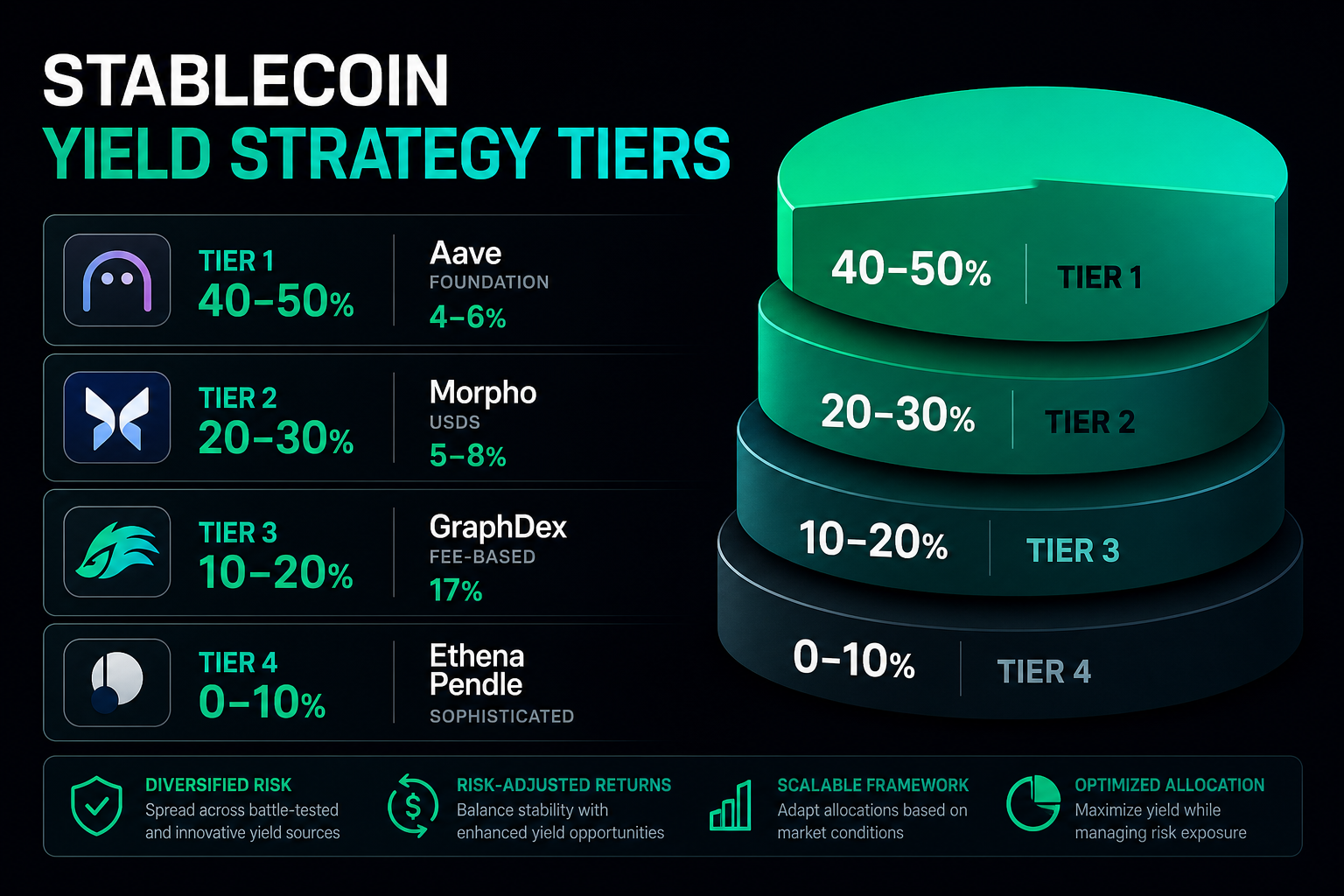
A Sensible Stablecoin Yield Strategy
For most users wanting to earn stablecoin yield in 2026, a diversified approach makes sense:
Tier 1 — Foundation (40-50%): Aave or Compound USDC. Lowest DeFi risk, established protocols, 4-6% APY. The core of your stablecoin yield.
Tier 2 — Diversified DeFi (20-30%): Morpho Blue curated vaults or USDS/DSR. Slightly higher yields with different risk profiles. Diversifies from pure Aave exposure.
Tier 3 — Platform yields (10-20%): Fee-based platforms like GraphDex (up to 17% APY) or CeFi earn products on exchanges you actually use. Different yield source from pure lending.
Tier 4 — Sophisticated strategies (0-10%): Yield-bearing stablecoins (Ethena USDe) or yield tokenization (Pendle). Higher yields with additional complexity and risk.
Optionally: FDIC-insured HYSA for the portion you want fully insured.
The discipline: Diversify across yield sources (lending, fee-based, yield-bearing), avoid platforms that don't clearly explain where yield comes from, and rebalance periodically as rates change.
Add fee-based 17% APY yield to your strategy on GraphDex
Related Guides
- Best Stablecoin Staking Rates in 2026: Where to Earn the Highest APY
- Best Solana Staking in 2026: Native, Liquid & Stablecoin Options Compared
- How to Stake USDC in 2026: Best Platforms and Highest APY Compared
- Money Market vs Stablecoin Yield in 2026: Complete Comparison
Frequently Asked Questions
What's the best way to earn yield on USDC? The best risk-adjusted approach is DeFi lending on Aave (4-6% APY) or Compound for a conservative core position, optionally supplemented by Morpho Blue curated vaults (5-8%) or fee-based platforms (up to 17% APY on GraphDex). For maximum simplicity, exchange earn products at Bybit or Binance offer 5-10% APY with custodial convenience.
What's the best yield on USDT in 2026? USDT-specific yields: Aave (4-6%), Bybit Easy Earn (5-10%), Nexo (12-16% with loyalty tiers), YouHodler (up to 18%), GraphDex fee-based (up to 17%). The realistic sustainable range for blue-chip platforms is 4-8%; higher rates typically reflect higher platform risk.
Is DeFi safer than CeFi for stablecoin yield? Different risk profiles, not strictly safer. DeFi (Aave, Compound) eliminates exchange custody risk but adds smart contract risk. CeFi (Binance, Bybit) eliminates smart contract concerns but adds exchange solvency risk. The FTX 2022 collapse showed CeFi extremes; major DeFi protocols have weathered multiple stress events. Diversifying across both is reasonable.
Are stablecoin yields taxable? Generally yes. In most jurisdictions, stablecoin yields are treated as ordinary income at the time of receipt. Some platforms issue 1099s; others don't, leaving record-keeping to you. Tools like Koinly or CoinTracker help track DeFi income for tax reporting. Consult a crypto-specialist tax professional for your jurisdiction.
What APY is realistic for stablecoins? Realistic 2026 yields: 4-5% (FDIC-insured savings), 4-6% (blue-chip DeFi lending), 5-8% (yield-bearing stablecoins, Morpho vaults), 5-15% (CeFi earn products), up to 17% (fee-based platform yields). Anything advertising 30%+ usually has hidden risks, unsustainable token emissions, or both. The "100% APY" era of 2020 is over for sustainable yield.
Can I lose money earning stablecoin yield? Yes — risks include smart contract exploits (DeFi), exchange failures (CeFi), depegs in some yield-bearing stablecoins, regulatory changes, and rare protocol failures. Even FDIC-insured savings carry inflation risk (yields below inflation rate erode real value). Always diversify across yield sources and never deploy more than you can afford to lose.
Where does stablecoin yield actually come from? Sustainable sources: real borrower interest (lending protocols), real platform trading fees (fee-based platforms), Treasury yields (yield-bearing stablecoins), exchange operations (CeFi earn). Unsustainable: emission-based yields where the "yield" is newly printed tokens. As CoinGecko notes: "If you don't know where the yield comes from, you are the yield."
About This Guide
This guide is published by the GraphDex Research team — analysts and traders building the infrastructure for digital asset trading on Solana. Our content is based on live DeFi data, current platform rates, and hands-on experience.
Sources & data: Yield rates, platform features, and TVL figures reflect publicly available information as of 2026 and change continuously. Stablecoin yields carry real risks. This guide is educational and not financial advice — always do your own research and consult tax professionals.
GraphDex is the infrastructure for digital asset trading — trade, predict, and earn in one place. Learn more at graphdex.io.
Last reviewed: May 2026 · GraphDex Research
The infrastructure for digital asset trading. Trade, predict, stake, repeat. graphdex.io